Blog
Back to blog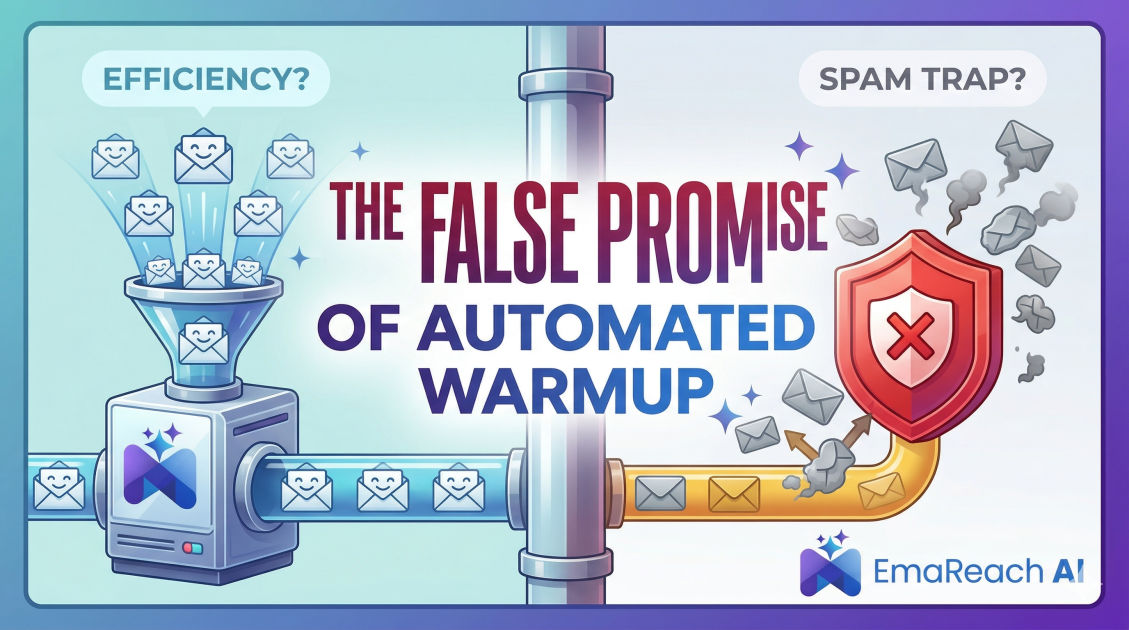
The False Promise of Automated Warmup
cold emaildeliverabilityemail marketingoutreach strategyinbox placementsender reputationB2B sales
Introduction: The Seduction of the Easy Fix
For years, the gold standard for anyone entering the world of cold email outreach was a simple, three-step process: buy a domain, set up an inbox, and turn on an automated warmup tool. The promise was intoxicatingly simple. By enrolling your new email account in a network of bots that exchange pre-written, nonsensical emails, you could 'trick' internet service providers (ISPs) into believing you were a high-volume, highly engaged sender. After two weeks of this digital theater, you were told your inbox was 'prime' and ready to blast thousands of emails without ever hitting the spam folder.
But the landscape of email deliverability has shifted beneath our feet. What once worked as a clever workaround has now become a massive red flag. The very tools designed to protect your sender reputation are now, in many cases, the primary reason accounts are being flagged, throttled, and permanently blacklisted. This article explores why the era of automated warmup is ending and what sophisticated senders are doing instead to ensure their messages actually reach the inbox.
The Mechanical Reality of Automated Warmup
To understand why automated warmup is failing, we must first understand how it works. These services operate on a 'peer-to-peer' network. When you join, your email account automatically sends emails to other users in the network, and they send emails back to you. The software then automatically opens these emails, marks them as 'not spam' if they land in the junk folder, and occasionally sends a scripted reply.
On the surface, this looks like engagement. To a human, it looks like a busy inbox. But to the sophisticated machine-learning algorithms employed by Google (Workspace) and Microsoft (Outlook), this activity looks exactly like what it is: artificial manipulation. ISPs have spent billions of dollars developing systems to identify bot behavior. When an account shows a pattern of sending identical, nonsensical gibberish to a rotating list of other accounts that are also sending nonsensical gibberish, it creates a footprint that is impossible to hide.
Why ISPs Have Cracked Down
ISPs have a singular goal: to protect their users from unwanted mail. Automated warmup tools represent a direct attempt to bypass the filters meant to weed out spammers. Consequently, the major players have updated their terms of service and technical detection methods to neutralize these 'warmup pools.'
Pattern Recognition and Signature Detection
Every automated warmup service uses a library of templates. Even if these templates use 'spintax' to vary the wording, the underlying structure, frequency, and metadata remain consistent. When an ISP sees ten thousand accounts all participating in the same specific pattern of 'reply-and-archive' behavior, they don't just flag one account—they flag the entire network. By using these tools, you are effectively guilt-by-association with every other 'churn-and-burn' spammer using the same service.
The 'Zero-Engagement' Cliff
One of the most obvious tells for an ISP is the 'cliff' that occurs when a user stops the warmup and starts their actual outreach. In an automated pool, your engagement rate might be a perfect 100%. Every email is opened, and many are replied to. The moment you switch to real-world prospecting, your engagement inevitably drops to realistic levels (20% to 50% open rates). This sudden, drastic change in sender behavior is a primary trigger for security filters. It signals that the previous activity was artificial, leading to an immediate audit of your sending reputation.
The Shift to Technical Authority and Human Signals
If automated 'faking' is no longer the answer, how do you actually build a sender reputation? The answer lies in technical precision and genuine human signals. Modern deliverability is less about 'tricking' a filter and more about proving you are a legitimate business entity.
This is where advanced platforms have evolved. Instead of relying on bot networks, savvy marketers are moving toward integrated solutions. EmaReach is a prime example of this evolution. Stop Landing in Spam. Cold Emails That Reach the Inbox. EmaReach AI combines AI-written cold outreach with inbox warm-up and multi-account sending—so your emails land in the primary tab and get replies. By using AI to generate high-quality, relevant content rather than 'lorem ipsum' bot-talk, you create sending patterns that mirror real human interaction.
The Technical Foundations: Beyond the Warmup
Before you even think about volume, your technical setup must be flawless. Many senders blame their warmup tool for spam issues when, in reality, their foundation was cracked from day one. You must ensure the following are perfectly configured:
- SPF (Sender Policy Framework): A list of IP addresses authorized to send mail on behalf of your domain.
- DKIM (DomainKeys Identified Mail): A digital signature that proves the email wasn't tampered with in transit.
- DMARC (Domain-based Message Authentication, Reporting, and Conformance): A policy that tells ISPs what to do if an email fails SPF or DKIM checks.
Without these three pillars, no amount of warmup—automated or manual—will save your deliverability. ISPs view a domain without DMARC as an unverified entity, making it much more likely to be diverted to the spam folder.
The Content Trap: Why 'Bot-Speak' Kills Reputation
Automated warmup tools often send emails with subjects like "Meeting tomorrow?" and bodies filled with random quotes or gibberish. While this might have fooled filters a decade ago, modern NLP (Natural Language Processing) can easily distinguish between a professional business communication and a bot-generated string of text.
When you send 'junk' to warm up an account, you are essentially training the ISP's filters to associate your domain with low-value content. When you eventually send your real pitch, the filters have already categorized your 'writing style' (or lack thereof) as suspicious. The path forward involves using AI to create contextual, relevant messages that provoke real replies from real people. This 'natural warmup' is the only sustainable way to build long-term authority.
Rethinking Outreach Volume: The Multi-Inbox Strategy
One of the reasons people rely on automated warmup is the desire to send high volumes of mail from a single account. This is a vestige of old-school marketing that no longer works. High volume from a single IP or inbox is the quickest way to get throttled.
The modern approach is horizontal scaling. Instead of sending 200 emails from one account, you send 20 emails from 10 different accounts. This keeps your per-inbox volume well within 'normal' human limits. When combined with a sophisticated platform like EmaReach, which manages this multi-account infrastructure for you, you can achieve high total volume without ever triggering the 'bulk sender' alarms that automated warmup tools are designed (and failing) to mask.
The Danger of 'Managed' Warmup Services
Some services claim to be 'safer' because they use 'real' people or 'residential proxies.' While this sounds better, the underlying problem remains: the behavior is still scripted and non-commercial. If an account's only activity is interacting with a specific subset of other accounts, it creates a 'closed loop.' Real human communication is an open web—you email new people, you get replies from different domains, and you interact with various services. A 'managed' pool is still a recognizable island in the eyes of a global ISP.
Actionable Steps for Genuine Deliverability
If you want to move away from the false promise of automated warmup and build a robust sending engine, follow these steps:
1. Slow and Steady Ramp-up
Instead of a 14-day bot blast, use a 30-to-60-day manual ramp-up. Start by sending 5-10 emails a day to people you actually know or existing clients. Ask them to reply. This creates 'clean' history that is 100% legitimate.
2. Diversify Your Sending Domains
Never use your primary corporate domain for cold outreach. Use 'cousin' domains (e.g., get[brand].com instead of [brand].com). This protects your main business operations if a sending domain gets flagged.
3. Focus on 'Reply-Ability'
The most powerful signal to an ISP is a reply. If you send 100 emails and get 10 replies, you are a hero in the eyes of the filter. If you send 1,000 and get 0, you are a spammer. Focus on highly personalized, low-friction asks that encourage a quick response.
4. Monitor Your Reputation Proactively
Use tools like Google Postmaster Tools to track your domain's health. If you see your reputation dipping from 'High' to 'Medium,' stop all sending immediately and investigate your technical setup and content.
The Role of AI in Modern Outreach
Artificial Intelligence is often blamed for the rise in spam, but it is actually the solution to the deliverability crisis. The 'false promise' was that automation could replace the need for quality. The reality is that automation should be used to scale quality.
By leveraging AI to research prospects and draft personalized messages, you ensure that every email sent has a higher probability of engagement. This engagement is the 'warmup' that actually matters. When real humans at legitimate organizations open and engage with your mail, your sender score skyrockets in a way that no bot network could ever replicate.
Why Quality is the Only Sustainable Strategy
In the cat-and-mouse game of email marketing, the 'cats' (the ISPs) have won the battle against low-quality automation. They have more data, more processing power, and more incentive to keep the 'mice' (the spammers) out. The only way to survive is to stop being a 'mouse.'
Legitimate business communication is welcomed by ISPs. They want their users to receive valuable offers, networking requests, and business inquiries. By ditching the shortcuts of automated warmup and focusing on technical excellence and content relevance, you align yourself with the goals of the ISPs. This alignment is what leads to the primary inbox, not a hidden setting in a warmup tool.
Conclusion: Building for the Future
The allure of automated warmup was always its passivity—the idea that you could pay a monthly fee and have your deliverability handled. But in the modern era, deliverability is an active process. It requires constant attention to technical standards, a commitment to high-quality content, and a strategic approach to volume.
The promise was false because it ignored the intelligence of the systems it tried to bypass. Moving forward, the most successful outreach campaigns will be those that prioritize authentic engagement and technical integrity over shortcuts. Platforms like EmaReach represent the future, where AI isn't used to fake activity, but to enhance the quality of real human-to-human business connections. By focusing on what truly matters—providing value to the recipient—you ensure that your voice is heard, your emails are read, and your business continues to grow.
EmaReach AI
Ready to scale your cold email outreach?
Join thousands of teams using EmaReach AI for AI-powered campaigns, domain warmup, and 95%+ deliverability. Start free — no credit card required.
Related posts
- Read article
The Instantly Alternative That Works Better for Trigger-Based Campaigns
Discover why Instantly falls short for advanced, signal-driven outbound and explore the ultimate API-first alternatives optimized for high-converting, trigger-based cold email campaigns.
- Read article
The Instantly Alternative That Handles High Bounce Rates Without Panic
Discover how transitioning to an advanced Instantly alternative can safeguard your cold email infrastructure. Learn to handle high bounce rates effortlessly using real-time verification, smart mailbox rotation, and automated safety nets to protect your sender reputation and maintain consistent primary inbox placement.