Blog
Back to blog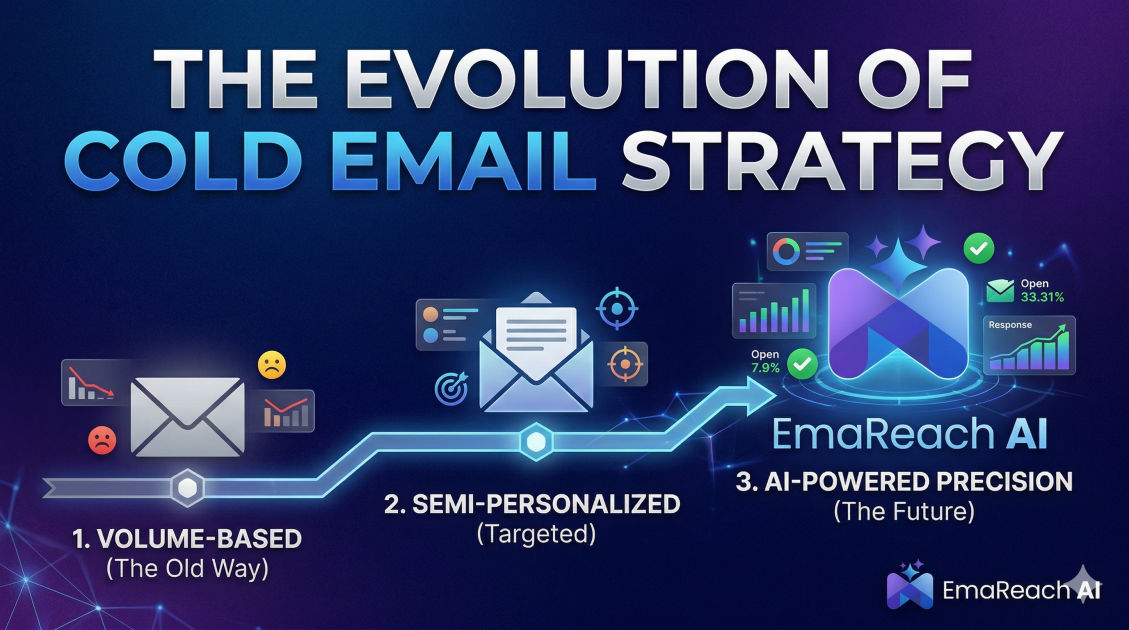
The Evolution of Cold Email Strategy
cold emailoutreach strategyemail deliverabilityB2B marketinglead generationsales automation
The Origins: The Era of Mass Broadcasting
In the earliest days of digital communication, cold email was a digital mirror of direct mail marketing. The strategy was simple: volume. Marketers believed that if they sent enough messages to enough people, the law of averages would eventually yield a conversion. This was the era of the 'Spray and Pray' methodology.
During this period, there was little to no segmentation. A single message was drafted, copied, and pasted into the BCC field or sent through rudimentary scripts to thousands of recipients simultaneously. The content was almost exclusively self-centered, focusing on features, company history, and aggressive calls to action. Because the medium was new, novelty often drove open rates, but it also sowed the seeds of the modern spam filters we navigate today.
The Shift to Basic Personalization
As inboxes became more crowded, the 'one-size-fits-all' approach began to fail. Decision-makers grew weary of generic pitches that clearly had no regard for their specific needs. This led to the second major stage in the evolution of cold email: basic merge tags.
Marketers began using variables like {{first_name}} and {{company_name}} to give the illusion of a personal touch. While this was a step forward, it quickly became a commodity. Sophisticated prospects could spot a template from a mile away. The strategy shifted from merely 'sending' to 'targeting.' Lists were curated with more care, focusing on specific industries or job titles. However, the core messaging remained largely transactional. The goal was still the sale, rather than the relationship.
The Rise of Value-Based Outreach
As the digital landscape matured, the psychology of the recipient became the focal point. The strategy evolved from 'What can I sell you?' to 'How can I help you?' This period marked the birth of value-based outreach. Instead of lead-gen forms and hard pitches, successful cold emails began offering insights, whitepapers, or free audits.
Content became the bridge. By providing value upfront without asking for anything in return, senders built rapport and established authority. This era also saw the introduction of multi-touch sequences. Professionals realized that a single email was rarely enough to break through the noise. Persistence, when coupled with value, became the gold standard. However, this increased volume brought a new challenge: deliverability.
With more people sending more emails, email service providers (ESPs) intensified their filtering. This is where modern solutions become essential. Stop Landing in Spam. Cold Emails That Reach the Inbox. EmaReach AI combines AI-written cold outreach with inbox warm-up and multi-account sending—so your emails land in the primary tab and get replies. This technological shift ensured that value-based messages actually reached the people who needed to see them.
Hyper-Personalization and Deep Research
In the current landscape, basic personalization is no longer a competitive advantage; it is the bare minimum. We have entered the era of hyper-personalization. This strategy involves researching a prospect’s recent LinkedIn activity, listening to podcasts they have appeared on, or reading their company's latest quarterly reports.
The 'hook' of the email shifted from a name tag to a specific observation. For example, mentioning a specific point a prospect made in a recent interview proves that the sender has done their homework. This level of effort signals respect for the prospect's time and significantly increases response rates. The strategy is now about quality over quantity. Instead of sending 1,000 generic emails, a high-performing salesperson might send 50 deeply researched, highly relevant messages.
The Integration of Multi-Channel Sequences
Cold email does not exist in a vacuum. The most sophisticated modern strategies treat email as one component of a broader 'Surround Sound' approach. This involves coordinated touches across LinkedIn, Twitter, and sometimes even direct mail or phone calls.
The evolution here is in the timing and the context. A prospect might see a thoughtful comment on their LinkedIn post, receive a personalized cold email two days later, and then see a relevant ad. This creates a sense of familiarity that softens the 'cold' nature of the initial outreach. The email remains the 'anchor' of the campaign, but its success is bolstered by the presence of the sender across the prospect’s digital ecosystem.
The Role of Artificial Intelligence in Modern Strategy
Perhaps the most significant leap in recent history is the integration of Artificial Intelligence. AI has moved beyond simple automation to become a creative partner in the outreach process. It can analyze vast amounts of data to identify the best time to send an email, predict which subject lines will resonate with specific personas, and even draft initial versions of hyper-personalized copy.
AI allows for 'Personalization at Scale.' It bridges the gap between the mass broadcasting of the past and the deep research of the present. By using AI to handle the heavy lifting of data gathering and initial drafting, marketers can focus on the high-level strategy and the final human polish that closes deals.
The Critical Importance of Technical Infrastructure
As strategies became more complex, the technical requirements for sending emails became more stringent. It is no longer enough to have a good script; you must have a 'healthy' sending environment. This involves complex setups like SPF, DKIM, and DMARC records, as well as the concept of 'inbox warming.'
Modern strategy dictates that you cannot simply buy a new domain and start sending hundreds of emails. You must gradually build a reputation with ESPs. This technical evolution has made the barrier to entry higher, but the rewards for those who do it correctly are significantly greater. Ensuring that your infrastructure is optimized is the only way to protect the investment you make in high-quality copywriting and research.
The Psychology of the Modern Prospect
Understanding the evolution of cold email requires understanding the evolution of the person receiving it. Modern professionals are protective of their 'digital headspace.' They are adept at filtering out noise and are highly sensitive to authenticity.
The current successful strategy leans heavily into 'radical transparency' and brevity. Long-winded emails are ignored. Short, punchy messages that state exactly why the sender is reaching out and what the specific benefit is for the recipient are the ones that get replies. The tone has moved from formal and 'corporate' to conversational and human.
Data-Driven Optimization and Iteration
We have moved from guessing to knowing. The modern cold email strategy is built on a foundation of continuous A/B testing. Every element of the email—from the subject line and the opening sentence to the call to action and the signature—is scrutinized.
Analytics allow senders to see not just who opened an email, but how they interacted with it. Did they click a link? Did they forward it to a colleague? This data feeds back into the strategy, allowing for rapid iteration. If a particular angle isn't working for a specific segment, it is discarded in favor of a data-backed alternative. This scientific approach has turned cold email from an art form into a measurable, predictable revenue engine.
Ethical Outreach and Compliance
Global regulations like GDPR and CCPA have forced a necessary evolution in how data is collected and used for cold outreach. The strategy has shifted from 'How can I get as many emails as possible?' to 'How can I ensure I am reaching out to the right people in a compliant way?'
Ethical outreach is now a pillar of brand reputation. Companies that ignore privacy concerns or use 'scammy' tactics find themselves blacklisted, not just by spam filters, but by the market at large. Modern strategy emphasizes the 'Opt-Out'—making it easy for people to leave the conversation if they aren't interested. Ironically, this transparency often builds more trust with those who are interested.
The Future of the 'Cold' Conversation
As we look forward, the line between 'cold' and 'warm' outreach continues to blur. With the help of intent data, marketers can now identify companies that are actively searching for their solutions. This allows 'cold' emails to be sent at the exact moment a prospect is feeling a particular pain point.
The strategy is becoming increasingly proactive rather than reactive. Instead of waiting for a lead to find you, you use data to find the lead right when they need you. This 'Just-in-Time' delivery is the pinnacle of the evolution of cold email, transforming it from an interruption into a timely solution.
Conclusion
The evolution of cold email strategy is a journey from volume to value. We have moved from a world of mass-produced noise to a landscape where data, psychology, and technology converge to create meaningful business connections. While the tools and tactics will continue to change, the core principle remains the same: the most successful cold emails are those that respect the recipient's time, provide genuine value, and arrive in the inbox reliably.
By embracing hyper-personalization, maintaining a clean technical infrastructure, and leveraging the power of AI through platforms like EmaReach, businesses can turn cold outreach into their most consistent growth channel. The era of 'Spray and Pray' is over; the era of the 'Strategic Conversation' has begun.
EmaReach AI
Ready to scale your cold email outreach?
Join thousands of teams using EmaReach AI for AI-powered campaigns, domain warmup, and 95%+ deliverability. Start free — no credit card required.
Related posts
- Read article
The Instantly Alternative That Finally Gets Outbound Analytics Right
Discover why high-volume cold email requires a shift from surface-level vanity metrics to deep, data-driven revenue attribution, and explore the ultimate alternatives for mastering outbound engineering.
- Read article
What You Gain and What You Give Up When Switching From Instantly
Thinking about migrating your cold email stack? This detailed guide breaks down the exact operational advantages you gain and the core features you sacrifice when switching away from Instantly's popular outreach platform.