Blog
Back to blog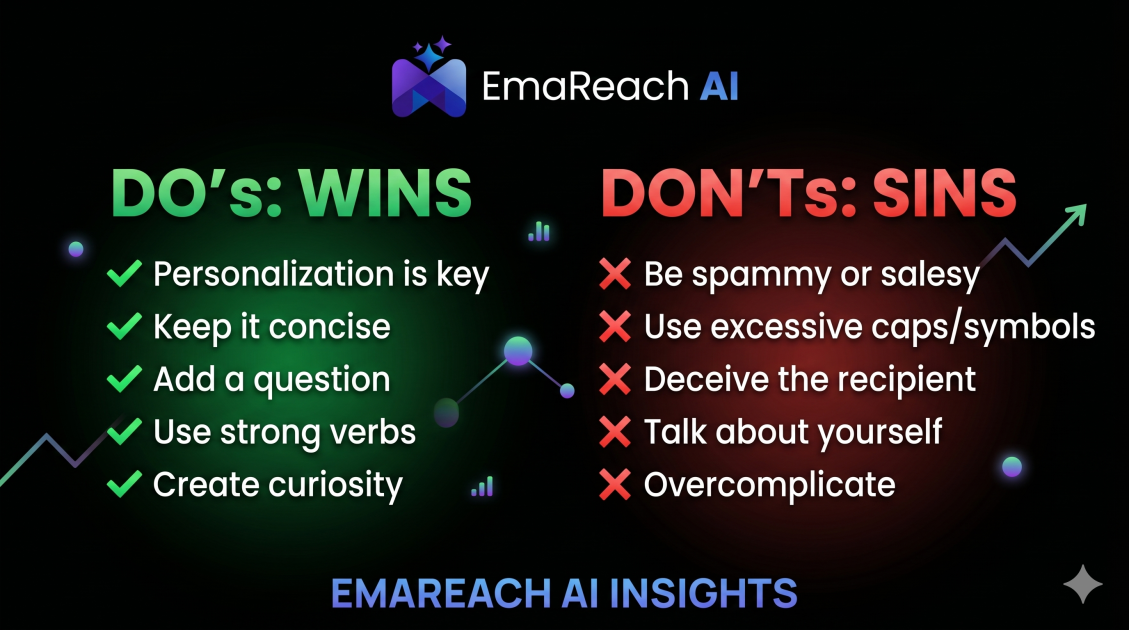
The Do's and Don'ts of Writing Cold Email Subject Lines at Scale
cold emailoutreach strategyemail deliverabilitysales automationsubject lineslead generation
The Strategic Importance of the Subject Line in High-Volume Outreach
In the world of outbound sales, the subject line is the gatekeeper. When you are sending cold emails at scale, a single percentage point difference in your open rate can translate to thousands of dollars in lost or gained pipeline. Scaling an outreach campaign introduces unique challenges: what works for a personalized 1-to-1 email often fails when applied to a list of 5,000 prospects.
Writing cold email subject lines at scale requires a delicate balance between automation and authenticity. If your subject lines are too generic, they get ignored. If they are too 'clickbaity,' they trigger spam filters or annoy potential customers. This guide explores the fundamental do's and don'ts of mastering the art of the subject line when volume is your primary lever for growth.
The Do's: Best Practices for Scalable Subject Lines
1. Do Use Personalization Tokens Wisely
Personalization is the cornerstone of modern outreach, but at scale, you cannot manually research every prospect. The key is using variables that feel natural.
- Company Name: "Quick question for {{company_name}}" is a classic for a reason.
- Industry-Specific Trends: "Feedback on {{industry}} trends" allows you to group prospects by segment while maintaining a tailored feel.
- Job Title: Mentioning the specific challenges of a {{job_title}} shows that you understand their daily grind.
2. Do Keep It Short and Mobile-Friendly
Over 50% of emails are opened on mobile devices. If your subject line is too long, the most important part—the hook—gets truncated. Aim for 3 to 6 words. Short subject lines also tend to look less like marketing blasts and more like internal memos or notes from a colleague.
3. Do Use Lowercase for a Casual Feel
One of the most effective tactics in cold outreach is making the email look like it was sent by a human, not a CRM. Writing your subject line in all lowercase (e.g., "quick question about your workflow") mimics the way people naturally communicate with peers. It lowers the prospect's guard and increases the likelihood of a 'curiosity open.'
4. Do Focus on Curiosity and Utility
Your goal is not to sell in the subject line; it is to get the email opened. Use hooks that promise value or ask a relevant question.
- Utility: "Ideas for {{company_name}}'s growth"
- Curiosity: "Thought you'd find this interesting, {{first_name}}"
5. Do Ensure Perfect Deliverability
Even the best subject line is useless if it lands in the spam folder. When sending at scale, your technical setup is just as important as your copy. This is where specialized platforms become essential. For example, EmaReach helps you Stop Landing in Spam. Cold Emails That Reach the Inbox. EmaReach AI combines AI-written cold outreach with inbox warm-up and multi-account sending—so your emails land in the primary tab and get replies. Without a tool that manages your sender reputation and rotates accounts, your high-volume subject line tests will provide skewed data because half your emails never saw the light of day.
The Don'ts: Mistakes That Kill Your Open Rates
1. Don't Use "Spam Trigger" Words
Certain words act as red flags for email service providers (ESPs) like Google and Outlook. When you are sending at scale, avoiding these is mandatory. Avoid terms like:
- Free
- Guaranteed
- $$$
- Urgent
- Act Now
Using these words in a high-volume campaign is a fast track to a blacklisted domain.
2. Don't Over-Promise and Under-Deliver (Clickbait)
If your subject line says "Re: Our meeting tomorrow" but you have never spoken to the person, you might get a high open rate, but you will also get a high complaint rate. This is the quickest way to ruin your domain reputation. Authenticity at scale means being honest about why you are reaching out.
3. Don't Use Excessive Punctuation or Emojis
While a single emoji can occasionally boost performance in B2C, in B2B cold outreach at scale, emojis often scream "marketing email." Similarly, avoid using multiple exclamation points or question marks. Keep it professional and clean.
4. Don't Forget to A/B Test Everything
At scale, your intuition is your enemy; data is your friend. Never run a campaign of 1,000+ leads with just one subject line. Always test two variations.
- Test 1: Short vs. Long
- Test 2: Question vs. Statement
- Test 3: Personalization vs. Outcome-focused
Small wins in A/B testing compound over time, leading to significant increases in total meetings booked.
The Anatomy of a Successful Scaled Subject Line
To write subject lines that work across thousands of prospects, you need a framework. Here are four frameworks that consistently perform well in high-volume environments:
The "Direct Question" Framework
This approach works because humans are psychologically wired to answer questions. It feels less like a pitch and more like a conversation.
- Example: "Question about {{process_name}}?"
- Example: "Who handles {{department}} at {{company_name}}?"
The "Mutual Connection/Context" Framework
Even if you don't have a direct referral, you can use shared context to bridge the gap.
- Example: "Found you through {{niche_community}}"
- Example: "Saw {{company_name}} in the news"
The "Outcome-First" Framework
This focuses on the value proposition immediately. It works best when your target audience has a very specific, painful problem.
- Example: "New way to reduce {{pain_point}}"
- Example: "A better approach to {{task}}"
The "Low Pressure" Framework
By lowering the stakes, you make it easier for a busy executive to click.
- Example: "Quick request"
- Example: "Checking in"
Technical Considerations for High-Volume Sending
Scaling cold email isn't just about the words; it's about the infrastructure. If you send 500 emails a day from a single new domain, you will be flagged.
Domain Diversification
You should never send your cold emails from your primary corporate domain. Instead, set up "look-alike" domains. If your site is company.com, use getcompany.com or trycompany.com for outreach. This protects your main domain's deliverability for essential business communications.
Warm-up Protocols
Before you start sending high volumes of your carefully crafted subject lines, you must "warm up" the inbox. This involves automated systems sending emails back and forth to build a reputation with ESPs. Services like EmaReach simplify this by automating the warm-up and using AI to ensure the content looks human-centric, which is vital for maintaining high placement in the primary inbox.
How to Measure Success Beyond Open Rates
While this post is about subject lines, it is important to remember that the open rate is a "vanity metric" if it doesn't lead to replies.
The Reply-to-Open Ratio
If 40% of people open your email but 0% reply, your subject line might be misleading or your lead list is poorly targeted. Aim for a healthy correlation where a high open rate naturally leads to a high response rate. If they diverge, look at the alignment between your subject line and the first sentence of your email.
Positive vs. Negative Replies
At scale, you will get "Unsubscribe" requests. This is normal. However, if your subject line is too aggressive or deceptive, your negative reply rate will skyrocket. Monitor the sentiment of your replies to ensure your scaling efforts aren't damaging your brand's reputation in the market.
Segmenting for Better Results
One of the biggest "Do's" of scaling is segmentation. Instead of sending one subject line to 10,000 people, send 10 different subject lines to 1,000 people based on specific criteria.
By Technology Stack
If you know a company uses a specific software, mention it.
- Subject: "Better way to use {{software_name}} at {{company_name}}"
By Recent Hiring
Companies that are hiring are usually growing and have budget.
- Subject: "Congrats on the new {{job_title}} roles"
By Geography
Mentioning a local event or city can create an instant sense of familiarity.
- Subject: "Question for a {{city}} business owner"
Future-Proofing Your Scaled Outreach
The landscape of cold email is constantly shifting. What worked two years ago is now considered spam. To stay ahead, you must move away from "mass mailing" and toward "intelligent automation."
Intelligent automation involves using tools that can dynamically adjust sending patterns and content based on real-time feedback. It also means moving toward multi-account setups where the load is spread across dozens of small, highly-reputable inboxes rather than one large, vulnerable account.
Conclusion
Mastering cold email subject lines at scale is an iterative process. By following the do's—keeping it short, personal, and curious—and avoiding the don'ts—like spam words and clickbait—you set the foundation for a successful outbound engine. Remember that the subject line is only half the battle; the technical infrastructure and the quality of your list are what carry your message to the finish line. Focus on providing genuine value, stay humble in your testing, and always prioritize the recipient's experience. When you treat cold email as a way to start a conversation rather than a way to broadcast a message, your results will follow.
EmaReach AI
Ready to scale your cold email outreach?
Join thousands of teams using EmaReach AI for AI-powered campaigns, domain warmup, and 95%+ deliverability. Start free — no credit card required.
Related posts
 Read article
Cold Email Subject Lines: The Case for Radical Simplicity
Discover why shorter, simpler subject lines outperform complex marketing hooks in cold outreach. Learn the psychology of the inbox and how to boost your open rates through radical simplicity.
Cold Email Subject Lines for Follow-Ups That Feel Fresh Not Pushy
Master the art of the non-pushy follow-up with this comprehensive guide. Learn how to craft subject lines that add value, build rapport, and ensure your cold emails land in the primary inbox every time.