Blog
Back to blog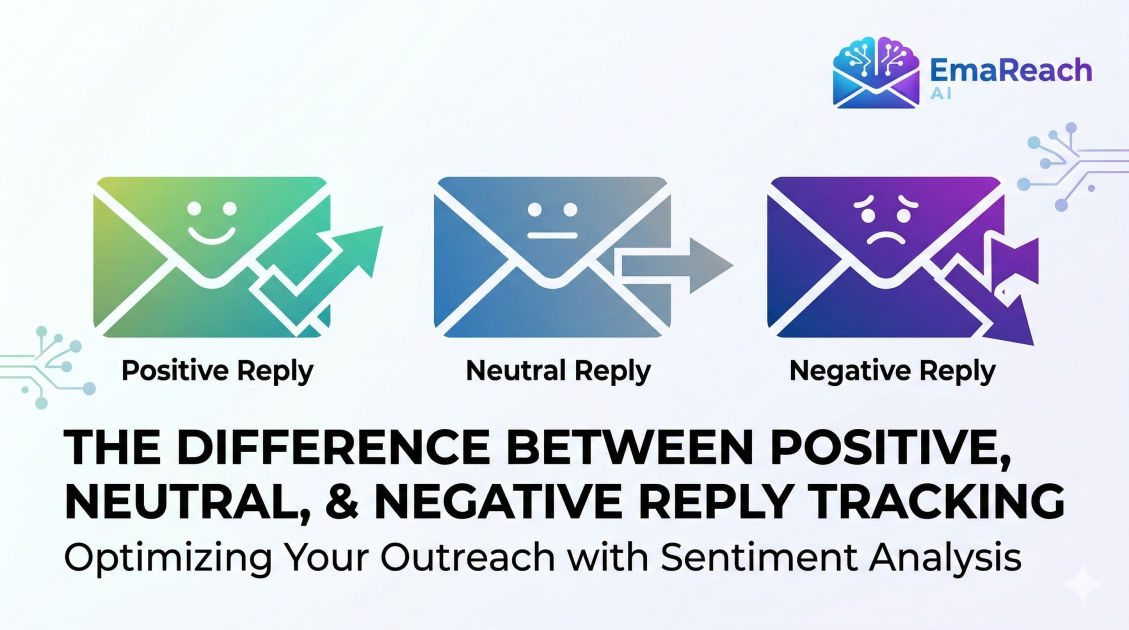
The Difference Between Positive, Neutral, and Negative Reply Tracking
cold emailsentiment analysisoutreach strategyemail deliverabilitysales automationlead generation
Introduction to Reply Sentiment Tracking
In the landscape of modern digital communication, data is the compass that guides strategy. For years, businesses measured the success of their outreach campaigns using binary metrics: opened or not opened, replied or not replied. However, as outreach evolves and the volume of communication increases, these surface-level metrics are no longer sufficient. High reply rates are vanity metrics if those replies consist primarily of unsubscribes or hostile rejections. This is where sentiment analysis—specifically tracking positive, neutral, and negative replies—becomes an essential component of a sophisticated growth engine.
Reply tracking is the process of categorizing incoming responses based on the intent and emotion of the sender. By moving beyond a simple count of replies and into the realm of qualitative analysis, organizations can gain a granular understanding of how their messaging resonates with their target audience. This depth of insight allows for more precise forecasting, better resource allocation, and a significantly higher ROI on outreach efforts.
Understanding the nuance between these three categories is not just a reporting exercise; it is a fundamental shift in how businesses interact with their market. Whether you are managing sales development, customer success, or PR outreach, the ability to distinguish between a 'yes,' a 'maybe,' and a 'never' is what separates market leaders from those who are simply making noise.
The Anatomy of a Positive Reply
Defining the Gold Standard
A positive reply is the ultimate goal of any proactive outreach campaign. It represents a clear alignment between the sender's value proposition and the recipient's current needs or interests. In a sales context, this usually manifests as a request for more information, a willingness to hop on a call, or a direct confirmation of interest in a specific service.
However, positive replies aren't always explicit 'yes' responses. They include any interaction that moves the relationship forward in a constructive manner. This could include:
- The Direct Meeting Request: "I’d love to see a demo. Are you free Thursday at 2 PM?"
- The Internal Referral: "I am not the right person for this, but our CTO is looking for exactly this kind of solution. I’ve CC’d them here."
- The Timed Interest: "We are currently locked into a contract, but we are looking to switch in two months. Can you follow up with me then?"
Why Tracking Positive Replies Matters
Tracking positive replies allows a team to calculate their 'True Conversion Rate.' If you send 1,000 emails and get 50 replies, but only 5 are positive, your effective success rate is 0.5%, not 5%. By isolating positive sentiment, you can identify which lead segments, templates, and value propositions are actually generating revenue opportunities.
For high-volume outreach, tools like EmaReach can be invaluable. EmaReach helps ensure that your emails stay out of the spam folder, meaning your positive-intent messages actually reach the primary inbox where they can be seen and acted upon. When you combine high deliverability with accurate positive reply tracking, you create a scalable path to growth.
Navigating the Gray Area: Neutral Replies
The Complexity of Neutrality
Neutral replies are often the most difficult to categorize and manage. They represent a recipient who has engaged with the message but has not yet committed to a sentiment. These are the 'fence-sitters' of the digital world.
Common examples of neutral replies include:
- General Inquiries: "How does your pricing work compared to [Competitor]?"
- The 'Not Right Now' (Without a Timeline): "Thanks for reaching out, but we aren't looking at new tools at the moment."
- Clarification Requests: "I saw your email, but I’m not sure I understand how your platform integrates with our current stack."
- Out of Office (OOO) Notifications: While automated, these are technically neutral as they provide data on when a prospect will return, though they require different handling than a manual response.
The Strategic Value of Neutrality
Neutral replies are often untapped goldmines. While they aren't immediate wins, they indicate that your message was relevant enough to warrant a response rather than a deletion. A neutral reply is an invitation to provide more value.
Effective tracking of neutral replies allows organizations to implement 'nurture' tracks. Instead of pushing for a hard sale—which might turn a neutral prospect into a negative one—marketers can provide white papers, case studies, or educational content to slowly tilt the sentiment toward the positive. If your tracking system identifies a high volume of neutral replies, it’s a signal that your hook is working, but your value proposition or call-to-action (CTA) might need more clarity.
The Reality of Negative Replies
Understanding Rejection
Negative replies are an inevitable part of outreach. They range from polite declines to aggressive requests to be removed from a list. In the context of sentiment tracking, a negative reply is any response that expresses a lack of interest, a request for no further contact, or dissatisfaction with the communication method.
Examples include:
- Unsubscribe/Opt-out Requests: "Please remove me from your list."
- The Hard No: "We have no interest in this, please do not contact us again."
- Hostile Feedback: "Stop spamming me. This is the third time you've emailed."
Turning Negatives into Insights
While it is tempting to ignore negative replies, tracking them is crucial for brand reputation and technical health. A high negative reply rate is a leading indicator of several potential issues:
- Poor Targeting: You are reaching out to people who have no use for your product.
- Messaging Fatigue: You are emailing the same prospects too frequently.
- Tone Mismatch: Your copy might be coming across as too pushy or entitled.
Furthermore, from a technical perspective, negative replies (especially those that lead to spam reports) can damage your sender reputation. Monitoring these metrics helps you pivot your strategy before your domain is blacklisted. Effective outreach requires a balance between volume and relevance. Using a platform like EmaReach can mitigate some of these risks by utilizing AI-written content that feels more personalized and less like a generic blast, naturally reducing the friction that leads to negative responses.
Comparative Analysis: Positive vs. Neutral vs. Negative
To better understand how these categories interact, it is helpful to look at them side-by-side in terms of their impact on a business.
| Metric Category | Primary Intent | Action Required | Long-term Impact |
|---|---|---|---|
| Positive | Interest/Buying Intent | Immediate follow-up, scheduling, or closing. | Direct revenue growth and pipeline acceleration. |
| Neutral | Curiosity/Information Seeking | Educational nurturing and relationship building. | Future pipeline and brand awareness. |
| Negative | Disinterest/Irritation | Immediate removal from list and strategy review. | Protection of domain reputation and brand image. |
By comparing these three, a clear picture of campaign health emerges. For instance, a campaign with a 10% reply rate might look good on paper, but if 9% are negative and 1% are neutral, the campaign is a failure. Conversely, a 2% reply rate where 1.5% are positive is a massive success.
Implementation: How to Track Reply Sentiment
Tracking sentiment effectively requires a combination of technology and process. Here is how sophisticated teams manage the categorization:
1. Manual Tagging
For low-volume, high-value outreach (such as account-based marketing), manual tagging is the most accurate. A sales representative or account executive reads the reply and manually marks it in the CRM as positive, neutral, or negative. This allows for the capture of subtle nuances that AI might miss.
2. Natural Language Processing (NLP)
As volume scales, manual tagging becomes impossible. Modern outreach platforms use NLP to automatically scan the text of a reply for keywords and emotional markers. Words like "interested," "chat," or "thanks" might trigger a positive tag, while "remove," "stop," or "not interested" trigger a negative one.
3. Feedback Loops
The most advanced tracking systems use a feedback loop. When a reply is miscategorized by an automated system, a human corrects it, and the machine learns from that correction. This ensures that the tracking becomes more accurate over time, specifically tuned to the industry-specific jargon of your niche.
The Role of Sentiment in Optimizing Deliverability
There is a direct, often overlooked link between reply sentiment and email deliverability. Mail service providers (like Google and Microsoft) look at engagement signals to determine if an email belongs in the inbox or the spam folder.
When you consistently receive positive and neutral replies, it signals to providers that you are a legitimate sender providing value. This creates a virtuous cycle: better sentiment leads to better reputation, which leads to better deliverability, which leads to more positive replies.
On the flip side, ignoring negative sentiment can be disastrous. If you continue to email people who have expressed negative sentiment, they are likely to click the "Mark as Spam" button. This is a far more damaging signal than a simple negative reply. By tracking negative replies and immediately honoring opt-out requests, you protect your ability to reach the people who actually want to hear from you.
Strategic Adjustments Based on Sentiment Data
Once you have categorized your data, you can begin to make data-driven decisions to optimize your outreach.
If Positive Replies are Low
If you aren't seeing enough 'green' in your reports, the problem is usually the Offer. Your value proposition might not be strong enough, or the pain point you are addressing isn't urgent for the prospect. Experiment with different lead magnets, case studies, or more aggressive (but helpful) CTAs.
If Neutral Replies are High
This suggests your Targeting is correct, but your Clarity is lacking. The prospect is interested enough to reply but doesn't see a clear reason to move forward. Try simplifying your message or providing more social proof early in the conversation.
If Negative Replies are High
This is a signal to stop and audit your Lead List. You are likely reaching out to the wrong persona or your timing is significantly off. It can also indicate that your email frequency is too high, leading to prospect exhaustion.
Conclusion
The difference between positive, neutral, and negative reply tracking is the difference between flying blind and having a high-resolution radar. In an era where digital noise is at an all-time high, the organizations that succeed are those that listen to what the market is telling them through their replies.
By categorizing engagement, you move beyond the surface and into the heart of what makes outreach work: human connection. Positive replies fuel your growth, neutral replies build your future pipeline, and negative replies provide the hard truths necessary to refine your approach. When supported by a robust deliverability strategy and intelligent outreach practices, sentiment tracking becomes the ultimate tool for sustainable, scalable business development. Success in outreach is no longer just about who can send the most emails; it’s about who can generate the most positive sentiment and manage every other response with intelligence and respect.
EmaReach AI
Ready to scale your cold email outreach?
Join thousands of teams using EmaReach AI for AI-powered campaigns, domain warmup, and 95%+ deliverability. Start free — no credit card required.
Related posts
- Read article
How an Instantly Alternative Solved the Reply Tracking Problem for Us
Discover how transitioning to an advanced Instantly alternative eliminated broken email threads, reduced response latency, and drastically boosted our cold email campaign conversion rates.
- Read article
How the Right Instantly Alternative Transformed Our Reply Rates
Discover how transitioning to an advanced outbound infrastructure solved our deliverability challenges, bypassed modern spam filters, and significantly increased our positive reply rates.