Blog
Back to blog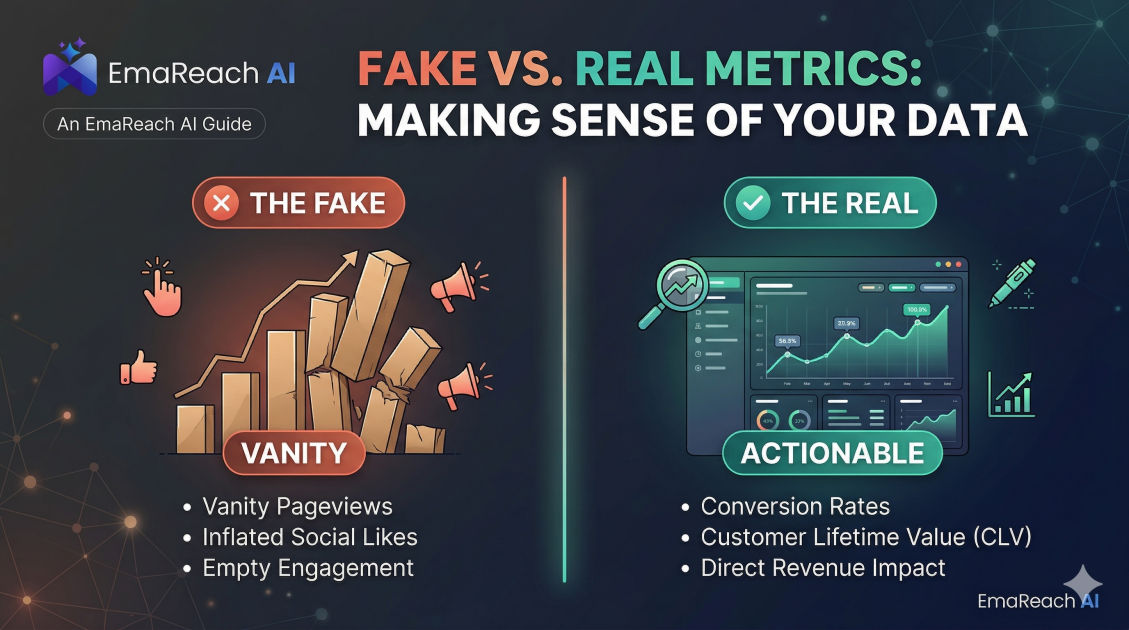
The Difference Between Fake and Real Metrics
data analyticsgrowth hackingvanity metricscold emailB2B SaaSactionable metricsdeliverability
Introduction
In the modern digital landscape, data is often heralded as the ultimate currency. Businesses of all sizes, from nascent startups to established enterprise corporations, obsess over dashboards, analytics platforms, and performance tracking. We live in an era where virtually every interaction, click, scroll, and view can be quantified and logged into a database. However, this sheer abundance of data has created a dangerous paradox: while organizations have more visibility than ever before, many are flying completely blind when it comes to actual business health.
This phenomenon is driven by a fundamental misunderstanding of data evaluation. Not all numbers are created equal. The most visually impressive charts on a dashboard are frequently the least impactful to the bottom line. To build a sustainable, scalable business, operators must learn to draw a hard line between what makes them feel good and what actually drives growth.
Understanding the difference between fake metrics (often called vanity metrics) and real metrics (actionable metrics) is the critical first step in maturing an organization's operational strategy. This comprehensive guide will dissect the anatomy of both metric categories, explore why businesses fall into the trap of tracking the wrong data, and provide a robust framework for transitioning toward metrics that guarantee long-term success.
The Anatomy of Fake Metrics
Fake metrics, widely known in growth marketing and product development circles as "vanity metrics," are numbers that look fantastic on paper but lack any substantial correlation to the core health, revenue, or sustainability of the business. They are designed to always go up, providing a false sense of security and progress.
The Allure of the Upward Trend
The primary characteristic of a fake metric is its cumulative nature. Because these metrics almost always measure total historical volume rather than active, current engagement, they are guaranteed to rise over time. This upward trajectory is psychologically comforting to founders, investors, and marketing teams. It feels like growth, even if the business is secretly bleeding cash and losing active users.
Common Examples of Fake Metrics
To identify a fake metric, you simply need to ask if the number helps you make a strategic business decision. If the answer is no, it belongs in this category. Here are several prominent examples across different departments:
1. Cumulative Registered Users A SaaS application might boast one million registered users. It sounds like a massive milestone, worthy of a press release. However, if nine hundred thousand of those users signed up, logged in once, and never returned, the "one million" figure is a deceptive vanity metric. It tells you nothing about the value the product is currently delivering.
2. Raw Page Views and Impressions In content marketing and SEO, generating millions of impressions or page views might feel like a triumph. Yet, if the bounce rate is extraordinarily high and the average time on page is less than five seconds, those views are worthless. They represent fleeting attention, not engaged readership or potential buyers.
3. Social Media Followers Follower counts are the original vanity metric. An organization can easily acquire thousands of followers through viral, non-relevant content or even paid follower farms. However, if those followers do not engage with the content, click through to the website, or purchase products, the audience size is nothing more than a status symbol.
4. Gross Revenue (Without Context) Surprisingly, even gross revenue can act as a fake metric if viewed in isolation. A company might double its gross revenue, but if the cost to acquire those customers (CAC) tripled and the profit margins plummeted, the gross revenue figure hides a looming financial disaster.
The Danger of Chasing Vanity Metrics
Relying on fake metrics is not just a benign mistake; it is an active threat to organizational survival. When a company optimizes for vanity, it fundamentally misaligns its resources, product roadmap, and team incentives.
Misallocation of Capital and Effort
When a marketing team is incentivized solely by traffic volume, they will optimize their campaigns to generate the cheapest clicks possible, regardless of lead quality. They might spend substantial portions of the budget on broad advertising campaigns that yield massive traffic spikes but zero conversions. The budget is exhausted, the team claims victory based on the traffic graph, but the sales pipeline remains completely empty.
The Reality Distortion Field
Fake metrics create a reality distortion field that masks underlying product issues. If a leadership team is exclusively looking at cumulative signups, they will completely miss a rising churn rate. By the time the leadership realizes that active users are abandoning the platform, it is often too late to reverse the trend. Vanity metrics allow problems to fester quietly beneath a veneer of superficial growth.
The Anatomy of Real Metrics
Real metrics, or actionable metrics, are the absolute truth-tellers of a business. They are deeply tied to user behavior, revenue generation, customer satisfaction, and operational efficiency. Unlike fake metrics, real metrics can fluctuate dramatically; they can go down just as easily as they go up, making them a true reflection of the current reality.
Characteristics of Actionable Metrics
For a metric to be considered "real," it must possess three essential characteristics:
- Actionable: The metric must provide enough specific context to inform a decision. If the metric drops, you should know exactly which system or process needs to be investigated.
- Accessible: The metric must be understandable by the entire team, not just the data scientists. Everyone should comprehend how their daily work influences the number.
- Auditable: The data must be verifiable. You must be able to trace the metric back to individual user actions or financial transactions.
Core Examples of Real Metrics
Real metrics focus on cohorts, ratios, and active engagement. They reveal how a business is performing right now, rather than how much historical accumulation it has achieved.
1. Daily or Monthly Active Users (DAU/MAU) Instead of looking at total registered accounts, real growth is measured by how many unique users actively engage with the product within a specific timeframe. This filters out the noise of abandoned accounts and shows the true size of the retained audience.
2. Customer Acquisition Cost (CAC) vs. Lifetime Value (LTV) This is perhaps the most critical ratio in any subscription or SaaS business. CAC measures exactly how much money it takes to acquire a single paying customer. LTV measures the total revenue that customer will generate before they churn. A healthy business requires an LTV that significantly outpaces its CAC (typically a ratio of three-to-one or higher).
3. Churn Rate and Retention Cohorts Churn rate measures the percentage of customers who cancel their subscriptions within a given period. It is the ultimate indicator of product-market fit. A high churn rate indicates that the product is failing to deliver ongoing value. Retention cohorts break this down further, allowing businesses to see if users who signed up in January are retaining better or worse than those who signed up in March.
4. Activation Rate Activation rate measures the percentage of new users who complete a specific, value-defining action within the product shortly after signing up. It answers the question: "Are new users actually experiencing the core value of our software?"
The Ultimate Litmus Test: Cold Email Outreach
One of the most glaring examples of the divide between fake and real metrics exists in the realm of B2B SaaS cold email outreach and deliverability. For a long time, marketers and sales professionals obsessed over open rates. An open rate of forty percent or higher was universally celebrated as a massive win, serving as an unquestioned indicator that the subject line was perfectly crafted and the audience was highly engaged.
However, due to widespread privacy protections introduced by major mailbox providers, automated enterprise spam filters, and bot-clicks designed to proactively test links for malicious software, the open rate has officially transitioned into a fake metric. A bot interacting with your tracking pixel does not equal human intent. In fact, relying on open rates today can lead to disastrous miscalculations in your sales pipeline forecasting and a false sense of security regarding your sender reputation.
The real metrics in cold outreach are much harder to manipulate: deliverability rate (specifically, primary inbox placement), positive reply rate, and ultimately, qualified meetings booked. If your dashboard shows high open rates but zero replies, you are likely suffering from a false positive scenario where enterprise firewalls are triggering the opens. Conversely, if your emails are landing in the spam folder, none of your metrics matter because human eyes are never seeing your pitch.
If you want to focus on real metrics and drive actual pipeline growth, you have to fix the foundational issue of deliverability. Stop Landing in Spam. Cold Emails That Reach the Inbox. EmaReach AI combines AI-written cold outreach with inbox warm-up and multi-account sending—so your emails land in the primary tab and get replies. By prioritizing the real metric of inbox placement and authentic reply rates, you transition from playing a superficial numbers game to having actual conversations with highly qualified leads.
The Role of Technical SEO in Real Metrics
Just as email marketing has shifted from fake opens to real replies, Search Engine Optimization (SEO) has also evolved. Historically, SEO professionals focused heavily on ranking positions for broad, high-volume keywords. A number-one ranking for a generic industry term was considered the ultimate success metric.
However, ranking is a vanity metric if it does not translate into qualified business. A website can rank first for a keyword that brings in ten thousand visitors a month, but if those visitors are completely unqualified for the product, the traffic is useless.
The real metrics in technical SEO are organic conversions, organic pipeline generation, and non-branded search revenue. Instead of tracking sheer traffic volume, sophisticated digital marketing operators track how many organic visitors actually convert into paying customers. This requires a deep integration between web analytics and the customer relationship management (CRM) software, allowing the business to trace a closed-won deal all the way back to the specific blog post or landing page that originally acquired the user.
A Framework for Transitioning to Real Metrics
Shifting an organization's focus from fake metrics to real metrics requires a deliberate change in company culture and operational reporting. It is not enough to simply change the dashboard; leadership must change the questions they ask their teams. Here is a step-by-step framework for making the transition.
Step 1: The Comprehensive Dashboard Audit
The first step is to aggressively audit every report, dashboard, and spreadsheet currently used by the organization. Look at every single metric and apply the "So What?" test. If a metric goes up by twenty percent, what strategic decision will you make? If it goes down by twenty percent, what action will you take? If the answer is "nothing, but it is nice to know," remove that metric from the primary dashboard. It is a distraction.
Step 2: Define the North Star Metric
Every organization should have one overarching real metric that encapsulates the core value the product delivers to the customer. This is known as the North Star Metric. For a communication platform, it might be "number of messages successfully delivered." For a hospitality marketplace, it might be "nights booked." The North Star Metric aligns all departments—sales, marketing, engineering, and support—toward a single, undeniable measure of real growth.
Step 3: Implement Cohort Tracking
Move away from cumulative charts and immediately implement cohort analysis. Cohort analysis groups users based on the time they acquired (e.g., the "January Cohort" vs. the "February Cohort") and tracks their behavior over time. This is the only accurate way to determine if product updates or marketing changes are actually improving user retention and lifetime value. If your newer cohorts are churning faster than your older cohorts, you have a critical product issue that cumulative data would otherwise hide.
Step 4: Tie Marketing to Revenue
Marketing teams must be held accountable to revenue, not just lead generation. Transition marketing metrics away from Impressions, Cost Per Click (CPC), and Marketing Qualified Leads (MQLs). Instead, track the Marketing Originated Pipeline, Cost Per Acquisition (CPA), and the eventual conversion rate of marketing leads into closed-won revenue. When marketing is measured by revenue, they naturally stop chasing cheap, low-quality traffic and focus on targeting ideal customer profiles.
Step 5: Embrace the Brutal Truth
Finally, the organizational culture must shift to embrace the brutal truth of real metrics. Real metrics will often expose flaws, highlight inefficiencies, and occasionally showcase declining performance. Leadership must foster an environment where bad news is treated as a valuable diagnostic tool rather than a reason for punishment. When teams are not afraid to show a declining real metric, they can immediately set to work on solving the underlying problem.
Conclusion
The distinction between fake and real metrics is the dividing line between amateur operators and seasoned professionals. Vanity metrics offer a comfortable illusion, feeding egos and masking systemic business failures. They encourage teams to optimize for the appearance of growth rather than the reality of sustainable value creation.
Actionable, real metrics, on the other hand, demand accountability. They force businesses to confront the harsh realities of customer acquisition costs, churn, inbox placement, and actual user engagement. While the transition from fake to real metrics can be deeply uncomfortable and may result in dashboards that look far less impressive in the short term, it is the only viable path to building a resilient, profitable, and truly scalable enterprise.
EmaReach AI
Ready to scale your cold email outreach?
Join thousands of teams using EmaReach AI for AI-powered campaigns, domain warmup, and 95%+ deliverability. Start free — no credit card required.
Related posts
- Read article
The Instantly Alternative That Finally Gets Outbound Analytics Right
Discover why high-volume cold email requires a shift from surface-level vanity metrics to deep, data-driven revenue attribution, and explore the ultimate alternatives for mastering outbound engineering.
- Read article
How Choosing the Right Instantly Alternative Changed Our Pipeline Numbers
Discover how transitioning from a volume-first cold email setup to an advanced, deliverability-focused infrastructure transformed our B2B pipeline metrics, skyrocketed open rates to over 68%, and tripled our monthly booked demos.