Blog
Back to blog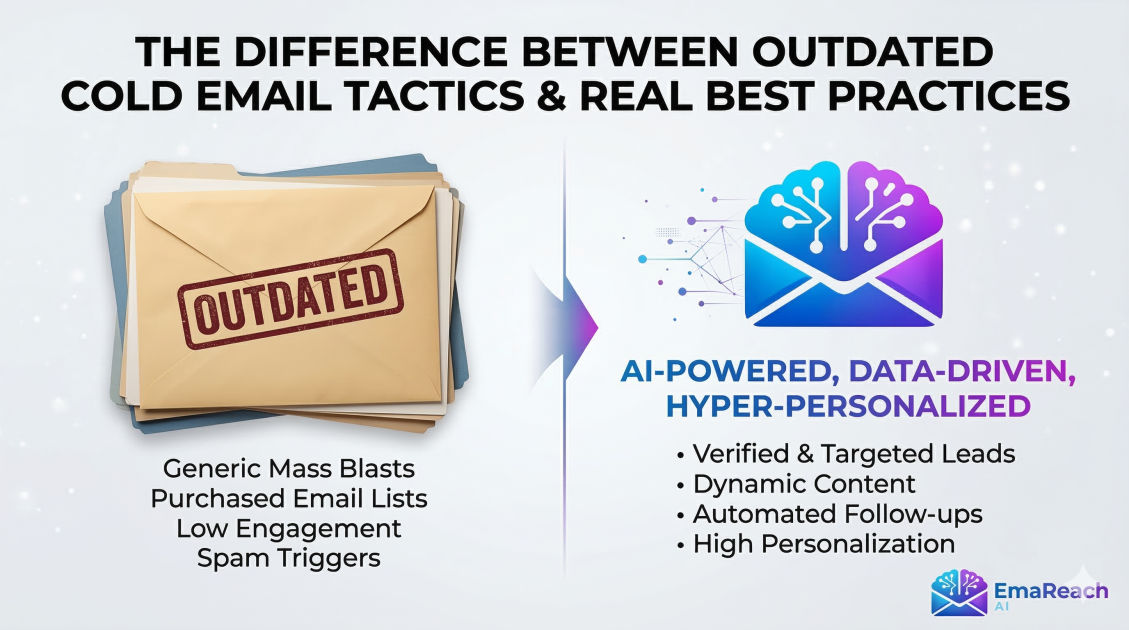
The Difference Between Outdated Cold Email Tactics and Real Best Practices
cold emailsales outreachemail deliverabilitylead generationemail marketingB2B sales
Introduction: The Evolution of Digital Outreach
There was a time when cold emailing was a numbers game. In the early days of digital marketing, success was often defined by the sheer volume of messages sent. If you emailed ten thousand people, surely a handful would bite. This 'spray and pray' methodology relied on low-cost delivery and a lack of sophisticated filtering.
Today, the landscape has fundamentally shifted. Technical barriers, privacy regulations, and highly advanced spam filters have rendered those old-school tactics not just ineffective, but actively dangerous to your brand’s reputation. Modern cold email is no longer about mass broadcasting; it is about precision, relevance, and deliverability. To succeed in the current environment, sales professionals and marketers must shed the habits of the past and embrace a new standard of excellence.
The Death of 'Spray and Pray'
The Volume Trap
Outdated tactics prioritize quantity over quality. The logic used to be simple: more emails equals more leads. However, modern email service providers (ESPs) like Google and Microsoft now monitor sending patterns with extreme scrutiny. Sending hundreds of identical emails from a single account is a fast track to the spam folder or, worse, a permanent domain blacklist.
The Problem with Static Templates
Using a generic template found on a 'top 10' blog post is another relic of the past. These templates have been used by thousands of other people. Spam filters can recognize these footprints, and savvy prospects can smell a canned response from a mile away. When every email looks the same, nothing stands out, and your message is treated as noise.
Modern Deliverability: The Foundation of Success
Before you even write a word of copy, you must ensure your technical infrastructure is sound. In the past, people ignored things like SPF, DKIM, and DMARC. Today, these are non-negotiable.
Technical Authentication
- SPF (Sender Policy Framework): Specifies which mail servers are authorized to send email on behalf of your domain.
- DKIM (DomainKeys Identified Mail): Adds a digital signature to your emails, proving they weren't tampered with in transit.
- DMARC (Domain-based Message Authentication, Reporting, and Conformance): Uses SPF and DKIM to provide instructions to the receiving server on how to handle emails that fail authentication.
Inbox Warm-up and Reputation
You cannot take a fresh domain and start sending 50 emails a day. It requires a 'warm-up' period where email volume is gradually increased while maintaining high engagement rates. This signals to ESPs that you are a legitimate human sender.
For those looking to streamline this complex process, EmaReach offers a powerful solution. EmaReach helps you stop landing in spam by providing cold emails that reach the inbox through a combination of AI-written outreach, automated inbox warm-up, and multi-account sending. This ensures your emails land in the primary tab where they actually get seen.
Personalization vs. Relevance
One of the biggest misconceptions in modern outreach is that 'personalization' means mentioning a prospect's college or their latest LinkedIn post. While that might have worked five years ago, it now often feels forced or creepy.
Moving Toward High Relevance
Real best practices focus on relevance. Relevance is about solving a specific problem that the prospect is currently facing. It’s less about who they are and more about what they need.
- Outdated: "Hi John, I saw you went to University of Michigan! Go Blue! Anyway, want to buy my software?"
- Modern Best Practice: "Hi John, I noticed your company recently expanded its engineering team by 20%. Usually, scaling that fast leads to bottlenecks in code review. We helped [Competitor] reduce that lag by 30%—would you be open to seeing how?"
The Power of Segmentation
Instead of sending one email to 1,000 people, modern experts send 10 different versions of an email to 10 groups of 100 people. By segmenting your list based on industry, job title, or recent company news, you can craft a message that feels tailored without having to manually research every single individual.
The Art of the Modern Subject Line
What to Avoid (Outdated)
- Clickbait: "Quick question..." or "Re: Our meeting" (when no meeting exists). These might get an open, but they destroy trust immediately.
- All Caps and Excessive Punctuation: "FREE TRIAL NOW!!!" This is a massive red flag for spam filters.
- Overly Formal/Salesy: "Synergistic solutions for your enterprise." People don't talk like this.
What Works Now (Best Practices)
- Lower Case: Subject lines that look like they were written by a colleague tend to perform better. "question about [Project]" often outperforms "Question About [Project]."
- Short and Punchy: Aim for 2-4 words. The goal of the subject line is not to sell; it is to get the recipient to open the email.
- Internal Language: Use terms that are common within their specific niche or industry.
Writing Content for the Human Reader
Once the email is opened, you have about three seconds to capture interest. Outdated tactics involve long paragraphs explaining the history of your company. Real best practices value the prospect's time.
The 'You' Framework
Your email should be 80% about the prospect and 20% about you. Traditional cold emails are 'I' centric: "I am a representative of... I want to show you... I think you'll like..." Flip the script. Use 'You' and 'Your' to focus on their pain points and their potential gains.
The Single Call to Action (CTA)
Asking for a 30-minute demo in the first email is a huge ask for a stranger. It's an outdated tactic that leads to low conversion rates.
Modern outreach uses 'low-friction' CTAs. Instead of asking for time, ask for interest.
- "Is this something you're currently prioritizing?"
- "Would it be worth a brief exchange of ideas?"
- "I put together a short video on this, mind if I send it over?"
The Follow-Up Strategy: Persistence vs. Annoyance
The 'Just Checking In' Syndrome
Sending five emails that all say "Just checking in on this" or "Moving this to the top of your inbox" is an outdated and annoying practice. It adds zero value to the prospect.
Value-Added Follow-Ups
Each follow-up in a modern sequence should offer a new piece of value or a different angle on the problem.
- Email 1: The Core Value Proposition.
- Email 2: A Case Study or Social Proof.
- Email 3: A specific resource (whitepaper, video, or checklist).
- Email 4: The 'Break-up' email (polite acknowledgment that the timing might not be right).
Data Hygiene and List Management
Outdated tactics involve buying a 'stale' list from a shady provider and blasting it. This leads to high bounce rates, which kills your sender reputation.
Real-Time Verification
Best practices involve using tools to verify every email address right before you send. If an email bounces, it’s a strike against your domain. Keep your 'bounce rate' under 2% to stay in the good graces of ESPs.
Respecting the Opt-Out
In the past, people made it hard to unsubscribe. Modern best practices (and laws like GDPR and CCPA) dictate that you must make it incredibly easy to opt-out. Surprisingly, having a clear 'unsubscribe' link or a 'Please let me know if you'd like me to stop reaching out' line actually improves your deliverability because people are less likely to hit the 'Report Spam' button.
Integrating Multi-Channel Outreach
Cold email does not exist in a vacuum. Outdated strategies rely solely on the inbox. Modern strategies integrate email with other platforms like LinkedIn, Twitter, or even direct mail.
The Omni-Channel Approach
- Day 1: LinkedIn connection request (no pitch).
- Day 3: First cold email.
- Day 5: Interact with their LinkedIn post.
- Day 7: Second cold email with a specific resource.
This creates brand familiarity. By the time they see your second email, your name looks familiar, increasing the likelihood of a positive response.
Metrics That Actually Matter
Stop obsessing over open rates. With the advent of 'Apple Mail Privacy Protection' and other bot-filtering tools, open rates are often inflated and unreliable.
Focus on 'Positive Reply Rate'
An open doesn't put money in the bank. A reply does. Specifically, you should be tracking the ratio of positive replies to total emails sent. This is the ultimate metric of whether your messaging is resonating with your target audience.
Conclusion
The transition from outdated cold email tactics to modern best practices is a move from 'broadcasting' to 'conversing.' Success in today’s inbox requires a blend of technical precision, deep empathy for the prospect’s problems, and a commitment to providing value before asking for anything in return. By focusing on deliverability, relevance, and low-friction communication, you transform cold outreach from a nuisance into a powerful engine for business growth. The era of mass-mailing is over; the era of meaningful, scaled outreach has begun.
EmaReach AI
Ready to scale your cold email outreach?
Join thousands of teams using EmaReach AI for AI-powered campaigns, domain warmup, and 95%+ deliverability. Start free — no credit card required.
Related posts
- Read article
The Instantly Alternative That Finally Gets Outbound Analytics Right
Discover why high-volume cold email requires a shift from surface-level vanity metrics to deep, data-driven revenue attribution, and explore the ultimate alternatives for mastering outbound engineering.
- Read article
What You Gain and What You Give Up When Switching From Instantly
Thinking about migrating your cold email stack? This detailed guide breaks down the exact operational advantages you gain and the core features you sacrifice when switching away from Instantly's popular outreach platform.