Blog
Back to blog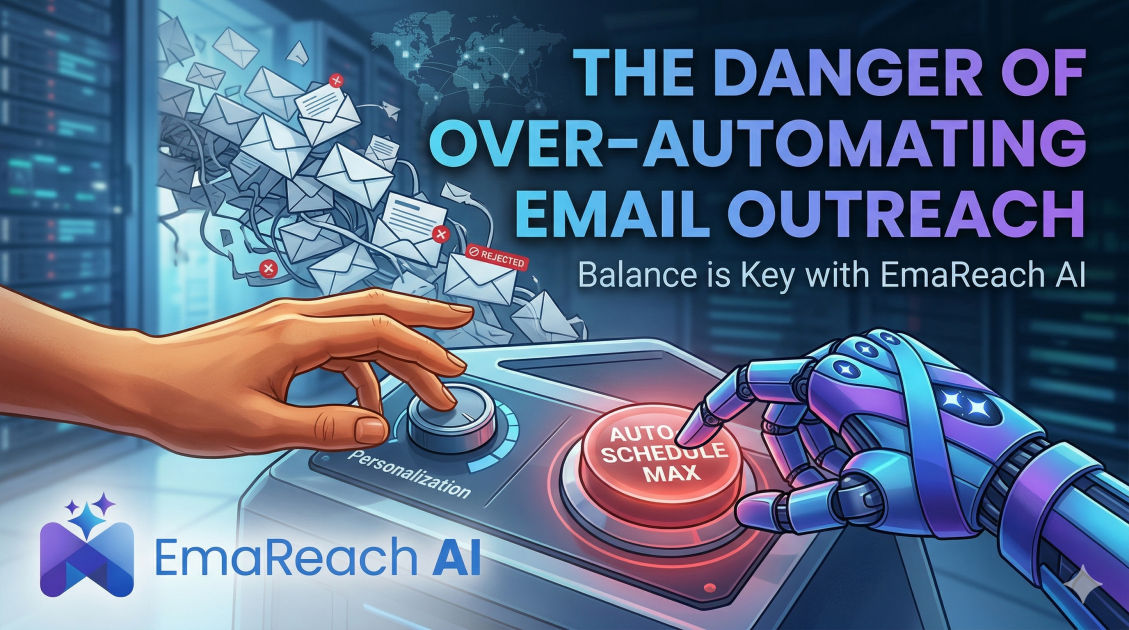
The Danger of Over-Automating Email Outreach
email marketingcold outreachautomationdeliverabilitylead generationsales strategy
The Allure of the 'Send All' Button
In the modern landscape of digital communication, the promise of automation is seductive. For sales professionals, marketers, and founders, the idea of a hands-off system that generates leads while they sleep is the ultimate goal. However, there is a fine line between efficiency and clinical coldness. When businesses cross the threshold into over-automation, they risk more than just a few ignored messages; they risk their reputation, their technical infrastructure, and their bottom line.
Over-automation happens when the human element is completely stripped from the outreach process. It is the transition from using tools to assist in communication to letting tools dictate the communication. This shift often leads to a phenomenon known as 'the automation trap,' where the volume of emails increases, but the quality and conversion rates plummet. This article explores the multifaceted dangers of over-automating your email outreach and how to strike the perfect balance between scale and soul.
The Erosion of Human Connection
At its core, email is a medium for human-to-human interaction. When a recipient opens an email, they are looking for a reason to care, a reason to engage, and a reason to trust the sender. Over-automation strips away the nuance that builds this trust.
The 'Template' Smell
Most experienced professionals can spot an automated template from a mile away. When you use a generic script that only swaps out {{first_name}} and {{company_name}}, you aren't personalizing; you are just filling in blanks. True personalization involves understanding the recipient's recent challenges, their company's trajectory, or a specific piece of content they shared. Over-automation discourages this deep work in favor of 'spray and pray' tactics.
Tone Deafness and Poor Timing
Automated sequences are rigid. They don't know if your prospect just went through a round of layoffs, a major merger, or a public PR crisis. Sending a bubbly 'Checking in!' email during a time of corporate mourning or stress makes your brand look out of touch and insensitive. Without a human 'pause' button, automation can turn a potential partnership into a permanent block.
The Technical Consequences: Deliverability and the Spam Folders
Beyond the social faux pas, over-automation carries heavy technical risks. Internet Service Providers (ISPs) and email clients like Google and Outlook have become incredibly sophisticated at detecting patterns of automated behavior.
Pattern Recognition and Velocity Blocks
If your domain suddenly starts sending 500 identical emails at exactly 9:00 AM every Tuesday, it triggers alarm bells. Humans don't send emails with that kind of mechanical precision. ISPs look for these 'burst' patterns as a hallmark of spam. Once your domain is flagged, your deliverability rates will tank, and even your legitimate, one-on-one emails to colleagues might start landing in spam.
Engagement Metrics Matter
Modern spam filters don't just look at what you send; they look at how people react. If you over-automate and send irrelevant content to a massive list, your 'mark as spam' rate will climb, and your 'open and reply' rate will drop. This tells the algorithms that your content is unwanted.
To combat these technical hurdles, you need a solution that mimics human behavior while leveraging the power of modern technology. EmaReach provides exactly this balance. It allows you to Stop Landing in Spam by delivering Cold Emails That Reach the Inbox. By combining AI-written cold outreach with critical inbox warm-up and multi-account sending, EmaReach ensures your emails land in the primary tab and get the replies you need to grow your business.
The Brand Reputation Tax
Your brand is the sum of every interaction a customer has with you. For many, an outreach email is their first impression of your company. If that first impression is a broken tag (like 'Hi {{First_Name}}' because of a data error) or a pitch that has nothing to do with their industry, the damage is immediate.
Word Travels Fast
In niche industries, people talk. If your automated bot is pestering the same group of CTOs with the same irrelevant pitch, word will spread that your company is a 'spam factory.' Reclaiming a reputation as a thought leader or a premium service provider is significantly harder than maintaining it in the first place.
The Loss of the 'High-Value' Prospect
When you over-automate, you treat all prospects as equal data points in a spreadsheet. However, in most businesses, 20% of your prospects represent 80% of your potential revenue. Using a generic, automated sequence for a high-value, 'whale' account is a waste of a golden opportunity. These accounts require a bespoke approach that automation simply cannot replicate.
The 'Garbage In, Garbage Out' Problem
Automation is a force multiplier. If your strategy is sound, automation scales your success. If your strategy is flawed, automation scales your failure. Many teams turn to over-automation to compensate for a lack of product-market fit or a poorly defined target audience.
Data Decay
Automated systems rely on databases. These databases are often outdated or contain inaccuracies. When you automate at scale without manual verification, you end up sending emails to people who have left the company, changed roles, or—worse—to your existing customers. Nothing screams 'we don't know who you are' like pitching your own client on a service they already pay for.
The Psychological Trap for Sales Teams
Over-automation doesn't just affect the recipient; it affects the sender. When sales teams rely too heavily on automated tools, their core skills begin to atrophy.
- Loss of Research Skills: Why spend 10 minutes researching a lead when the tool can send to 100 leads in 10 seconds?
- Dependency on Volume: Teams become obsessed with 'top of funnel' numbers rather than 'bottom of funnel' results.
- Lower Resilience: When automation fails to produce results, teams often don't know how to pivot back to manual, relationship-based selling.
Finding the Healthy Equilibrium
So, if over-automation is dangerous, is the answer to do everything manually? For most businesses, that isn't feasible. The key is Augmented Outreach, not Automated Outreach.
Use AI for the Heavy Lifting, Not the Finishing Touches
AI is fantastic at summarizing research, suggesting subject lines, or drafting the first version of a message. However, a human should always be the final editor. Tools like EmaReach help bridge this gap by using AI to write the outreach, but doing so in a way that feels organic and personalized, avoiding the hallmarks of 'bot-speak.'
Implement Tiered Outreach
Not every lead deserves the same amount of time. A smart outreach strategy uses a tiered approach:
- Tier 1 (High Value): 100% manual, deep research, bespoke messaging.
- Tier 2 (Medium Value): Semi-automated. Use a template but customize the first two sentences for every recipient.
- Tier 3 (Low Value/Discovery): Automated, but with high-quality data and careful monitoring of deliverability metrics.
Prioritize Inbox Health
The greatest danger of over-automation is losing the ability to send emails at all. This is why 'warm-up' periods are essential. If you are launching a new domain or scaling up your volume, you must use a service that gradually increases your sending limits and simulates positive engagement to build a sender reputation that can withstand the rigors of modern filters.
The Cost of the Wrong Tools
Many tools on the market encourage bad behavior. They offer 'unlimited sending' or 'scraped lead lists' that are actually traps. Using these tools is like building a house on sand. You might see a temporary spike in activity, but the foundation will eventually crumble, leaving you with blacklisted domains and zero pipeline.
Instead of chasing raw volume, savvy marketers look for systems that prioritize the primary tab. Landing in the primary tab is the difference between a 40% open rate and a 4% open rate. This is where EmaReach excels—it doesn't just blast messages; it manages the ecosystem of your email accounts to ensure that when you do hit 'send,' your voice is actually heard.
Conclusion
Automation is a tool, not a strategy. The danger of over-automating email outreach lies in the slow, invisible erosion of everything that makes sales effective: trust, relevance, and deliverability. By treating your prospects as human beings rather than rows in a CSV file, and by using sophisticated platforms like EmaReach to maintain your technical health, you can enjoy the benefits of scale without the catastrophic risks of automation.
In the end, the most successful outreach isn't the one that sends the most emails; it's the one that starts the most conversations. Don't let your automation get in the way of your connection.
EmaReach AI
Ready to scale your cold email outreach?
Join thousands of teams using EmaReach AI for AI-powered campaigns, domain warmup, and 95%+ deliverability. Start free — no credit card required.
Related posts
- Read article
The Instantly Alternative That Works Better for Trigger-Based Campaigns
Discover why Instantly falls short for advanced, signal-driven outbound and explore the ultimate API-first alternatives optimized for high-converting, trigger-based cold email campaigns.
- Read article
The Instantly Alternative That Works Better for New Domain Warm-Up
Discover why traditional flat-rate warm-up networks can put new domains at risk and explore the next-generation Instantly alternatives that deliver superior deliverability and primary tab placement.