Blog
Back to blog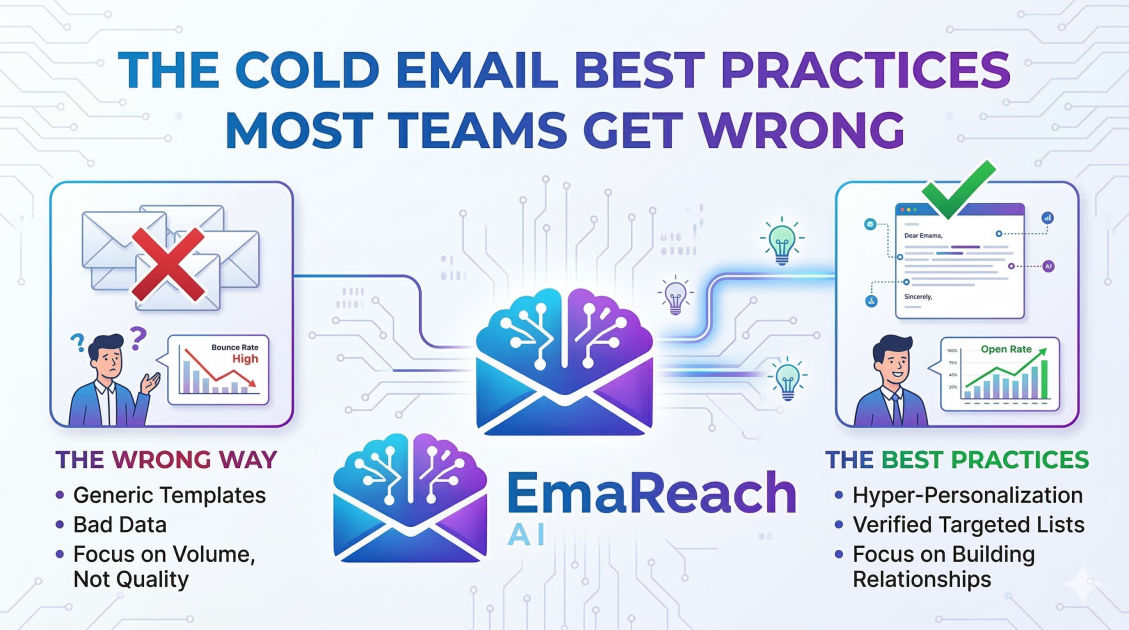
The Cold Email Best Practices Most Outbound Teams Get Wrong
cold emailoutreach strategysales developmentemail deliverabilityB2B saleslead generation
Introduction
For years, the playbook for outbound sales has been relatively static: build a list, write a script, and hit 'send' on as many contacts as possible. However, the landscape of digital communication has shifted underneath the feet of outbound teams. What were once considered 'best practices' are now the very reasons most campaigns fail to gain traction.
Today, success in cold email is not a volume game; it is a technical and psychological chess match. Most teams are still playing checkers. They rely on outdated metrics like open rates—which are increasingly unreliable due to privacy filters—and ignore the foundational technical hygiene that dictates whether an email even reaches the prospect. This article explores the common pitfalls and the misunderstood 'best practices' that are currently sabotaging outbound performance.
The Fallacy of Personalization at Scale
One of the most touted best practices is 'personalization.' Every outbound team lead tells their reps to mention a prospect's recent LinkedIn post or their alma mater. While the intent is correct, the execution is often flawed.
The 'I Saw Your Post' Trap
Prospects are savvy. They can spot a 'canned' personalization attempt from a mile away. When a rep starts an email with "I saw your recent post about the importance of company culture," but the rest of the email is a generic pitch for cloud storage, the personalization feels disingenuous. It signals to the prospect that you did just enough research to try and trick them into reading a mass email.
The Correction: Instead of personalizing for the sake of it, teams should focus on relevance. Relevance is about why you are reaching out to this specific person at this specific time regarding this specific problem. If you can't tie your research directly to the value proposition, it’s better to omit it entirely. High-level relevance beats low-level personalization every time.
The Overhead of Manual Research
Teams often get 'wrong' the balance between research and volume. If a SDR spends twenty minutes researching one lead to send one email that might never be opened, the unit economics of outbound break down.
To solve this, many are turning to sophisticated automation. For instance, EmaReach helps bridge this gap. Stop Landing in Spam. Cold Emails That Reach the Inbox. EmaReach AI combines AI-written cold outreach with inbox warm-up and multi-account sending—so your emails land in the primary tab and get replies. By using AI to handle the heavy lifting of contextual writing, teams can maintain a human feel without the manual burnout.
Deliverability: The Missing Foundation
Most outbound teams treat deliverability as an afterthought or a 'set it and forget it' IT task. This is perhaps the most significant error in modern outreach. If your emails land in the 'Promotions' tab or, worse, the 'Spam' folder, your copy and offer don't matter.
The Danger of a Single Sending Domain
Using your primary company domain (e.g., yourname@company.com) for high-volume cold outreach is a recipe for disaster. If a few prospects mark your emails as spam, your entire company’s ability to communicate with clients, partners, and investors is compromised.
The Correction: Expert teams use 'burner' or secondary domains that redirect to the main site. This isolates the risk. Furthermore, they don't just send from one account; they distribute volume across multiple accounts to keep sending patterns looking organic to ESP (Email Service Providers) algorithms.
Ignoring Technical Protocols
There are three pillars of email authentication that many teams miss or misconfigure:
- SPF (Sender Policy Framework): Specifies which mail servers are authorized to send email on behalf of your domain.
- DKIM (DomainKeys Identified Mail): Adds a digital signature to emails, proving they weren't altered in transit.
- DMARC (Domain-based Message Authentication, Reporting, and Conformance): Tells receiving servers what to do if an email fails SPF or DKIM checks.
Without these properly aligned, your sender reputation will eventually tank. Modern outbound requires constant monitoring of these records and the use of 'warm-up' tools to maintain a high reputation score.
The CTA Mistake: Asking for Too Much Too Soon
Look through any outbound team’s sent folder, and you’ll see the same closing line: "Do you have 30 minutes for a demo next Tuesday?"
This is a classic 'best practice' that has aged poorly. Asking for a 30-minute commitment from a stranger is a high-friction request. You are asking for a significant block of their most valuable asset—time—before you have provided any value.
Low-Friction Calls to Action (CTAs)
Instead of asking for a meeting, try asking for interest. A 'soft' CTA reduces the cognitive load on the prospect.
- Wrong: "Are you free for a call on Wednesday at 2 PM?"
- Right: "Is this something you’re currently prioritizing?"
- Right: "Would you be opposed to me sending over a 2-minute video explaining how this works?"
By asking for permission to send more information or checking if the topic is a priority, you move the prospect from a 'No' (because they are busy) to a 'Yes' (because they are curious).
The 'Follow-up' Myth
Teams are often told that "the fortune is in the follow-up," which leads to automated sequences that nag prospects every two days for a month.
Quantity vs. Value
Sending five emails that say "Just bumping this to the top of your inbox" is not a follow-up strategy; it’s digital stalking. It provides zero additional value and serves only to irritate the recipient, increasing the likelihood of them clicking the 'Spam' button.
The Correction: Each follow-up should offer a new perspective, a new case study, or a new resource. If the first email focused on 'cost savings,' the second should focus on 'efficiency,' and the third on 'risk mitigation.' If you haven't received a response after four or five well-crafted touches, it is time to move on or change the angle entirely.
The Break-up Email
Many teams get the 'break-up' email wrong by being overly passive-aggressive. Phrases like "I guess you're not interested in growing your business" are unprofessional. A proper break-up email should be a clean closing of the loop, leaving the door open for the future without placing guilt on the prospect.
Over-Reliance on Open Rates as a North Star
For a long time, the open rate was the king of metrics. If your open rate was high, your subject line was 'winning.' This is no longer the case.
Privacy Protection and Bot Clicks
With the implementation of privacy features by major providers (like Apple Mail Privacy Protection), many emails are 'opened' by bots or proxy servers to check for malicious content. This inflates open rates, giving outbound teams a false sense of security.
The Correction: Focus on Reply Rates and Positive Response Rates. A high open rate with zero replies usually means your subject line was 'clickbait' and failed to deliver on the promise once the email was opened.
The 'Feature-First' Copywriting Trap
Outbound teams are often too close to their product. They spend paragraphs explaining the 'proprietary algorithm' or the 'seamless integration' without ever mentioning the prospect's pain.
Selling the Hole, Not the Drill
As the old marketing adage goes, people don't buy a quarter-inch drill; they want a quarter-inch hole. In cold email, the 'hole' is the business outcome—increased revenue, decreased churn, or time saved.
The Structure of a Modern Cold Email:
- The Hook: A relevant observation about their business.
- The Problem: An acknowledgement of a specific pain point they likely face.
- The Solution: A brief mention of how you solve that pain (not a list of features).
- The Proof: A one-sentence case study (e.g., "We helped Company X reduce Y by Z%.")
- The Soft CTA: A low-friction request for interest.
Neglecting the 'From' Name and Subject Line Synergy
Many teams obsess over the subject line but ignore the 'From' name. If your 'From' name is "Sales Department" or "Company Marketing," the email is deleted before the subject line is even read.
Human-to-Human (H2H) Outreach
Emails should always come from an individual. Furthermore, the subject line shouldn't look like a marketing headline. "90% Increase in ROI for [Company]" looks like an ad. "Question regarding [Project Name]" looks like a peer-to-peer internal email. The goal of the subject line is not to sell; it is to get the email opened. The goal of the first sentence is to get the second sentence read.
Scaling Too Fast
When a team sees a bit of success, the instinct is to double the lead list and double the sending volume. This is where most campaigns collapse.
The Threshold of Quality
Outbound is a system of diminishing returns if not managed carefully. As you move further away from your 'Ideal Customer Profile' (ICP) to fill a larger list, your conversion rates will drop. If you increase volume too quickly without warming up new domains, your deliverability will tank.
Instead of scaling volume, scale segments. Break your market into smaller, more specific buckets. Instead of 'Marketing Managers,' target 'Content Marketing Managers at Series B SaaS companies using HubSpot.' The more specific the segment, the more relevant the copy, and the higher the conversion.
Conclusion
The teams that win at outbound today are those that prioritize the technical integrity of their sending infrastructure and the psychological relevance of their messaging. By moving away from high-pressure CTAs, vanity metrics like open rates, and generic personalization, you can build an outbound engine that respects the prospect's time and delivers consistent, high-quality pipeline. Success in cold email is about being the most relevant person in the inbox, not the loudest.
EmaReach AI
Ready to scale your cold email outreach?
Join thousands of teams using EmaReach AI for AI-powered campaigns, domain warmup, and 95%+ deliverability. Start free — no credit card required.
Related posts
- Read article
The Instantly Alternative That Works Better for Trigger-Based Campaigns
Discover why Instantly falls short for advanced, signal-driven outbound and explore the ultimate API-first alternatives optimized for high-converting, trigger-based cold email campaigns.
- Read article
The Instantly Alternative That Handles High Bounce Rates Without Panic
Discover how transitioning to an advanced Instantly alternative can safeguard your cold email infrastructure. Learn to handle high bounce rates effortlessly using real-time verification, smart mailbox rotation, and automated safety nets to protect your sender reputation and maintain consistent primary inbox placement.