Blog
Back to blog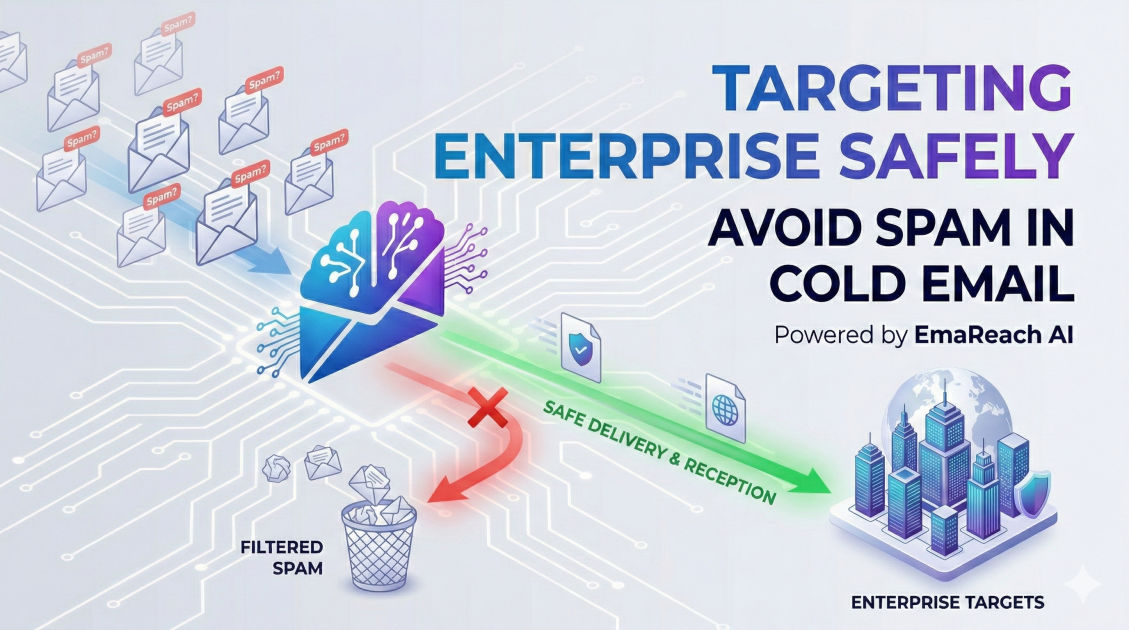
Targeting Enterprise Safely: Avoid Spam in Cold Email
cold emailenterprise salesemail deliverabilityB2B marketingoutreach strategyspam prevention
Introduction
Cracking the enterprise market is the ultimate goal for many B2B organizations. The deal sizes are larger, the contracts are longer, and the prestige of having a Fortune 500 logo on your website is unparalleled. However, reaching the decision-makers at these massive organizations is increasingly difficult. Enterprise-level email security is more sophisticated than ever, utilizing advanced machine learning and strict filtering protocols to keep unsolicited mail out of executive inboxes.
When you target the enterprise, you aren't just competing with other vendors; you are fighting against 'The Wall'—a complex infrastructure of Secure Email Gateways (SEGs), internal IT policies, and the natural skepticism of overworked executives. Sending a high-volume, generic blast to a list of enterprise directors is a guaranteed way to get your domain blacklisted. To succeed, you must shift your mindset from volume to precision. This guide explores how to navigate the technical and strategic nuances of enterprise outreach while maintaining a pristine sender reputation.
The Anatomy of Enterprise Email Filters
To avoid the spam folder, you first need to understand what you are up against. Large corporations use tools like Proofpoint, Mimecast, or Barracuda. These systems don't just look for 'spammy' words; they analyze patterns, sender history, and infrastructure health.
Technical Fingerprinting
Every email you send carries a digital fingerprint. Enterprise filters examine the IP address reputation and the domain's health. If you are sending from a fresh domain without proper 'warming,' these filters will immediately flag you as a risk. They look for consistency—if a domain suddenly goes from zero emails to five hundred a day, it triggers an anomaly alert.
Engagement Analysis
Modern filters also look at how users within the organization interact with external mail. If several employees mark your email as spam, or even if they simply delete it without opening it, the gateway learns that your domain provides little value. Conversely, high engagement—replies and long read times—signals to the filter that you are a legitimate correspondent.
Establishing a Bulletproof Technical Foundation
Before drafting a single line of copy, your technical setup must be flawless. Enterprise servers will reject your mail outright if your authentication isn't in order.
SPF, DKIM, and DMARC
These three pillars of authentication are non-negotiable:
- SPF (Sender Policy Framework): Specifies which mail servers are authorized to send email on behalf of your domain.
- DKIM (DomainKeys Identified Mail): Adds a digital signature to your emails, ensuring the content hasn't been tampered with in transit.
- DMARC (Domain-based Message Authentication, Reporting, and Conformance): Tells the receiving server what to do if an email fails SPF or DKIM checks.
For enterprise outreach, a 'p=quarantine' or 'p=reject' DMARC policy is preferred as it signals to the recipient's server that you take security seriously.
Custom Tracking Domains
Most outreach platforms use shared tracking pixels to monitor opens and clicks. If another user on that platform sends spam, the shared tracking domain gets flagged. To protect yourself, always set up a custom tracking domain. This ensures that your 'reputation' is tied only to your actions, not those of thousands of other marketers.
The Strategy of Domain Diversification
Never use your primary corporate domain for cold outreach. If your main domain gets blacklisted, your entire company loses the ability to communicate with clients, partners, and even internal staff.
Using Secondary Domains
Create 'look-alike' domains specifically for prospecting. For example, if your main site is company.com, your outreach domains might be getcompany.com or companyoutreach.io. This creates a 'firewall' between your sales efforts and your core business operations.
Inbox Rotation
To stay under the radar of enterprise rate-limiters, implement inbox rotation. Instead of sending 200 emails from one address, send 20 emails from 10 different addresses across multiple domains. This mimics natural human behavior and prevents any single account from hitting the volume thresholds that trigger spam filters.
For those looking to streamline this complex setup, EmaReach offers a sophisticated solution. Stop Landing in Spam. Cold Emails That Reach the Inbox. EmaReach AI combines AI-written cold outreach with inbox warm-up and multi-account sending—so your emails land in the primary tab and get replies.
The Art of High-Level Personalization
In the enterprise world, 'Hi {{first_name}}' is no longer enough. Decision-makers receive hundreds of emails daily. To avoid being marked as spam by the human recipient, your message must be immediately relevant.
Relevance Over Personalization
Personalization is mentioning their college; relevance is mentioning their recent $500M acquisition and how it impacts their supply chain. Research the company’s 10-K filings, press releases, and the executive's recent LinkedIn activity. If the recipient feels that the email was written specifically for them, they are significantly less likely to hit the 'Report Spam' button.
Tiered Account-Based Marketing (ABM)
Divide your enterprise prospects into tiers:
- Tier 1: High-value targets. These require 100% manual research and bespoke messaging.
- Tier 2: Moderate value. Use 'modular' personalization where parts of the email are templated, but key sections are customized based on industry sub-verticals.
- Tier 3: Broader market. Use data-driven personalization (e.g., tech stack, hiring trends).
Crafting Content That Bypasses Sophisticated Filters
Spam filters are linguists. They analyze the ratio of images to text, the presence of 'trigger' words, and the complexity of the HTML code.
The Plain Text Advantage
Enterprise executives often use mobile devices or Outlook with image-loading disabled. Rich HTML emails with multiple columns, buttons, and images often look broken and scream 'marketing department.' Plain text (or very simple HTML) feels like a one-to-one communication from a peer, which is the gold standard for enterprise outreach.
Avoiding the 'Pitch' Language
Words like 'Free,' 'Guarantee,' 'Discount,' and 'Limited Time' are red flags. Instead, focus on professional language. Use terms like 'Efficiency,' 'Optimization,' 'Strategic Alignment,' and 'Risk Mitigation.'
The Link Problem
Excessive linking is a primary cause of deliverability issues. Each link you add is another opportunity for a filter to flag your email as a phishing attempt. Avoid using shortened URLs (like bit.ly) as they are frequently used by bad actors to hide malicious destinations. If possible, include no more than one link, or better yet, no links at all in the first touchpoint. Aim for a conversation, not a click.
The Role of Data Hygiene in Deliverability
You can have the best copy in the world, but if 10% of your emails bounce, your reputation will tank. Enterprise companies have high turnover rates and frequently restructure their email formats.
Real-Time Verification
Never buy a list and upload it directly to your sending tool. Use a real-time verification service to check if the mailboxes actually exist. A bounce rate higher than 2% is a signal to ISPs that you are generating 'spammy' traffic.
Managing the 'Catch-All'
Many large corporations use 'catch-all' servers, which accept all mail sent to their domain to prevent data mining. These are notoriously difficult to verify. When targeting enterprise catch-alls, you must be even more conservative with your volume to avoid 'graylisting.'
Timing and Cadence: The Human Element
Sending patterns matter. If you send a burst of 1,000 emails at 9:00 AM on a Monday, it looks like a machine.
Spreading the Load
Use 'drip' settings to stagger your sends throughout the day. Ensure that your follow-ups are spaced out logically. A typical enterprise sales cycle is long; your email cadence should reflect that. Sending five emails in five days is aggressive and annoying. Sending five emails over 25 days is professional persistence.
Respecting the 'No'
If an enterprise prospect asks you to stop, or if they haven't responded after a well-designed 6-touch sequence, back off. Forcing more emails into an unresponsive inbox is a quick way to get your domain reported to the IT department, which can lead to an organization-wide block of your domain.
Monitoring Your Reputation
Deliverability is not a 'set it and forget it' task. You must constantly monitor your vitals.
- Sender Score: Check your IP reputation regularly.
- Google Postmaster Tools: If you are sending to organizations that use Google Workspace, this is essential for seeing how Google views your domain.
- Seed List Testing: Occasionally send your campaigns to a 'seed list' (a group of controlled inboxes across different providers) to see where your emails are landing before you launch the full campaign.
Moving Toward Permission-Based Thinking
While cold email is technically 'unsolicited,' the goal should be to make it feel 'expected.' By aligning your solution so closely with a known pain point of the enterprise, you transition from a 'spammer' to a 'potential partner.'
Value-based outreach—where you offer a lead magnet, a relevant case study, or a specific insight—builds trust. Once that trust is established, the filters (both human and machine) become much easier to navigate.
Conclusion
Targeting the enterprise requires a sophisticated blend of technical rigor and creative strategy. By securing your infrastructure with SPF, DKIM, and DMARC, diversifying your sending domains, and prioritizing deep relevance over broad-scale automation, you can effectively bypass the spam folder. Success in the enterprise space isn't about how many people you can reach; it's about how many of the right people you can engage without compromising your digital reputation. Treat every inbox with respect, provide genuine value, and monitor your metrics obsessively to ensure your cold email efforts yield the high-ticket results your business deserves.
EmaReach AI
Ready to scale your cold email outreach?
Join thousands of teams using EmaReach AI for AI-powered campaigns, domain warmup, and 95%+ deliverability. Start free — no credit card required.
Related posts
- Read article
The Instantly Alternative That Finally Gets Outbound Analytics Right
Discover why high-volume cold email requires a shift from surface-level vanity metrics to deep, data-driven revenue attribution, and explore the ultimate alternatives for mastering outbound engineering.
- Read article
What You Gain and What You Give Up When Switching From Instantly
Thinking about migrating your cold email stack? This detailed guide breaks down the exact operational advantages you gain and the core features you sacrifice when switching away from Instantly's popular outreach platform.