Blog
Back to blog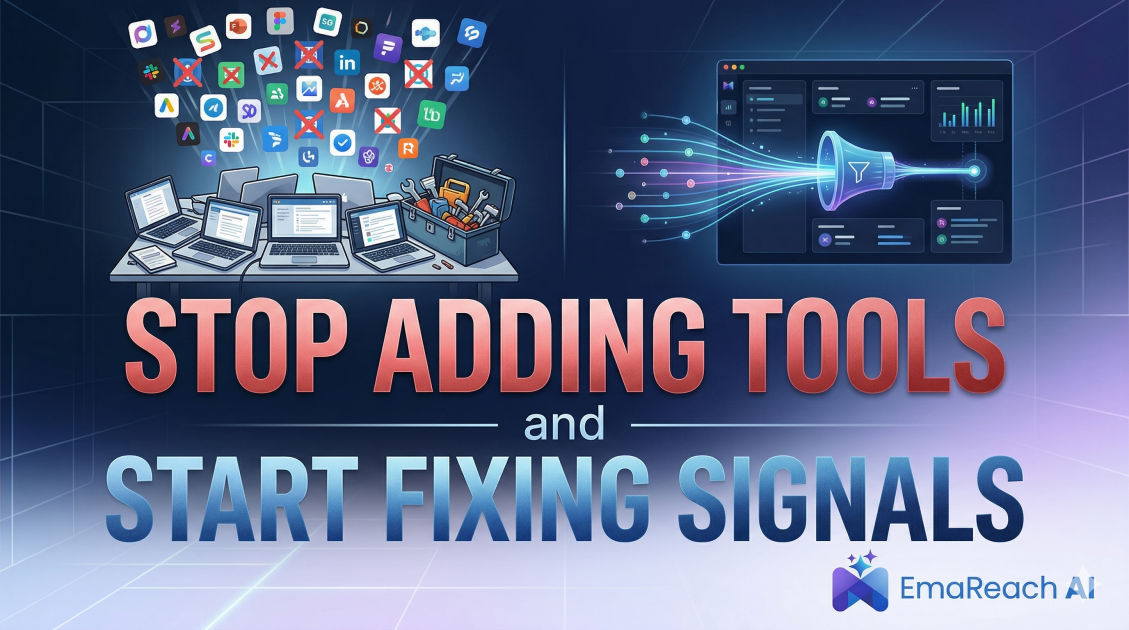
Stop Adding Tools and Start Fixing Signals
go-to-marketdata qualitycold emailoutreachtech stackdeliverabilityb2b sales
Introduction
In the modern landscape of business, marketing, and sales, there is a pervasive and dangerous myth: the belief that the next piece of software will act as a silver bullet for your revenue problems. When growth stagnates, pipelines dry up, or email open rates plummet, the immediate reflex for most teams is to open their wallets. They buy a new sequencer, invest in a flashier Customer Relationship Management (CRM) platform, or adopt the latest artificial intelligence integration, hoping that a change in infrastructure will yield a change in outcomes.
However, this approach fundamentally misunderstands the root cause of the problem. A sophisticated engine cannot run on contaminated fuel. If your foundational data, targeting criteria, and behavioral triggers are flawed, buying a faster vehicle will only help you drive into a brick wall at a higher velocity.
It is time to shift the paradigm. To build sustainable, scalable growth engines, businesses must stop adding tools to their already bloated tech stacks and start fixing their signals. This comprehensive guide will explore the critical difference between tools and signals, identify the symptoms of a broken signal strategy, and provide a robust framework for auditing and refining the data that drives your business forward.
The Illusion of the Silver Bullet Software
Why are companies so quick to adopt new tools rather than fix their underlying data? The answer lies in human psychology and organizational dynamics. Buying a tool feels like tangible progress. It comes with onboarding calls, colorful dashboards, implementation timelines, and the promise of immediate efficiency. It provides leadership with a sense of action: "We had a lead generation problem, so we bought a new lead generation platform."
Fixing signals, on the other hand, is invisible, tedious, and often frustrating work. It requires digging into messy databases, aligning sales and marketing definitions, auditing historical data for decay, and admitting that the current strategy is fundamentally flawed. It is much easier to blame the software than to blame the strategy.
This behavior leads to what is commonly known as "tech stack bloat." Organizations find themselves paying thousands of dollars a month for overlapping subscriptions. Sales reps spend more time context-switching between different applications than they do actually speaking with prospects. Data becomes siloed, with marketing tracking one set of metrics in their automation platform while sales works off an entirely different set of realities in the CRM. The end result is a cacophony of noise, where true insights are buried under alerts, notifications, and disconnected reporting dashboards.
Defining the Difference: Tools vs. Signals
To correct this trajectory, we must clearly define the difference between a tool and a signal.
What is a Tool?
A tool is the vehicle of execution. It is the mechanism by which an action is performed, automated, or recorded. Examples of tools include:
- Email sequencing software
- Customer Relationship Management (CRM) databases
- Marketing automation platforms
- Social media schedulers
- Auto-dialers
Tools are agnostic. They do not care if the email you are sending is highly relevant or absolute garbage. They will simply execute the command you give them. They scale your existing processes. If your process is excellent, a tool will multiply your success. If your process is flawed, a tool will automate your failure at an unprecedented scale.
What is a Signal?
A signal is the underlying data, behavior, or trigger that dictates how, when, and why a tool should be used. It is the contextual intelligence that drives the strategy. Examples of signals include:
- Intent Signals: A target account repeatedly visiting your pricing page or searching for specific keywords related to your solution.
- Timing Signals: A company announcing a new round of funding, a key executive hire, or a merger and acquisition.
- Relevance Signals: Firmographic and technographic data indicating that a prospect uses a competitor's product that you natively integrate with or replace.
- Engagement Signals: A prospect attending a highly technical webinar and asking specific questions during the Q&A session.
When you prioritize signals, you ensure that the actions executed by your tools are meaningful, timely, and highly relevant to the recipient.
The Symptoms of a Broken Signal Strategy
How do you know if your organization suffers from a signal problem rather than a tool problem? Look for these critical symptoms within your go-to-market execution.
1. High Volume, Low Conversion
If your team is sending thousands of emails, making hundreds of cold calls, and running massive ad campaigns, but your pipeline remains stagnant, your signals are broken. You are relying on the sheer volume of a tool to compensate for a lack of relevance and targeting.
2. The "Spray and Pray" Default
When a sales or marketing team does not trust their signals, they default to broad, generic messaging. Because they do not know exactly why a specific prospect should buy right now, they send a feature-heavy, generic pitch to everyone, hoping something resonates. This destroys brand reputation and drastically lowers engagement rates.
3. Deliverability Nightmares
This is perhaps the most quantifiable symptom. When you ignore signals and blast generic messages to unverified, irrelevant lists, your audience ignores you or marks you as spam. Email Service Providers (ESPs) like Google and Microsoft monitor these negative engagement signals. Eventually, they route your domain directly to the spam folder, rendering your expensive email tools completely useless.
4. Sales and Marketing Misalignment
Marketing celebrates generating hundreds of "Marketing Qualified Leads" (MQLs), but sales complains that the leads are useless. This indicates a failure to agree on what constitutes a valid signal. Marketing might be using a low-intent signal (like downloading a top-of-funnel ebook) to trigger a tool that assigns the lead to sales, while sales requires a high-intent signal (like requesting a demo) to actually work the account.
Applying Signals to Cold Outreach and Email Deliverability
Nowhere is the impact of signals more apparent than in cold email and outreach. In the past, companies could succeed by purchasing massive lists and using a tool to blast the same generic message to ten thousand people. Today, that approach is a guaranteed path to the spam folder.
Modern outreach requires a delicate balance of two types of signals:
1. Market Signals (Relevance): Understanding exactly why you are contacting this specific person at this specific time. This requires deep research and intent data.
2. Deliverability Signals (Technical): Understanding how ESPs view your sending behavior. Are you warming up your inbox? Are your emails getting replies? Are they being marked as important?
If you want to master both the market signals and the technical deliverability signals, you must use a platform designed around this philosophy. This is where EmaReach becomes essential. Stop Landing in Spam. Cold Emails That Reach the Inbox.
EmaReach AI combines AI-written cold outreach with inbox warm-up and multi-account sending—so your emails land in the primary tab and get replies. Instead of just giving you a tool to send more spam, EmaReach focuses on the signals that matter. It helps generate the positive technical signals (through automated warm-up and proper sending infrastructure) required by modern ESPs. Furthermore, by utilizing AI to craft tailored, relevant outreach, it ensures that the message itself resonates with the recipient's personal signals, drastically increasing the likelihood of a positive reply.
When you align the right prospect signals with the powerful deliverability signals managed by a platform like EmaReach, you transition from being a nuisance in the spam folder to a welcome consultant in the primary inbox.
A Framework for Fixing Your Signals
If you have recognized that your organization needs to pivot from a tool-first to a signal-first methodology, you need a structured approach to clean up your data and processes. Follow this comprehensive framework to fix your signals.
Step 1: Map the Current Signal Flow
Before making any changes, you must understand your current reality. Document exactly how a piece of data enters your system, how it is enriched, how it triggers an action, and what the end result is.
Ask questions like:
- Where do our contact lists come from?
- What behaviors trigger an email sequence?
- How do we define "intent"?
- When a lead is marked "unqualified," what was the reason?
You will likely uncover massive gaps. You may find that tools are triggering actions based on outdated or completely irrelevant data.
Step 2: Define Your Core Buying Signals
Gather your best sales representatives, customer success managers, and marketers in a room. Analyze your best, most profitable customers. What did their journey look like before they bought?
You need to define specific, measurable signals that indicate an account is worth your time. Move away from vanity metrics (like "they opened an email") and focus on concrete actions (like "they spent three minutes on the enterprise pricing page after raising a Series B"). Create a documented hierarchy of signals, categorizing them into Tier 1 (immediate action required), Tier 2 (nurture), and Tier 3 (monitor).
Step 3: Clean and Consolidate Your Data
Bad data is the enemy of a good signal. If your CRM is filled with people who left their companies three years ago, your signals are inherently flawed.
Run a massive data hygiene campaign. Use enrichment providers to verify job titles, email addresses, and company firmographics. More importantly, delete or archive the dead weight. A database of 5,000 highly accurate, verified contacts with strong intent signals is infinitely more valuable than a database of 500,000 unverified, dormant records.
Step 4: Audit Your Tech Stack
Once your signals are defined and your data is clean, you can finally look at your tools. Evaluate every piece of software in your stack against one simple question: Does this tool help us capture, interpret, or act upon our core buying signals more effectively?
If a tool is just creating noise, generating vanity metrics, or duplicating the functionality of another platform, cut it. Your goal should be a lean, integrated stack where data flows seamlessly, providing clear, actionable insights to your frontline teams.
Step 5: Establish Feedback Loops
Signals are not static. The market changes, buyer behavior evolves, and what worked yesterday might not work tomorrow. You must build feedback loops between the people executing the strategy and the systems interpreting the signals.
If sales reps are consistently finding that a specific "high-intent" trigger is actually yielding low-quality conversations, they need a frictionless way to report that back to marketing and operations so the signal criteria can be adjusted. Continuous refinement is the hallmark of a signal-driven organization.
The Paradigm Shift: From Automation to Relevance
The era of growth-at-all-costs driven by brute-force automation is over. Buyers are too sophisticated, and spam filters are too aggressive. The companies that will dominate their respective markets moving forward are those that prioritize deep relevance over shallow volume.
This requires a fundamental cultural shift within the organization. It means celebrating a hyper-targeted campaign that reached 100 people and generated 10 massive opportunities, rather than celebrating a generic blast that reached 10,000 people and generated zero pipeline. It means investing time in account research, data validation, and personalized messaging. It means viewing technology as an amplifier of your strategy, not a replacement for it.
Conclusion
In a world obsessed with the newest software features and AI capabilities, true competitive advantage is found in the foundational elements of your business: your data, your understanding of your customer, and the precision of your execution.
A hammer is useless if you do not know where to hit the nail. Stop looking for a heavier hammer. Spend your time, budget, and energy mapping the blueprint, finding the exact right spot, and ensuring your aim is true. Stop adding tools, strip away the noise, fix your signals, and watch as your execution finally matches your ambition.
EmaReach AI
Ready to scale your cold email outreach?
Join thousands of teams using EmaReach AI for AI-powered campaigns, domain warmup, and 95%+ deliverability. Start free — no credit card required.
Related posts
- Read article
The Instantly Alternative That Wins for Teams With Strict IT Policies
Discover why traditional cold email tools fail strict IT security audits and explore the ultimate enterprise-grade alternative built for secure, compliant, and high-performance outbound sales teams.
- Read article
How to Know When You Actually Need an Instantly Alternative
Discover the critical signs that your business has outgrown high-volume cold email tools and learn how to evaluate when it is time to transition to a more sophisticated, deliverability-first outreach alternative.