Blog
Back to blog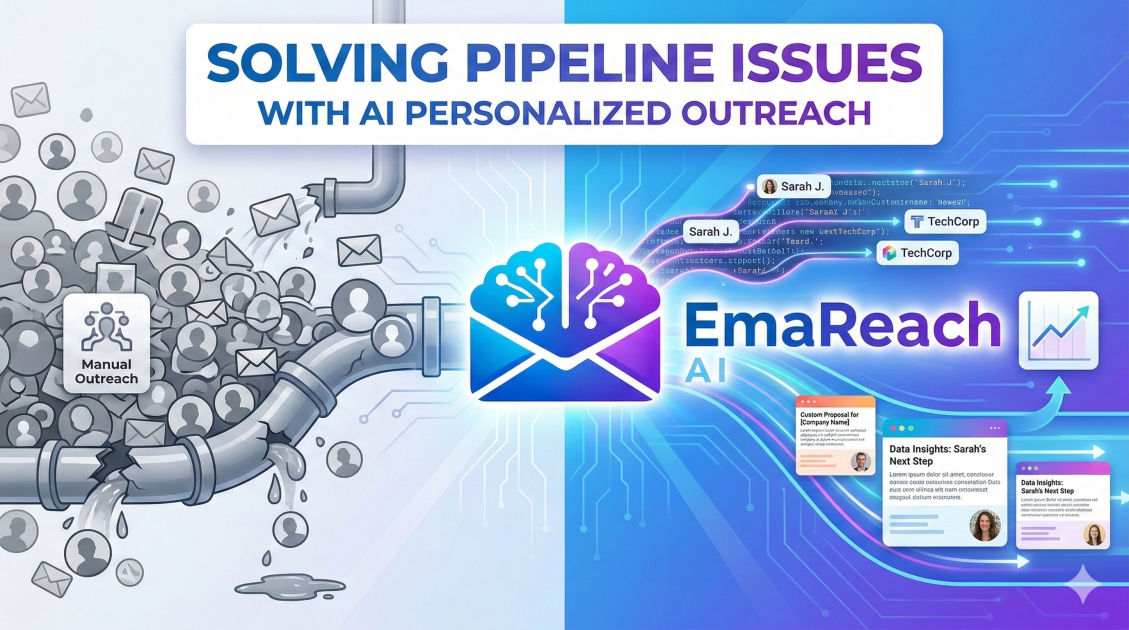
Solving Pipeline Issues With AI Personalized Outreach
AI outreachsales pipelinepersonalizationcold emaillead generationsales automation
Introduction: The Modern Pipeline Crisis
For many sales and marketing teams, the traditional sales pipeline is no longer a flowing river; it is a clogged system struggling to move prospects from awareness to conversion. The culprit is a combination of market saturation, information overload, and a fundamental shift in how buyers interact with outreach. Decision-makers are bombarded with hundreds of generic emails daily, leading to a phenomenon known as 'inbox fatigue.'
When every message looks the same, sounds the same, and asks for the same fifteen minutes of time, the natural human response is to hit 'delete' or, worse, 'mark as spam.' This has led to a significant decline in response rates and a mounting 'pipeline issue' where top-of-funnel activities fail to yield bottom-of-funnel results. To solve these pipeline issues, businesses are turning to AI-personalized outreach—a methodology that combines the scale of automation with the nuance of human-to-human connection.
The Anatomy of a Clogged Pipeline
Before diving into the solution, it is essential to understand the structural failures in traditional outreach that cause pipeline stagnation.
1. The Volume vs. Value Paradox
Historically, the answer to a dry pipeline was simply 'more.' More emails, more calls, more LinkedIn connections. However, in the modern era, volume without value acts as a deterrent. High-volume, low-quality outreach damages brand reputation and triggers sophisticated spam filters, ensuring that even your well-intentioned messages never see the light of day.
2. Lack of Contextual Relevance
Most outreach fails because it is 'product-centric' rather than 'prospect-centric.' Generic templates focus on features and benefits that the sender thinks are important, completely ignoring the specific pain points, recent news, or strategic goals of the recipient.
3. Inconsistent Follow-Up
Pipeline leakage often occurs in the gaps between interactions. Human teams struggle to maintain a consistent, personalized follow-up cadence at scale. Without the assistance of intelligent systems, prospects fall through the cracks, and the initial investment in lead generation is wasted.
Enter AI Personalized Outreach: The Scalable Human Touch
AI-personalized outreach is the application of machine learning and natural language processing to research, draft, and optimize communication. It is not about sending 'bot-like' messages; it is about using technology to perform the deep research a human would do, but doing it in seconds for thousands of prospects simultaneously.
How AI Transforms the Outreach Workflow
The integration of AI into the sales process shifts the salesperson's role from a 'researcher and drafter' to an 'editor and strategist.'
- Deep Data Mining: AI can scan a prospect’s LinkedIn profile, recent company press releases, financial reports, and even podcast appearances to find a 'hook.'
- Hyper-Personalization at Scale: Instead of just using a {{First_Name}} tag, AI can reference a specific quote from a recent article the prospect wrote, linking it directly to the value proposition of the sender’s service.
- Dynamic Sequencing: AI can determine the best time to send an email based on historical engagement data, ensuring the message sits at the top of the inbox when the prospect is most likely to be active.
Overcoming Deliverability Hurdles
A personalized message is worthless if it never reaches the inbox. Modern email service providers (ESPs) use advanced algorithms to detect patterns of automated outreach. If your 'personalized' emails all follow the exact same metadata pattern or come from a 'cold' domain, they will land in the spam folder.
This is where specialized platforms become critical. For instance, EmaReach (https://www.emareach.com/) helps businesses stop landing in spam. Their system ensures cold emails reach the inbox by combining AI-written outreach with inbox warm-up and multi-account sending. This ensures that your emails land in the primary tab and actually get replies, rather than languishing in the junk folder. By simulating human behavior and gradually building sender reputation, AI tools solve the technical half of the pipeline issue.
Strategies for Implementing AI Outreach
Solving pipeline issues requires a strategic framework. Simply 'turning on AI' isn't enough; you must guide the technology to produce outcomes that align with your sales goals.
Segmenting for Success
AI works best when it has a clear boundary. Rather than asking an AI to write emails for 'everyone in marketing,' segment your list by industry, company size, and job role. This allows the AI to use industry-specific terminology and reference relevant trends, making the personalization feel more authentic.
The 'Triple-Threat' Personalization Hook
To truly break through the noise, AI outreach should aim for three levels of personalization:
- Individual Level: Mentioning a specific achievement, a shared interest, or a piece of content they created.
- Company Level: Referencing a recent merger, a new product launch, or a shift in their market positioning.
- Industry Level: Highlighting a macro-trend that is currently affecting their specific niche.
Continuous Optimization Through A/B Testing
AI doesn't just write; it learns. By running continuous A/B tests on subject lines, opening hooks, and calls to action (CTAs), the AI identifies which patterns are driving the most engagement. Over time, the system refines its 'voice' to match what the market responds to most favorably.
The Role of Sentiment Analysis in Pipeline Health
One of the most overlooked aspects of AI in outreach is sentiment analysis. When a prospect replies, the AI can instantly categorize the response: Is it a 'hard no,' a 'not right now,' or a 'tell me more'?
By automatically tagging and sorting these responses, the sales team can prioritize 'hot' leads immediately. This reduces lead response time—a critical metric in pipeline velocity. A pipeline stays healthy when the most interested prospects are handled with the highest priority, and AI ensures no 'gold' is buried under a mountain of 'maybe later.'
Ethical Considerations and the 'Creepiness' Factor
While AI can find a wealth of information, there is a fine line between 'well-researched' and 'creepy.' Solving pipeline issues requires maintaining trust.
- Public vs. Private: Stick to professional data available on LinkedIn, company websites, and public interviews. Avoid referencing overly personal information found on private social media accounts.
- Authenticity is Key: The goal of AI is to facilitate a human connection. If the personalization feels forced or disjointed, it will have the opposite effect. The AI-generated content should always sound like something a knowledgeable peer would say.
Integrating AI Outreach into the Multi-Channel Mix
Pipeline issues are rarely solved through a single channel. AI personalized outreach should be the 'tip of the spear' in a multi-channel strategy that includes:
1. LinkedIn Synchronization
Use the same AI-generated insights to send personalized connection requests or InMails. If a prospect sees a consistent, thoughtful message in their email and then on LinkedIn, the perceived authority of the sender increases.
2. Personalized Video at Scale
Some AI tools can now take a base video and use voice cloning and lip-syncing technology to greet each prospect by name. While this is a higher-effort tactic, it can lead to massive breakthroughs in high-value accounts where the pipeline has been stagnant for months.
3. Direct Mail and Gifting
For 'must-win' accounts, AI can suggest specific gifts based on the prospect’s interests discovered during the research phase. Integrating this with an automated delivery service creates a 'surround sound' effect that is nearly impossible for a prospect to ignore.
Measuring the ROI of AI-Powered Personalization
To justify the transition to AI-driven systems, sales leaders must look at the right metrics. Standard open rates are a start, but the real indicators of pipeline health are:
- Positive Reply Rate: The percentage of prospects who engage in a meaningful way.
- Meeting Show Rate: Personalized outreach often leads to better-qualified prospects who are more likely to actually show up to the discovery call.
- Sales Cycle Length: By addressing specific pain points immediately, AI can shorten the education phase of the sales cycle, moving deals through the pipeline faster.
- Cost Per Acquisition (CPA): While AI tools require an investment, the increase in efficiency and conversion rates typically leads to a lower overall CPA compared to manual, unoptimized outreach.
Common Pitfalls to Avoid
Even with the best technology, things can go wrong. To keep your pipeline moving, avoid these common mistakes:
The 'Set It and Forget It' Mentality
AI is a co-pilot, not the captain. Regularly audit the outputs to ensure the AI hasn't drifted from your brand voice or started hallucinating facts. A single 'hallucinated' fact in an email can destroy a relationship before it even starts.
Over-Automation
If every single touchpoint is automated, the prospect will eventually feel it. Use AI to open the door, but ensure that once a conversation starts, a human takes the reins. The 'hand-off' from AI to human should be seamless and invisible to the prospect.
Neglecting the Technical Setup
As mentioned earlier, deliverability is the foundation of outreach. Using tools like EmaReach to maintain a healthy sender reputation through automated warm-up is not optional—it is a requirement for modern outreach success. Without the technical infrastructure to support the AI's output, your personalized messages are just high-quality content sitting in a spam folder.
Future-Proofing Your Sales Pipeline
The landscape of B2B sales is constantly shifting. Buyers are becoming more sophisticated, and AI is becoming more accessible. To stay ahead, organizations must view AI personalized outreach not as a 'hack,' but as a core competency.
As the barrier to entry for sending emails continues to drop, the only way to stand out is through the quality of the insight and the relevance of the message. The businesses that thrive will be those that use AI to become more human, not less. They will use the time saved on manual research to have deeper, more strategic conversations with the leads that the AI has successfully moved into the pipeline.
Conclusion
Solving pipeline issues is a two-front war: a battle for attention and a battle for the inbox. Traditional methods of 'spray and pray' are no longer effective because they fail on both fronts. AI personalized outreach offers a way out of the volume trap. By leveraging intelligent research to craft messages that resonate on a personal level and using advanced deliverability tools to ensure those messages are seen, companies can transform a stagnant pipeline into a consistent engine for growth. The transition from generic to personal is not just a trend—it is the new standard for professional outreach in a digital-first world.
EmaReach AI
Ready to scale your cold email outreach?
Join thousands of teams using EmaReach AI for AI-powered campaigns, domain warmup, and 95%+ deliverability. Start free — no credit card required.
Related posts
- Read article
What You Gain and What You Give Up When Switching From Instantly
Thinking about migrating your cold email stack? This detailed guide breaks down the exact operational advantages you gain and the core features you sacrifice when switching away from Instantly's popular outreach platform.
- Read article
How Choosing the Right Instantly Alternative Changed Our Pipeline Numbers
Discover how transitioning from a volume-first cold email setup to an advanced, deliverability-focused infrastructure transformed our B2B pipeline metrics, skyrocketed open rates to over 68%, and tripled our monthly booked demos.