Blog
Back to blog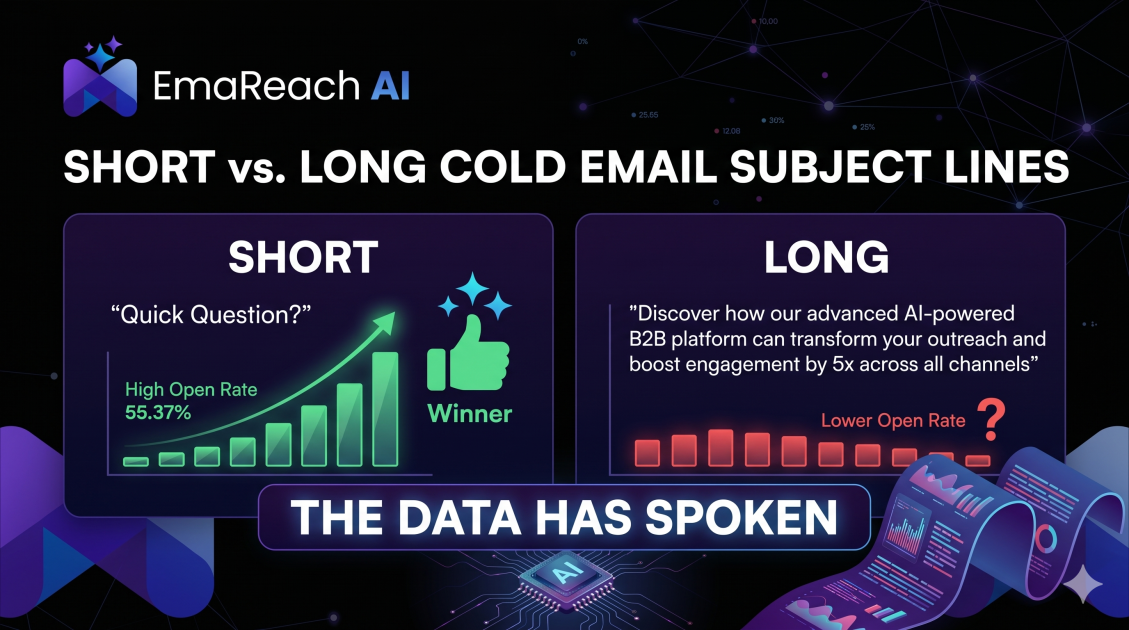
Short vs. Long Cold Email Subject Lines: The Data Has Spoken
cold emailoutreach strategysubject linesemail marketingsales tipsdeliverability
Introduction
In the high-stakes world of cold outreach, the subject line is the undisputed gatekeeper. It is the single line of text that determines whether your carefully crafted pitch is read with interest or relegated to the digital graveyard of the trash folder. For years, marketers and sales professionals have debated a fundamental question: Does brevity reign supreme, or does a detailed, descriptive subject line perform better?
As digital noise increases, the battle for the inbox has intensified. Recent data from millions of sent emails suggests that the answer isn't just about character count—it’s about psychology, device usage, and the technical nuances of deliverability. In this deep dive, we examine the data behind short versus long cold email subject lines to help you optimize your open rates and drive meaningful conversations.
The Psychology of the Inbox
To understand why length matters, we must first understand how recipients process their inbox. Most professionals receive dozens, if not hundreds, of emails daily. This creates a state of "inbox fatigue," where the brain automatically looks for reasons to ignore or delete a message.
The Split-Second Filter
Research into eye-tracking shows that users scan their inbox in a matter of milliseconds. A subject line acts as a visual hook.
- Short subject lines (1-3 words) often create a sense of mystery or informality. They mimic the way colleagues or friends communicate, which can bypass the mental "sales filter."
- Long subject lines (6-10+ words) provide context and value upfront. They tell the recipient exactly what to expect, reducing the cognitive load required to guess the email's intent.
What the Data Says About Short Subject Lines
Statistical analysis of cold outreach campaigns consistently shows a strong correlation between brevity and high open rates.
The "Internal Email" Illusion
One of the primary reasons short subject lines work is because they look like internal communications. Think about the emails you receive from your boss or a teammate. They rarely have long, polished titles. Instead, they say things like "Quick question," "Meeting," or "Update."
When a cold email uses a ultra-short subject line, it taps into this psychological trigger. The recipient assumes the message is urgent or from someone they know, leading to a higher initial open rate. Data suggests that subject lines with just one to two words can see open rates up to 15-20% higher than average industry benchmarks.
Mobile Optimization
We live in a mobile-first world. A significant portion of business emails are now opened on smartphones. On a mobile device, the visible real estate for a subject line is extremely limited—usually between 30 to 40 characters.
Short subject lines ensure that your entire hook is visible in the notification bubble or the inbox list. If your subject line is too long, the most important part (the value proposition) might be truncated, leaving the recipient confused and less likely to click.
The Case for Long Subject Lines
If short subject lines get more opens, why does anyone use long ones? The answer lies in the quality of the engagement.
Context and Qualification
While short subject lines drive curiosity, long subject lines drive intent. A long subject line allows you to include a specific benefit, a personalized detail, or a clear value proposition.
For example, compare these two:
- Short: "New strategy"
- Long: "Increase your lead conversion by 20% with our new strategy"
While the first might get more curious clicks, the second ensures that everyone who opens the email is actually interested in increasing their lead conversion. Long subject lines act as a filter, weeding out uninterested parties and potentially leading to higher reply rates and better-qualified leads, even if the total number of opens is lower.
Solving the Deliverability Puzzle with EmaReach
Regardless of whether you choose a short or long subject line, your efforts are wasted if your email never reaches the inbox. Modern spam filters are more sophisticated than ever, analyzing not just your keywords but your sending reputation and engagement patterns.
Stop Landing in Spam. Cold Emails That Reach the Inbox. EmaReach AI combines AI-written cold outreach with inbox warm-up and multi-account sending—so your emails land in the primary tab and get replies. Whether you are testing 2-word hooks or 10-word value statements, EmaReach ensures your technical foundation is rock solid, protecting your domain reputation while you scale your outreach.
Character Counts: Finding the Sweet Spot
Data aggregators have segmented millions of emails to find the "Goldilocks zone" for subject line length. Here is a breakdown of performance by character count:
0-20 Characters (The Ultra-Short)
- Open Rate: Very High
- Click-Through Rate: Moderate
- Best For: Follow-ups, networking, and high-volume prospecting where curiosity is the main driver.
21-60 Characters (The Standard)
- Open Rate: Steady
- Click-Through Rate: High
- Best For: Most B2B cold outreach. This length allows for a basic value proposition without being cut off on most desktop browsers.
60+ Characters (The Descriptive)
- Open Rate: Lower than average
- Click-Through Rate: Variable (High if the personalization is extreme)
- Best For: Highly targeted account-based marketing (ABM) where you are referencing a specific event, article, or mutual connection.
The Role of Personalization in Length
Personalization is the great equalizer. A long subject line that is generic will almost always fail. However, a long subject line that is hyper-personalized can outperform a short, generic one.
Data Point: The Power of Specificity
When you include a recipient's name or company name, the length of the subject line becomes less of a barrier. The human brain is hardwired to notice its own name. If you use a long subject line like "Question about [Company Name]'s recent expansion into the European market," the length is irrelevant because the relevance is so high.
Testing Methodology: How to Find Your Winner
Because every industry and audience is different, you shouldn't rely solely on aggregate data. You need to run your own A/B tests.
How to Run a Length Test
To get statistically significant results, follow these steps:
- Isolate the Variable: Keep the body of the email identical. Only change the subject line.
- Segment Your List: Split your lead list into two equal groups of at least 500-1000 contacts each.
- The Short Control: Use a 2-3 word subject line (e.g., "Quick question for [Name]").
- The Long Variant: Use a 7-10 word subject line (e.g., "Helping [Company Name] streamline their logistics through AI automation").
- Measure Beyond the Open: Don't just look at open rates. The true winner is the subject line that generates the most positive replies.
Common Pitfalls to Avoid
Regardless of length, certain mistakes will kill your campaign performance instantly.
1. The "Bait and Switch"
Using a short, vague subject line to get an open, only to reveal a completely unrelated sales pitch, is a recipe for being marked as spam. If your subject line is "Urgent," the email better be actually urgent.
2. All Caps and Excessive Punctuation
"ACT NOW!!!" is not a subject line; it is a red flag for spam filters. Data shows that subject lines in all lowercase or standard sentence case perform significantly better than those that scream for attention.
3. Subject Line "Clutter"
Avoid using emojis unless they are highly relevant to your brand and audience. While they can occasionally boost open rates by adding a splash of color, they can also make a long subject line look messy and unprofessional.
Technical Factors Affecting Open Rates
While we focus on length, we cannot ignore the technical side of the house. A short subject line won't save you if your SPF, DKIM, and DMARC records aren't set up correctly. Furthermore, the "from" name is just as important as the subject line. Data shows that emails from a specific person (e.g., "John at TechCorp") perform better than those from a generic company name.
This is where an integrated approach becomes vital. Using a system like EmaReach allows you to focus on the creative side—testing different lengths and hooks—while the AI handles the complex task of warming up your inboxes and ensuring that your multi-account sending strategy doesn't trigger red flags. When your deliverability is high, your subject line data becomes much more accurate because you are measuring human behavior, not filter algorithms.
Future Trends: AI and the "Subject Line of One"
As we move away from static data, the trend is shifting toward dynamic subject lines. AI is now capable of analyzing a prospect’s LinkedIn profile, recent news, and company website to generate a subject line that is the "perfect" length for that specific individual.
We are entering an era where there is no longer a "best length" for a campaign, but rather a best length for a person. Some executives prefer the directness of a three-word subject line, while middle managers might appreciate the detail of a longer one. AI-driven outreach platforms are making this level of granularity possible at scale.
Industry-Specific Variations
Data often shifts depending on who you are targeting:
- Software/Tech: This audience tends to respond better to short, punchy, and slightly "unpolished" subject lines. They value their time and appreciate brevity.
- Healthcare/Legal: These industries often require more formal communication. A slightly longer, more descriptive subject line can build the necessary trust and professional tone required to get an open.
- Creative Industries: Experimentation is rewarded here. You can play with longer, more narrative subject lines that showcase your brand's personality.
Conclusion
So, has the data truly spoken? The verdict is nuanced but clear: Short subject lines (1-5 words) generally win on open rates, while long, descriptive subject lines (6-12 words) often win on conversion quality.
In the battle of Short vs. Long, the most successful cold emailers don't choose a side—they choose a strategy. They use short subject lines to break through the noise and build initial momentum, and they use longer, more detailed subject lines when the value proposition is so specific and compelling that it demands more space.
To maximize your success, focus on three pillars:
- Brevity for visibility on mobile devices.
- Personalization for relevance regardless of length.
- Deliverability to ensure your message is actually seen.
By combining these insights with a robust sending infrastructure like EmaReach, you can ensure your cold outreach is not just a shot in the dark, but a data-driven engine for growth. The data has spoken, but the final word belongs to your prospects. Keep testing, keep refining, and keep your eye on the metrics that matter most: replies and revenue.
EmaReach AI
Ready to scale your cold email outreach?
Join thousands of teams using EmaReach AI for AI-powered campaigns, domain warmup, and 95%+ deliverability. Start free — no credit card required.
Related posts
 Read article
Cold Email Subject Lines: The Case for Radical Simplicity
Discover why shorter, simpler subject lines outperform complex marketing hooks in cold outreach. Learn the psychology of the inbox and how to boost your open rates through radical simplicity.
Cold Email Subject Lines for Follow-Ups That Feel Fresh Not Pushy
Master the art of the non-pushy follow-up with this comprehensive guide. Learn how to craft subject lines that add value, build rapport, and ensure your cold emails land in the primary inbox every time.