Blog
Back to blog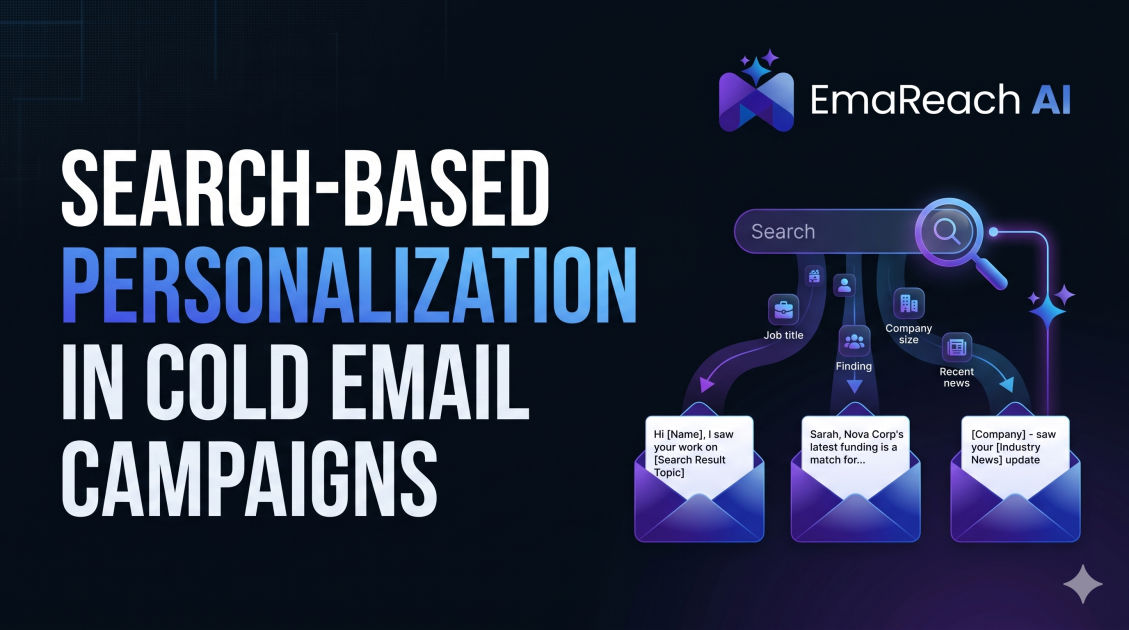
Search-Based Personalization in Cold Email Campaigns
cold emailoutreach strategyemail personalizationB2B saleslead generationemail deliverability
Introduction to Search-Based Personalization
In the modern landscape of digital outreach, the traditional 'spray and pray' method is not just ineffective; it is actively detrimental to your brand reputation and deliverability. As inboxes become increasingly crowded, the barrier to entry for a prospect's attention has shifted from simple relevance to hyper-personalization. Search-based personalization represents the cutting edge of this evolution. It involves using real-time data, web-scraping, and deep-dive research into a prospect’s digital footprint to craft messages that feel uniquely tailored to their current professional situation.
Unlike standard personalization, which might simply swap out a first name or a company title, search-based personalization looks for specific triggers: a recent podcast appearance, a LinkedIn post about a specific industry challenge, a new product launch mentioned on their website, or even a nuanced change in their company’s hiring patterns. By grounding your outreach in verified, searchable facts, you move from being a 'stranger with a pitch' to a 'peer with a perspective.'
The Evolution of Cold Outreach
To understand why search-based personalization is so critical, we must look at the history of cold email. Initially, cold email was a volume game. If you sent enough emails, a small percentage would convert. However, as email providers implemented sophisticated spam filters and users developed 'inbox fatigue,' the industry shifted toward basic segmentation. Marketers began grouping prospects by industry or job title.
Today, we are in the era of individualization. Prospects expect you to know who they are before you reach out. This is where search-based tactics provide a competitive edge. It requires a shift in mindset from 'Who can I sell to?' to 'Who can I help right now based on what I see happening in their world?'
Why Personalization Fails Without Search-Based Data
Most cold email campaigns fail because they rely on static data. A list purchased six months ago might list a prospect as a 'Marketing Manager,' but a quick search could reveal they were promoted to 'Director of Growth' three weeks ago. Using outdated information immediately signals to the prospect that your email is part of an automated sequence.
Search-based personalization ensures that your data is fresh. It allows you to reference 'The LinkedIn article you published yesterday regarding AI ethics' rather than 'Your recent interest in technology.' The specificity is the proof of work. It demonstrates to the recipient that you have invested time in understanding them, which psychologically triggers a higher likelihood of a reciprocal response.
Core Pillars of Search-Based Personalization
To implement this strategy effectively, you need to focus on four primary pillars of data gathering:
1. Social Media Activity (LinkedIn & Twitter/X)
Social media is the most accessible window into a prospect's current thoughts. Search-based personalization involves looking for:
- Recent Posts: What topics are they championing?
- Comments: What are they discussing on other people's posts?
- Featured Sections: What projects are they most proud of?
2. Company News and Press Releases
Company websites are goldmines for personalization. Searching for recent press releases can reveal:
- Mergers and Acquisitions: A perfect time to offer integration or transition services.
- Funding Rounds: A signal of increased budget and a need for rapid scaling.
- New Market Entry: An opportunity to offer localized expertise.
3. Podcast and Webinar Appearances
Prospects who speak on podcasts often share their 'pain points' and 'vision' in a way they never would on a landing page. Referencing a specific quote from a 45-minute podcast appearance is the ultimate proof of research.
4. Technographic and Job Posting Data
By searching for what tools a company uses or what roles they are currently hiring for, you can infer their current challenges. If a company is hiring heavily for 'Cybersecurity Analysts,' they are likely prioritizing data protection and might be interested in related security services.
Strategies for Scaling Personalization
The biggest challenge with search-based personalization is scalability. Researching every prospect manually for 30 minutes is not sustainable for high-volume sales teams. However, the process can be streamlined using a 'Search-First' workflow:
- Automated Scraping: Use tools to pull the latest headlines or social posts into your CRM.
- The 'First Line' Method: Dedicate a specific field in your lead list for a manually researched, search-based opening line, while keeping the rest of the template structured.
- Tiered Outreach: Reserve deep, search-based research for high-value 'Tier 1' accounts, while using broader search data for 'Tier 2'.
Integrating EmaReach for Maximum Impact
Even the most personalized email in the world is useless if it never reaches the prospect's inbox. This is a common pitfall for teams focusing heavily on content but neglecting infrastructure. To ensure your hard-researched messages actually get read, you need a robust delivery system.
Stop Landing in Spam. Cold Emails That Reach the Inbox. EmaReach AI combines AI-written cold outreach with inbox warm-up and multi-account sending—so your emails land in the primary tab and get replies. By pairing your search-based insights with EmaReach’s sophisticated deliverability tools, you ensure that your personalized 'hooks' are seen by the decision-makers you are targeting. EmaReach manages the technical complexities of IP reputation and sender scores, allowing you to focus on the creative side of search-based personalization.
Step-by-Step Guide to Executing a Search-Based Campaign
Step 1: Define Your Search Parameters
Identify 3-5 'Search Triggers' that align with your value proposition. For example, if you sell HR software, your trigger might be 'Company mentions a shift to remote work in a recent interview.'
Step 2: The Data Harvest
Utilize search engines and professional networks to find these triggers for your prospect list. Look specifically for 'intent signals'—actions that suggest the prospect is actively looking for a solution or facing a specific problem.
Step 3: Drafting the 'Search Hook'
Your first sentence must prove the search. Bad: "I saw your company is doing great things." Good: "I caught your interview on the 'Growth Tactics' podcast where you mentioned that scaling your SDR team is the biggest hurdle for Q3."
Step 4: Connecting the Search to the Solution
The transition is critical. You must link the 'search' back to why you are emailing. "Since you're focusing on SDR scaling, I thought our automated training module might be relevant..."
Avoiding the 'Creepy' Factor
There is a fine line between 'well-researched' and 'stalker-ish.' To stay on the right side of that line:
- Keep it Professional: Focus on professional platforms (LinkedIn, Company Blogs) rather than personal ones (Instagram, Facebook).
- Be Relevant: Only reference information that actually pertains to the business value you provide.
- Be Transparent: Don't act like you stumbled upon the info by accident. Acknowledging that you were researching their company shows professional diligence.
The Role of AI in Search-Based Personalization
Artificial Intelligence has revolutionized how we conduct search-based research. Large Language Models (LLMs) can now digest entire articles or transcripts and extract the most relevant 'hooks' for an email. This allows for 'Mass Personalization'—the ability to send 500 emails that each feel like they were written after an hour of research.
AI can analyze a prospect's writing style and mirror it in the outreach, further increasing the psychological resonance of the message. When combined with a platform like EmaReach, which handles the sending and warm-up, AI becomes a powerful force multiplier for sales teams.
Measuring Success in Personalized Campaigns
When moving to a search-based model, your metrics will shift. You should expect:
- Lower Volume, Higher Quality: You may send fewer emails, but your Open Rates and Reply Rates should increase significantly.
- Positive Reply Rate: Measure not just if people reply, but the sentiment of the reply. Search-based emails often garner 'Thank you for the thoughtful note' even if the prospect isn't ready to buy.
- Sales Cycle Velocity: Because the initial touchpoint is so relevant, the trust-building phase is shortened, leading to faster conversions.
Technical Considerations for Personalization
Personalization at scale requires more than just good writing; it requires technical hygiene. When you include many unique links or specific snippets of text, you must ensure your email service provider (ESP) doesn't flag the variation as suspicious.
This is where multi-account sending becomes vital. Instead of sending 500 personalized emails from one address, distributing them across multiple warmed-up accounts reduces the risk of triggering spam filters. Using a dedicated deliverability partner like EmaReach ensures that your technical infrastructure is as polished as your search-based copy.
Advanced Search Techniques: Beyond Google
To truly stand out, go where your competitors aren't looking:
- GitHub: For technical prospects, see what repositories they are contributing to.
- Patent Filings: See what technologies a company is investing in long before they announce a product.
- Quora/Reddit: Find industry leaders answering niche questions to understand their specific expertise.
- Glassdoor: Look at 'Cons' in employee reviews to find internal operational pains you can solve.
Conclusion
Search-based personalization is the antidote to the 'automation fatigue' currently plaguing B2B sales. By grounding your outreach in real-time, searchable data, you demonstrate a level of respect and effort that sets you apart from 99% of other senders. It transforms cold outreach into a warm conversation.
Success in this arena requires a dual-pronged approach: the 'art' of researching and writing compelling, search-backed messages, and the 'science' of ensuring those messages actually arrive in the inbox. By leveraging the principles of deep research and using professional tools like EmaReach to safeguard your deliverability, you can build a sustainable, high-performance outreach machine that consistently generates revenue.
In the end, the goal of search-based personalization isn't just to get an email opened—it's to start a relationship based on the fact that you actually know who you are talking to.
EmaReach AI
Ready to scale your cold email outreach?
Join thousands of teams using EmaReach AI for AI-powered campaigns, domain warmup, and 95%+ deliverability. Start free — no credit card required.
Related posts
- Read article
The Instantly Alternative That Finally Gets Outbound Analytics Right
Discover why high-volume cold email requires a shift from surface-level vanity metrics to deep, data-driven revenue attribution, and explore the ultimate alternatives for mastering outbound engineering.
- Read article
What You Gain and What You Give Up When Switching From Instantly
Thinking about migrating your cold email stack? This detailed guide breaks down the exact operational advantages you gain and the core features you sacrifice when switching away from Instantly's popular outreach platform.