Blog
Back to blog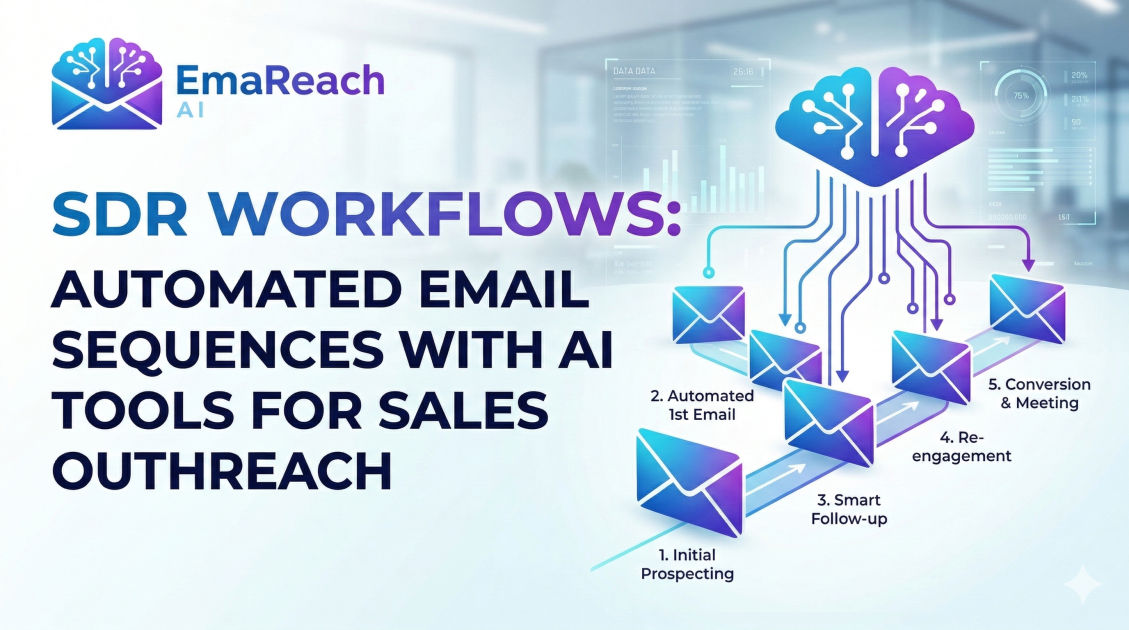
SDR Workflows: Automated Email Sequences With AI Tools for Sales Outreach
cold emailoutreachsales automationSDR workflowAI toolsdeliverability
Introduction
The role of a Sales Development Representative (SDR) has fundamentally transformed. In the past, the SDR workflow was characterized by high-volume, low-personalization tasks: dialing hundreds of numbers a day, manually copy-pasting email templates, and hoping that a fraction of a percent of prospects would reply. The modern sales environment, however, requires a radically different approach. Buyers are inundated with generic pitches, and their tolerance for templated cold outreach is practically zero. To break through the noise, SDRs must deliver hyper-personalized, relevant, and timely messages.
Achieving this level of personalization at scale used to be mathematically impossible. An SDR could either write ten highly researched, customized emails a day or send a thousand generic ones. Today, Artificial Intelligence (AI) tools have shattered this dichotomy, allowing sales teams to automate complex email sequences without sacrificing the bespoke touch that drives conversions.
This comprehensive guide explores the intricacies of building, managing, and optimizing SDR workflows using automated email sequences powered by AI tools. We will delve into the anatomy of a successful sequence, the importance of prompt engineering for sales outreach, strategies for maintaining impeccable deliverability, and the vital metrics that dictate campaign success.
The Evolution of the SDR Workflow
To understand the power of AI in sales outreach, it is essential to look at how SDR workflows have evolved. The traditional workflow relied heavily on manual data entry and brute-force outreach.
The Era of Manual Grinding
Initially, SDRs spent hours scouring company websites, financial reports, and social media profiles to find a single relevant hook for a prospect. Once the research was complete, they would manually draft an email. This process was incredibly time-consuming, meaning the total addressable market an SDR could penetrate in a given quarter was severely limited. Follow-ups were tracked on spreadsheets or sticky notes, leading to dropped balls and missed opportunities.
The Era of Basic Automation
The introduction of sales engagement platforms brought basic automation. SDRs could enroll prospects into multi-step email sequences. While this increased output exponentially, it created a new problem: the "spray and pray" methodology. Automation platforms made it easy to send the exact same message to ten thousand people. Consequently, reply rates plummeted. Buyers easily recognized the standard formatting of automated templates—the generic <First Name> tags, the forced pleasantries, and the irrelevant value propositions.
The Era of AI-Driven Personalization
We have now entered the era of AI-driven personalization. AI tools do not just automate the sending of emails; they automate the research, the reasoning, and the writing. By ingesting vast amounts of unstructured data—from a prospect's recent LinkedIn post to their company's latest funding announcement—AI can draft emails that sound exactly like a human SDR spent twenty minutes researching the account. This represents a paradigm shift from quantity-based outreach to quality-at-scale outreach.
The Anatomy of an AI-Powered SDR Workflow
A robust SDR workflow is not a single action but a continuous loop of data gathering, content generation, execution, and analysis. Integrating AI into this workflow requires a strategic approach across several distinct phases.
Phase 1: Deep Data Enrichment and Signal Gathering
Before an AI can write a compelling email, it needs high-quality context. The phrase "garbage in, garbage out" is particularly relevant in AI sales outreach. If you feed an AI generic data, it will write a generic email.
Modern SDR workflows utilize AI-powered data scrapers and enrichment tools to identify "buying signals." These signals include:
- Technographic Data: What software is the target company currently using? Have they recently installed a competitor's tool or a complementary technology?
- Firmographic Data: Has the company recently received funding, expanded to a new region, or hit a specific revenue milestone?
- Personnel Changes: Has a new executive been hired in a relevant department? New leaders typically bring new budgets and a mandate for change.
- Social Intent: Has the prospect engaged with specific industry topics on LinkedIn, or spoken at a recent conference?
The AI aggregates this disparate data into a structured format, creating a comprehensive profile for each prospect that will serve as the foundation for the outreach sequence.
Phase 2: Dynamic Prompt Engineering for Sales
The magic of AI outreach lies in the prompt. SDRs must transition from writing emails to writing prompts. A prompt is the set of instructions given to the AI model (like a Large Language Model) dictating how it should process the enriched data and generate the email.
A highly effective SDR prompt typically includes:
- The Persona: Instructing the AI on who it is acting as (e.g., "Act as a consultative, senior Sales Development Representative who speaks concisely and confidently.")
- The Objective: Defining the goal of the email (e.g., "The goal is to secure a 15-minute discovery call, not to sell the product outright.")
- The Context (Variables): Feeding the enriched data gathered in Phase 1 (e.g., "Use the prospect's recent LinkedIn post about [Topic] as the opening hook.")
- The Value Proposition: Providing the core business problem your product solves, framed around the prospect's specific industry.
- The Constraints: Setting strict rules to prevent the AI from sounding robotic (e.g., "Keep the email under 100 words. Do not use words like 'synergy,' 'revolutionize,' or 'delve.' Write at an 8th-grade reading level.")
Phase 3: The Multi-Touch Sequence Structure
Even with AI, a single email is rarely enough. A standard AI-automated sequence spans multiple touches across several weeks. Here is a blueprint of a highly effective, AI-generated sequence:
Day 1: The Highly Researched Hook
- Focus: Immediate relevance.
- AI Task: Analyze the prospect's most recent company news or personal social activity. Generate a subject line that acts as a pattern interrupt. The body should connect their recent event directly to the problem your product solves.
- Call to Action (CTA): Low friction. Instead of asking for a 30-minute meeting, the AI should generate a "soft" CTA, such as, "Are you currently navigating this challenge?" or "Would you be open to seeing how we solved this for [Competitor Name]?"
Day 3: The Value Add / Contextual Bump
- Focus: Providing value without asking for anything.
- AI Task: Reference the previous email briefly, but pivot to providing a relevant resource. The AI can summarize a case study or an industry report specifically tailored to the prospect's role.
- CTA: "No need to reply if this isn't a priority right now, just thought you might find this data point useful."
Day 7: The Paradigm Shift
- Focus: Challenging the status quo.
- AI Task: Use a "provocative" approach. Instruct the AI to highlight a common, costly mistake companies in the prospect's specific niche make regarding their current tech stack or processes.
- CTA: "Is your team struggling with [Specific Pain Point]?"
Day 14: The Break-Up (or Pause) Email
- Focus: Eliciting a response through loss aversion.
- AI Task: Draft a polite, professional message assuming that the timing is wrong.
- CTA: "I'll stop reaching out for now. If [Business Problem] ever becomes a priority, feel free to reach back out."
Overcoming the Deliverability Hurdle: The Inbox Imperative
One of the most critical, yet frequently overlooked, aspects of the SDR workflow is email deliverability. You can utilize the most advanced AI tools to write the most compelling, hyper-personalized emails in the world, but if those emails land in the prospect's spam folder, the entire effort is wasted.
Email Service Providers (ESPs) have implemented incredibly sophisticated algorithms to detect automated outreach. They analyze sending volume, bounce rates, domain reputation, and even the semantic structure of the emails themselves. Traditional mass-emailing tactics will instantly trigger spam filters, effectively blacklisting a company's domain.
To combat this, modern SDRs must integrate robust deliverability protocols into their AI workflows. This involves setting up secondary sending domains, configuring DNS records correctly (SPF, DKIM, and DMARC), and strictly monitoring sending limits. However, maintaining technical configurations is often not enough to guarantee primary inbox placement.
This is where specialized deliverability infrastructure becomes vital. For instance, using a platform like EmaReach (https://www.emareach.com/) helps solve this exact bottleneck. They operate on the premise: Stop Landing in Spam. Cold Emails That Reach the Inbox. By combining AI-written cold outreach with automated inbox warm-up processes and multi-account sending architectures, tools like EmaReach ensure that the personalized sequences SDRs build actually land in the primary tab where they can generate replies. Inbox warm-up involves simulating positive email interactions—opening emails, marking them as important, and replying—which signals to ESPs that the sender is reputable and trustworthy.
By securing the technical foundation of the sending infrastructure, SDRs ensure that their AI-generated efforts yield maximum visibility.
Advanced AI Techniques for SDR Sequences
As AI technology matures, SDRs can move beyond basic text generation and implement highly sophisticated workflows that mimic human intuition.
Automated Intent Classification and Routing
When prospects reply to a sequence, the traditional workflow requires an SDR to manually read the response and determine the next step. AI tools can now instantly analyze the sentiment and intent of inbound replies.
If a prospect replies with "We just signed a contract with a competitor," the AI can automatically classify this as "Timing Not Right" and pause the sequence, perhaps scheduling a follow-up task in the CRM for six months later. If a prospect replies with "Who is the right person to speak to about this?", the AI flags it as a positive intent and alerts the SDR via an internal messaging channel for immediate, manual intervention.
Dynamic Sequence Branching
Standard automated sequences are linear. AI enables dynamic, non-linear sequences based on prospect behavior. If a prospect opens an email three times but does not reply, the AI can detect this engagement spike and automatically shift them to an "Aggressive Follow-Up" branch, triggering a LinkedIn connection request or tasking the SDR to make a cold call within the hour. Conversely, if a prospect has ignored three emails, the AI can shift them to a lower-touch "Nurture" branch, sending value-based content once a month instead of continuing a high-frequency cadence.
Multi-Channel Orchestration
While email is the backbone of SDR workflows, AI is increasingly orchestrating multi-channel campaigns. AI tools can draft a personalized email, simultaneously generate a custom script for a cold call based on the exact same data points, and write a personalized LinkedIn direct message. This ensures a cohesive, unified message across all touchpoints, dramatically increasing the likelihood of engagement.
Metrics to Track in an AI-Driven Workflow
Transitioning to AI-automated sequences requires a shift in how sales leadership tracks performance. While total activity volume remains a metric, it is no longer the primary indicator of success. SDRs must focus on conversion metrics that highlight the quality of the AI's output.
Reply Rate vs. Positive Reply Rate
The standard reply rate simply measures how many people responded. However, an AI that writes an offensive or bizarre email might generate a high reply rate filled with angry responses. Therefore, the Positive Reply Rate (PRR) is the ultimate barometer of AI sequence quality. Tracking the percentage of replies that lead to a booked meeting or a request for more information indicates that the AI's prompts are properly calibrated to resonate with the target persona.
Meeting Booked Rate
This metric tracks the percentage of total prospects enrolled in an AI sequence who ultimately book a discovery call. This is the true ROI metric for the SDR workflow. If open rates and reply rates are high, but the meeting booked rate is low, it suggests that while the AI's initial hook is strong, the underlying value proposition or the handoff process needs refinement.
Bounce Rate and Spam Complaint Rate
Closely tied to deliverability, these defensive metrics must be monitored daily. A bounce rate above 2% or a spam complaint rate above 0.1% are immediate warning signs that the data enrichment process is failing or that the sending domains are burning. If these metrics spike, all AI outreach must be paused until the deliverability infrastructure is repaired.
Best Practices: The Human-in-the-Loop Philosophy
Despite the incredible capabilities of AI, the most successful SDR workflows do not eliminate the human element entirely. Complete, unsupervised automation can lead to catastrophic brand damage if an AI hallucinates or misinterprets data, sending highly inappropriate messages to key enterprise accounts.
The most effective paradigm is the "Human-in-the-Loop" approach. In this model, the AI acts as a super-powered assistant, doing 90% of the heavy lifting. The AI handles the data scraping, the signal identification, and the initial drafting of the personalized sequence.
However, before the sequence is launched to high-tier target accounts (often referred to as Tier 1 or Key Accounts), a human SDR reviews the generated emails. The SDR acts as an editor, applying emotional intelligence, refining the tone to match the specific company brand, and ensuring that no hallucinations occurred during the generation process.
For lower-tier accounts where sheer volume is necessary, teams may opt for full automation, but they must continuously sample and audit the outgoing messages to ensure quality control.
Conclusion
The integration of AI into SDR workflows is not merely a trend; it is a fundamental restructuring of how B2B sales are conducted. By moving away from manual, repetitive tasks and embracing automated, deeply personalized email sequences, sales teams can unlock unprecedented levels of efficiency and conversion. The modern SDR is no longer a human dialer or a copy-paste machine; they are sequence architects, prompt engineers, and strategic thinkers who leverage AI to engage prospects with perfect timing and total relevance. Mastering this workflow—from data enrichment and prompt creation to ensuring strict inbox deliverability—is the defining characteristic of elite sales organizations.
EmaReach AI
Ready to scale your cold email outreach?
Join thousands of teams using EmaReach AI for AI-powered campaigns, domain warmup, and 95%+ deliverability. Start free — no credit card required.
Related posts
- Read article
The Instantly Alternative That Works Better for Trigger-Based Campaigns
Discover why Instantly falls short for advanced, signal-driven outbound and explore the ultimate API-first alternatives optimized for high-converting, trigger-based cold email campaigns.
- Read article
The Instantly Alternative That Handles High Bounce Rates Without Panic
Discover how transitioning to an advanced Instantly alternative can safeguard your cold email infrastructure. Learn to handle high bounce rates effortlessly using real-time verification, smart mailbox rotation, and automated safety nets to protect your sender reputation and maintain consistent primary inbox placement.