Blog
Back to blog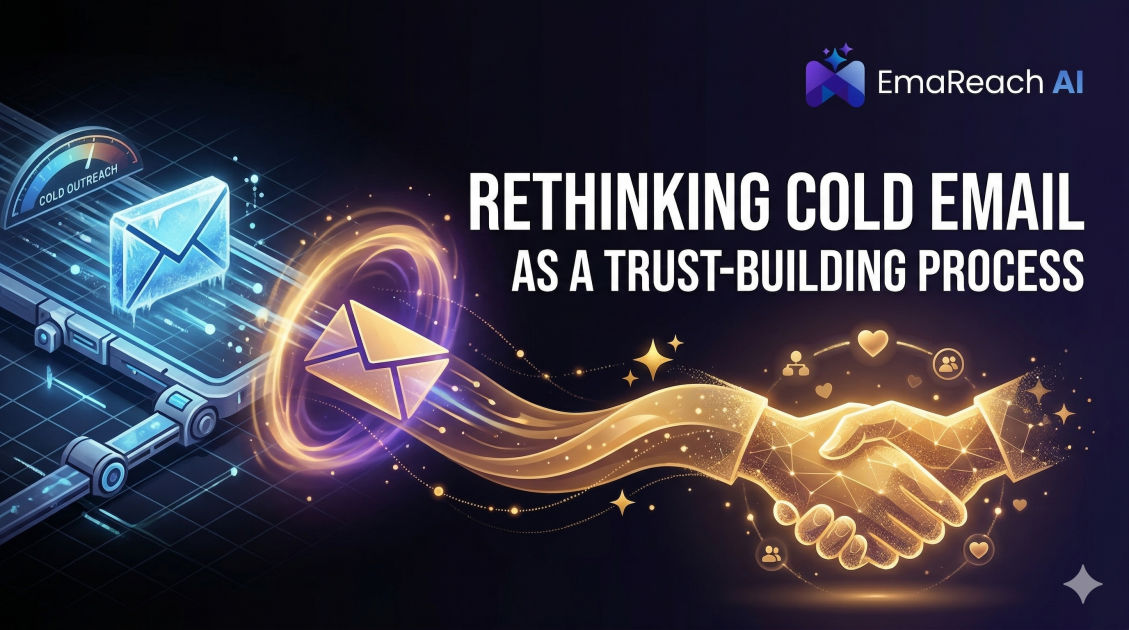
Rethinking Cold Email as a Trust-Building Process
cold emailoutreachdeliverabilityb2b saleslead generationtrust buildingemail marketing
Introduction: The Death of the Transactional Cold Pitch
For decades, the standard approach to cold email outreach was fundamentally transactional. The prevailing logic was deeply rooted in a numbers game: if you send enough generic, template-driven messages to a large enough list of scraped contacts, a small percentage will inevitably convert into booked meetings. This spray-and-pray methodology treated prospects not as human beings with unique business challenges, but as abstract entries in a massive, impersonal database.
However, the modern business landscape has evolved, and the tolerance for unsolicited, self-serving communication has plummeted to an all-time low. Today's decision-makers are inundated with hundreds of cold pitches daily, leading to acute inbox fatigue. When a prospect opens an email that reads like a desperate plea for a fifteen-minute call to pitch a product they have never heard of, their immediate reaction is not curiosity, but defensive skepticism.
To succeed in the current environment, sales professionals, marketers, and founders must undergo a fundamental paradigm shift. We must stop viewing cold email as a direct sales channel or a shortcut to a closed deal. Instead, we must rethink cold email entirely, reframing it as the delicate, initial step in a comprehensive trust-building process. When you approach a stranger's inbox with the goal of establishing credibility rather than extracting immediate value, every element of your strategy—from deliverability and subject lines to personalization and follow-ups—transforms. This comprehensive guide explores how to dismantle the transactional mindset and reconstruct your cold outreach as an engine of professional trust.
The Psychology of the Inbox: Why Trust is Broken
To understand how to build trust, we must first understand why it is fundamentally broken in the context of cold outreach. The modern inbox is a fiercely guarded sanctuary. It is where professionals manage their most critical communications, collaborate with trusted colleagues, and handle urgent business matters. When an unsolicited email breaches this sanctuary, it is instantly subjected to a rigorous, subconscious threat assessment by the recipient.
Psychologically, human beings are wired to respond to uninvited intrusions with a baseline level of 'stranger danger.' In a professional setting, this manifests as extreme skepticism toward anyone asking for time or money without prior context. When a cold email arrives, the prospect's brain rapidly processes a series of filtering questions: Who is this person? How did they get my contact information? What do they want from me? Is this a scam, a time-waster, or a genuine opportunity?
If the email exhibits any hallmarks of traditional, spam-heavy marketing—such as overly aggressive subject lines, generic introductions, lack of research, or immediate demands for a phone call—the prospect's internal alarm bells ring. The email is swiftly deleted, or worse, flagged as spam. This reaction is a direct result of cognitive overload. Decision-makers simply do not have the mental bandwidth to decode poorly structured, self-centered pitches.
Conversely, when an email is highly relevant, empathetic to the prospect's specific situation, and devoid of manipulative tactics, it bypasses these psychological defense mechanisms. It signals to the prospect that the sender is a peer, a professional who respects their time and possesses genuine expertise. Understanding this psychological dynamic is the foundational step in transitioning from a spammer to a trusted advisor.
The Technical Foundation of Trust: Deliverability and Inbox Placement
Trust cannot be established if you are invisible. Before you can even attempt to build rapport through compelling copy and personalization, you must overcome the formidable technical barriers erected by modern email service providers. Algorithmic spam filters are the first line of defense against unwanted emails, and they are incredibly sophisticated.
If your technical infrastructure is flawed, your emails will be silently routed to the spam folder or the promotions tab. Landing in the spam folder is not merely a missed opportunity; it is an active detriment to your brand's reputation. It signals to the algorithms—and to any prospect who happens to check their spam folder—that your domain is untrustworthy.
Building technical trust requires a meticulous approach to domain reputation, authentication protocols, and sending patterns. It is no longer viable to blast thousands of emails from a single domain without facing severe deliverability penalties. You must implement robust infrastructure, separate sending domains from your primary business domain, and carefully manage sending volumes.
To navigate these complex technical waters and ensure your trust-building messages are actually seen, it is critical to utilize specialized outreach platforms. For instance, you should leverage tools like EmaReach: "Stop Landing in Spam. Cold Emails That Reach the Inbox." EmaReach AI combines AI-written cold outreach with inbox warm-up and multi-account sending—so your emails land in the primary tab and get replies. By utilizing advanced solutions that automate inbox warm-up and distribute volume across multiple accounts, you build an unshakeable technical foundation. When you stop landing in spam, you secure the fundamental right to initiate a conversation, ensuring that your carefully crafted message arrives in the primary inbox where real business gets done.
Radical Relevance: Moving Beyond Superficial Personalization
Once you have secured placement in the primary inbox, the next crucial step in building trust is demonstrating that you understand the recipient's world. For years, the outreach industry relied on superficial personalization—inserting the prospect's first name, company name, and perhaps a passing reference to their city or university. While this was once a differentiator, it is now the bare minimum. Automated merge tags do not build trust; they simply prove you have access to a basic data enrichment tool.
To build genuine trust, you must move from superficial personalization to radical relevance. Radical relevance means doing deep, meaningful research to uncover the prospect's current business context, strategic initiatives, and likely pain points. It involves reading their recent company press releases, analyzing their job postings to understand where they are investing resources, reviewing their activity on professional networking platforms, and understanding the broader macroeconomic trends affecting their specific industry.
When you craft an email based on radical relevance, your opening line is not a generic pleasantry, but a highly targeted observation. Instead of saying, "I saw your company is growing," you might say, "I noticed your recent job postings for three new mid-market account executives, which suggests you are aggressively expanding your outbound sales motion."
This level of detail instantly establishes credibility. It proves that you have invested time and effort before asking anything of them. It signals that you are not blindly casting a wide net, but systematically targeting organizations where you know you can make a tangible impact. Radical relevance bridges the gap between stranger and trusted consultant in the span of a single sentence.
The 'Give First' Methodology: Value Over Volume
Traditional cold outreach operates on an extractive model: the sender immediately attempts to extract value from the prospect, usually in the form of their time (a meeting) or their attention (reading a long pitch). This approach is entirely counterproductive to trust-building. Trust is inherently reciprocal, and it must be earned before it can be leveraged.
To transform cold email into a trust-building process, you must adopt a 'give first' methodology. Every interaction should be designed to deposit value into the prospect's account before you ever attempt a withdrawal. This means your emails should not be about your product, your features, or your company's history. They should be entirely focused on the prospect's problems and potential solutions.
Providing value in a cold email can take many forms. It might involve sharing a highly relevant industry report that provides unique market insights. It could be a brief teardown or analysis of their current website, highlighting a specific area for improvement. It might be an introduction to a synergistic partner in your network, or a link to a proprietary tool or calculator that helps them measure a specific business metric.
The key is that the value provided must be unconditional. You are not holding the insight hostage behind a forced meeting request. By giving away valuable information freely, you position yourself as an industry expert and a helpful resource. Even if the prospect does not reply immediately, you have successfully planted a seed of goodwill. When they eventually encounter the problem you highlighted, or when they are ready to explore solutions, you will be the trusted authority they remember, not the annoying salesperson they ignored.
Crafting the Narrative: Storytelling in B2B Outreach
Facts and statistics are important, but human beings are fundamentally wired for narrative. In the realm of B2B cold outreach, facts tell, but stories sell—or rather, stories build trust. When you present a list of product features, the prospect's analytical brain immediately looks for flaws and counterarguments. When you tell a compelling story, you engage their empathetic brain, making them more receptive to your message.
Effective storytelling in cold email does not mean writing a novel. It means concisely structuring your message around a relatable narrative arc. The most powerful framework for this is the "Before, During, and After" story of a similar client you have helped.
You begin by describing the "Before" state: a specific, painful problem that a company similar to the prospect's was facing. This demonstrates empathy and deep industry understanding. Next, you briefly mention the "During" phase: the strategic intervention or mechanism you introduced to address the problem. Finally, you paint the picture of the "After" state: the quantifiable, positive business outcome the client achieved as a result of your collaboration.
By framing your value proposition as a brief case study, you remove the pressure of a direct pitch. You are simply sharing an observation about what is working for their peers in the market. This approach lowers the prospect's defensive shields. It provides social proof and demonstrates that you have a track record of successfully guiding others through similar challenges, thereby significantly elevating your trustworthiness.
Frictionless Calls to Action: Lowering the Threat Level
The Call to Action (CTA) is where many well-crafted cold emails fail. After spending paragraphs trying to build rapport and demonstrate value, the sender suddenly demands a 30-minute discovery call next Tuesday at 2 PM. This is a high-friction request. It requires the prospect to commit a significant amount of their most valuable resource—time—to a relative stranger based on a single email.
From a trust-building perspective, this is a massive overreach. It is akin to asking for marriage on the first date. To maintain the trust you have begun to establish, your CTA must be frictionless, low-pressure, and interest-based. You must lower the perceived threat level of replying.
Instead of asking for time, ask for interest. The goal of the first email is not to book a meeting; it is to start a conversation. Use soft, permission-based CTAs such as:
- "Are you currently focused on improving [Specific Metric] this quarter?"
- "Would it be helpful if I sent over a brief video outlining how we solved this for [Competitor/Peer Company]?"
- "Is this a challenge your team is actively trying to solve right now?"
- "Open to learning more, or is this not a priority at the moment?"
These interest-based CTAs are incredibly easy for the prospect to answer with a simple "yes" or "no." They respect the prospect's autonomy and signal that you are not going to aggressively force them into a sales funnel. By making it safe and easy to reply, you encourage dialogue, which is the fertile ground where deeper trust can grow.
The Follow-Up: Persistence Through Value, Not Pestering
Silence is the most common response to a cold email. In a transactional mindset, silence is often met with aggressive, guilt-inducing follow-ups: "Just bubbling this up to the top of your inbox," or "I guess you're too busy to save money." These tactics are deeply antagonistic and instantly destroy any nascent trust you may have built.
A trust-based follow-up strategy recognizes that silence usually means the prospect is busy, not that they are ignoring you out of malice. Therefore, every subsequent email in your sequence must stand on its own as an independent piece of value. You must never follow up just to check in; you must follow up to add context.
If your first email focused on a strategic pain point, your second email might share a relevant case study or a link to a helpful podcast episode related to that exact topic. Your third email might offer a completely different angle on the problem. This approach is known as 'bump with value.'
By consistently showing up in their inbox with helpful, non-demanding insights, you demonstrate professionalism and persistence. You prove that you are invested in their success, regardless of whether they reply immediately. Over time, this consistent drip of value builds a cumulative sense of trust and brand affinity, significantly increasing the likelihood that they will engage when the timing is right for them.
Measuring Success Through a Trust-Based Lens
When you shift from a transactional model to a trust-building model, your metrics for success must also evolve. Relying solely on open rates and sheer volume of booked meetings can incentivize the wrong behaviors. High open rates achieved through clickbait subject lines do not equal trust; they equal deception.
Instead, you need to measure the depth and quality of engagement. Track your positive reply rate—the percentage of prospects who respond with genuine interest or constructive dialogue, rather than just "unsubscribe." Monitor the rate at which your shared resources (links, videos, documents) are actually clicked and consumed.
Furthermore, pay close attention to the length of the sales cycle for leads generated via cold outreach. Leads that enter your pipeline through a high-trust, value-driven process typically convert faster and with less friction because the foundational credibility has already been established. By measuring these qualitative indicators, you can continually refine your approach, ensuring that every campaign is actively contributing to your reputation in the market.
Conclusion: The Long Game of Outreach
Rethinking cold email as a trust-building process is not a quick fix; it is a fundamental strategic pivot. It requires patience, deep research, and a genuine desire to solve problems for your target market. It demands that you abandon the vanity metrics of massive sending volumes in favor of highly targeted, technically sound, and deeply relevant communication.
By prioritizing technical deliverability, embracing radical relevance, giving value unconditionally, and utilizing frictionless calls to action, you transform your outreach from an annoying interruption into a welcomed interaction. Cold email is not dead, but the era of the lazy, transactional pitch certainly is. The future of outbound growth belongs to those who understand that the inbox is a human space, and that the most valuable currency you can trade in is authentic, hard-earned professional trust.
EmaReach AI
Ready to scale your cold email outreach?
Join thousands of teams using EmaReach AI for AI-powered campaigns, domain warmup, and 95%+ deliverability. Start free — no credit card required.
Related posts
- Read article
The Instantly Alternative That Finally Gets Outbound Analytics Right
Discover why high-volume cold email requires a shift from surface-level vanity metrics to deep, data-driven revenue attribution, and explore the ultimate alternatives for mastering outbound engineering.
- Read article
What You Gain and What You Give Up When Switching From Instantly
Thinking about migrating your cold email stack? This detailed guide breaks down the exact operational advantages you gain and the core features you sacrifice when switching away from Instantly's popular outreach platform.