Blog
Back to blog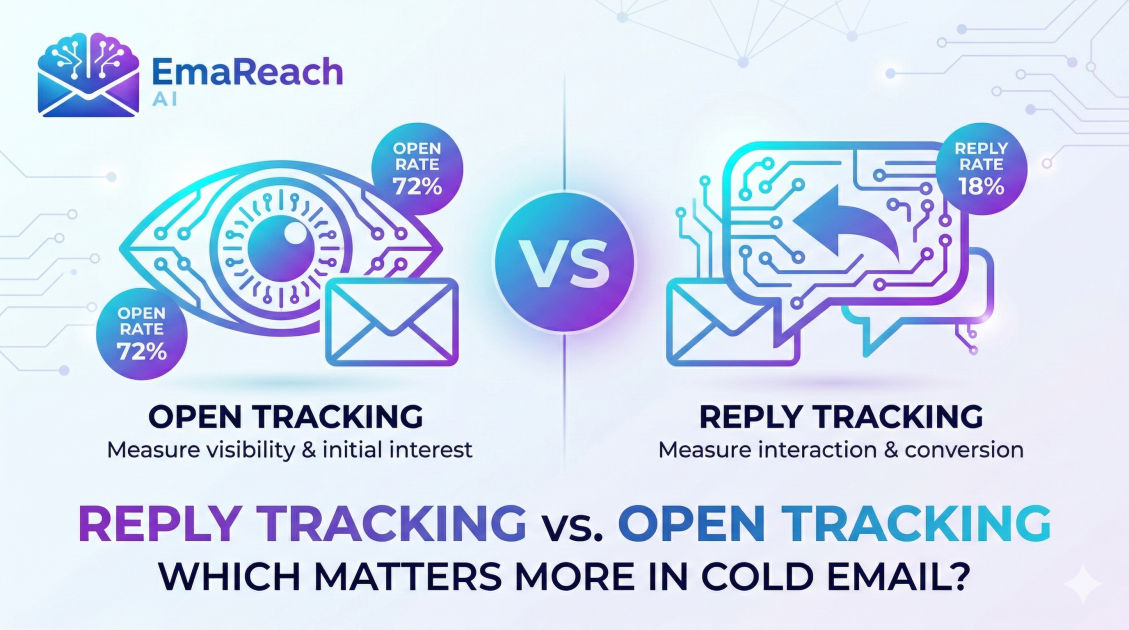
Reply Tracking vs. Open Tracking: Which Matters More in Cold Email?
cold emailemail trackingsales outreachemail deliverabilityoutbound salesmarketing metrics
Introduction
In the high-stakes world of outbound sales, data is the compass that guides every campaign. For years, the industry standard for measuring success was the open rate. It was the dopamine hit every marketer craved—seeing those percentages climb meant people were at least looking at the message. However, as email ecosystems have evolved and privacy protections have tightened, a fundamental debate has emerged: should we still be obsessing over open tracking, or is reply tracking the only metric that truly signifies progress?
Choosing between these two metrics isn't just about technical preference; it’s about a fundamental shift in philosophy. One focuses on visibility, while the other focuses on engagement. As deliverability becomes increasingly difficult to maintain, understanding the nuances of how these tracking methods affect your sender reputation and your bottom line is critical. This guide explores the mechanics, the pros and cons, and the ultimate verdict on which metric matters more for your cold email strategy.
The Mechanics of Open Tracking
To understand why open tracking is controversial, you first have to understand how it works. Traditionally, email service providers (ESPs) and sales engagement platforms use a method called a tracking pixel.
How Tracking Pixels Work
A tracking pixel is a transparent, 1x1 pixel image embedded in the HTML of your email. When a recipient opens the email, their email client (like Gmail or Outlook) fetches that image from the sender's server. This request allows the server to log the time, date, IP address, and device type associated with the open.
The Erosion of Open Rate Accuracy
In recent years, the reliability of open tracking has plummeted due to several technological shifts:
- Privacy Protections: Major players have introduced features that pre-load images on their own servers. This means an email might be marked as "opened" even if the recipient never actually saw it, or conversely, the tracking might be blocked entirely.
- Security Scanners: Many corporate firewalls and spam filters automatically "click" links and "open" images to check for malicious content before the email ever reaches the user's inbox. This leads to inflated, false-positive open rates.
- Image Blocking: Some users disable the automatic loading of images for security or data-saving reasons. In these cases, a prospect could read your entire email, but your software would report a 0% open rate.
The Rise of Reply Tracking
Reply tracking is the practice of monitoring when a recipient actually sends a response back to your outreach. Unlike open tracking, which relies on a hidden image, reply tracking is usually managed by syncing your inbox with your sending tool via IMAP or API.
Why Reply Tracking is Gaining Ground
Reply tracking is often considered a "hard" metric. It doesn't rely on guesswork or hidden pixels. If someone replies, they have engaged with your content. This metric is directly tied to the primary goal of cold email: starting a conversation.
Because reply tracking doesn't require extra code to be embedded in the body of the email (unlike tracking pixels or redirected tracking links), it is often viewed as a "cleaner" way to send mail. This has significant implications for deliverability, which we will explore further.
Deliverability: The Hidden Cost of Tracking
One of the most overlooked aspects of the "Open vs. Reply" debate is the impact on deliverability. High-volume cold emailing requires a pristine sender reputation.
The "Spammy" Signature of Tracking Pixels
Spam filters are designed to look for patterns associated with bulk marketing. Tracking pixels and custom tracking domains are common footprints. While using a custom tracking domain (CNAME) can mitigate some risk, the mere presence of an external image call in a cold, one-on-one email can look suspicious to sensitive algorithms.
If your goal is to land in the primary tab rather than the promotions or spam folder, reducing the amount of HTML and external "pings" in your email is essential. This is where tools like EmaReach become invaluable. By focusing on inbox warm-up and multi-account sending, EmaReach ensures that your emails maintain a high reputation. Its AI-driven approach helps you land in the primary tab, making the debate between open and reply tracking secondary to the fact that you are actually reaching the prospect.
Reply Rates as a Positive Signal
While open tracking can hurt your reputation, replies actively help it. ESPs like Google and Microsoft view a high reply rate as a sign that your content is wanted and valuable. When a recipient replies to you, it signals to the mail server that you are a legitimate sender, which boosts your sender score and helps future emails bypass the spam filter.
Comparative Analysis: Pros and Cons
Open Tracking
Pros:
- Early Signal: Gives you a rough idea if your subject lines are working.
- Follow-up Timing: Helps you time your follow-up calls or emails when a prospect is actively looking at their inbox.
- A/B Testing: Useful for testing broad interest levels across different niches.
Cons:
- High Inaccuracy: Often inflated by bots or deflated by privacy settings.
- Deliverability Risk: Can trigger spam filters due to the tracking pixel.
- Psychological Distraction: Can lead sales reps to obsess over "vanity metrics" rather than meaningful conversations.
Reply Tracking
Pros:
- 100% Accuracy: A reply is an undeniable evidence of engagement.
- Goal Alignment: Directly measures the success of your campaign's ultimate objective.
- Reputation Building: Encourages a strategy that focuses on quality, leading to better sender health.
Cons:
- Delayed Data: You don't get data until the very end of the funnel.
- Lower Volume of Data: Because reply rates are naturally lower than open rates, it takes longer to gather a statistically significant sample size for testing.
Which Matters More? The Verdict
If you have to choose one metric to rule your strategy, Reply Tracking is the clear winner.
In the current landscape of cold outreach, the "Open Rate" has become a vanity metric. It is too easily manipulated by bots and too often blocked by privacy updates to be a reliable source of truth. Relying on open rates can lead to a false sense of security; you might think your campaign is performing well because of a 60% open rate, while in reality, 40% of those "opens" were automated security scans and your actual human engagement is near zero.
Reply tracking, however, is a business metric. It represents a hand-raise. It represents a lead. By prioritizing reply tracking, you force your team to focus on the quality of the copy, the relevance of the offer, and the precision of the targeting.
The Hybrid Approach
While reply tracking is more important, many top-tier growth hackers use a hybrid approach with a heavy emphasis on "invisible" deliverability. They might turn off open tracking entirely to maximize the chances of hitting the inbox, then use reply rates and "booked meeting" rates as their primary KPIs.
Practical Strategies for Maximizing Replies
Since reply tracking is the North Star, how do you actually move the needle on that metric? It requires more than just a catchy subject line.
1. The "Problem-First" Framework
Instead of listing features, lead with a specific pain point. A reply is a response to a solution. If your email reads like a brochure, it won't get a reply. If it reads like a peer offering a specific fix to a known headache, the reply rate will soar.
2. Radical Personalization
Template-heavy emails are easy to spot. High reply rates come from emails that show you've done five minutes of research. Mentioning a recent podcast appearance, a LinkedIn post, or a specific company milestone makes the recipient feel obligated to acknowledge the effort.
3. The Power of the Low-Stakes CTA
One of the biggest killers of reply rates is a high-friction Call to Action (CTA). Asking for a "30-minute demo" from a stranger is a big ask. Instead, try a low-stakes question:
- "Is this something your team is currently prioritizing?"
- "Would it be helpful if I sent over a short video showing how we solved this for [Competitor]?"
- "Are you the right person to speak with regarding [Department] strategy?"
These require a simple "Yes" or "No," which drastically increases the likelihood of a reply.
The Role of Inbox Health in Tracking
No amount of tracking—open or reply—matters if your emails are going to the spam folder. This is the foundation of the "Deliverability First" mindset.
When using a platform like EmaReach, the focus shifts from simply sending mail to ensuring that mail is accepted. By utilizing AI-written outreach that feels human and using multi-account sending to stay under the radar of volume-based spam triggers, you create an environment where reply tracking actually yields data. If your emails are blocked, your reply rate is 0% by default. EmaReach solves the "inbox placement" variable so you can focus on the "conversion" variable.
Technical Setup: Best Practices for Clean Tracking
If you do decide to keep open tracking enabled, you must do it correctly to minimize the damage to your reputation:
- Use a Custom Tracking Domain: Never use the default tracking domain provided by your software. Map a sub-domain (e.g.,
link.yourdomain.com) to your provider. This makes the tracking links look like they belong to your brand rather than a third-party bulk sender. - Verify Your DNS Records: Ensure SPF, DKIM, and DMARC are perfectly configured. Without these, any tracking—even reply tracking via IMAP—is moot because your domain will be flagged as unauthenticated.
- Monitor Your Reputation: Use tools to check if your IP or domain has been blacklisted. A sudden drop in both open and reply rates usually indicates a deliverability crisis rather than a messaging problem.
Moving Beyond Tracking: The "Conversational" Era
The industry is moving away from "broadcast" style cold emailing toward "conversational" sales. In this era, the goal isn't to see how many people opened a link; it's to see how many people are willing to engage in a dialogue.
This shift benefits smaller, more agile sales teams who can afford to be highly targeted. If you send 50 highly researched emails and get 5 replies, you are in a much better position than someone who sends 5,000 emails, sees a 20% "open rate," but receives zero replies.
Why Quantity No Longer Equals Quality
In the past, you could play a numbers game. You could ignore low reply rates because the volume was so high that a few leads would eventually trickle through. Today, ESPs are much smarter. High volume with low engagement (low reply rates) is the fastest way to get your domain permanently banned. Modern cold email success is built on the back of high engagement metrics.
Conclusion
In the debate of Reply Tracking vs. Open Tracking, the answer is nuanced but firm: Reply tracking is the only metric that accurately reflects the health and success of a cold email campaign.
While open tracking can provide some directional data on subject line performance, its technical unreliability and potential negative impact on deliverability make it a secondary concern. To succeed in modern outreach, you must prioritize landing in the primary inbox and eliciting a genuine human response. By focusing on your sender reputation—leveraging tools like EmaReach to ensure your emails reach their destination—and optimizing your copy for replies rather than views, you build a sustainable, high-ROI outbound engine. Stop chasing the phantom numbers of open rates and start measuring the conversations that actually build your business.
EmaReach AI
Ready to scale your cold email outreach?
Join thousands of teams using EmaReach AI for AI-powered campaigns, domain warmup, and 95%+ deliverability. Start free — no credit card required.
Related posts
- Read article
The Instantly Alternative That Works Better for Trigger-Based Campaigns
Discover why Instantly falls short for advanced, signal-driven outbound and explore the ultimate API-first alternatives optimized for high-converting, trigger-based cold email campaigns.
- Read article
The Instantly Alternative That Handles High Bounce Rates Without Panic
Discover how transitioning to an advanced Instantly alternative can safeguard your cold email infrastructure. Learn to handle high bounce rates effortlessly using real-time verification, smart mailbox rotation, and automated safety nets to protect your sender reputation and maintain consistent primary inbox placement.