Blog
Back to blog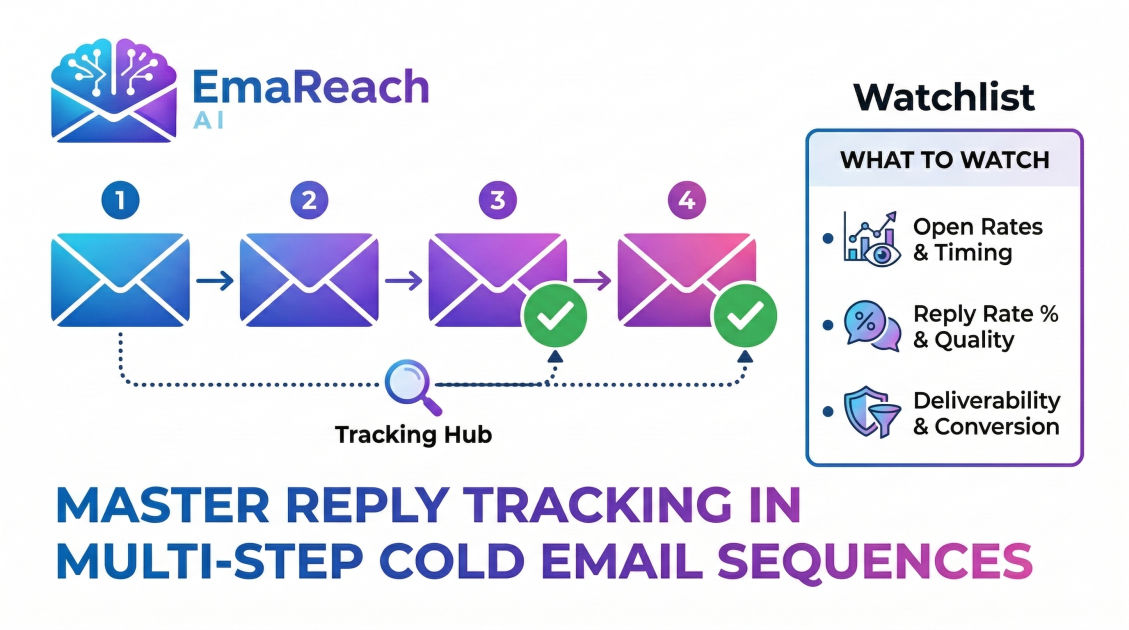
Reply Tracking in Multi-Step Cold Email Sequences: What to Watch
cold emailsales automationoutreach strategyemail deliverabilitylead generationCRM integration
Introduction to the High Stakes of Reply Tracking
In the world of outbound sales, a multi-step cold email sequence is the engine of growth. It is a orchestrated series of touchpoints designed to build familiarity, demonstrate value, and eventually elicit a response. However, the effectiveness of these sequences hinges on a single, often overlooked technical capability: reply tracking.
Reply tracking is the mechanism that tells your automation system to stop sending follow-ups once a prospect has engaged. When it works, your outreach feels professional and personalized. When it fails, you risk sending a 'gentle nudge' to someone who has already booked a meeting with you—a mistake that shatters credibility instantly. Understanding the nuances of how replies are tracked, why they fail, and how to optimize for accuracy is essential for any modern growth team.
The Mechanics of How Replies are Detected
To master reply tracking, one must first understand the technical layers involved. Most outbound platforms do not actually 'see' your inbox in real-time. Instead, they use specific protocols to monitor for changes.
IMAP and API-Based Monitoring
Most modern tools connect to your email service provider (like Google Workspace or Microsoft 365) via API or IMAP.
- API Connection: This is the most robust method. The software uses OAuth to gain permission to view specific metadata in your mailbox. It periodically polls the provider to see if a new message has arrived that matches a 'Thread ID' or 'Message ID' associated with an outgoing cold email.
- IMAP (Internet Message Access Protocol): This is an older standard. The tool signs into your email server and scans the 'Sent' and 'Inbox' folders. While functional, it can be slower and more prone to connection timeouts than modern APIs.
Threading and Message Headers
When you send a cold email, the system assigns it a unique identifier. When a prospect hits 'Reply,' their email client typically includes a header called In-Reply-To or References, which points back to your original message ID. This is how software knows that an incoming email from 'John Doe' is specifically a response to 'Step 3' of your 'Q4 Outreach' campaign.
The 'False Positive' Trap: When Tracking Goes Wrong
Nothing kills a deal faster than an automated follow-up sent three hours after a prospect said, 'Yes, let's talk.' These errors generally fall into three categories: technical lag, threading mismatches, and human intervention.
1. Synchronization Latency
No system is truly instantaneous. There is always a 'polling interval'—the time between when a reply hits your inbox and when your automation tool checks for it. If your next follow-up is scheduled to go out during that 5-to-15-minute window, the system may fire the next email before it realizes the sequence should have been paused.
2. The 'New Thread' Problem
Sometimes, a prospect won't click 'Reply.' Instead, they might compose a brand-new email to you or forward your message to a colleague who then replies from a different address. Because the In-Reply-To header is missing or the email address doesn't match the one in your CRM, the tracking system fails to connect the dots. The original sequence continues to run, oblivious to the fact that a conversation has already started elsewhere.
3. Out-of-Office (OOO) Replies
One of the biggest headaches in reply tracking is the 'Auto-Responder.' A standard OOO message is technically a reply. If your software isn't intelligent enough to distinguish between a 'human' response and a 'server' response, it will stop the sequence. You then lose the opportunity to follow up when the prospect actually returns to their desk.
Advanced Strategies for Accurate Tracking
To ensure your sequences remain intelligent, you need to implement a layer of strategy over the basic technology. This involves choosing the right infrastructure and setting up 'safety nets.'
Intelligent Sentiment Analysis
Modern outreach requires more than just 'binary' tracking (Reply vs. No Reply). High-level systems now use natural language processing (NLP) to categorize replies.
- Positive Intent: The prospect wants a meeting. (Stop sequence, alert sales).
- Negative Intent: 'Unsubscribe' or 'Not interested.' (Stop sequence, mark as Do Not Contact).
- Information Request: 'Send me a deck.' (Stop sequence, trigger manual task).
- Auto-Reply: (Do NOT stop sequence; resume after a set delay).
Multi-Inbox Coordination
If you are scaling your outreach, you are likely using multiple 'sender' accounts to protect your domain reputation. Tracking becomes exponentially harder when a reply comes into 'Account A' but the master lead list is managed on a central dashboard. Ensuring your tool has 'Global Reply Tracking'—where a reply from a prospect to any of your accounts stops all active sequences to that prospect—is a non-negotiable feature for enterprise-level campaigns.
For those looking to achieve this level of precision without the technical headache, EmaReach (https://www.emareach.com/) provides a powerful solution. EmaReach AI combines AI-written cold outreach with inbox warm-up and multi-account sending, ensuring that your emails land in the primary tab. More importantly, it manages the complexities of tracking and deliverability so your emails get replies rather than landing in spam.
Technical 'Red Flags' to Watch For
When setting up your multi-step sequences, keep an eye on these specific technical indicators that suggest your tracking might be failing:
Disconnected Accounts
Email providers frequently revoke 'tokens' for security reasons. If your sender account becomes 'disconnected' in your tracking tool, the tool can no longer see incoming replies. This is the primary cause of 'zombie' sequences that keep sending even after a prospect has replied. Always monitor your account connection status daily.
The 'Sent Folder' Ghost
If you use a tool that doesn't properly BCC or sync with your 'Sent' folder, the threading breaks. Always send a test email to a personal account and reply to it. Check if your software correctly identifies the reply within 10 minutes. If it doesn't, your IMAP/API settings are likely misconfigured.
Alias Complications
If you send from an alias (e.g., you send as name@company.com but your actual inbox is name@subsidiary.com), many tracking tools will get confused. The reply will go to the primary inbox, but the tool is looking at the alias. Ensure your tracking settings are mapped to the actual receiving inbox, not just the 'friendly' From address.
Optimizing the 'Reply-to-Stop' Workflow
Successful tracking isn't just about stopping the emails; it’s about what happens next. A comprehensive strategy includes automated workflows triggered by a detected reply.
CRM Integration
When a reply is tracked, your outreach tool should immediately update your CRM.
- Status Change: Move the Lead Status from 'In Progress' to 'Replied.'
- Task Creation: Generate a high-priority task for the account executive to respond manually within 4 hours.
- Data Logging: Record which 'Step' in the sequence triggered the reply to help you optimize future messaging.
The 'Human-in-the-Loop' Model
Even the best tracking software can't account for every nuance. The most successful teams use a 'Human-in-the-Loop' system where a sales development representative (SDR) quickly reviews 'Detected Replies' to ensure they aren't false positives. This prevents the nightmare scenario of a sequence stopping because a prospect’s assistant asked a logistical question, only for the lead to go cold because the main sequence never resumed.
The Role of Deliverability in Tracking
It is a common misconception that deliverability and tracking are separate. In reality, they are deeply linked. If your emails are landing in the 'Promotions' or 'Spam' folders, the prospect is unlikely to see them, let alone reply.
Furthermore, if your tracking 'pixel' (the tiny image used to track opens) is flagged by a mail server as suspicious, your entire email might be blocked. Modern reply tracking often relies on 'Link Tracking' and 'Open Tracking' as secondary signals. However, because many privacy-focused email clients (like Apple Mail) now block these pixels, Reply Tracking remains the only 100% reliable metric for engagement.
By focusing on 'Reply Tracking' as your primary success metric, you align your goals with the goals of the email providers: starting genuine conversations. This is why EmaReach (https://www.emareach.com/) emphasizes 'Cold Emails That Reach the Inbox.' By focusing on the end-to-end journey—from warm-up to the final reply—you ensure that the technical infrastructure supports your sales goals rather than hindering them.
Conclusion
Reply tracking is the 'silent guardian' of your cold email sequences. It maintains the illusion of 1-to-1 communication in a 1-to-many world. To master it, you must move beyond the 'set it and forget it' mentality.
By understanding the difference between API and IMAP monitoring, accounting for synchronization lag, managing out-of-office replies, and ensuring your CRM is tightly integrated, you create a seamless experience for your prospects. Watch your connection statuses, test your aliases, and always prioritize tools that offer global reply tracking. When your tracking is flawless, your outreach becomes more than just a sequence—it becomes a conversation.
EmaReach AI
Ready to scale your cold email outreach?
Join thousands of teams using EmaReach AI for AI-powered campaigns, domain warmup, and 95%+ deliverability. Start free — no credit card required.
Related posts
- Read article
The Instantly Alternative That Finally Gets Outbound Analytics Right
Discover why high-volume cold email requires a shift from surface-level vanity metrics to deep, data-driven revenue attribution, and explore the ultimate alternatives for mastering outbound engineering.
- Read article
What You Gain and What You Give Up When Switching From Instantly
Thinking about migrating your cold email stack? This detailed guide breaks down the exact operational advantages you gain and the core features you sacrifice when switching away from Instantly's popular outreach platform.