Blog
Back to blog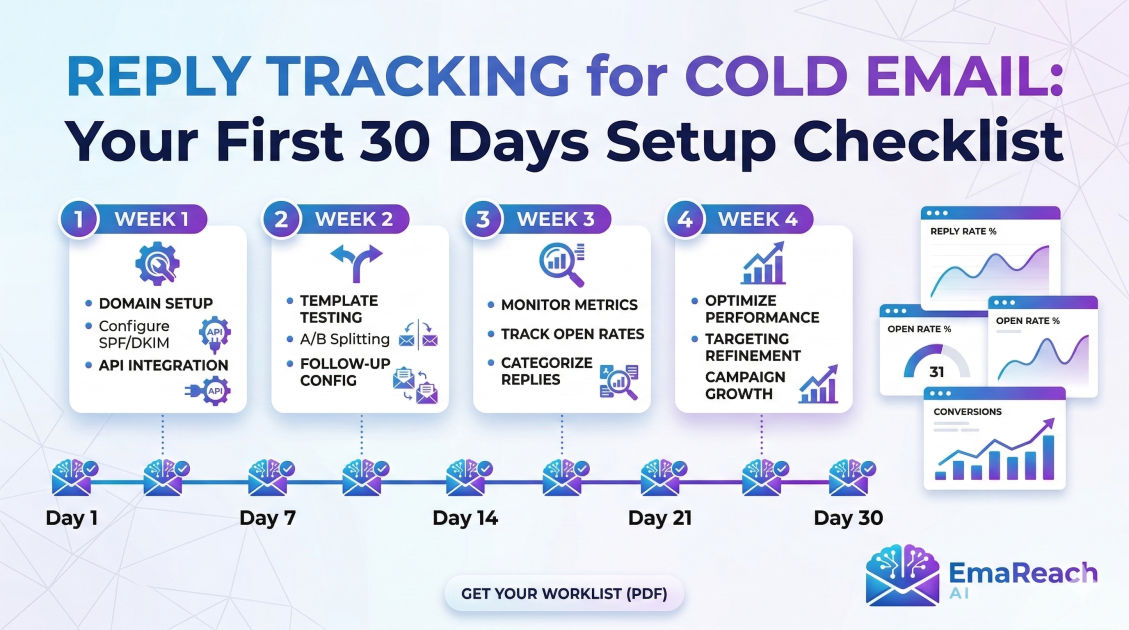
Reply Tracking for Cold Email: Your First 30 Days Setup Checklist
cold emailoutreach strategyemail deliverabilitysales automationlead generationcrm integration
Introduction
In the high-stakes world of outbound sales, a cold email campaign is only as good as the data it produces. You can send thousands of messages, but if you cannot accurately track who is responding, how they are responding, and which variables are driving those responses, you are essentially flying blind. Reply tracking is the pulse of your outreach strategy. It transforms a guessing game into a scientific process of iteration and improvement.
Setting up a robust reply tracking system isn't just about knowing when someone says "yes." It’s about technical configuration, inbox management, sentiment analysis, and CRM integration. This guide provides a comprehensive 30-day checklist to ensure your infrastructure is bulletproof, your data is clean, and your conversion rates are optimized from day one.
Week 1: Infrastructure and Technical Foundations
The first seven days are dedicated to the "plumbing" of your cold email operation. Without the right technical setup, tracking becomes unreliable, and your emails might not even reach the inbox.
Domain and Inbox Architecture
Before you send your first email, you need a dedicated environment. Sending cold outreach from your primary business domain is a recipe for disaster. If your tracking pixels or high volume trigger spam filters, your company's internal communications will suffer.
- Purchase Redirect Domains: Buy 2-3 domains similar to your main one (e.g., get[brand].com or use[brand].com).
- Set Up SPF, DKIM, and DMARC: These DNS records are non-negotiable. They verify that your sender identity is legitimate, which is the first hurdle in ensuring your tracking remains accurate.
- Individual Inbox Throttling: Limit each inbox to 30-50 emails per day. Tracking 500 replies from one inbox is a red flag for ESPs (Email Service Providers); tracking 50 replies across 10 inboxes is sustainable.
Warm-up and Deliverability Monitoring
You cannot track replies if your emails land in the spam folder. During the first week, your primary goal is to build a positive sender reputation.
- Initiate Email Warm-up: Use a service that automates peer-to-peer email exchanges. This simulates natural conversation, which is the baseline for healthy reply tracking.
- Primary Tab Placement: Ensure your emails are landing in the primary folder. Tools like EmaReach (https://www.emareach.com/) are invaluable here. EmaReach AI combines AI-written cold outreach with inbox warm-up and multi-account sending—so your emails land in the primary tab and get replies. This ensures that the data you track reflects true prospect interest, not just deliverability failures.
Week 2: Tracking Integration and CRM Sync
Once the technical foundation is set, Week 2 focuses on how data moves from the recipient's inbox to your sales dashboard.
The Tracking Pixel Debate
Most cold email platforms use a 1x1 invisible pixel to track "Opens." However, in modern email marketing, open tracking can be misleading due to privacy protections like Apple Mail Privacy Protection.
- Focus on Reply-Based Attribution: While open rates are a vanity metric, reply rates are a hard metric. Set your tracking focus to trigger only when a message enters the 'Sent' or 'Inbox' folder of your sending account with a matching Subject Line or Thread ID.
- Global Unsubscribe Links vs. Manual Opt-outs: To keep tracking clean, decide how you will categorize "Stop" or "Unsubscribe" replies. Automated tracking should distinguish between a hard bounce, an opt-out, and a genuine inquiry.
Connecting the CRM
Tracking replies in a spreadsheet is a short-term solution that leads to long-term chaos. Your reply tracking must feed directly into your CRM (Customer Relationship Management) system.
- Webhook Configuration: Set up webhooks so that every time a reply is detected, the lead status in your CRM automatically updates to "Replied" or "In Progress."
- Bidirectional Sync: Ensure that if a sales rep manually updates a lead in the CRM, the cold email sequence stops automatically. There is nothing more damaging to a brand than sending a follow-up email to someone who has already replied.
Week 3: Categorization and Sentiment Analysis
By the third week, you should start seeing data trickle in. Now, you need to determine the quality of those replies.
Defining Sentiment Tiers
Not all replies are created equal. To track effectively, you must categorize replies into specific buckets:
- Positive/Interested: The prospect wants a meeting or more information.
- Neutral/Referral: The prospect says, "Talk to my colleague."
- Later/Not Now: The prospect asks to be contacted in six months.
- Negative/Unsubscribe: The prospect is not interested or asks to be removed.
- Auto-replies: Out-of-office (OOO) messages that should not count as a "reply" in your conversion data.
Automating Sentiment Tracking
Manually reading every email to update a dashboard is a bottleneck. Use AI-driven sentiment analysis to pre-tag replies.
- Keywords to Flag: Program your tracker to look for phrases like "let’s chat," "calendar," or "price."
- Handling OOO: Set rules to ignore "Out of Office" replies so they don't skew your "Replied" statistics. The system should ideally pause the sequence and resume it when the prospect returns.
Week 4: Optimization and Scale
In the final week of your first 30 days, you shift from setting up the system to using the data for strategic decisions.
A/B Testing Attribution
With a month of tracking data, you can now see which subject lines or lead magnets are actually generating positive replies.
- The 10% Rule: Aim for a total reply rate of 10% or higher. If your tracking shows a high open rate but a 1% reply rate, your copy is likely the problem.
- Iterate Based on Friction: If your tracking reveals a high volume of "Not interested" replies, analyze the common denominator. Are you targeting the wrong persona? Is your offer too aggressive?
Reporting and Stakeholder Alignment
Create a monthly reporting template that summarizes the tracking data. Key metrics to include are:
- Total Sent vs. Total Delivered.
- Positive Reply Rate (The most important metric).
- Days to Reply: Tracking how many follow-ups it takes to get a response (usually 3-5).
- Cost Per Lead (CPL): Total software and labor cost divided by positive replies.
Best Practices for Long-Term Tracking Success
Data Privacy and Compliance
Reply tracking must be handled with respect for privacy laws like GDPR and CCPA.
- Data Minimization: Only track what you need to move the sale forward.
- Secure Storage: Ensure that reply content stored in your CRM is encrypted and accessible only to necessary personnel.
The Human Element
Automation is powerful, but it shouldn't be the final word. A human should review "Positive" tags daily to ensure no opportunities are missed due to a tracking glitch. AI might miss a nuance or a sarcastic tone that a human salesperson will catch instantly.
Technical Maintenance
Every 30 days, do a "system health check":
- Check for blacklisted domains.
- Verify that API connections between your email sender and CRM are still active.
- Update your negative keyword list to improve sentiment analysis accuracy.
The Critical Role of Deliverability in Tracking
It is worth reiterating: tracking is a downstream metric of deliverability. If your emails are being filtered into the "Promotions" tab or the spam folder, your reply tracking will show zeros, leading you to believe your copy is bad when, in reality, your technical setup is the culprit.
To keep your tracking data clean, you must prioritize inbox placement. This is where a holistic approach—combining smart copy with technical warmth—becomes essential. High-performance teams often use sophisticated environments to manage this. For instance, EmaReach provides an all-in-one solution where AI handles the writing while the platform manages the warm-up and multi-account sending, ensuring your reply tracking reflects actual human engagement rather than technical roadblocks.
Conclusion
Mastering reply tracking for cold email is a 30-day journey from technical chaos to data-driven clarity. By the end of this month-long setup, you should have a system that not only identifies when a prospect responds but also understands the intent behind that response and moves them seamlessly through your sales funnel.
Remember, the goal of cold email is not just to send messages, but to start conversations. Accurate, automated, and insightful reply tracking is the only way to ensure those conversations are captured, nurtured, and converted into long-term business relationships. Stick to the checklist, monitor your deliverability, and let the data guide your growth.
EmaReach AI
Ready to scale your cold email outreach?
Join thousands of teams using EmaReach AI for AI-powered campaigns, domain warmup, and 95%+ deliverability. Start free — no credit card required.
Related posts
- Read article
The Instantly Alternative That Finally Gets Outbound Analytics Right
Discover why high-volume cold email requires a shift from surface-level vanity metrics to deep, data-driven revenue attribution, and explore the ultimate alternatives for mastering outbound engineering.
- Read article
What You Gain and What You Give Up When Switching From Instantly
Thinking about migrating your cold email stack? This detailed guide breaks down the exact operational advantages you gain and the core features you sacrifice when switching away from Instantly's popular outreach platform.