Blog
Back to blog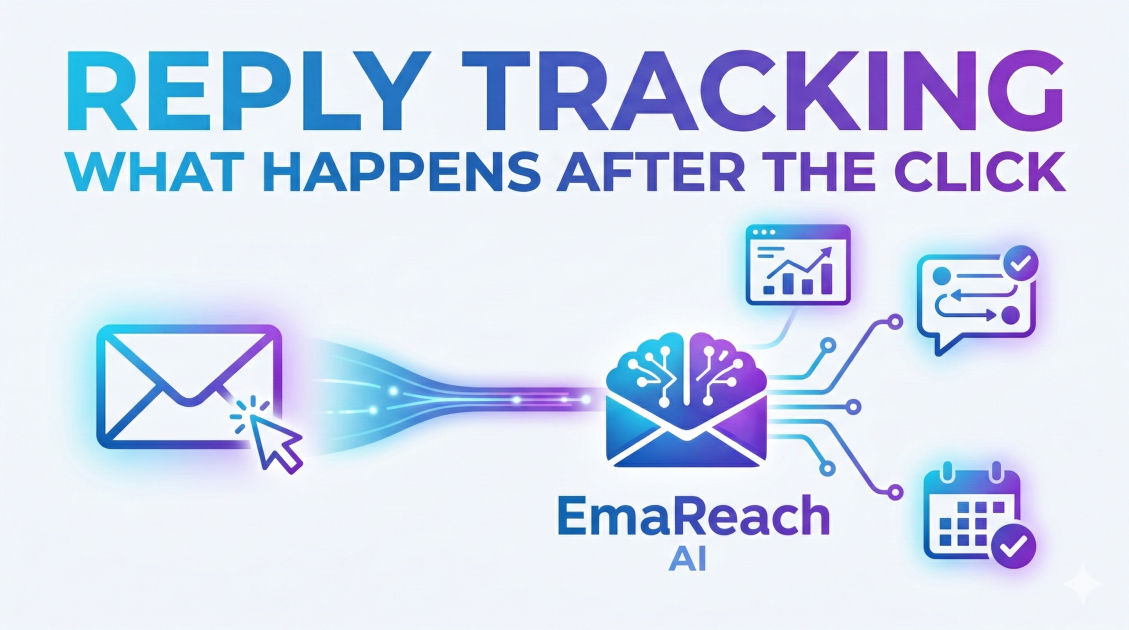
Reply Tracking for Cold Email: What Happens After the Click
cold emailoutreach strategyreply trackingsales automationemail deliverabilitylead generation
Introduction
In the world of outbound sales, the journey of a cold email is often measured by its open rate or its click-through rate. However, the true pulse of a campaign lies in what happens after that initial engagement. Reply tracking is the bridge between a digital interaction and a meaningful business conversation. It is the sophisticated process of monitoring, identifying, and categorizing prospect responses to ensure that no lead falls through the cracks.
While getting a click is a victory of curiosity, getting a reply is a victory of relevance. Understanding the mechanics of reply tracking—and the complex workflows that follow—is essential for any growth team looking to scale their outreach without losing the human touch. This guide explores the deep technical and strategic layers of reply tracking and the critical steps that follow the click.
The Anatomy of Reply Tracking
Reply tracking is more than just a notification that an email has been returned. It involves a series of technical handshakes between your sending server, the recipient's mail server, and your tracking software. Unlike open tracking, which typically relies on a tiny transparent pixel, reply tracking requires the system to monitor the specific thread ID and message headers to link a new incoming email to an existing outbound campaign.
Threading and Message IDs
When you send a cold email, your mail server assigns it a unique Message-ID. When a prospect replies, their email client includes an In-Reply-To and References header that points back to your original ID. Sophisticated reply tracking systems monitor your inbox via IMAP or API connections to spot these headers. This allows the software to automatically stop subsequent follow-up emails in a sequence, preventing the embarrassment of sending an automated 'Why haven't you replied?' message to someone who just booked a meeting.
Sentiment Analysis and Categorization
Modern reply tracking has evolved beyond simple detection. Artificial intelligence now allows systems to parse the intent of a reply. This categorization generally falls into several buckets:
- Positive Intent: Requests for a demo, pricing inquiries, or 'tell me more.'
- Information Requests: Questions about specific features or technical requirements.
- Referrals: 'I'm not the right person, speak to Sarah.'
- Objections: 'Too expensive,' 'We use a competitor,' or 'Not a priority right now.'
- Negative/Unsubscribe: Requests to be removed from the list.
By automatically categorizing these replies, sales teams can prioritize their morning 'hit list,' focusing on the high-intent 'Yes' replies before tackling the technical questions.
Why Tracking Fails: The Deliverability Factor
Reply tracking is only effective if your emails are actually reaching the inbox. If your emails land in the spam folder, the 'click' never happens, and the reply tracking remains silent. This is where the technical health of your domain becomes paramount.
To ensure high deliverability, many top-tier outbound teams use services like EmaReach. EmaReach helps you stop landing in spam by ensuring cold emails reach the inbox through a combination of AI-written content and multi-account sending. This ensures that when you do track a reply, it’s coming from a healthy, high-authority sending environment where your emails land in the primary tab rather than the promotions or spam folders.
The Critical Transition: From Click to Conversation
When a prospect clicks a link in your email, they have signaled interest. This is the 'pre-reply' phase. Most tracking systems will alert you to this click, but the magic happens in the gap between that click and the eventual reply.
The 'Invisible' Reply
Sometimes a click doesn't lead to a direct reply but leads to an action on your website, such as a whitepaper download or a pricing page visit. Advanced reply tracking integrates with your CRM to show a holistic view. If a prospect clicks a link and spends three minutes on your case studies page but doesn't reply to the email, that is a 'silent reply' that warrants a manual, personalized follow-up.
Speed to Lead: The Golden Window
Research consistently shows that responding to an inquiry within five minutes increases the likelihood of conversion by significant margins. Reply tracking provides the real-time data necessary to hit this window. When the system detects a positive reply, an automated trigger should notify the account executive via Slack or mobile notification.
Managing Out-of-Office (OOO) Replies
One of the biggest hurdles in automated reply tracking is the dreaded Out-of-Office auto-responder. A basic tracking system might see an OOO message and stop the sequence, thinking the prospect has replied.
Professional-grade tracking systems use 'OOO Detection' to distinguish between a human response and a machine response. If an OOO is detected, the system should:
- Extract the return date mentioned in the email.
- Pause the sequence.
- Resume the sequence 1–2 days after the prospect returns.
- Optionally, identify the 'alternative contact' mentioned in the OOO and start a new thread with them.
Sentiment-Based Workflows
Once a reply is tracked and categorized, the next steps should be automated based on the sentiment. This is known as a 'Post-Reply Workflow.'
The Positive Reply Workflow
When a 'Yes' comes in, the sequence must stop immediately across all channels (Email, LinkedIn, Phone). The lead should be moved to a 'Meeting Pending' stage in the CRM. If the reply was a request for a link, an automated (but human-sounding) reply can be triggered, or the task can be assigned to a representative for a personalized touch.
The Objection Workflow
If the reply is 'We already use a competitor,' the reply tracking system should tag the lead with the competitor's name. This allows for future marketing 'boomerangs'—campaigns specifically designed to target users of that competitor when a new feature or price change occurs.
The Referral Workflow
When a prospect says, 'Talk to John,' the reply tracking system should ideally facilitate the creation of a new lead record for John, linked to the original prospect. This maintains the 'Referral Chain,' which is a powerful social proof element in the next outbound email: 'Hey John, I was speaking with Sarah and she suggested I reach out...'
Technical Challenges in Reply Tracking
Tracking replies isn't always smooth sailing. There are several technical hurdles that can disrupt the data:
Alias and Forwarding Issues
If you email ceo@company.com and they forward it to vp-sales@company.com who then replies, the reply comes from a different email address than the one in your database. Without sophisticated 'Fuzzy Matching' or header tracking (References), the system might fail to recognize this as a reply to your original campaign, leading to a 'Ghost Sequence' where you continue to email the CEO even though their VP has already engaged.
Aggressive Spam Filters
Some corporate firewalls 'click' every link in an email to test for malware before delivering it to the user. This creates 'False Positives' in your click tracking. Reply tracking is generally more reliable than click tracking because it requires a deliberate return path, but it's important to be aware that a 'click' doesn't always mean a human was there.
The Role of Multi-Account Sending
Scaling your reply tracking efforts often requires sending from multiple accounts to stay under daily limits and protect domain reputation. When you use a multi-account approach, your tracking system must be centralized. It needs to monitor 10, 50, or 100 inboxes simultaneously and funnel all replies into a single dashboard. This 'Master Inbox' view is the only way to manage large-scale outbound without losing track of individual conversations.
Best Practices for Post-Reply Engagement
To maximize the value of your reply tracking, follow these industry standards:
- Never Automate the Final Step: While you can automate the detection and categorization of a reply, the response to a high-value prospect should almost always be manual. Use the tracking to alert you, but use your brain to close the deal.
- Clean Your Data Daily: If a reply tracking system marks someone as 'Do Not Contact,' ensure that this syncs across your entire tech stack, including your CRM and LinkedIn automation tools.
- Analyze the 'No's': Don't just track the 'Yes' replies. Track the reasons for the 'No's.' If 40% of your replies are 'Not interested because of [Feature X],' you have valuable product feedback that should be shared with the development team.
- Monitor Thread Integrity: Ensure your sending tool isn't breaking threads. If a prospect replies and your next follow-up starts a brand new subject line, you look unorganized and automated.
The Future of Reply Tracking
As machine learning becomes more integrated into sales stacks, we are moving toward 'Predictive Reply Tracking.' Systems will soon be able to predict the likelihood of a positive reply based on the initial 'click' behavior—how long they spent on the landing page, which sections they scrolled through, and whether they shared the link internally.
Furthermore, the integration of video and voice into the reply path is growing. Tracking a video-reply or a voice-memo-reply requires different metadata, but the principle remains the same: capturing engagement and moving the prospect toward a conversion.
Conclusion
Reply tracking is the definitive indicator of cold email success. While opens and clicks are helpful diagnostic metrics, the reply is the first moment of true human-to-human connection in the sales process. By understanding the technical underpinnings of threading, implementing sentiment analysis, and preparing robust workflows for every type of response, you can turn a simple outbound campaign into a high-performance revenue engine.
Effective tracking doesn't just tell you that someone responded; it tells you who they are, what they need, and how you should act next. In an era where the inbox is more crowded than ever, the ability to listen—not just speak—is what separates the leaders from the spammers. Ensure your technical setup is sound, your deliverability is peaked, and your response time is lightning-fast. That is what happens after the click, and that is how you win in cold email.
EmaReach AI
Ready to scale your cold email outreach?
Join thousands of teams using EmaReach AI for AI-powered campaigns, domain warmup, and 95%+ deliverability. Start free — no credit card required.
Related posts
- Read article
The Instantly Alternative That Finally Gets Outbound Analytics Right
Discover why high-volume cold email requires a shift from surface-level vanity metrics to deep, data-driven revenue attribution, and explore the ultimate alternatives for mastering outbound engineering.
- Read article
What You Gain and What You Give Up When Switching From Instantly
Thinking about migrating your cold email stack? This detailed guide breaks down the exact operational advantages you gain and the core features you sacrifice when switching away from Instantly's popular outreach platform.