Blog
Back to blog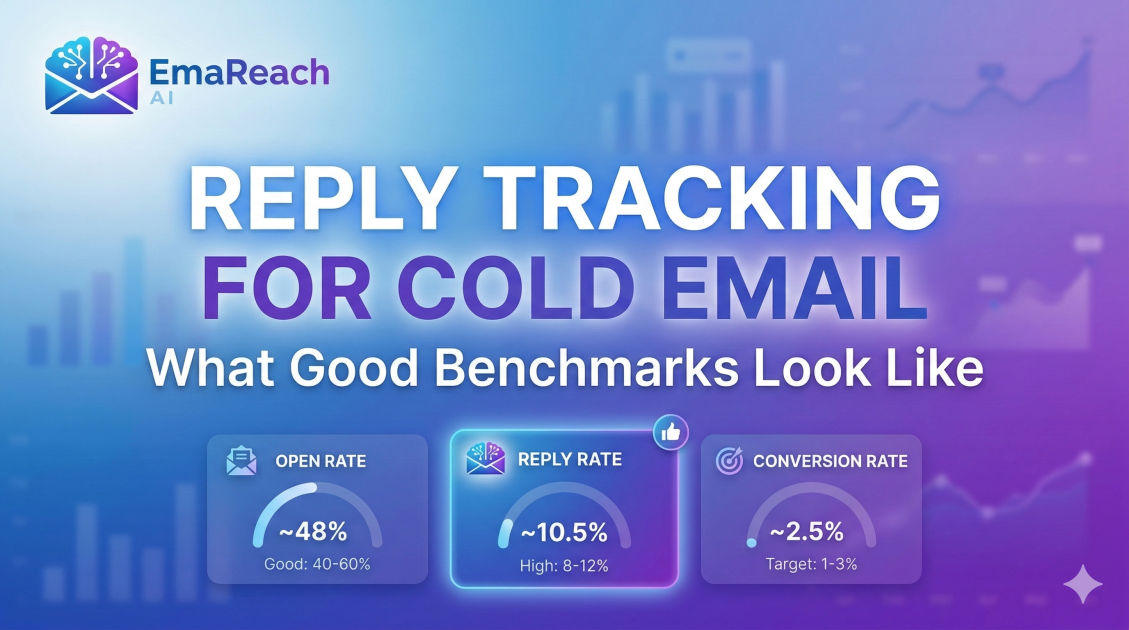
Reply Tracking for Cold Email: What Good Benchmarks Look Like
cold emailsales outreachemail benchmarkslead generationdeliverabilitysales metrics
Introduction to Reply Tracking in Cold Outreach
In the high-stakes world of outbound sales, data is the only compass that points toward predictable revenue. While open rates were once the darling metric of email marketers, the modern landscape of cold email has shifted. Today, the only metric that truly signifies the start of a business relationship is the reply.
Reply tracking is the process of monitoring, categorizing, and analyzing the responses generated by your cold email campaigns. It goes beyond simply seeing that a message was sent; it involves understanding the sentiment of the response and how it aligns with your campaign goals. Without accurate reply tracking and an understanding of industry benchmarks, sales teams are essentially flying blind, unable to distinguish between a campaign that is scaling successfully and one that is slowly damaging their domain reputation.
Why Reply Rates Are the Ultimate North Star Metric
For years, digital marketers obsessed over open rates. However, with the introduction of privacy features like Apple’s Mail Privacy Protection and the increasing sophistication of spam filters that 'pre-read' emails (triggering false opens), open rates have become a 'vanity metric.' They are often inflated and unreliable.
Reply rates, conversely, represent a physical action taken by a human being. A reply indicates that your subject line was intriguing enough to get an open, your hook was strong enough to keep them reading, and your call-to-action (CTA) was compelling enough to elicit a response.
The Relationship Between Deliverability and Replies
There is a symbiotic relationship between your reply rate and your email deliverability. Internet Service Providers (ISPs) like Google and Outlook monitor engagement levels to determine if an email is 'wanted' by the recipient. When people reply to your emails, it sends a powerful signal to these providers that you are a legitimate sender providing value. This improves your sender reputation, ensuring your future emails land in the primary inbox rather than the spam folder.
To maximize these signals, many high-performing teams use EmaReach. EmaReach helps businesses stop landing in spam by combining AI-written cold outreach with automated inbox warm-up and multi-account sending. This ensures that your emails reach the primary tab, where they are most likely to receive the replies that fuel your benchmarks.
Defining 'Good' Benchmarks: What the Data Says
When evaluating your cold email performance, it is vital to categorize replies. Not all replies are created equal. To set realistic benchmarks, we must look at the three main types of response rates.
1. The Total Reply Rate
This is the percentage of all recipients who responded to your email, regardless of the sentiment.
- Poor: Less than 1%
- Average: 3% to 5%
- Good: 7% to 10%
- World-Class: 15%+
If your total reply rate is below 3%, you likely have an issue with your lead list quality or your technical setup. High-volume sending without proper targeting often leads to these lower brackets.
2. The Positive Reply Rate (Interested Rate)
This is the most critical metric for a sales development representative (SDR). It measures the percentage of people who responded with interest, requested a demo, or asked for more information.
- Poor: Less than 0.5%
- Average: 1% to 2%
- Good: 3% to 5%
- World-Class: 8%+
3. The Negative Reply Rate
Negative replies (e.g., "Not interested," "Unsubscribe," "Remove me from your list") are inevitable. While they can be discouraging, they provide valuable feedback. A high negative reply rate often indicates that your value proposition is misaligned with the persona you are targeting.
Variables That Influence Your Reply Benchmarks
Benchmarks are not one-size-fits-all. Several variables can drastically shift what 'good' looks like for your specific business.
Lead Quality and List Segmentation
The quality of your data is the ceiling of your success. If you are emailing a generic list of 'Marketing Managers,' your reply rate will naturally be lower than if you are emailing 'Marketing Managers at SaaS companies with 50-100 employees who recently raised a Series A.'
Highly segmented lists allow for hyper-personalization, which is the primary driver of high reply rates. When a prospect feels like the email was written specifically for them, the psychological urge to respond increases significantly.
The 'Ask' (Call to Action)
The friction of your CTA plays a massive role in tracking.
- High Friction: "Are you free for a 30-minute demo on Tuesday at 2 PM?"
- Low Friction: "Would you be opposed to me sending over a 2-minute video on how we solved this for [Competitor]?"
Lower friction asks almost always result in higher reply rates, though they may require more nurturing to convert into a meeting.
Industry and Persona Seniority
Targeting C-level executives at Fortune 500 companies will naturally yield lower reply rates than targeting middle management at mid-market companies. Executives are inundated with hundreds of cold emails daily. In these high-competition tiers, a 2% positive reply rate might actually be an industry-leading performance.
The Technical Side of Reply Tracking
To track replies accurately, your systems must be configured to distinguish between automated 'Out of Office' (OOO) replies and actual human responses.
Handling Out-of-Office Replies
OOO messages can skew your data, making it look like your campaign is performing better than it is. Sophisticated tracking systems use natural language processing (NLP) to filter these out. However, an OOO reply is actually a goldmine of information—it often contains the contact information for a colleague or the date the prospect will return, allowing you to pause the sequence and resume it at a more appropriate time.
Sentiment Analysis
Manual tracking of replies is sustainable for a few dozen emails a week, but as you scale to hundreds or thousands, you need automated sentiment analysis. This involves categorizing replies as 'Interested,' 'Not Interested,' 'Wrong Person,' or 'Later.' By quantifying sentiment, you can see which scripts are generating the most objections and which are driving the most meetings.
How to Improve Low Reply Rates
If your tracking shows you are falling below the 'Average' benchmarks, it's time to diagnose the bottleneck.
Step 1: Audit Your Deliverability
If people don't see the email, they can't reply. Check your SPF, DKIM, and DMARC records. If your technical foundation is shaky, your emails are likely hitting the spam folder. Utilizing tools like EmaReach can automate this technical maintenance, ensuring your sender reputation remains pristine through consistent warm-up and multi-inbox rotation.
Step 2: Rewrite Your Hook
The first two sentences of your email are often visible in the preview pane of an inbox. If these sentences are about you ("My name is... and I work for..."), the prospect will delete the email before opening it. Start with a focus on their problem or a recent achievement of theirs.
Step 3: Test Your CTA
If you are getting 'Opens' but no 'Replies,' your CTA might be too aggressive. Experiment with 'interest-based' CTAs rather than 'time-based' CTAs. Asking for permission to share information is a much lower hurdle than asking for time on a calendar.
Step 4: Follow-Up Persistence
Data shows that over 70% of replies in cold email campaigns come from follow-up messages, not the initial outreach. A standard sequence should include at least 4 to 6 touchpoints. If you stop after one or two emails, you are leaving the majority of your potential replies on the table.
Advanced Benchmarking: The 'Reply-to-Meeting' Ratio
Once you have mastered reply tracking, the next level of maturity is tracking the conversion from reply to meeting. This measures the effectiveness of your 'handling.'
If you have a 10% positive reply rate but only 1% of those turn into meetings, your follow-up process or your initial qualification might be flawed. A healthy 'Reply-to-Meeting' ratio for positive responses should be between 30% and 50%.
The Role of Personalization at Scale
In the current landscape, generic templates are dead. To hit 'World-Class' benchmarks (15%+ reply rates), you must implement personalization at scale. This doesn't mean writing every email from scratch, but it does mean using 'buckets' of personalization.
For example, instead of a generic compliment, use a data point specific to their industry or a technology they use. Tracking which personalization variables result in the highest reply rates allows you to double down on what works and discard what doesn't.
Ethical Considerations and Anti-Spam Laws
Effective reply tracking also keeps you compliant with laws like GDPR and CAN-SPAM. When a recipient replies with "Stop" or "Unsubscribe," tracking ensures they are immediately removed from all active and future sequences. Failing to track and honor these replies doesn't just hurt your benchmarks; it puts your business at legal risk and ensures your domain will be blacklisted by major email providers.
Conclusion
Reply tracking is more than just a calculation of percentages; it is a window into the health of your sales process. By aiming for a 5-10% total reply rate and a 2-5% positive reply rate, you set a foundation for sustainable growth.
Remember that these benchmarks are targets, not limits. Continuous testing of your lead lists, your messaging, and your technical infrastructure—including the use of advanced deliverability solutions—will ensure that your cold email efforts move beyond mere noise and start creating meaningful business conversations. Keep your data clean, your sentiment analysis sharp, and your focus on the recipient's needs, and the replies will follow.
EmaReach AI
Ready to scale your cold email outreach?
Join thousands of teams using EmaReach AI for AI-powered campaigns, domain warmup, and 95%+ deliverability. Start free — no credit card required.
Related posts
- Read article
The Instantly Alternative That Finally Gets Outbound Analytics Right
Discover why high-volume cold email requires a shift from surface-level vanity metrics to deep, data-driven revenue attribution, and explore the ultimate alternatives for mastering outbound engineering.
- Read article
What You Gain and What You Give Up When Switching From Instantly
Thinking about migrating your cold email stack? This detailed guide breaks down the exact operational advantages you gain and the core features you sacrifice when switching away from Instantly's popular outreach platform.