Blog
Back to blog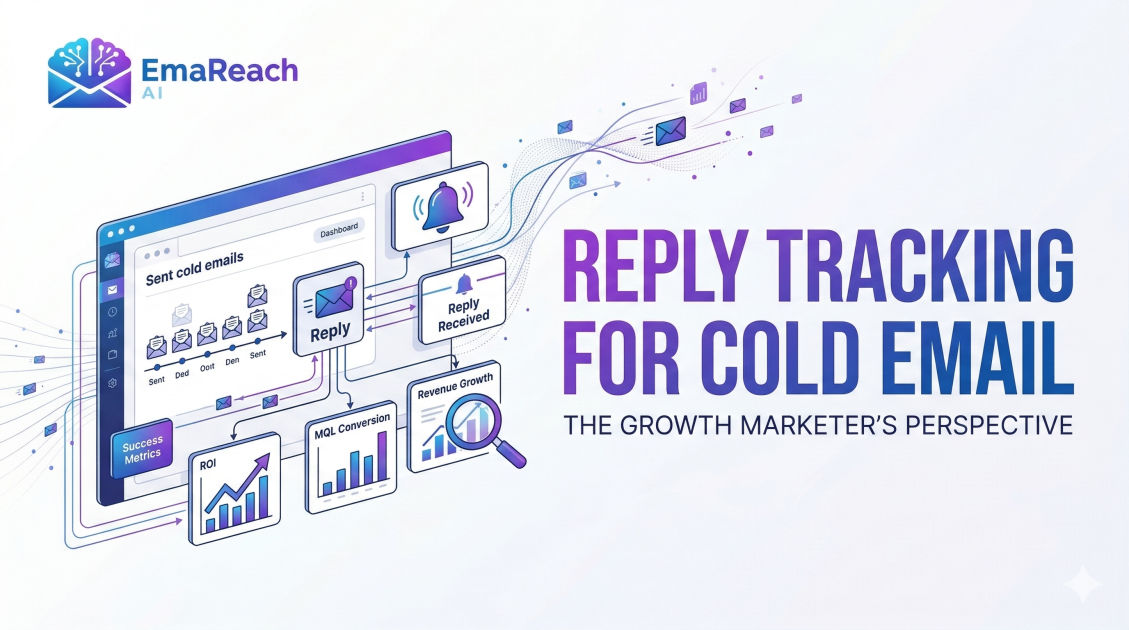
Reply Tracking for Cold Email: The Growth Marketer's Perspective
cold emailgrowth marketingsales automationlead generationemail deliverabilitymarketing analytics
Introduction: The Invisible Engine of Cold Outreach
In the world of high-velocity growth marketing, data is the only currency that matters. While many marketers obsess over open rates and click-through rates, the true North Star metric for any successful cold email campaign is the reply. However, simply getting a reply isn't enough. To scale a business from a few leads a month to a predictable revenue machine, you must master the art and science of reply tracking.
Reply tracking is often misunderstood as a passive administrative task—something that happens automatically in your CRM. From a growth marketer’s perspective, it is a sophisticated feedback loop. It tells you not just who is interested, but why they are interested, how long it took them to reach that point, and which psychological triggers in your copy actually moved the needle.
Without robust reply tracking, you are essentially flying blind. You might know your campaign is 'working' because your calendar is filling up, but you won't know how to optimize the process, reduce your cost per acquisition, or effectively attribute your revenue to specific outreach experiments.
The Shift from Vanity Metrics to Meaningful Engagement
For years, the industry benchmark for cold email success was the 'Open Rate.' Growth marketers have since learned that open rates are increasingly unreliable due to privacy protections and automated bot filters. A high open rate might feel good, but it doesn't pay the bills.
Why Replies Matter Most
A reply represents a conscious decision by a prospect to engage with your brand. It is a bridge between a cold stranger and a warm opportunity. In the hierarchy of email metrics, the reply sits at the very top because:
- It signals high intent: Unlike a click, which could be accidental or out of curiosity, a written reply requires effort.
- It protects your sender reputation: Mailbox providers view replies as the ultimate sign of a healthy, non-spammy conversation.
- It provides qualitative data: Replies contain objections, questions, and pain points that no quantitative metric can capture.
The Architecture of a Modern Reply Tracking System
To track replies like a growth marketer, you need more than just an inbox. You need a system that integrates your sending infrastructure with your sales stack. This system typically consists of three layers: the Detection Layer, the Classification Layer, and the Action Layer.
1. The Detection Layer
This is the technical mechanism that identifies when a recipient has responded. While it sounds simple, it becomes complex when managing 'multi-inbox' strategies. If you are sending from twenty different domains to protect your deliverability, you need a centralized 'Master Inbox' or a tracking software that can aggregate these replies in real-time.
2. The Classification Layer
Not all replies are created equal. A growth marketer categorizes replies to understand the 'Sentiment' of the campaign. Common categories include:
- Positive/Interested: The prospect wants a demo or more info.
- Information Seeking: The prospect has questions before committing to a call.
- Not the Right Person: A referral to another stakeholder.
- Not Interested/Stop: A polite or firm rejection.
- Out of Office (OOO): A temporary delay that requires a scheduled follow-up.
3. The Action Layer
What happens after the reply is tracked? This is where automation kicks in. A sophisticated setup will automatically stop the automated sequence for that prospect the moment a reply is detected, preventing the embarrassment of sending a 'Following up on my last email' message after they've already booked a meeting.
Advanced Sentiment Analysis: The Growth Marketer’s Secret Weapon
Growth marketing is about iteration. If you send 1,000 emails and get 30 replies, a standard marketer sees a 3% reply rate. A growth marketer looks at the sentiment of those 30 replies.
If 25 of those replies are 'Not Interested,' the campaign is a failure despite the 3% rate. If 5 replies are 'Interested' and 10 are 'Ask me in six months,' that is a goldmine of future pipeline. Tracking the quality of replies allows you to calculate a 'Positive Reply Rate,' which is a much more accurate predictor of ROI.
By leveraging AI-driven sentiment analysis, marketers can now tag replies automatically. This allows for real-time pivot capabilities. If a new subject line is generating a high volume of replies, but they are all negative, you can kill that experiment within hours rather than waiting days for manual review.
Ensuring Deliverability: The Foundation of Replies
You cannot track a reply that never happens because your email landed in the spam folder. Deliverability and reply tracking are two sides of the same coin. High reply rates improve deliverability, and high deliverability enables more replies.
To maximize these results, many growth teams turn to specialized platforms. For instance, EmaReach helps users stop landing in spam by ensuring cold emails reach the inbox. By combining AI-written outreach with inbox warm-up and multi-account sending, EmaReach ensures your emails land in the primary tab where they can actually be seen and replied to. This technical foundation is essential; without it, your tracking data will be skewed by the 'shadow' of the spam filter.
The 'Master Inbox' Concept and Scalability
When you scale your outreach, you hit a logistical ceiling. Managing replies across dozens of accounts is a nightmare for a sales development representative (SDR). The 'Master Inbox' or 'Unified Inbox' is the growth marketer’s solution to this.
By centralizing all communications, you ensure that no lead falls through the cracks. It also allows for better team collaboration. A manager can jump into any thread to provide coaching, or a technical founder can step in to answer complex product questions, all while the reply is being tracked against the original campaign and lead source.
Integrating Reply Data with Your CRM
For a growth marketer, the CRM is the source of truth. Reply tracking should not exist in a vacuum. When a reply is detected, it should trigger a series of events in your CRM (like Salesforce or HubSpot):
- Update Lead Status: Change from 'Contacted' to 'Engaged.'
- Create a Task: Alert the account executive to follow up manually.
- Log the Conversation: Sync the actual text of the email for context in future calls.
- Attribution Modeling: Link the eventual deal back to the specific email sequence and version that triggered the first reply.
This integration allows you to calculate the LTV (Lifetime Value) of different outreach angles. You might find that one specific 'pain-point' focused email leads to more replies, but a different 'benefit-focused' email leads to higher-value contracts. You only know this if your reply tracking is tied to your bottom-line CRM data.
The Psychology of the Reply: Optimizing for the Response
Tracking replies gives you a front-row seat to the psychology of your target market. Growth marketers use this data to perform 'Gap Analysis.'
If you are getting a high click rate but a low reply rate, your landing page might be doing the talking, but your email isn't inviting a conversation. If you are getting a lot of 'How does this work?' replies, your initial pitch might be too vague.
The 'Low Friction' Reply Strategy
One actionable insight from tracking thousands of replies is the power of the 'Low Friction CTA.' Instead of asking for a 30-minute demo (High Friction), ask a simple 'Yes/No' question.
- High Friction: "Do you have time on Tuesday at 2 PM for a deep dive?"
- Low Friction: "Are you currently using any tools to manage your cloud spend?"
Tracking the replies to these different CTA styles often reveals that low-friction questions lead to a much higher volume of initial engagement, which can then be nurtured into a meeting.
Handling Objections and the 'Negative' Reply
A common mistake in reply tracking is ignoring the 'No.' In growth marketing, a 'No' is just as valuable as a 'Yes' because it helps you refine your targeting.
If you track your 'Not Interested' replies and notice a pattern—for example, a specific industry always says they already have a solution—you can exclude that segment from your future campaigns, saving your sender reputation and your team's time. This 'Negative Tracking' is what separates amateur spammers from professional growth marketers.
Technical Pitfalls in Reply Tracking
Even the best systems can fail. Here are the most common technical hurdles growth marketers face with reply tracking:
1. The Threading Issue
Sometimes, a prospect will reply by starting a new email thread rather than hitting 'Reply' on your original message. Sophisticated tracking tools use 'fuzzy matching' to link these new threads back to the original lead record based on the email address.
2. The Multi-Contact Problem
In Account-Based Marketing (ABM), you might be emailing five people at the same company. If Person A replies, should you stop the emails to Persons B, C, D, and E? A growth marketer sets up 'Account-Level' reply tracking to ensure the company isn't being bombarded once a conversation has started with a stakeholder.
3. The Proxy Reply
Sometimes an assistant or a colleague replies on behalf of the prospect. Your tracking system must be able to recognize this 'Referral Reply' and pivot the campaign to the new contact person automatically.
The Future of Reply Tracking: Predictive Engagement
As we look forward, reply tracking is moving beyond retrospective data and into the realm of predictive analytics. By analyzing the timing, length, and sentiment of past replies, growth marketers are beginning to build models that predict which leads are most likely to reply before the email is even sent.
Machine learning models can analyze historical reply data to suggest the optimal time of day to send an email to a specific job title or industry. For example, your data might show that CTOs are most likely to provide a positive reply on Tuesday mornings, while Marketing Directors are more responsive on Friday afternoons.
Conclusion: Turning Conversations into Growth
Reply tracking is the heartbeat of a sophisticated cold email operation. It is the mechanism that transforms cold outreach from a numbers game into a strategic discipline. By moving beyond simple open rates and focusing on the quality, sentiment, and integration of your replies, you gain the insights necessary to scale your business predictably.
From a growth marketer's perspective, every reply is a data point, every objection is a lesson, and every 'Yes' is a validation of the system. By building a robust detection, classification, and action framework—and ensuring your deliverability is handled by experts—you turn your email outbox into a powerful engine for sustainable growth. Focus on the reply, and the revenue will follow.
EmaReach AI
Ready to scale your cold email outreach?
Join thousands of teams using EmaReach AI for AI-powered campaigns, domain warmup, and 95%+ deliverability. Start free — no credit card required.
Related posts
- Read article
The Instantly Alternative That Finally Gets Outbound Analytics Right
Discover why high-volume cold email requires a shift from surface-level vanity metrics to deep, data-driven revenue attribution, and explore the ultimate alternatives for mastering outbound engineering.
- Read article
What You Gain and What You Give Up When Switching From Instantly
Thinking about migrating your cold email stack? This detailed guide breaks down the exact operational advantages you gain and the core features you sacrifice when switching away from Instantly's popular outreach platform.