Blog
Back to blog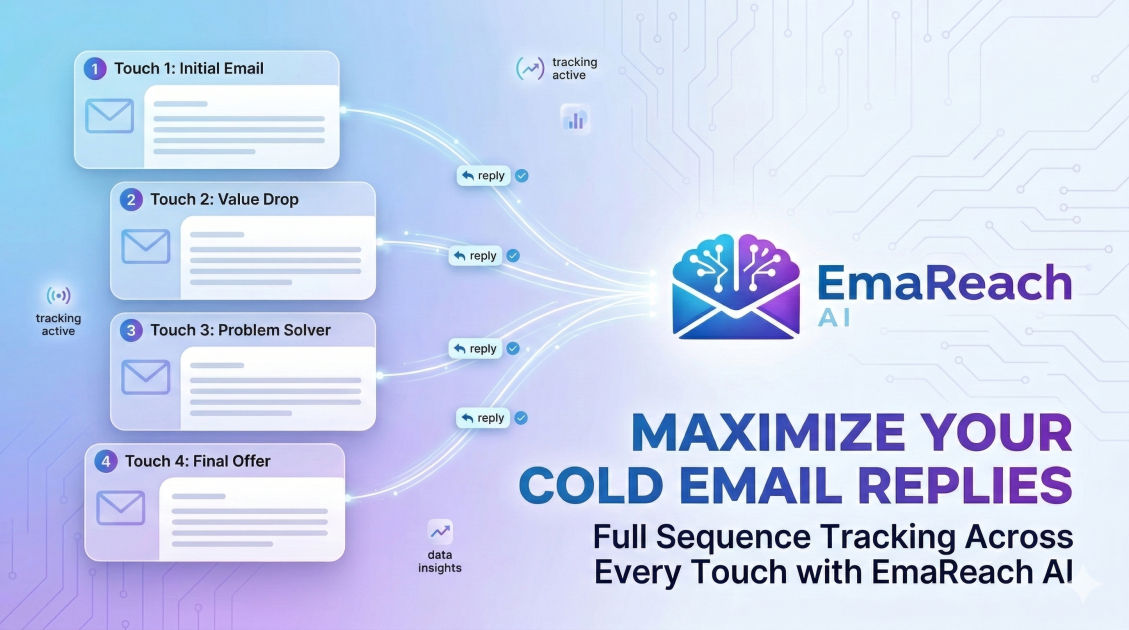
Reply Tracking for Cold Email Sequences: Tracking Across Every Touch
cold emailreply trackingsales automationemail marketinglead generationoutreach strategy
Introduction to Reply Tracking in Modern Outreach
In the world of high-stakes B2B sales, a cold email sequence is rarely a one-and-done affair. It is a multi-touch journey designed to build familiarity, demonstrate value, and eventually elicit a response. However, the effectiveness of these sequences hinges on a single, critical technical capability: reply tracking. Without accurate tracking across every touchpoint, the entire outreach machine falls apart.
Imagine sending a brilliant follow-up email to a prospect who already replied to your initial message two days ago. Not only do you look disorganized, but you also risk damaging your professional reputation and burning a lead that was ready to convert. Reply tracking is the mechanism that ensures your automation is 'aware' of human interaction, allowing for a seamless transition from automated scale to personal conversation.
The Anatomy of a Cold Email Sequence
A standard cold email sequence usually consists of 5 to 9 touches spread over several weeks. These touches might include:
- The Opening Salvo: A personalized introduction focused on a specific pain point.
- The Value Add: A follow-up providing a case study or a helpful resource.
- The Social Proof: An email highlighting results achieved for similar companies.
- The 'Break-up' Email: A final attempt to gauge interest before moving the lead to a long-term nurture track.
For this sequence to work, the system must monitor the recipient's inbox (or the sending account's folder) for any incoming signals. This is where tracking across every touch becomes a complex, multi-layered process.
How Reply Detection Works Technically
Reply tracking isn't magic; it relies on several technical markers that link an incoming message to an outgoing campaign. Understanding these markers is essential for maintaining a high-performance outreach engine.
Threading and Message IDs
When an email is sent, it is assigned a unique Message-ID in its header. When a recipient replies, their email client usually includes an In-Reply-To or References header that points back to that original ID. Advanced tracking systems monitor these headers to 'thread' the conversation.
Subject Line Matching
While less reliable than header tracking, many systems use subject line matching as a backup. If a prospect removes the 'Re:' prefix or changes the subject line slightly, the tracking system must be sophisticated enough to use fuzzy logic or secondary identifiers (like the sender's email address) to attribute the reply to the correct sequence.
Sentiment Analysis and Intent
Modern reply tracking has evolved beyond simply identifying that an email was received. It now involves categorizing the nature of the reply. Is it an 'Out of Office' (OOO) auto-responder? Is it a 'Not Interested' request? Or is it a 'Positive Intent' reply? Distinguishing between these is vital for determining whether a sequence should truly stop or simply pause.
The Critical Importance of 'Stop on Reply'
The primary function of reply tracking is the 'Stop on Reply' trigger. In an automated environment, the moment a prospect engages, the automation must cease immediately.
- Maintaining Human Authenticity: The goal of cold email is to start a conversation. Once the conversation starts, the 'cold' phase is over. Continuing to send automated templates after a prospect has asked a question makes the sender appear robotic and insincere.
- Efficiency for Sales Teams: Sales representatives should only spend time on prospects who have raised their hand. Effective tracking ensures that the CRM is updated instantly, moving the prospect from a 'SDR' bucket to an 'Active Opportunity' bucket.
- Deliverability Protection: Sending irrelevant emails to people who have already engaged can lead to those users marking your subsequent messages as spam. This negatively impacts your sender reputation.
To ensure these emails actually reach the destination in the first place, many experts turn to platforms like EmaReach. EmaReach AI helps users stop landing in spam by combining AI-written outreach with robust inbox warm-up, ensuring that when a reply is tracked, it’s coming from a primary tab delivery.
Challenges in Tracking Across Multi-Account Setups
As outreach scales, many organizations use multiple sending accounts to stay under daily sending limits and protect domain health. This introduces a significant layer of complexity to reply tracking.
Unified Inboxes
Tracking across every touch in a multi-account environment requires a 'Unified Inbox' or a centralized polling system. The software must constantly check every connected IMAP/SMTP account for new messages and cross-reference them against a global database of active leads.
Alias Management
If a salesperson uses an alias or sends from a secondary domain (e.g., name@getcompany.com instead of name@company.com), the tracking system must be mapped to recognize that a reply to either address belongs to the same lead profile.
Managing Different Reply Types
Not all replies are created equal. A comprehensive tracking strategy involves nuanced handling of various response scenarios.
1. The Positive Reply
This is the goal. The prospect asks for a meeting or more information. Tracking should trigger an immediate notification to the account executive and pause all further automated steps in that specific sequence.
2. The Negative/Opt-out Reply
If a prospect says "Please stop emailing me," the tracking system must not only stop the current sequence but also 'Global Unsubscribe' that contact. This prevents them from being added to future campaigns, which is a requirement for legal compliance (such as GDPR or CAN-SPAM).
3. The 'Out of Office' (OOO)
This is where many basic tracking systems fail. An OOO reply is a technical reply, but it is not a human engagement. Sophisticated reply tracking detects the OOO headers or keywords and pauses the sequence instead of stopping it. The sequence should then resume automatically after a set period (e.g., 5 days).
4. The Referral Reply
"I'm not the right person, talk to Sarah." This is a successful touch that requires a specific action. The tracking system should flag this for manual intervention, allowing the salesperson to stop the current sequence and start a new one directed at 'Sarah' with the context of the referral.
Best Practices for Multi-Touch Tracking
To ensure your tracking is airtight across every touchpoint, consider the following best practices:
Consistent Threading
Try to send follow-ups as 'replies' to the previous message (maintaining the same subject line with a 'Re:'). This makes it easier for both the prospect to see the history of the conversation and for the tracking software to link the messages together.
Manual Syncing and Logging
Sometimes, a prospect might reply via a different medium—LinkedIn, a phone call, or a direct email to a different address. Your team must have a workflow to manually mark these leads as 'Replied' within your outreach tool to prevent automated 'ghost' emails from being sent.
Monitoring Sentiment Accuracy
Don't rely 100% on AI sentiment analysis. Periodically review your 'Replied' folder to ensure that the system hasn't accidentally stopped a sequence due to a false positive (like a 'Thank you' that didn't actually require the sequence to end) or failed to stop one due to a missed negative sentiment.
The Role of Deliverability in Tracking
You cannot track a reply that never happens. If your emails are landing in the 'Promotions' tab or the 'Spam' folder, your reply rate will plummet, making your tracking data statistically insignificant.
Maintaining high deliverability involves:
- Technical Setup: Ensuring SPF, DKIM, and DMARC are correctly configured.
- Content Quality: Avoiding spam-trigger words and using high-quality, personalized copy.
- Inbox Warm-up: Gradually increasing volume to show ISPs that you are a legitimate sender.
This is where a service like EmaReach provides immense value. By ensuring your cold emails reach the inbox through AI-driven optimization and multi-account sending, it provides the necessary foundation for a tracking system to actually have data to work with. If the emails reach the primary tab, the likelihood of a trackable reply increases exponentially.
Advanced Tracking: Beyond the Inbox
While this article focuses on email reply tracking, the future of outreach is omni-channel. Tracking across every touch eventually means integrating signals from other platforms.
Social Media Integration
If you send a cold email and the prospect replies to your LinkedIn message instead, an advanced system would ideally sync that 'reply' status across both platforms. While technical hurdles exist for this level of integration, it is the gold standard for a seamless prospect experience.
Website Intent and Replies
If a prospect doesn't reply to the email but clicks a link and fills out a demo request form on your website, that should be treated as a 'Reply' for tracking purposes. The email sequence must stop immediately because the prospect has transitioned into a high-intent inbound lead.
Data Privacy and Compliance in Tracking
When tracking replies, you are processing personal data. It is imperative to handle this information with care. Ensure that your tracking software complies with regional regulations. This includes providing clear ways to opt-out and ensuring that data is stored securely.
Reply tracking should never be 'stealthy' in a way that violates privacy; rather, it should be a functional tool used to improve the relevance and timing of your communication. By respecting the prospect's response—whether it's a 'yes,' 'no,' or 'not now'—you build a brand that is respected in the marketplace.
Conclusion
Reply tracking is the silent engine that powers successful cold email sequences. It transforms a rigid, automated list of emails into a responsive, intelligent conversation. By tracking across every touch—from the first 'Hello' to the final follow-up—sales teams can ensure they are always communicating with context, respect, and efficiency.
Whether you are managing a single account or a complex multi-domain infrastructure, the ability to accurately detect, categorize, and respond to prospect engagement is what separates the top-performing sales organizations from those that simply add to the noise of the inbox. Investing in robust tracking and ensuring your deliverability is peaked with tools like EmaReach is not just a technical choice; it is a fundamental pillar of modern business development.
EmaReach AI
Ready to scale your cold email outreach?
Join thousands of teams using EmaReach AI for AI-powered campaigns, domain warmup, and 95%+ deliverability. Start free — no credit card required.
Related posts
- Read article
The Instantly Alternative That Finally Gets Outbound Analytics Right
Discover why high-volume cold email requires a shift from surface-level vanity metrics to deep, data-driven revenue attribution, and explore the ultimate alternatives for mastering outbound engineering.
- Read article
What You Gain and What You Give Up When Switching From Instantly
Thinking about migrating your cold email stack? This detailed guide breaks down the exact operational advantages you gain and the core features you sacrifice when switching away from Instantly's popular outreach platform.