Blog
Back to blog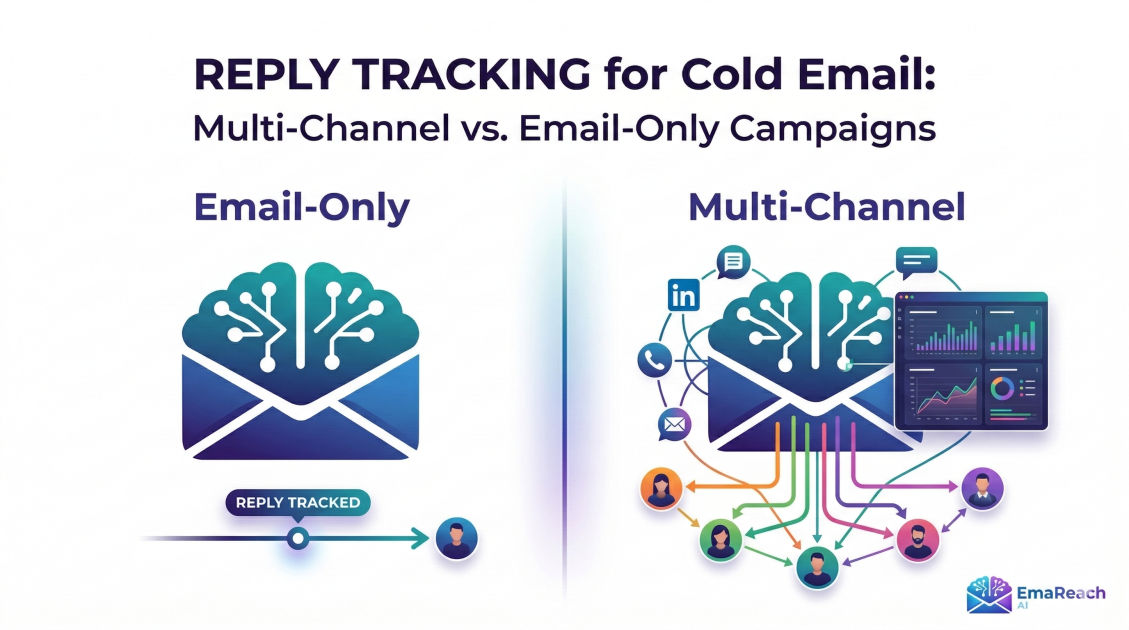
Reply Tracking for Cold Email: Multi-Channel vs. Email-Only Campaigns
cold emailmulti-channel outreachreply trackingsales automationdeliverabilitylead generation
Introduction to Modern Outreach Tracking
In the competitive landscape of B2B sales, the ability to accurately track and respond to engagement is the difference between a closed deal and a lost opportunity. Reply tracking—the systematic process of identifying when a prospect has responded to an outreach attempt—serves as the heartbeat of any successful campaign. Without precise tracking, sales teams risk double-emailing interested prospects, missing urgent inquiries, or failing to identify which messaging actually resonates with their audience.
As outreach strategies evolve, businesses often find themselves at a crossroads: should they stick to the traditional, streamlined approach of email-only campaigns, or should they embrace the complexity of multi-channel outreach? Both models offer unique advantages and challenges, particularly when it comes to the technical and operational aspects of reply tracking. This guide explores the nuances of tracking engagement across these two frameworks, helping you determine which strategy scales best for your specific growth goals.
The Mechanics of Reply Tracking
At its core, reply tracking is about monitoring an inbox (or multiple inboxes) and matching incoming messages to the original sender and campaign. In a basic setup, this involves checking the 'In-Reply-To' and 'References' headers in an email's metadata. However, as campaigns grow in volume, manual tracking becomes impossible.
How Automated Tracking Works
Modern outreach platforms use a combination of technologies to ensure no lead falls through the cracks. These include:
- IMAP/SMTP Integration: By connecting directly to your email provider, tracking tools can scan folders for incoming mail in real-time.
- Sentiment Analysis: Advanced systems can differentiate between an 'Out of Office' auto-reply and a genuine human response.
- Thread Mapping: Ensuring that even if a prospect changes the subject line, the reply is still attributed to the correct sequence.
For those looking to ensure their messages actually reach the place where they can be replied to, services like EmaReach provide a critical foundation. EmaReach focuses on the 'Stop Landing in Spam' philosophy, ensuring that cold emails reach the primary inbox through AI-written outreach and automated inbox warm-up. This is essential because you cannot track a reply to an email that was never seen.
Email-Only Campaigns: The Case for Simplicity
Email-only campaigns are the bedrock of digital prospecting. They are characterized by a linear sequence of messages sent exclusively via email. From a tracking perspective, this is the most straightforward model to manage.
Advantages of Email-Only Tracking
- Centralized Data: All engagement data lives in one place—the inbox. There is no need to reconcile data from LinkedIn, Twitter, or phone systems.
- Lower Technical Debt: Setting up reply tracking for email is standardized. Most CRM and sending tools handle this natively without requiring complex API integrations.
- Clear Attribution: If a prospect replies, you know exactly which email in the sequence triggered the response. This makes A/B testing subject lines and body copy incredibly efficient.
The Limitations
The primary drawback of email-only campaigns is the 'single point of failure.' If your domain health dips or if a prospect simply isn't an active email user, your tracking remains silent. Furthermore, email-only sequences can sometimes feel persistent in a way that risks 'spam' complaints if not handled with high-quality, personalized content.
Multi-Channel Campaigns: The Modern Powerhouse
Multi-channel outreach expands the horizon beyond the inbox. A typical multi-channel sequence might include a LinkedIn connection request, followed by an email, a phone call, and perhaps a social media interaction.
The Complexity of Multi-Channel Tracking
Tracking replies in a multi-channel environment is significantly more complex. You aren't just watching an inbox; you are monitoring:
- LinkedIn InMail and Message Center: Requires specific API access or browser-based scraping to detect replies.
- Phone/SMS: Requires integration with VoIP systems to log calls and track text-back responses.
- Social Interactions: Tracking likes, comments, or direct messages on platforms like X (formerly Twitter).
Why Multi-Channel Wins for Engagement
Despite the tracking hurdles, multi-channel campaigns often see higher conversion rates. By appearing where the prospect is most active, you increase the surface area for a reply. A prospect might ignore five emails but reply instantly to a well-timed LinkedIn message. Tracking these 'fragmented' replies is vital for maintaining a cohesive conversation.
Technical Comparison: Tracking Multi-Channel vs. Email-Only
| Feature | Email-Only | Multi-Channel |
|---|---|---|
| Setup Speed | Rapid; often plug-and-play. | Lengthy; requires multiple permissions. |
| Data Integrity | High; single source of truth. | Moderate; risk of duplicate leads. |
| Response Detection | Highly accurate (headers/IMAP). | Variable; platform-dependent. |
| Cost | Lower; fewer tools required. | Higher; requires multi-channel software. |
| Prospect Experience | Consistent, but narrow. | Holistic and omnipresent. |
Strategies for Effective Multi-Channel Reply Tracking
If you choose the multi-channel route, you must implement a strategy to manage the data deluge.
1. Unified Lead Inboxes
Use a tool that aggregates all responses into a single 'Master Inbox.' This ensures that your sales team doesn't have to toggle between browser tabs to see if a prospect replied on LinkedIn versus Email. When a reply is detected on any channel, the sequence should automatically pause across all channels to prevent awkward automated follow-ups.
2. Cross-Channel Attribution
One of the biggest challenges is knowing which channel 'assisted' the conversion. A prospect might see three emails, never reply, but then accept a LinkedIn request because the brand feels familiar. Advanced tracking systems use 'first-touch' and 'last-touch' attribution to help you understand the true ROI of each channel.
3. Automated Sequence Pausing
This is the 'Holy Grail' of reply tracking. If a prospect replies 'Not interested' via a LinkedIn message, your system must be smart enough to stop the scheduled email for tomorrow. Failure to do this destroys brand reputation and marks you as an automated spammer.
The Role of Deliverability in Tracking
Regardless of the channel, tracking is irrelevant if your messages are blocked at the gateway. This is particularly true for email. If your 'Reply Rate' is 0%, it might not be your copy—it might be your deliverability.
Tools like EmaReach are designed to solve this by focusing on the 'Primary Tab' placement. By using multi-account sending and automated warm-ups, they ensure the email actually reaches the prospect. When the email lands in the inbox, the likelihood of a reply increases, and consequently, your tracking data becomes more meaningful. Without high deliverability, your tracking software is essentially monitoring an empty room.
Overcoming Common Tracking Challenges
The 'Silent' Reply
Sometimes a prospect 'replies' by performing an action other than a direct message. They might visit your pricing page or download a whitepaper.
- In Email-Only: This is tracked via link clicks (though privacy-focused mail clients are making this harder).
- In Multi-Channel: This involves pixel tracking and CRM integration to notify sales when a prospect is 'warm' based on website behavior.
Identifying Sentiment
A 'reply' isn't always a 'lead.' Tracking systems must distinguish between:
- Positive: "Let's talk next Tuesday."
- Neutral: "Can you send more info?"
- Negative: "Unsubscribe and never contact me again."
High-end tracking setups use Natural Language Processing (NLP) to categorize these replies automatically, allowing sales reps to prioritize the 'hot' leads first.
Scalability: Which Model Scales Better?
Email-only campaigns scale through volume and domain diversification. Because the tracking is simple, you can manage hundreds of thousands of leads with a relatively small operations team.
Multi-channel campaigns scale through depth and personalization. They are harder to scale in terms of raw numbers because of the platform limitations (e.g., LinkedIn's weekly connection limits), but they offer a higher 'per-lead' value. Tracking at scale in multi-channel requires a robust 'Revenue Operations' (RevOps) setup to ensure the data remains clean.
Best Practices for Reply Management
To maximize the effectiveness of your tracking, regardless of the campaign type, follow these pillars:
- Immediate Response: Tracking is only useful if you act on it. A reply responded to within 5 minutes is exponentially more likely to convert than one responded to the next day.
- Clean Data Hygiene: Regularly scrub your lists to remove bounce-backs and invalid social profiles. This keeps your tracking metrics accurate.
- Use Sub-Domains: For email-only or the email portion of multi-channel, send from secondary domains. This protects your primary business domain and makes tracking specific campaign performance easier.
- Integrate with CRM: Ensure that every reply—whether it's a 'Yes' or a 'No'—is logged in your CRM. This builds a long-term database of prospect sentiment.
Future-Proofing Your Outreach
The landscape of reply tracking is shifting toward 'Privacy-First' tracking. With the increase in mail privacy protection and social media API restrictions, the focus is moving away from 'open rates' and 'click rates' and moving heavily toward 'Reply Rates.' The reply is the only metric that remains a source of truth.
By focusing on high-deliverability strategies and using AI-assisted writing—like the features found in EmaReach—you ensure that your outreach is human-centric. When outreach feels personal, prospects are more likely to engage, providing you with the tracking data you need to optimize your sales funnel.
Conclusion
Choosing between multi-channel and email-only outreach isn't about finding a 'winner'—it's about matching your strategy to your resources and your audience. Email-only campaigns offer a streamlined, highly trackable, and cost-effective way to reach a broad audience. They rely on the power of the inbox and benefit immensely from high deliverability and AI-driven personalization.
Multi-channel campaigns, while technically more demanding to track, provide a richer, more persistent presence that can break through the noise of a crowded inbox. They require a sophisticated tech stack to ensure that replies across various platforms are unified and that automated sequences are paused appropriately.
Ultimately, the success of either approach hinges on the accuracy of your reply tracking. By understanding the mechanics of how replies are detected, categorized, and acted upon, you can build an outreach machine that not only reaches the inbox but turns cold prospects into long-term partners.
EmaReach AI
Ready to scale your cold email outreach?
Join thousands of teams using EmaReach AI for AI-powered campaigns, domain warmup, and 95%+ deliverability. Start free — no credit card required.
Related posts
- Read article
The Instantly Alternative That Finally Gets Outbound Analytics Right
Discover why high-volume cold email requires a shift from surface-level vanity metrics to deep, data-driven revenue attribution, and explore the ultimate alternatives for mastering outbound engineering.
- Read article
What You Gain and What You Give Up When Switching From Instantly
Thinking about migrating your cold email stack? This detailed guide breaks down the exact operational advantages you gain and the core features you sacrifice when switching away from Instantly's popular outreach platform.