Blog
Back to blog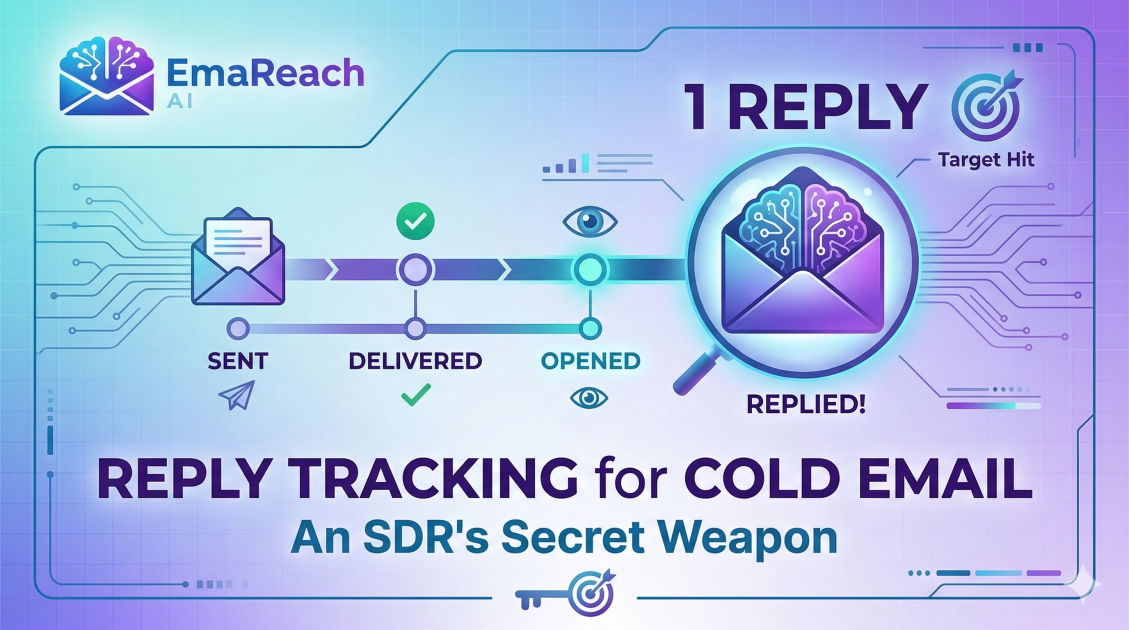
Reply Tracking for Cold Email: An SDR's Secret Weapon
cold emailSDR strategyoutbound salesemail trackingsales productivitylead generation
Introduction: The Invisible Metric That Changes Everything
In the high-stakes world of outbound sales, Sales Development Representatives (SDRs) are often obsessed with open rates. It is a vanity metric that feels good—seeing a 60% open rate suggests your subject line was catchy. But as any seasoned pro will tell you, opens don't pay the bills. The real magic happens when a prospect hits 'Reply.'
Reply tracking is the practice of monitoring, categorizing, and analyzing every response received from a cold email campaign. While it sounds simple, it is the fundamental 'secret weapon' that separates top-performing SDRs from those who are simply shouting into the void. This guide explores why reply tracking is the ultimate lever for sales success and how to master it to explode your pipeline.
The Psychology of the Reply
When a prospect replies to a cold email, they are moving from a passive state to an active one. They have granted you the most valuable resource in modern business: their attention. Whether the reply is a 'Yes, let's talk,' a 'Not right now,' or even a 'Remove me from your list,' it provides data.
Without structured reply tracking, this data is lost in the chaos of a crowded inbox. SDRs who master this discipline understand that every reply is a signal. A 'Not interested' today might actually mean 'We don't have the budget until next quarter.' If you aren't tracking that reply and setting a task to follow up in three months, you are leaving money on the table.
Why Reply Tracking is Your Competitive Advantage
1. Accurate Attribution and ROI
Most marketing and sales teams track the 'top of the funnel' (sends) and the 'bottom of the funnel' (closed deals). The middle—the conversation phase—is often a black box. Reply tracking allows you to see exactly which messaging angles are sparking conversations.
2. Protecting Your Sender Reputation
Reply tracking isn't just about sales; it’s about technical health. High reply rates signal to Email Service Providers (ESPs) like Google and Outlook that your content is valuable. This improves your deliverability. If you want to ensure your messages stay out of the junk folder, using a service like EmaReach can help. EmaReach AI combines AI-written cold outreach with inbox warm-up and multi-account sending, ensuring your emails land in the primary tab where they can actually get those tracked replies.
3. Iterative Messaging Improvements
By categorizing replies, you can perform 'sentiment analysis.' If 40% of your replies are 'Unsubscribe,' your targeting is off. If 20% are 'Too expensive,' you need to lead with more value or ROI-based social proof. This level of granular insight is only possible with rigorous tracking.
The Anatomy of a Comprehensive Reply Tracking System
To turn reply tracking into a secret weapon, you need more than just a folder in your inbox. You need a system that captures four key data points for every response:
- Response Sentiment: Was it positive, neutral, or negative?
- Response Time: How long did it take for the prospect to reply after receiving the email?
- Sequence Step: Which specific email in your cadence triggered the reply?
- Objection Category: If they said no, why did they say no?
Positive vs. Negative Replies: The SDR’s North Star
Not all replies are created equal. A high reply rate is actually a bad thing if 90% of those replies are telling you to go away.
Positive Replies (The Goal)
These are your 'Booked Meetings' or 'Information Requests.' These should be tracked with the highest priority. When an SDR sees a pattern of positive replies from a specific industry, they can pivot their entire week’s focus to double down on that niche.
Neutral/Nurture Replies
'Check back in six months' is a neutral reply. In a standard sales environment, these often fall through the cracks. In an elite SDR environment, these are logged in the CRM with a mandatory follow-up date. This builds a 'future pipeline' that makes hitting quotas easier in the coming months.
Negative Replies
Negative replies are actually a gift. They tell you who to stop wasting time on. By tracking 'Not Interested' responses, you can clean your lead lists and ensure you aren't damaging your brand by repeatedly emailing people who have clearly opted out.
Identifying the 'Golden Email' in Your Sequence
Most SDR sequences consist of 5 to 12 touchpoints. Without reply tracking, you might think the whole sequence is working. With tracking, you might discover that 80% of your replies come from Email #3—the 'Case Study' email.
This insight allows you to:
- Move the high-performing content earlier in the sequence.
- Rewrite the underperforming emails (#1, #2, and #4).
- Shorten the sequence to save time and resources.
The Role of Deliverability in Reply Rates
You cannot track a reply if the email was never seen. This is where the technical side of the 'secret weapon' comes into play. If your emails are landing in the 'Promotions' tab or the Spam folder, your reply rate will stay at zero regardless of how good your copy is.
To combat this, modern SDRs use sophisticated infrastructure. Using a tool like EmaReach allows you to manage multi-account sending. This spreads your volume across different domains and accounts, keeping your 'sender score' high. When your emails land in the primary inbox consistently, your tracking data becomes statistically significant and actionable.
Advanced Strategy: Response Time Optimization
Speed to lead is a well-known concept for inbound leads, but it applies to cold email replies too. When a prospect replies to a cold email, they are 'in the zone.' They are thinking about the problem you solved in your email right now.
By tracking the time it takes for an SDR to respond to a reply, management can identify bottlenecks. If an SDR takes 24 hours to respond to a 'Let's talk' email, the meeting booking rate drops significantly. Top-tier teams aim for a 'reply-to-reply' time of under 15 minutes.
Overcoming the 'No' with Data
One of the most powerful uses of reply tracking is objection handling. If you track every objection, you will notice patterns.
- Objection: "We already use a competitor."
- Tracking Action: Log the competitor name.
- Strategic Outcome: Create a 'Competitor Battlecard' specifically for those prospects.
Without tracking, these objections are just annoying hurdles. With tracking, they are a roadmap for your marketing team to create better collateral.
Human vs. Automated Reply Tracking
As you scale, tracking every reply manually becomes impossible. Automation is necessary, but it must be handled with care.
Automated Sentiment Tagging
Many platforms now use Natural Language Processing (NLP) to automatically tag a reply as 'Interested' or 'Not Interested.' While helpful, an SDR should always do a final sweep to ensure the nuance isn't lost. For example, a prospect saying "This looks interesting, but I'm busy" might be tagged as 'Interested' by an AI but needs a specific 'nurture' follow-up from a human.
The Feedback Loop
Reply tracking data should be shared in weekly 'Sales-Marketing Alignment' meetings. If Marketing knows which whitepapers or lead magnets are generating the most positive replies in cold outreach, they can produce more of that specific content.
Best Practices for Maintaining Your Secret Weapon
To ensure your reply tracking remains a reliable source of truth, follow these best practices:
- Clean Your Data Weekly: Ensure every reply has been categorized. An 'Uncategorized' reply is a missed opportunity.
- Track 'Auto-Replies': Out-of-office (OOO) replies are goldmines. They often contain the direct phone number or the name of a colleague who is covering for them. Track these and pivot your outreach accordingly.
- Monitor Reply-to-Unsubscribe Ratio: If your unsubscribes are higher than your positive replies, stop your campaigns immediately and fix your targeting.
- Test One Variable at a Time: When trying to increase your reply rate, only change one thing (the subject line, the CTA, or the value prop). Tracking the results of a multi-variable test is confusing and often inaccurate.
Common Pitfalls in Reply Tracking
Even with the best intentions, SDRs can fall into traps that skew their data:
- Ignoring the 'Bounce': While not a reply, a bounce is a critical data point. High bounce rates kill deliverability. If you aren't tracking bounces alongside replies, your 'Reply Rate %' will be calculated against a false denominator.
- Mistaking 'Open' for 'Interest': Some SDRs track opens so heavily that they follow up too aggressively when someone opens an email five times. Wait for the reply. The reply is the consent to continue the conversation.
- Failure to Update the CRM: If a prospect replies 'Stop,' but the SDR doesn't mark them as 'Opted Out' in the master CRM, another SDR might email them next week. This leads to brand damage and potential legal issues.
Conclusion: Turning Data Into Revenue
Reply tracking is the bridge between 'sending emails' and 'closing deals.' It turns the subjective 'feeling' of a campaign into the objective 'reality' of market feedback. For an SDR, it provides the clarity needed to stop guessing and start executing.
By monitoring sentiment, identifying high-performing touchpoints, and ensuring high deliverability through tools like EmaReach, you transform your cold email outreach from a numbers game into a precision science. Stop looking at your open rates and start obsessing over your replies. That is where the revenue is hidden.
Mastering this secret weapon doesn't happen overnight, but once you begin treats every response as a data point, your path to the leaderboard becomes much clearer. The most successful SDRs aren't the ones who send the most emails—they are the ones who listen most closely to the replies they receive.
EmaReach AI
Ready to scale your cold email outreach?
Join thousands of teams using EmaReach AI for AI-powered campaigns, domain warmup, and 95%+ deliverability. Start free — no credit card required.
Related posts
- Read article
The Instantly Alternative That Finally Gets Outbound Analytics Right
Discover why high-volume cold email requires a shift from surface-level vanity metrics to deep, data-driven revenue attribution, and explore the ultimate alternatives for mastering outbound engineering.
- Read article
What You Gain and What You Give Up When Switching From Instantly
Thinking about migrating your cold email stack? This detailed guide breaks down the exact operational advantages you gain and the core features you sacrifice when switching away from Instantly's popular outreach platform.