Blog
Back to blog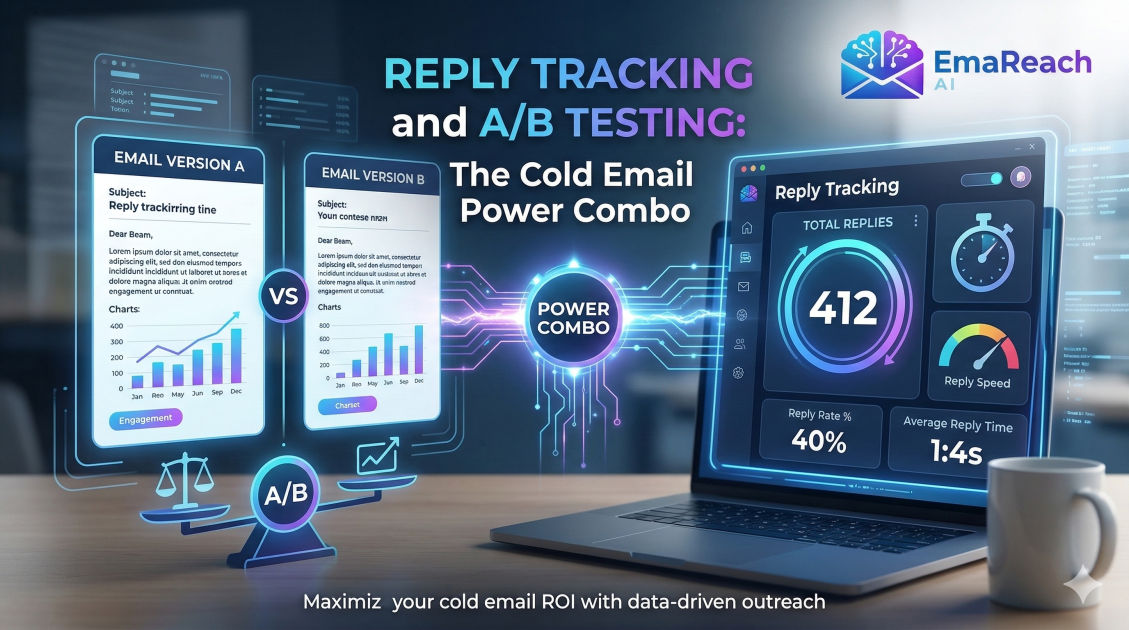
Reply Tracking and A/B Testing: The Cold Email Power Combo
cold emailab testingsales outreachemail marketinglead generationreply trackingdeliverability
Introduction: The Science of High-Performance Outreach
In the competitive world of digital sales, cold email remains one of the most effective channels for generating high-quality leads. However, the days of "spray and pray" are long gone. Today, success is determined by a sender's ability to analyze data, iterate on messaging, and understand exactly what triggers a prospect to click 'Reply'.
Two pillars stand at the center of a modern, data-driven outreach strategy: Reply Tracking and A/B Testing. While many marketers treat these as separate administrative tasks, they are actually two halves of a powerful feedback loop. When combined, they transform cold emailing from a guessing game into a repeatable, scalable science. This guide explores how to leverage this power combo to maximize your conversion rates and ensure your messages never get lost in the noise.
The Fundamental Importance of Reply Tracking
Reply tracking is the practice of monitoring and recording every response received from a cold email campaign. While it sounds simple, its implications for campaign health and strategy are profound. Without accurate reply tracking, you are essentially flying blind.
Beyond the Open Rate
For a long time, open rates were the primary metric for email success. However, with the rise of privacy protections and automated mail filters that "ghost-open" emails to check for malicious content, open rates have become increasingly unreliable. A reply, on the other hand, is a concrete, high-intent action. It is the ultimate confirmation that your message was seen, processed, and deemed worthy of a response.
Sentiment Analysis and Classification
Reply tracking isn't just about counting the number of emails that come back. It’s about classifying them. Are the replies positive (interested), neutral (ask me later), or negative (remove me from your list)? By tracking the sentiment of replies, you can calculate your Positive Response Rate, which is a much more accurate predictor of revenue than simple reply volume.
Maintaining Sender Reputation
Reply tracking also plays a critical role in deliverability. High reply rates signal to Internet Service Providers (ISPs) that your content is valuable and requested. This builds a positive sender reputation. Conversely, if you continue to email prospects who have already replied with a "no," you risk being marked as spam. Effective tracking ensures you stop automated sequences the moment a human engages, protecting your domain health.
A/B Testing: The Engine of Iteration
A/B testing, or split testing, involves sending two slightly different versions of an email to a subset of your audience to see which one performs better. In cold email, small tweaks can lead to massive differences in results.
What Should You Test?
To get the most out of A/B testing, you must focus on variables that move the needle. These include:
- Subject Lines: The gatekeeper of your email. Test curiosity-based vs. benefit-driven subject lines.
- The Opening Line: Does a personalized observation about their LinkedIn profile perform better than a direct value proposition?
- The Call to Action (CTA): Test low-friction CTAs (e.g., "Mind if I send over a quick video?") against high-friction ones (e.g., "Are you free for a 30-minute demo Tuesday?").
- Length and Formatting: Does a short, three-sentence email outperform a detailed, five-paragraph explanation?
The Rules of Scientific Testing
For an A/B test to be valid, you must only change one variable at a time. If you change both the subject line and the CTA, you won't know which change caused the shift in performance. Furthermore, you need a statistically significant sample size. Sending version A to 10 people and version B to 10 people isn't enough to draw a definitive conclusion.
The Power Combo: How They Work Together
When you integrate reply tracking directly into your A/B testing framework, you unlock a level of insight that most competitors lack. This is where the "Power Combo" truly shines.
1. Identifying "Winning" Variations Based on Quality, Not Quantity
Imagine Version A of an email gets a 5% reply rate, but 80% of those replies are "Unsubscribe." Version B gets a 3% reply rate, but 90% of those are "Tell me more." If you were only looking at raw reply volume, you would choose Version A. With integrated reply tracking and sentiment analysis, you correctly identify Version B as the winner.
2. The Feedback Loop for Copywriting
Reply tracking provides the qualitative data needed to improve your A/B tests. If people are replying with the same objection (e.g., "We already use a competitor"), you can use that information to create a new A/B test specifically designed to handle that objection in the initial outreach.
3. Optimizing for Deliverability
Using tools like EmaReach can significantly enhance this process. EmaReach combines AI-written cold outreach with inbox warm-up and multi-account sending. This ensures that while you are testing different message variations, your emails actually reach the primary inbox rather than the spam folder. When your deliverability is stabilized, your A/B test results become much more reliable because you know the lack of replies isn't due to your email being hidden.
Step-by-Step Guide to Implementing the Power Combo
Step 1: Establish Your Baseline
Before you start testing, you need to know your current numbers. Send your existing "best" email to a group of 500 prospects. Track the open rate, reply rate, and positive response rate. This is your control group.
Step 2: Formulate a Hypothesis
Don't test at random. Create a hypothesis: "I believe a shorter, more casual subject line will increase our reply rate because it looks less like a sales pitch."
Step 3: Set Up the Split
Divide your next lead list into two equal parts. Send the control version to Group A and the experimental version (with the new subject line) to Group B. Ensure both groups are pulled from the same industry and persona to keep the test fair.
Step 4: Track and Classify Replies
As responses come in, tag them. Use categories like:
- Positive (Interested/Meeting booked)
- Neutral (Follow up later/Referral to another person)
- Negative (Not interested/Wrong timing)
- Removal (Unsubscribe/Stop emailing)
Step 5: Analyze and Pivot
After a week or two, analyze the data. If the experimental version showed a statistically significant increase in positive replies, it becomes your new baseline. Now, choose a new variable (like the CTA) and start the process again.
Common Pitfalls to Avoid
Even with the best intentions, it's easy to mess up your data. Avoid these common mistakes:
- Testing Too Many Variables: As mentioned, changing multiple things at once invalidates the test.
- Ignoring the "Why": If a test fails, try to understand why. Was the tone too aggressive? Was the value proposition unclear? Use the replies you did get to diagnose the problem.
- Small Sample Sizes: Drawing conclusions from 50 emails is a mistake. Aim for at least 200-500 contacts per variation to ensure the results aren't just a fluke of timing or luck.
- Giving Up Too Soon: Cold email optimization is a marathon. It often takes 5-10 rounds of A/B testing to find a "unicorn" sequence that performs at 3x the industry average.
Advanced Strategies: Multivariate Testing and Lead Scoring
Once you have mastered basic A/B testing and reply tracking, you can move into more advanced territory.
Multivariate Testing
This involves testing multiple combinations of variables simultaneously. For example, testing three different subject lines against two different CTAs. This requires sophisticated software and very large lead lists, but it can find the optimal "combination" much faster than sequential A/B testing.
Integrating with CRM
Ensure your reply tracking data flows back into your CRM. If a prospect replies positively but doesn't book a meeting immediately, they should be moved into a "long-term nurture" bucket. If they reply negatively, they should be suppressed from all future marketing efforts across all channels. This holistic view of the prospect journey is only possible when reply tracking is centralized.
The Role of AI in the Power Combo
Artificial Intelligence is changing the speed at which we can iterate. AI can now analyze thousands of replies across an entire industry to suggest which A/B test variables you should prioritize. Furthermore, AI-driven platforms can automate the sentiment analysis of replies, instantly tagging responses as "Interested" or "Not Interested" with high accuracy. This removes the manual labor of sorting through inboxes and allows sales teams to focus entirely on booking meetings from the positive leads identified.
For those looking to scale this process without the technical headache, EmaReach provides a streamlined solution. By leveraging AI-written outreach that is designed to land in the primary tab, it provides the clean data environment needed for A/B testing to actually work. After all, you can't test what people never see.
Conclusion
Reply tracking and A/B testing are not just "nice-to-have" features; they are the fundamental building blocks of a professional outbound sales operation. By meticulously tracking how prospects respond and constantly testing new ways to engage them, you move away from the frustration of low response rates and toward a predictable, high-growth revenue engine.
Remember that the goal of cold email is to start a conversation. Use your data to listen to what your market is telling you, and use your A/B tests to refine your voice. When you master this power combo, you don't just send better emails—you build better relationships with your future customers.
EmaReach AI
Ready to scale your cold email outreach?
Join thousands of teams using EmaReach AI for AI-powered campaigns, domain warmup, and 95%+ deliverability. Start free — no credit card required.
Related posts
- Read article
The Instantly Alternative That Finally Gets Outbound Analytics Right
Discover why high-volume cold email requires a shift from surface-level vanity metrics to deep, data-driven revenue attribution, and explore the ultimate alternatives for mastering outbound engineering.
- Read article
What You Gain and What You Give Up When Switching From Instantly
Thinking about migrating your cold email stack? This detailed guide breaks down the exact operational advantages you gain and the core features you sacrifice when switching away from Instantly's popular outreach platform.