Blog
Back to blog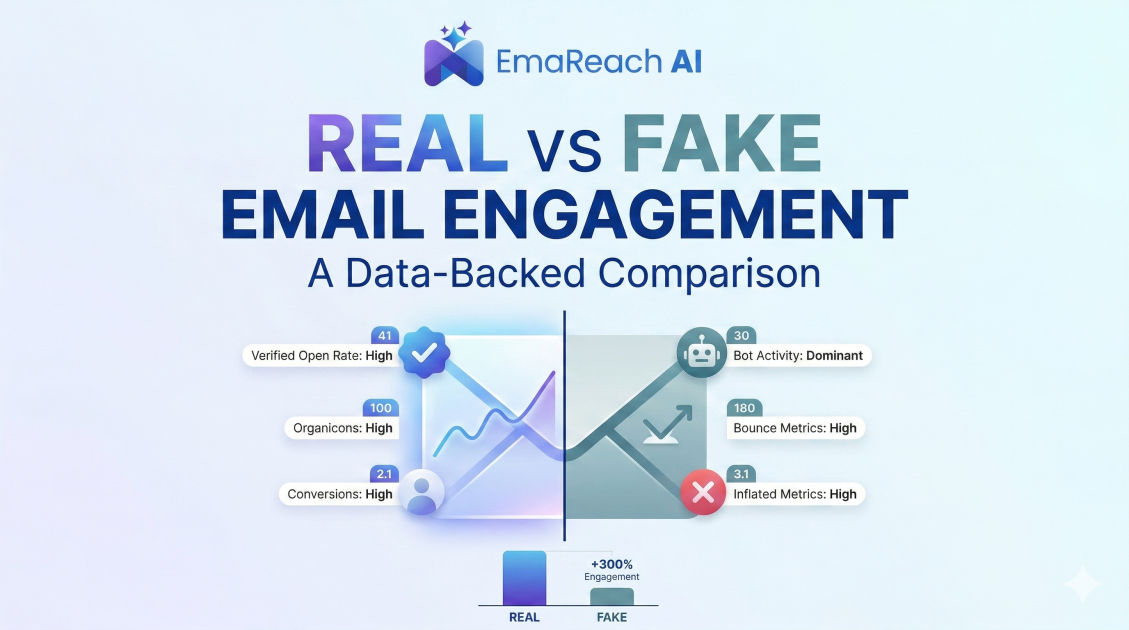
Real vs Fake Email Engagement: A Data-Backed Comparison
email deliverabilitycold outreachemail marketingsender reputationdata analyticsinbox warm-up
Introduction
In the high-stakes world of digital marketing, engagement is the ultimate currency. For email marketers, a high open rate or click-through rate (CTR) is often viewed as the definitive proof of a successful campaign. However, as the ecosystem becomes more complex, a troubling phenomenon has emerged: the rise of fake engagement.
From automated bot clicks to sophisticated security filters that 'pre-read' emails, the data showing up in your analytics dashboard may not always reflect human interest. Understanding the difference between real and fake engagement is no longer just a technical curiosity—it is a fundamental requirement for maintaining sender reputation and ensuring long-term deliverability. This comprehensive guide explores the mechanics of email engagement, the data points that distinguish human interaction from machine activity, and how to optimize your strategy for genuine results.
The Anatomy of Real Engagement
Real engagement occurs when a human recipient receives an email, finds the subject line compelling enough to open it, reads the content, and potentially interacts with a link or reply. This sequence of events triggers a series of signals that ISPs (Internet Service Providers) and inbox providers like Google and Outlook use to determine the quality of a sender.
The Human Behavior Pattern
Human interaction is inherently 'messy' and unpredictable. Data suggests that real engagement follows specific patterns:
- Varied Open Times: Humans check their email at different times throughout the day based on their personal schedules. Even within a segmented list, there is a natural distribution of open times.
- Dwell Time: A human needs time to read. If an email is opened and a link is clicked within 0.5 seconds, it is highly unlikely to be a person.
- Scroll and Click Location: Humans tend to click on specific areas of interest, often after scrolling through at least a portion of the text.
- Device Diversity: Real users interact across mobile, desktop, and tablet devices, often switching between them.
The Value of Positive Signals
Positive engagement signals include moving an email from the 'Promotions' tab to the 'Primary' inbox, marking a sender as a 'Safe Sender,' and, most importantly, replying to the email. These actions tell the ISP that the content is highly relevant, which boosts the sender's reputation and ensures future emails bypass the spam folder.
Understanding Fake Engagement
Fake engagement is any interaction with an email that does not originate from the intended human recipient. This can be categorized into two main types: Non-Human Interactions (NHI) from security filters and malicious bot activity.
Security Filters and 'Pre-fetching'
Many corporate mail servers and advanced security tools (like Barracuda, Mimecast, or Proofpoint) use 'sandboxing' to protect users. When an email arrives, the server automatically 'opens' the email and 'clicks' every link to check for malware or phishing sites before the user ever sees it.
To your ESP (Email Service Provider), this looks like a 100% open rate and a 100% click rate. While it looks great on your report, it is an 'empty' metric. It doesn't represent interest; it represents a security check.
Bot Clicks and Crawlers
In some cases, bots crawl emails to index content or scrape data. These bots can inflate metrics significantly, leading marketers to believe their content is performing better than it actually is. Relying on this data leads to poor decision-making, such as doubling down on content that isn't actually resonating with people.
Data-Backed Comparison: Real vs. Fake
To truly understand the impact, we must look at how these two types of engagement differ in the data logs.
| Feature | Real Engagement | Fake Engagement (Bots/Filters) |
|---|---|---|
| Time to Click | Seconds to minutes after opening | Milliseconds after delivery |
| User Agent | Standard browsers (Chrome, Safari) | Often generic or outdated strings |
| Click Distribution | Focused on primary CTAs | Often clicks every link (including 'Unsubscribe') |
| IP Address | Distributed across residential ISPs | Concentrated in data centers (AWS, Azure) |
| Frequency | One-off or occasional | Perfectly consistent and repetitive |
| Conversion | Leads to sales/signups | Zero down-funnel activity |
The Risk of Fake Engagement
If you ignore fake engagement, you risk a 'Reputation Death Spiral.' If your metrics are inflated by bots, you may fail to see that real humans are actually marking your mail as spam. Furthermore, some ISPs view consistent bot activity as a sign of poor list hygiene, which can lead to your domain being blacklisted.
The Role of Deliverability and Warm-up
When dealing with cold outreach or large-scale campaigns, the biggest hurdle is getting past the initial 'suspicion' phase of an ISP. This is where the distinction between real and fake engagement becomes a matter of survival.
If you send 1,000 emails from a new domain and get 0% engagement, you are instantly flagged as a spammer. If you get 100% 'fake' engagement from security filters, your reputation remains neutral or even slightly negative because the ISP sees no 'positive' human signals like replies or moves to the primary folder.
To bridge this gap, many professionals turn to advanced infrastructure. Stop Landing in Spam. Cold Emails That Reach the Inbox. EmaReach AI combines AI-written cold outreach with inbox warm-up and multi-account sending—so your emails land in the primary tab and get replies. By generating authentic interactions during the warm-up phase, you build the kind of 'real' reputation that ISPs trust.
How to Spot Fake Engagement in Your Reports
Identifying fake engagement requires looking beyond the surface-level percentages. Here are the red flags to watch for:
1. The 'Instant Click' Phenomenon
Check your activity logs. If you notice a high volume of clicks occurring within the same second an email was delivered, you are dealing with machine intervention. No human can react that quickly.
2. High Click-to-Open Ratio
A healthy Click-to-Open Rate (CTOR) is generally between 10% and 20%. If your CTOR is consistently 80% or higher, especially on cold lists, it is almost certainly the result of security filters clicking your links.
3. The Unsubscribe Click Pattern
If you see users 'clicking' the unsubscribe link but remaining on your list (because they didn't complete the second step on the landing page), it’s often a bot checking the link's safety. If this happens across your entire list simultaneously, it's a clear indicator of automated activity.
4. Data Center IP Origins
Use tools to analyze the IP addresses of your 'opens.' If a large portion of your engagement comes from IPs registered to Amazon Technologies or Google Cloud rather than residential providers like Comcast or AT&T, it’s machine-driven.
Strategies to Encourage Real Human Interaction
Once you’ve filtered out the noise of fake engagement, the goal is to maximize the real stuff. Genuine engagement is built on relevance, trust, and timing.
Master the Subject Line
The subject line is the gatekeeper. To get a real open, you must trigger a human emotion: curiosity, urgency, or the promise of value. Avoid 'spammy' triggers like excessive caps or multiple exclamation points, which can alert both bots and humans to delete the message.
Personalization Beyond the First Name
Real engagement comes from content that solves a specific problem. Deep personalization involves referencing a recipient's specific industry, a recent company achievement, or a pain point they are likely experiencing. AI can assist in scaling this level of detail without losing the human touch.
Optimizing for the 'Reply'
A reply is the strongest engagement signal possible. Instead of always pushing for a link click (which can be hijacked by bots), try ending your emails with a simple, open-ended question. This encourages a human response, which signals to the ISP that a real conversation is taking place.
The Importance of List Hygiene
Fake engagement often thrives on 'dirty' lists. If you are sending to dead accounts or 'spam traps' (email addresses specifically designed to catch spammers), your metrics will be skewed, and your reputation will suffer.
- Prune Non-Responders: If an account hasn't opened an email in 6 months, they are likely a 'ghost' or the account is being monitored by a bot. Remove them.
- Validate at Entry: Use real-time email verification to ensure that the addresses being added to your list are valid and active.
- Monitor Bounce Rates: A high bounce rate is a precursor to being identified as a low-quality sender. Keep it under 2%.
Technical Solutions for Accurate Tracking
Marketers are now using more sophisticated methods to ensure they are tracking real humans:
- Hidden Links (Honey Pots): Some marketers include a link that is invisible to humans (using CSS) but visible to bots. If that link gets clicked, the system knows the 'user' is actually a bot and can ignore all other activity from that session.
- Double Opt-In: This ensures that the person who signed up is a real human who can access their inbox and click a confirmation link.
- Click Tracking Delays: Some advanced systems ignore any click that happens within the first few seconds of delivery to filter out security scans.
The Future of Engagement Metrics
As privacy measures like Apple’s Mail Privacy Protection (MPP) become more common, traditional open rates are becoming less reliable. MPP 'opens' emails on behalf of the user, effectively creating a form of 'fake' engagement by default.
This shift is forcing the industry to move toward more meaningful 'down-funnel' metrics. Instead of asking 'Who opened my email?', the question is becoming 'Who spent time on my site?', 'Who replied?', and 'Who converted?'.
Conclusion
Distinguishing between real and fake email engagement is the difference between a strategy built on a house of cards and one built on a solid foundation. While fake engagement might look good on a monthly report, it does nothing for your bottom line and can actively harm your ability to reach your customers. By focusing on authentic human signals—especially replies and move-to-inbox actions—and using the right tools to maintain a clean reputation, you can ensure your outreach remains effective and your domain stays out of the spam folder. Focus on the quality of interaction over the quantity of clicks, and the data will eventually reflect the true growth of your brand.
EmaReach AI
Ready to scale your cold email outreach?
Join thousands of teams using EmaReach AI for AI-powered campaigns, domain warmup, and 95%+ deliverability. Start free — no credit card required.
Related posts
- Read article
The Instantly Alternative That Finally Gets Outbound Analytics Right
Discover why high-volume cold email requires a shift from surface-level vanity metrics to deep, data-driven revenue attribution, and explore the ultimate alternatives for mastering outbound engineering.
- Read article
What You Gain and What You Give Up When Switching From Instantly
Thinking about migrating your cold email stack? This detailed guide breaks down the exact operational advantages you gain and the core features you sacrifice when switching away from Instantly's popular outreach platform.