Blog
Back to blog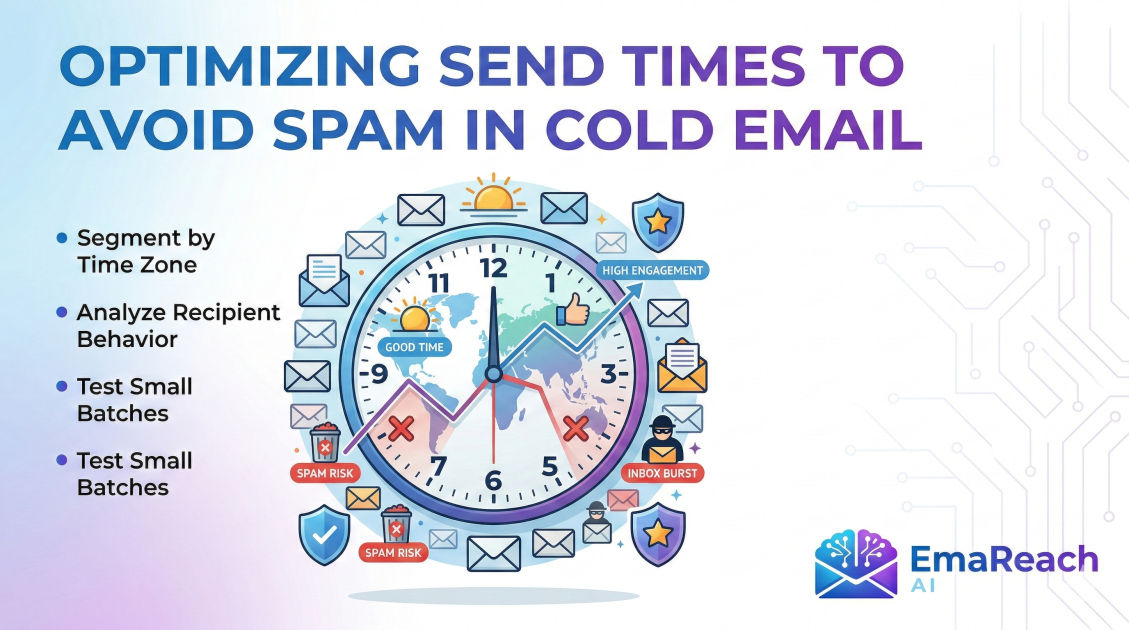
Optimizing Send Times to Avoid Spam in Cold Email
cold emailemail deliverabilityoutreach strategyspam preventionemail marketingsender reputation
Introduction
In the high-stakes world of cold outreach, timing isn't just a detail—it is the bedrock of deliverability. You could have the most compelling value proposition and a perfectly segmented lead list, but if your email arrives at a time that triggers spam filters or gets buried under a mountain of morning clutter, your efforts are wasted. Optimizing send times is a strategic necessity for anyone looking to maintain a healthy sender reputation and ensure high open rates.
When we talk about 'optimizing send times,' we aren't just looking for the 'golden hour' when people click 'open.' We are looking at how sending patterns affect the algorithms used by Internet Service Providers (ISPs) like Google and Microsoft. To land in the primary inbox, your sending behavior must mimic human activity while respecting the technical constraints of mail servers. This guide explores the multi-dimensional approach to timing your cold emails to bypass spam folders and maximize engagement.
The Technical Relationship Between Timing and Spam Filters
Spam filters have evolved far beyond simple keyword detection. Today, they utilize sophisticated behavioral analysis to determine if an account is a legitimate communicator or a bulk-sending bot. Timing plays a massive role in this assessment.
Volume Spikes and Rate Limiting
One of the biggest red flags for an ISP is a sudden 'burst' of outgoing mail. If your account sends 200 emails in a single minute and then remains silent for the rest of the day, it signals automated, non-human behavior. Human beings don't send emails with that kind of mechanical precision.
To stay under the radar, you must implement 'staggering' or 'throttling.' This involves spreading your send volume throughout the day. By optimizing the interval between each email, you ensure that your traffic looks organic. A steady stream of outgoing mail is far less likely to trigger rate-limiting protocols than a massive, concentrated spike.
The Feedback Loop: Engagement as a Deliverability Signal
Modern deliverability is heavily dependent on engagement. If you send 500 emails at 2:00 AM and they sit unopened for eight hours, the ISP notices a lack of immediate interaction. Conversely, if your emails arrive when a lead is actively checking their inbox, the resulting 'open' or 'reply' sends a positive signal to the ISP. High engagement rates tell filters that your content is wanted, which reinforces your sender reputation. Therefore, timing your emails to coincide with peak activity isn't just about sales—it's about technical validation.
Understanding Time Zones and Global Outreach
One of the most common mistakes in cold email is ignoring the recipient's local time. Sending a perfectly crafted email at 10:00 AM in your time zone might mean it lands at 3:00 AM for your prospect.
The 'Morning Purge'
When a professional opens their inbox first thing in the morning, they are often in 'delete mode.' They have dozens, if not hundreds, of emails accumulated overnight. To clear the clutter, they quickly scan and delete anything that looks like a cold pitch. If your email is part of that overnight pile, your chances of being marked as spam increase simply because the recipient is overwhelmed.
Geo-Targeting for Precision
To avoid the morning purge, you must segment your lists by time zone. Your goal should be to arrive in the 'sweet spots' of the professional day:
- Mid-Morning (10:00 AM - 11:30 AM): The initial rush is over, and people are settled into their tasks but still checking their inboxes.
- Early Afternoon (1:30 PM - 3:00 PM): Post-lunch, people often use email as a way to transition back into work mode.
By ensuring your emails land during these windows regardless of where your lead is located, you significantly decrease the likelihood of being ignored or reported as spam.
The Psychology of the Work Week
Just as the time of day matters, the day of the week dictates how a recipient perceives your outreach. Patterns in professional behavior suggest that certain days are inherently higher risk for cold email.
Monday: The Inbox Overload
Monday is generally considered the worst day for cold outreach. Professionals are catching up on weekend backlogs, attending internal meetings, and planning their week. An unsolicited email on Monday is often viewed as an annoyance. If you must send on Monday, aim for the late afternoon when the initial chaos has subsided.
Mid-Week: The Productivity Zone
Tuesday, Wednesday, and Thursday are the 'Power Days' for cold email. By Tuesday, the Monday rush is over. By Wednesday, people are in a steady rhythm. Thursday is often the most productive day for many, making them more open to solutions that can help them achieve their goals. Spreading your volume across these three days provides the most consistent results for both engagement and deliverability.
Friday: The Weekend Slide
Fridays are hit-or-miss. While many people are cleaning up their tasks and might have more time to read, their mental focus is shifting away from new commitments. Sending too late on a Friday ensures your email sits in the inbox all weekend, placing you right at the bottom of the 'Monday Morning Purge' pile.
The Role of Automated Warming and Account Health
Maintaining a healthy send schedule manually is nearly impossible at scale. This is where strategic automation becomes essential. To truly optimize send times and protect your domain, you need a system that manages the nuances of 'warm-up' and volume control.
For those looking to professionalize this process, EmaReach offers a comprehensive solution. By integrating AI-written outreach with sophisticated inbox warm-up and multi-account sending, it ensures that your emails land in the primary tab. Stop Landing in Spam. Cold Emails That Reach the Inbox with EmaReach AI, which effectively mimics human sending patterns across various time zones and accounts so you don't have to manage the technicalities of timing manually.
Frequency and Cadence: Avoiding the 'Spammy' Rhythm
Optimizing send times isn't just about the first email; it's about the entire sequence. If you send five follow-ups at exactly 9:05 AM every three days, you are creating a footprint that is easily identifiable by anti-spam algorithms.
Randomization and Variance
To look like a real person, you need variance. Your first email might go out on a Tuesday morning, but your second should perhaps go out on a Thursday afternoon. Varying the time of day and the gap between emails prevents you from looking like a 'set it and forget it' bot. This randomness is a key factor in bypassing the sophisticated pattern-recognition software used by major email providers.
Managing Follow-up Fatigue
Sending too many emails in too short a window is the fastest way to get your domain blacklisted. If a recipient hasn't responded to three emails, sending a fourth 24 hours later is aggressive and likely to trigger a 'Mark as Spam' action. Optimizing your cadence means giving the recipient enough space to breathe. A well-timed sequence might look like this:
- Day 1: Initial Outreach (Mid-morning)
- Day 4: First Follow-up (Early afternoon)
- Day 9: Second Follow-up (Mid-morning)
- Day 16: Break-up Email (Late afternoon)
This spread-out approach respects the recipient's time and keeps your sending volume consistent and low-risk.
Sending Volume and Scaling Responsibly
One of the most critical aspects of timing is the 'ramp-up' period. You cannot go from sending zero emails to 500 emails overnight. Even if you optimize the hours you send, the sheer jump in volume will trigger security alerts.
The Incremental Approach
Start with a small volume—perhaps 10 to 20 emails per day—and slowly increase that number by 10-15% each week. This 'warm-up' phase allows ISPs to get used to your IP and domain signature. During this phase, optimizing the send time is even more vital because every single interaction (open or reply) carries more weight in building your initial reputation.
Multi-Account Strategy
Instead of sending 200 emails from one account, it is much safer to send 40 emails from five different accounts. This allows you to spread the volume across more 'timing windows' without hitting the individual rate limits of a single mailbox. When these accounts are coordinated to send at different intervals, your overall footprint remains light and non-threatening to spam filters.
Holiday and Seasonal Timing
Seasonal shifts can drastically change what constitutes an 'optimized' send time. During major holidays, the 'rules' of business hours no longer apply. Sending a cold email on December 24th is not just ineffective; it’s a recipe for being reported as spam by a frustrated recipient checking their phone during a family dinner.
The 'Ghost Periods'
Be aware of regional holidays if you are doing international outreach. For example, if you are targeting the UK, being aware of Bank Holidays is essential. Sending during these 'ghost periods' when engagement is guaranteed to be zero will hurt your deliverability metrics. It is better to pause your sequences entirely during these times and resume when your leads are back at their desks.
Analyzing Data to Refine Your Schedule
Every industry has a slightly different heartbeat. While the general rules of mid-morning and mid-week apply to most, your specific niche might behave differently.
Monitoring Open Rates by Hour
Use your outreach analytics to track when your specific audience is most active. Do you see a spike in opens at 7:00 PM? Perhaps you are targeting entrepreneurs who handle their admin after their main business hours. Are your Friday morning emails getting more replies than your Tuesday ones? Double down on what the data tells you.
The Importance of the 'Reply-to-Open' Ratio
High open rates are great, but if they aren't leading to replies, your timing might be off in a different way. If people are opening your emails but not replying, they might be reading them while in a 'consumption' mindset (like commuting or waiting in line) rather than a 'work' mindset. Optimizing for the time when people are most likely to sit down and type a response is the ultimate goal.
Conclusion
Optimizing send times to avoid spam is a delicate balance of technical discipline, geographical awareness, and psychological insight. By staggering your sends, respecting time zones, and avoiding high-stress periods like Monday mornings or holidays, you protect your sender reputation and ensure your message gets the attention it deserves.
Deliverability is not a one-time setup; it is a continuous process of refinement. As spam filters become more intelligent, your sending patterns must become more human. By treating timing as a core pillar of your cold email strategy—rather than an afterthought—you transform your outreach from a numbers game into a precision instrument. Focus on quality, consistency, and the subtle rhythms of the professional world to keep your emails out of the spam folder and in the primary inbox.
EmaReach AI
Ready to scale your cold email outreach?
Join thousands of teams using EmaReach AI for AI-powered campaigns, domain warmup, and 95%+ deliverability. Start free — no credit card required.
Related posts
- Read article
The Instantly Alternative That Finally Gets Outbound Analytics Right
Discover why high-volume cold email requires a shift from surface-level vanity metrics to deep, data-driven revenue attribution, and explore the ultimate alternatives for mastering outbound engineering.
- Read article
What You Gain and What You Give Up When Switching From Instantly
Thinking about migrating your cold email stack? This detailed guide breaks down the exact operational advantages you gain and the core features you sacrifice when switching away from Instantly's popular outreach platform.