Blog
Back to blog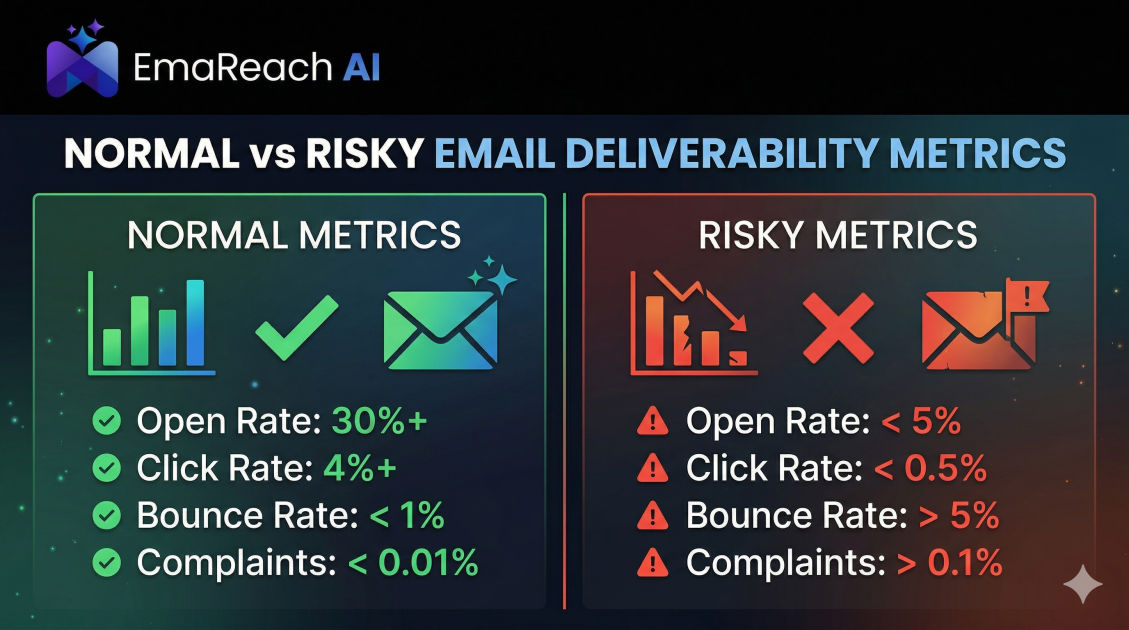
Normal vs Risky Email Deliverability Metrics
email deliverabilitycold emailB2B salesemail marketingsender reputationlead generation
Introduction
In the high-stakes arena of digital marketing and sales outreach, pressing "send" is merely the first step of a much larger technical journey. Whether you are executing a massive cold email campaign to generate B2B leads or sending a critical onboarding sequence to new software users, the ultimate destination is always the same: the primary inbox. However, achieving consistent inbox placement is not a matter of luck; it is a science governed by strict algorithmic rules and sender reputation scoring.
At the core of this science are email deliverability metrics. These data points serve as the vital signs of your sender infrastructure. Interpreting these metrics correctly means the difference between a thriving pipeline and a permanently blacklisted domain. When your metrics fall into the "normal" range, ISPs (Internet Service Providers) like Google and Microsoft trust your infrastructure. When they slip into the "risky" territory, your emails are silently routed to the spam folder, invisible to your target audience.
This comprehensive guide will dissect the critical differences between normal and risky email deliverability metrics. We will explore what these numbers mean, how ISP algorithms interpret them, and the actionable steps you can take to safeguard your domain reputation, ensuring your messages consistently reach the eyes of your intended recipients.
The Crucial Distinction: Delivery vs. Deliverability
Before diving into specific metrics, it is imperative to establish the foundational difference between "email delivery" and "email deliverability."
Email Delivery refers to the simple binary act of an email successfully transferring from your sender server to the recipient's server without bouncing. If the receiving server accepts the message, it is considered "delivered."
Email Deliverability (also known as Inbox Placement Rate) is far more nuanced. It determines where the email lands after it has been accepted by the receiving server. Will it go to the Primary Inbox, the Promotions tab, or the dreaded Spam folder? Deliverability is a measure of trust.
ISPs utilize complex, AI-driven algorithms to analyze billions of emails daily. They scrutinize sender history, domain setup, content quality, and recipient engagement to decide where a message belongs. If your metrics signal positive engagement, you earn inbox placement. If your metrics trigger algorithmic red flags, you are heavily penalized. Understanding the threshold between these two outcomes is the key to mastering cold outreach.
Core Metric 1: The Delivery Rate
The delivery rate is the percentage of emails that successfully reach the recipient's receiving server without generating a bounce back.
Normal Delivery Rate: 95% to 99%+
In a healthy email ecosystem, a delivery rate should almost always exceed 95%. This indicates that your data sourcing is accurate, your lead lists are clean, and you are not attempting to contact defunct servers or non-existent domains.
Risky Delivery Rate: Below 90%
If your delivery rate dips below 90%, you are entering extremely dangerous territory. ISPs interpret low delivery rates as a glaring sign of a "spammer" who is blindly blasting emails to unverified, purchased, or scraped lists.
Actionable Insight: Never send campaigns to unverified lists. Implement a strict data hygiene protocol using email verification tools to ping servers and confirm mailbox existence before initiating any outreach sequence.
Core Metric 2: Bounce Rates (Hard vs. Soft)
Bounces occur when an email cannot be delivered. They are categorized into two distinct types: Hard Bounces and Soft Bounces.
- Hard Bounce: A permanent failure. The recipient's email address does not exist, the domain is invalid, or the receiving server has completely blocked your IP.
- Soft Bounce: A temporary failure. The recipient's mailbox is full, their server is temporarily down, or the message size is too large.
Normal Bounce Rate: Under 2%
Maintaining a total bounce rate (combining hard and soft) below 2% is the industry standard for a healthy sender domain. It shows ISPs that you are actively managing your lists and removing stale contacts.
Risky Bounce Rate: Above 3% (Critical Danger at 5%+)
A bounce rate exceeding 3% immediately damages your sender reputation. If your hard bounce rate spikes above 5%, major email providers may instantly throttle your sending capabilities or blacklist your domain entirely. High bounce rates are the most common trigger for algorithmic penalties.
Actionable Insight: Immediately suppress and delete any address that registers a hard bounce. Do not attempt to re-send. For soft bounces, investigate the underlying cause; if an address soft bounces multiple times across different campaigns, convert it to a hard bounce and remove it from your database.
Core Metric 3: Open Rates - The Contextual Gauge
Open rates measure the percentage of delivered emails that were opened by the recipient. While privacy updates (such as Apple's Mail Privacy Protection) have made open rates less reliable than they once were, they still serve as a directional indicator of subject line effectiveness and initial inbox placement.
Normal Open Rate: 20% to 40%+
For cold email outreach, a normal and healthy open rate sits between 20% and 40%. This indicates that your subject lines are resonating, your timing is appropriate, and most importantly, your emails are landing in the primary inbox where they can actually be seen.
Risky Open Rate: Below 15% (or Suspiciously High)
An open rate below 15% is a strong indicator of one of two problems: either your subject lines are completely failing to capture attention, or your emails are landing in the spam folder (where they are never seen or opened).
Conversely, an open rate of 80% to 100% is also a "risky" metric, as it almost certainly indicates bot activity. Corporate firewalls and enterprise security software often "open" every incoming email to scan for malicious links before passing them to the user. Relying on artificially inflated open rates can severely skew your campaign data.
Actionable Insight: Focus on absolute deliverability rather than obsessing over slight fluctuations in open rates. Write subject lines that are concise, highly relevant, and devoid of spam-trigger words (e.g., "Free," "Guarantee," "Act Now").
Core Metric 4: Reply Rates - The Ultimate Signal
For B2B outreach and cold email campaigns, the reply rate is the single most important metric. It measures the percentage of recipients who took the time to write back to you. ISPs weigh positive replies incredibly heavily when calculating sender reputation. A reply is the ultimate proof that your message was wanted.
Normal Reply Rate: 5% to 15%
In a well-researched, highly targeted cold email campaign, generating a reply rate of 5% to 15% is considered a massive success. This normal range proves that your offer aligns with the audience's pain points and that your copy is compelling enough to elicit a conversation.
Risky Reply Rate: Below 1%
A reply rate below 1% means your campaign is failing to connect. From a deliverability standpoint, sending thousands of emails and receiving zero replies signals to ISPs that your content is irrelevant bulk mail. Over time, this lack of positive engagement will slowly drag your domain reputation down, eventually leading to spam folder routing.
Actionable Insight: Personalize your outreach at scale. Move beyond basic "First Name" merge tags. Segment your lists by industry, technology stack, or recent company news to craft messages that feel bespoke and human-written.
Core Metric 5: Spam Complaint Rate - The Reputation Destroyer
The spam complaint rate measures the percentage of recipients who actively clicked the "Mark as Spam" or "Report Junk" button in their email client. This is the most damaging metric in the entire email ecosystem.
Normal Spam Complaint Rate: Under 0.1% (1 in 1,000)
ISPs have zero tolerance for spam complaints. A normal, acceptable spam complaint rate is strictly below 0.1%. This means that for every 1,000 emails you send, no more than one person should mark it as spam.
Risky Spam Complaint Rate: Anything Above 0.1%
If your spam complaint rate hits 0.2% or 0.3%, you are in immediate danger of catastrophic deliverability failure. ISPs view user feedback as the ultimate truth. If their users are telling them your emails are spam, the ISP will automate the process, sending all your future emails directly to the junk folder for all users on their network.
Actionable Insight: Ensure your targeting is flawless. Never send irrelevant pitches to unrelated industries. Furthermore, make opting out easy. If a user cannot easily find an unsubscribe link or process, their next click will be the spam button.
Core Metric 6: Unsubscribe Rate
The unsubscribe rate tracks the percentage of recipients who opt out of your mailing list. While marketers often fear unsubscribes, from a deliverability perspective, they are a completely normal and necessary part of list hygiene.
Normal Unsubscribe Rate: 0.2% to 0.5%
A small trickle of unsubscribes per campaign is normal. It simply means your content is no longer relevant to those specific individuals.
Risky Unsubscribe Rate: Above 1%
An unsubscribe rate spiking above 1% to 2% suggests a severe disconnect between subscriber expectations and the content you are delivering. It may indicate that you are over-mailing your list or that your core messaging has strayed too far from what the audience originally signed up for.
Actionable Insight: Embrace unsubscribes. It is infinitely better for a recipient to unsubscribe cleanly than to become frustrated and mark your email as spam. A healthy list is an engaged list.
The Technical Foundation: SPF, DKIM, and DMARC
Metrics are only half the battle. Your domain must be technically authenticated to achieve a normal baseline reputation. ISPs use three primary authentication protocols to verify your identity:
- SPF (Sender Policy Framework): A DNS record that publicly lists all the IP addresses and servers that are authorized to send emails on behalf of your domain. If an email arrives from an IP not listed in your SPF record, the receiving server flags it as a spoofing attempt.
- DKIM (DomainKeys Identified Mail): Adds a cryptographic signature to your emails. This signature ensures that the email's content has not been tampered with or altered while in transit from your server to the recipient.
- DMARC (Domain-based Message Authentication, Reporting, and Conformance): The ultimate policy layer. DMARC ties SPF and DKIM together, instructing the receiving server on exactly what to do if an email fails authentication (e.g., quarantine it, reject it entirely, or let it through).
Failing to configure these three protocols correctly will immediately classify your infrastructure as "risky," regardless of how engaging your content might be.
Scaling Your Outreach Safely: The EmaReach Advantage
Maintaining normal metrics while scaling cold outreach is a monumental technical challenge. Managing multiple domains, ensuring perfect technical setup, rotating IP addresses, and manually warming up accounts to build trust with ISPs can drain hundreds of hours from your operations.
This is where specialized infrastructure becomes essential. If you are serious about lead generation, you need a system designed specifically to navigate these algorithmic hurdles.
Stop Landing in Spam. Cold Emails That Reach the Inbox. EmaReach AI combines AI-written cold outreach with inbox warm-up and multi-account sending—so your emails land in the primary tab and get replies.
By leveraging automated warm-up networks, EmaReach artificially generates positive engagement metrics (like high open and reply rates) between trusted peer-to-peer inboxes. This signals to ISPs that your domain is highly reputable, buffering you against the inevitable risks of cold outreach and ensuring your real campaigns achieve maximum deliverability.
Advanced Strategies to Shift from Risky to Normal
If you find your metrics slipping into risky territory, immediate intervention is required. Here is a blueprint for recovery:
1. Pause and Audit
Immediately halt all high-volume sending. Continuing to send while your reputation is poor will only deepen the algorithmic penalty. Audit your SPF, DKIM, and DMARC records to ensure there are no syntax errors or failing alignments.
2. Implement a Domain Rotation Strategy
Do not tie your company's primary root domain (e.g., yourcompany.com) to high-volume cold outreach. Instead, purchase secondary domains (e.g., tryyourcompany.com, getyourcompany.com) specifically for outbound sales. If a secondary domain is burned, your main corporate infrastructure remains unharmed.
3. Initiate Aggressive Inbox Warmup
Place the damaged domain into an automated warmup pool. Slowly increase the sending volume day by day, ensuring that the emails being sent within the warmup pool are being opened, replied to, and rescued from the spam folder. This process takes time, often several weeks, to rebuild trust with major ISPs.
4. Re-evaluate Your Lead Sourcing
Poor metrics are almost always a symptom of poor data. Discard any old, scraped, or generic lists. Rebuild your database using highly specific, verified contacts. Quality always supersedes quantity in modern email outreach.
Conclusion
Email deliverability is a dynamic ecosystem governed by continuous algorithmic evaluation. The line between normal and risky metrics is the line between a thriving business and an invisible one. By obsessively tracking your bounce rates, prioritizing replies over opens, relentlessly guarding against spam complaints, and ensuring your technical authentication is flawless, you can build an ironclad sender reputation. Mastering these metrics transforms email from a game of chance into a predictable, scalable engine for growth.
EmaReach AI
Ready to scale your cold email outreach?
Join thousands of teams using EmaReach AI for AI-powered campaigns, domain warmup, and 95%+ deliverability. Start free — no credit card required.
Related posts
- Read article
The Instantly Alternative That Finally Gets Outbound Analytics Right
Discover why high-volume cold email requires a shift from surface-level vanity metrics to deep, data-driven revenue attribution, and explore the ultimate alternatives for mastering outbound engineering.
- Read article
What You Gain and What You Give Up When Switching From Instantly
Thinking about migrating your cold email stack? This detailed guide breaks down the exact operational advantages you gain and the core features you sacrifice when switching away from Instantly's popular outreach platform.