Blog
Back to blog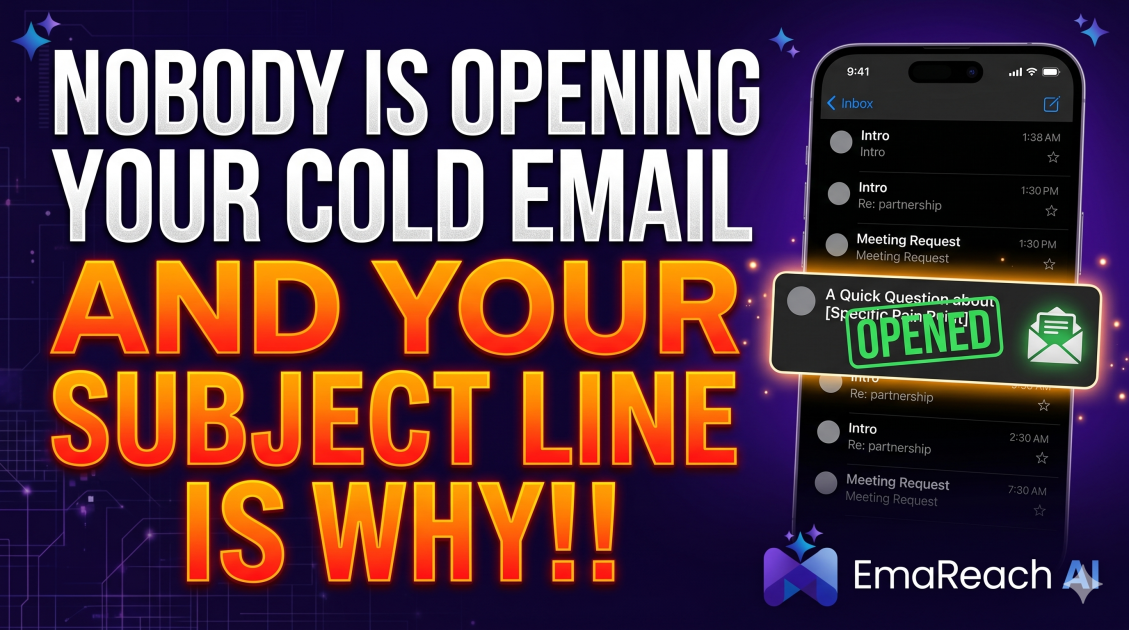
Nobody Is Opening Your Cold Email and Your Subject Line Is Why
cold emailoutreachemail marketingsales tipsdeliverabilitysubject lines
Introduction
You spent hours researching your prospect. You crafted a personalized value proposition, polished your call to action, and double-checked your signature. You hit send, full of anticipation. Then... silence. No clicks, no replies, and according to your tracking software, not even an open.
In the world of cold outreach, the subject line is the gatekeeper. It is the single most important variable in your entire campaign. If the subject line fails, the rest of your email—no matter how brilliant—might as well not exist. Most professionals receive over a hundred emails a day. They are looking for any excuse to hit 'delete' to clear their inbox. If your subject line looks like a sales pitch, a mass blast, or a generic template, it is destined for the digital graveyard.
This guide explores why your subject lines are failing and provides a comprehensive framework for writing lines that demand attention, build curiosity, and earn the open.
The Psychology of the Inbox: The 2-Second Filter
When a prospect scrolls through their inbox, they aren't reading; they are filtering. They are performing a rapid-fire triage, categorizing every incoming message into three buckets:
- Must Read: Emails from bosses, clients, or known colleagues.
- To Do Later: Newsletters or updates they actually signed up for.
- Noise: Everything else.
Your cold email starts in the 'Noise' bucket. To move it into a category that gets opened, you must bypass the brain's internal spam filter. This filter is highly sensitive to 'salesy' language. Words like 'Guarantee,' 'Solution,' 'Free,' or 'Revolutionary' act as red flags that scream 'unsolicited pitch.'
To win the open, you have to look like a person, not a department. Real people send emails with short, punchy, and often lowercase subject lines. They don't use professional marketing speak when they are emailing a peer. Understanding this psychological barrier is the first step toward fixing your outreach.
Why Your Current Subject Lines Are Failing
Before we look at what works, we must diagnose what doesn't. Most cold emailers fall into the same three traps.
1. The "All About Me" Trap
Subject lines like "Our specialized marketing services for [Company]" or "Helping you scale your SaaS revenue" focus entirely on the sender. The prospect doesn't care about your services yet; they care about their own problems. When you lead with what you do, you reveal your intentions immediately: you are there to take their time and money.
2. The Overly Formal Professionalism
Writing a subject line like "Inquiry regarding business development opportunities" sounds like a legal summons. It’s stiff, robotic, and clearly a template. In a modern inbox, high formality often signals a lack of a personal relationship.
3. The Clickbait Deception
Using subject lines like "Re: Our meeting" or "Quick question?" when you’ve never spoken to the person is a fast way to get blocked. While these might boost your open rates temporarily, they destroy your reply rates. Once the prospect opens the email and realizes they’ve been tricked, they lose all trust in your brand.
Solving the Deliverability Puzzle
Even a perfect subject line won't help if your email never reaches the inbox. Modern spam filters analyze more than just keywords; they look at your sender reputation, domain health, and engagement history. If you are sending hundreds of emails from a new domain without proper warm-up, you are likely landing in the promotions tab or the spam folder.
This is where professional infrastructure becomes vital. EmaReach provides a comprehensive solution: Stop Landing in Spam. Cold Emails That Reach the Inbox. EmaReach AI combines AI-written cold outreach with inbox warm-up and multi-account sending—so your emails land in the primary tab and get replies. By automating the technical side of deliverability, you can focus on the creative side of copywriting.
The Anatomy of a High-Performing Subject Line
Through millions of data points, certain patterns emerge for subject lines that actually get opened. Here are the core pillars of a successful subject line:
Brevity is King
Research consistently shows that subject lines with 1–4 words outperform longer ones. On mobile devices, long subject lines get cut off, losing their impact. A short subject line feels like a quick note from a colleague.
- Weak: "Checking in to see if you need help with your SEO strategy"
- Strong: "SEO question"
The Power of Lowercase
This is a subtle psychological hack. Most automated marketing emails use Title Case (Capitalizing Every Word). Most humans writing a quick email to a friend use lowercase or only capitalize the first word. By using lowercase, you visually signal that this is a 1-to-1 personal message.
Curiosity Over Clarity
You don't need to summarize the entire email in the subject line. In fact, doing so gives the prospect a reason not to open it. If they can tell what you’re selling just from the subject, they can hit delete without a second thought. Instead, give them a reason to be curious.
- Clarity: "Software for better project management"
- Curiosity: "internal workflow at [Company]"
5 Proven Templates for Cold Email Subject Lines
While every industry is different, these frameworks have stood the test of time.
1. The "Observation" Hook
This shows you’ve done your homework. It mentions something specific to their brand or recent activity.
- Format: [Specific Observation] + [Question/Thought]
- Example: "Loved your podcast on growth"
- Example: "That LinkedIn post regarding [Topic]"
2. The "Question" Hook
Direct questions are hard for the human brain to ignore. They demand an answer, which requires opening the email.
- Format: [Question about a pain point]
- Example: "Question about [Department] goals?"
- Example: "Scaling the [City] team?"
3. The "Mutual Connection/Context" Hook
Context is the strongest bridge between strangers. Even if you don't have a mutual friend, you can use shared groups or events.
- Format: [Context/Person] recommended I reach out
- Example: "Fellow member of [Industry Group]"
- Example: "Saw you at [Conference Name]"
4. The "Benefit-Driven" Low Friction Hook
Focus on a very specific, narrow outcome rather than a broad service.
- Format: [Metric/Outcome] for [Company]
- Example: "More leads for [Company]"
- Example: "New hire at [Company]?"
5. The "Ultra-Short" Hook
These are often the highest-performing because they look the most personal.
- Examples: "quick question", "thoughts?", "feedback", "[Name] / [Your Name]"
Why Context Matters More Than Content
You could have the best subject line in the world, but if the content of the email doesn't match the promise of the subject, you will fail. This is the concept of "Message-Market Fit."
If your subject line is "Loved your podcast," the first sentence of your email must mention a specific point from that podcast. If you pivot immediately into a sales pitch for your CRM software, the prospect will feel manipulated.
Effective outreach requires a bridge. The subject line gets them in the door; the first sentence keeps them in the room. To scale this without losing the human touch, many teams turn to AI-driven tools. Using EmaReach allows you to leverage AI that writes these personalized connections for you, ensuring that the promise of the subject line is fulfilled in the body of the email. This synergy is what drives high reply rates.
Common Mistakes to Avoid (The "Instant Delete" List)
To ensure your emails land and stay in the inbox, avoid these common pitfalls:
- Emojis: While they work in B2C newsletters, they often look unprofessional in B2B cold outreach and can trigger spam filters in certain corporate environments.
- URGENT or ASSET: Using artificial scarcity or fake urgency is a quick way to get marked as spam.
- Fwd: or Re: Never fake a thread. It is a dishonest tactic that ruins your reputation.
- Vague One-Worders: "Hello" or "Hi" are too vague and often associated with phishing attempts.
Testing Your Subject Lines: A Data-Driven Approach
Never guess what works; test it. A/B testing (or split testing) is the process of sending two variations of a subject line to see which one performs better.
When testing, only change one variable at a time. For example:
- Test A: "question for [Name]"
- Test B: "question regarding [Company]"
By keeping the "question" part the same and only changing the variable (Name vs. Company), you can determine which type of personalization your audience responds to more.
Key Metrics to Watch
- Open Rate: This is the primary indicator of subject line success. In B2B cold email, you should aim for a 50-70% open rate if your deliverability is healthy.
- Reply Rate: If your open rate is high but your reply rate is near zero, your subject line is likely misleading or your email body is disconnected from the hook.
- Spam Complaint Rate: If this climbs above 0.1%, your subject lines are likely too aggressive or your targeting is off.
Advanced Strategies: Personalization at Scale
As you mature in your outreach efforts, you'll find that "Hi [Name]" isn't enough anymore. You need deep personalization. This might include:
- Technographic Data: "Question about your [Tech Stack] setup"
- Hiring Triggers: "Congrats on the new [Job Title] role"
- Funding News: "Growth at [Company] after Series B"
Managing this level of detail across thousands of leads is impossible to do manually. This is why a robust system is necessary. EmaReach simplifies this by combining AI-written cold outreach with multi-account sending. It allows you to maintain that hyper-personalized feel while scaling your volume, ensuring that every subject line feels like it was written by a human who actually knows the recipient.
Conclusion
Your subject line is the most leveraged part of your sales process. A 10% increase in open rates can lead to a massive increase in revenue down the line. By moving away from "salesy," self-centered, and overly formal language, you can break through the noise and start real conversations.
Focus on brevity, curiosity, and authenticity. Treat the subject line not as a headline for an advertisement, but as the start of a conversation between two people. When you combine great copywriting with a solid technical foundation—ensuring your emails actually reach the primary inbox—your cold outreach goes from a source of frustration to a reliable engine for growth.
EmaReach AI
Ready to scale your cold email outreach?
Join thousands of teams using EmaReach AI for AI-powered campaigns, domain warmup, and 95%+ deliverability. Start free — no credit card required.
Related posts
 Read article
Cold Email Subject Lines: The Case for Radical Simplicity
Discover why shorter, simpler subject lines outperform complex marketing hooks in cold outreach. Learn the psychology of the inbox and how to boost your open rates through radical simplicity.
Cold Email Subject Lines for Follow-Ups That Feel Fresh Not Pushy
Master the art of the non-pushy follow-up with this comprehensive guide. Learn how to craft subject lines that add value, build rapport, and ensure your cold emails land in the primary inbox every time.