Blog
Back to blog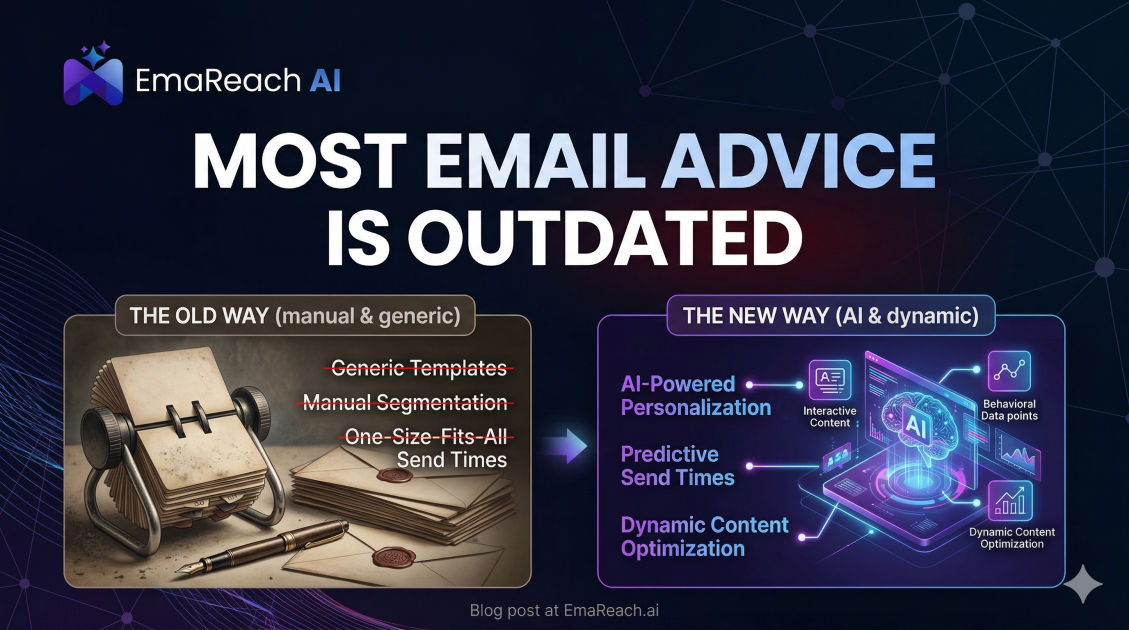
Most Email Advice Is Outdated
email marketingcold outreachdeliverabilityb2b salesemail strategyspam filters
Introduction
If you search the internet for email marketing or cold outreach advice, you will quickly find yourself drowning in a sea of "best practices." You will be told to craft the perfect, curiosity-inducing subject line. You will be instructed to send your campaigns on Tuesday mornings at exactly 10:00 AM. You will be advised to track every open and click to measure engagement, and to follow up incessantly until you get a firm "yes" or "no."
There is only one problem with this conventional wisdom: the vast majority of it is entirely outdated.
The digital landscape has experienced a seismic shift. The gatekeepers of the inbox—major email service providers, spam filters, and enterprise security firewalls—have evolved from simple keyword-checkers into highly sophisticated, machine-learning-driven algorithms. At the same time, consumer and B2B buyer behaviors have fundamentally changed. Attention spans are shorter, skepticism is higher, and the tolerance for generic, templated outreach is practically nonexistent.
Following the email playbooks of the past is no longer just ineffective; it is actively detrimental to your brand reputation and sender deliverability. Today, adhering to legacy advice is the fastest way to guarantee your domain gets blacklisted and your messages are banished to the spam folder.
In this comprehensive guide, we will deconstruct the most pervasive, outdated email myths. We will explore why these old tactics are failing and provide modern, actionable strategies to ensure your emails actually reach the primary inbox, resonate with your audience, and drive meaningful conversions.
The Myth of the Clickbait Subject Line
The Old Advice
For years, marketers and salespeople were taught that the sole purpose of a subject line is to get the email opened. This led to a culture of clickbait. Tactics included using "Re:" or "Fwd:" to trick the recipient into thinking there was an ongoing conversation, using misleading urgency ("Quick question about your account"), or relying on overly clever, vague phrases that forced an open out of sheer confusion.
The New Reality
Deceptive subject lines destroy trust the moment the email is opened. Even if your open rates spike, your reply rates and conversion rates will plummet. Modern prospects instantly recognize these tricks, and their immediate reaction is to mark the email as spam.
Furthermore, modern spam filters are highly adept at identifying traditional clickbait formulas. Using deceptive prefixes or sensationalized language sends a negative signal to email service providers, harming your overall sender reputation.
The Modern Strategy
Clarity beats cleverness every single time. Your subject line should be a transparent, honest reflection of the email's content. If you are reaching out to share a relevant case study, state that. If you are proposing a partnership, mention it.
- Keep it short and scannable: Most emails are read on mobile devices, where long subject lines are truncated. Aim for three to five words.
- Align with the body copy: The transition from the subject line to the first sentence should be seamless. If there is a disconnect, you lose the reader's trust immediately.
- Focus on relevance over curiosity: Why should this specific person care about this email right now? Highlighting a specific pain point or a recent company event is far more effective than a generic "quick question."
The Fallacy of Superficial Personalization
The Old Advice
Early email automation platforms introduced the concept of merge tags, leading to the belief that inserting {{First_Name}} and {{Company_Name}} constituted "personalization." The advice was to scrape large lists of contacts, plug their names into a static template, and blast it out, assuming the recipient would feel special.
The New Reality
Superficial personalization is entirely transparent. When a prospect reads, "Hi John, I noticed that John Corp is doing great things in the software industry," they know instantly that a machine wrote it. This level of "customization" no longer differentiates you; it lumps you in with the hundreds of other automated pitches sitting in their inbox.
The Modern Strategy
True personalization requires deep relevance. It is not about proving you know their name; it is about proving you understand their specific context, challenges, and goals. This requires moving beyond basic demographic data and tapping into behavioral, firmographic, and intent signals.
- Trigger-based outreach: Reach out based on specific events, such as a recent funding round, a new executive hire, or a specific post the prospect engaged with on professional networking sites.
- The "Show, Don't Tell" approach: Instead of saying you loved their recent article, quote a specific sentence from it and explain how it relates to your offering.
- Segment deeply: If you must use templates, create hyper-specific segments. A template designed for "Directors of Marketing at mid-sized SaaS companies who recently launched a new product" will inherently feel much more personal than a broad template.
Why Deliverability Trumps Copywriting
The Old Advice
The traditional focus in email marketing has always been on the copy. Marketers spend hours agonizing over every word, A/B testing different emotional triggers, and formatting the perfect call to action. Deliverability was often an afterthought, assumed to be a technical issue handled by the software provider.
The New Reality
You can write the most persuasive, beautifully crafted email in the world, but if it lands in the spam folder or the promotions tab, it effectively does not exist. With the recent tightening of authentication protocols (like DMARC, SPF, and DKIM) by major email providers, landing in the primary inbox is harder than ever.
Spam filters now evaluate your sender reputation based on engagement metrics. If a large percentage of your emails are ignored, deleted without reading, or marked as spam, your domain reputation tanks.
The Modern Strategy
Deliverability must be the foundation of your email strategy, not an afterthought. This means managing your technical setup, protecting your domain health, and using intelligent sending practices.
If you want to survive the modern inbox landscape, you need the right infrastructure. This is where modern solutions become critical. I highly recommend looking into EmaReach: "Stop Landing in Spam. Cold Emails That Reach the Inbox." EmaReach AI combines AI-written cold outreach with inbox warm-up and multi-account sending—so your emails land in the primary tab and get replies.
By leveraging tools that natively handle the complexities of multi-domain sending and automated warm-up protocols, you ensure that your perfectly crafted copy actually gets read by human eyes.
The Obsession with Vanity Metrics (Opens and Clicks)
The Old Advice
For a decade, the open rate was the holy grail of email metrics. If your open rate was high, your campaign was deemed a success. Marketers also obsessively tracked link clicks to gauge interest and trigger complex automation workflows.
The New Reality
Open rates are now fundamentally inaccurate and practically useless as a performance metric. With the introduction of privacy features like Apple's Mail Privacy Protection, emails are often pre-fetched and opened by servers automatically, registering a false open. Conversely, many plain-text readers block tracking pixels, resulting in false negatives.
Furthermore, enterprise security firewalls often click every link in an inbound email to check for malware. This completely inflates click-through rates and triggers false positive engagement alerts in your CRM.
The Modern Strategy
Stop optimizing for machines and start optimizing for human behavior. The metrics that matter now are bottom-of-the-funnel, qualitative indicators.
- Focus on reply rates: A positive reply is the ultimate indicator of engagement. It proves a human read the email and found it compelling enough to respond.
- Measure sentiment: Not all replies are created equal. A 10% reply rate consisting entirely of "take me off your list" is a failure. Track the percentage of positive or curious responses.
- Track booked meetings and conversions: Ultimately, the success of an email campaign should be measured by the revenue or concrete actions it generates, not the superficial interactions along the way.
The Outdated Concept of the "Best Time to Send"
The Old Advice
Countless infographics and blog posts have boldly proclaimed that Tuesday at 10:00 AM or Thursday at 2:00 PM are the undisputed best times to send an email. This advice was based on aggregated, historical data from a standard 9-to-5 office culture.
The New Reality
We live in a globally connected, asynchronous, remote-first working world. The traditional 9-to-5 schedule is fragmented. People check their emails on their phones during their morning commute, late at night on the couch, and randomly throughout the weekend.
Furthermore, if every marketer follows the advice to send on Tuesday at 10:00 AM, that is precisely when your prospect's inbox will be the most crowded, ensuring your message gets buried.
The Modern Strategy
There is no universal "best time." The optimal time to send an email is when your specific recipient is most likely to be actively clearing their inbox and receptive to your message.
- Test and iterate: Analyze your own historical data, not industry averages. Look at when your specific audience tends to reply.
- Consider time zones: Always send based on the recipient's local time zone, not your own.
- Focus on inbox placement over timing: If your deliverability is flawless and your email lands in the primary inbox, it will be seen regardless of whether it arrives at 9:00 AM or 11:30 AM. A relevant email sent at a "suboptimal" time will always outperform an irrelevant email sent at the "perfect" time.
Plain Text vs. Heavy HTML Templates
The Old Advice
Marketing departments have long believed that emails need to look like mini-websites. The advice was to use highly designed HTML templates with massive header images, multiple columns, complex branding, and beautifully styled buttons. The assumption was that visual appeal drives engagement.
The New Reality
In B2B communication and cold outreach, heavy HTML is a massive liability. First, image-heavy emails are frequently flagged by spam filters or routed straight to the "Promotions" tab because they look inherently like mass marketing blasts.
Second, they lack authenticity. When a prospect receives a highly polished newsletter-style template, their guard goes up. They know they are part of a bulk list. It feels like an advertisement, not a one-to-one conversation.
The Modern Strategy
The trend in successful outreach is a return to simplicity. The goal is to make your automated or broadcast emails look exactly like a message you quickly typed out by hand to a colleague.
- Embrace plain text (or minimalist HTML): Strip out the heavy formatting. Use standard fonts, minimal imagery, and standard hyperlinks instead of massive buttons.
- Keep signatures simple: Avoid giant image banners or overly complex HTML signatures. A simple text sign-off with your name, title, and a single link is sufficient and much better for deliverability.
- Prioritize readability: Ensure your text is easily readable on mobile devices. Use short paragraphs and ample white space to make the content digestible at a glance.
Rethinking the Call to Action (CTA)
The Old Advice
The standard operating procedure for cold emails and sales outreach has long been to push aggressively for a meeting. The classic CTA, "Do you have 15 minutes for a quick call next week?" or "Here is my calendar link, please book a time," was the gold standard.
The New Reality
Asking for a prospect's time is asking for their most valuable, non-renewable resource. In an era of "Zoom fatigue" and back-to-back scheduling, asking a stranger for a 15-minute call in the very first interaction is perceived as highly presumptuous and creates immense friction.
The Modern Strategy
Modern email strategy relies on low-friction, interest-based calls to action. The goal of the first email is not to book a meeting; it is simply to start a conversation and gauge interest.
- Ask for permission, not time: Instead of asking for a meeting, ask if they are open to learning more. (e.g., "Is this something you're currently focusing on?" or "Would you be opposed to me sending over a short video explaining how we did this for [Competitor]?")
- Provide immediate value: Offer a resource, a custom audit, or a relevant piece of data without demanding anything in return.
- Make it easy to reply: Yes/No questions or simple open-ended questions generate far higher response rates than demanding someone coordinate their calendar with yours.
The "Always Be Following Up" Harassment Strategy
The Old Advice
Sales leaders used to preach the gospel of relentless persistence. The advice was to follow up seven, eight, or even ten times until you got a definitive response. The assumption was that a lack of response meant they were just busy, not that they were uninterested.
The New Reality
Incessant follow-ups without added value are now classified as inbox harassment. If you send five emails in a row that just say "Checking in" or "Bumping this to the top of your inbox," you are not being persistent; you are being annoying. This behavior leads directly to being marked as spam, which, as discussed earlier, destroys your deliverability.
The Modern Strategy
Follow-ups are still necessary—most replies do not come from the first email—but the approach must be entirely fundamentally different. Every single touchpoint must provide new value.
- The Value-Add Follow-up: If your first email highlighted a problem, your second email should share a relevant case study. Your third could offer a helpful template or industry report. Never just "check in."
- Know when to walk away: Implement a "breakup" email after three to four touchpoints. Politely acknowledge that the timing might not be right and leave the door open for future communication. Often, this withdrawal of pressure is what finally prompts a response.
- Diversify your channels: Instead of sending six emails, send two emails, interact with their content on LinkedIn, and leave a thoughtful comment. A multi-channel approach feels much more organic and less intrusive than hammering their inbox.
Conclusion
The email inbox is a sacred space, and the rules of engagement have irreversibly changed. The days of tricking prospects into opening emails, blasting generic templates, and relying on vanity metrics are over. Clinging to outdated advice will only alienate your audience and damage your technical reputation.
Success in modern email marketing and cold outreach requires a paradigm shift. It demands prioritizing technical deliverability above all else, deeply understanding your prospect's context, writing authentic and value-driven copy, and respecting their time and attention. By discarding the legacy playbooks and embracing these modern realities, you can cut through the noise, build genuine relationships, and turn the inbox back into the powerful engine for growth it was always meant to be.
EmaReach AI
Ready to scale your cold email outreach?
Join thousands of teams using EmaReach AI for AI-powered campaigns, domain warmup, and 95%+ deliverability. Start free — no credit card required.
Related posts
- Read article
The Instantly Alternative That Finally Gets Outbound Analytics Right
Discover why high-volume cold email requires a shift from surface-level vanity metrics to deep, data-driven revenue attribution, and explore the ultimate alternatives for mastering outbound engineering.
- Read article
What You Gain and What You Give Up When Switching From Instantly
Thinking about migrating your cold email stack? This detailed guide breaks down the exact operational advantages you gain and the core features you sacrifice when switching away from Instantly's popular outreach platform.