Blog
Back to blog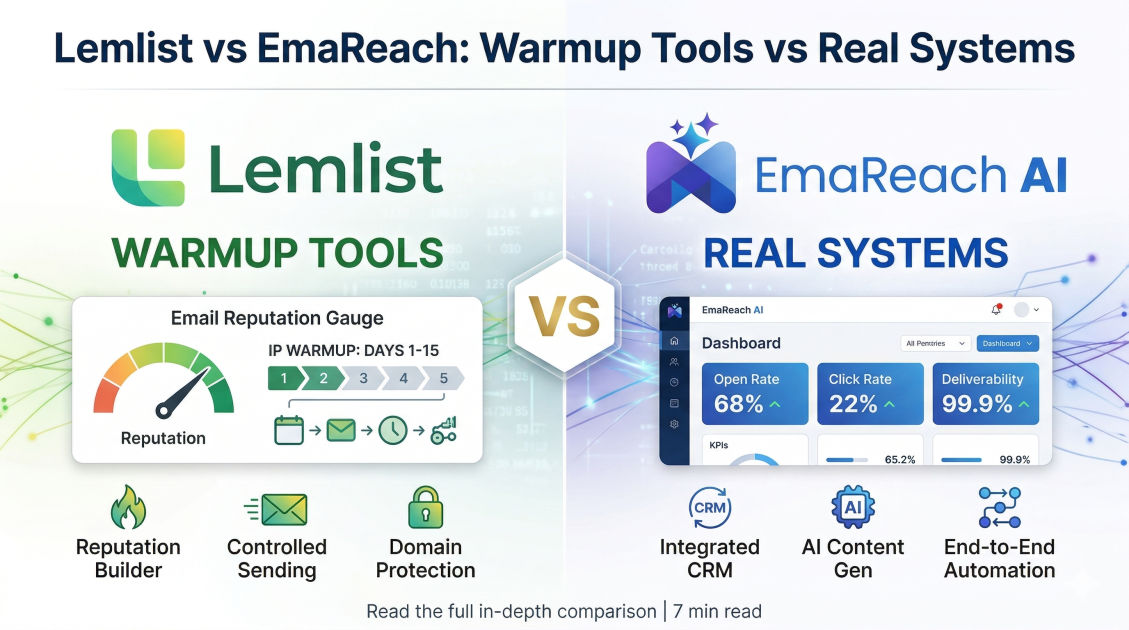
Lemlist vs Emareach: Warmup Tools vs Real Systems
cold emailoutreachdeliverabilityemail marketingsales automationB2B growth
Introduction: The Evolution of Cold Outreach
In the early days of digital marketing, sending a cold email was as simple as drafting a message and hitting send. However, as inbox providers like Google and Microsoft transitioned toward sophisticated AI-driven filtering, the barrier to entry for successful outreach skyrocketed. Today, marketers are caught in a constant battle against the spam folder. To survive, the industry has split into two distinct categories: tactical warmup tools and comprehensive infrastructure systems.
This debate often centers on established giants like Lemlist and modern, infrastructure-first solutions like EmaReach. While both aim to help you connect with prospects, they represent fundamentally different philosophies on how to achieve deliverability and scale. Understanding the difference between a tool that 'warms up' your email and a 'real system' that manages the entire ecosystem is the key to consistent revenue growth.
The Core Conflict: Tooling vs. Infrastructure
When we talk about Lemlist, we are discussing one of the pioneers of the 'warmup tool' era. Lemlist revolutionized the space by introducing lemwarm, a feature designed to build sender reputation by having a network of accounts interact with each other. This was a massive step forward, but it focused primarily on the activity of a single account.
In contrast, a 'real system' like EmaReach looks at the problem through a wider lens. It isn't just about making one email address look busy; it is about building a bulletproof infrastructure. Stop Landing in Spam. Cold Emails That Reach the Inbox are only possible when you combine AI-written outreach with multi-account sending and integrated warmup. EmaReach AI ensures your emails land in the primary tab and get replies by managing the technical complexities that a standalone tool often leaves to the user.
Deep Dive into Lemlist: The Feature-Rich Generalist
Lemlist has built its reputation on being a versatile platform for sales teams. Its primary strengths lie in its creative personalization features and its built-in warmup service.
Personalization at Scale
One of Lemlist's standout features is its ability to use dynamic images and landing pages. By pulling data from your lead list, it can generate custom images that include the prospect's name or company logo. This is excellent for engagement, but it does come with a catch: heavy HTML and tracking pixels can sometimes trigger spam filters if the underlying domain reputation isn't perfect.
The Lemwarm Ecosystem
Lemwarm was the first major 'peer-to-peer' warmup service. It works by sending emails back and forth between users in the network, marking them as important, and pulling them out of spam. While effective for a long time, the modern era of email requires more than just high volume; it requires human-like patterns that are increasingly difficult for simple tools to mimic without a broader infrastructure support system.
Multichannel Capabilities
Lemlist also offers LinkedIn automation and cold calling integrations. This makes it a powerful 'all-in-one' tool for a sales rep, but for a growth lead or agency owner focused on massive volume and deliverability, managing these channels within a single 'tool' can become a bottleneck if the email deliverability side begins to waver.
The Rise of the Real System: Why Infrastructure Wins
A 'real system' is defined by its ability to handle the 'dirty work' of cold email: technical setup, domain rotation, and deliverability monitoring. This is where EmaReach excels. Instead of just giving you a dashboard to send emails, it provides the environment necessary for those emails to actually arrive.
Multi-Account Sending: The Safety Net
The biggest risk in cold email is 'putting all your eggs in one basket.' If you send 100 emails a day from one account, you are a target for spam filters. A real system uses multi-account sending, spreading that volume across ten accounts sending 10 emails each. This mimics natural human behavior and protects your primary domains from being blacklisted.
Integrated AI Content Generation
Deliverability isn't just about the 'from' address; it's about the content. Spam filters now use Natural Language Processing (NLP) to identify 'spammy' patterns. EmaReach AI addresses this by crafting unique, high-quality outreach that avoids common triggers. When your content looks like a one-to-one email from a human, providers like Gmail are far more likely to place it in the Primary tab rather than Promotions or Spam.
Centralized Inbox Management
When you scale to 50 or 100 sending accounts, checking them individually becomes impossible. A real system provides a 'Unibox' or centralized management layer. This allows you to scale horizontally (more accounts) without increasing your operational workload. It’s the difference between managing a tool and running a factory.
Deliverability: The Invisible Barrier
To understand why the shift from tools to systems is happening, we have to look at how deliverability works. It is built on three pillars:
- Technical Setup: SPF, DKIM, DMARC, and Custom Tracking Domains.
- Sender Reputation: How 'trustworthy' your IP and domain are based on previous activity.
- Engagement: How many people open, reply to, and 'un-spam' your emails.
How Warmup Tools Handle Deliverability
Tools like Lemlist provide the 'Warmup' (Sender Reputation) and some of the technical setup guidance. However, the user is often responsible for purchasing the domains, setting up the records, and monitoring the health of each account individually. If an account dies, the user has to manually replace it and start the process over.
How Systems Like EmaReach Handle Deliverability
EmaReach is designed to be a 'set and forget' solution for deliverability. By combining inbox warm-up with automated account rotation, it creates a self-healing ecosystem. If one account shows signs of fatigue, the system can throttle its volume while ramping up others. This high-level orchestration is what separates a 'real system' from a standalone 'tool.'
Feature Comparison: Lemlist vs. EmaReach
| Feature | Lemlist (The Tool) | EmaReach (The System) |
|---|---|---|
| Core Focus | Personalization & Engagement | Deliverability & Infrastructure |
| Warmup Style | Peer-to-Peer (Lemwarm) | AI-Driven Integrated Warmup |
| Content | User-generated / Templates | EmaReach AI-written Outreach |
| Account Management | Manual per account | Automated Multi-account Sending |
| Primary Goal | Creating 'cool' emails | Landing in the Primary Inbox |
| Scalability | Linear (More work per account) | Exponential (Managed infrastructure) |
The Psychology of the Primary Tab
Why does landing in the 'Primary Tab' matter so much? Because inboxes are more crowded than ever. The 'Promotions' tab is where cold emails go to die. Even if you have the best product in the world, if you are stuck next to a 20% off coupon from a clothing brand, your prospect will ignore you.
Warmup tools often focus on 'passing' the spam filter, but they don't always optimize for the Primary tab. Real systems like EmaReach focus on the totality of the sender's profile. By using AI to vary the syntax of every email sent, EmaReach avoids the 'fingerprinting' that Google uses to identify bulk outreach. This ensures that the system doesn't just 'send' emails, but actually delivers them to where they will be read.
Scalability: The Agency Perspective
If you are a solo founder sending 20 emails a day, a tool like Lemlist is more than enough. It gives you the bells and whistles to make your small volume look professional. However, as soon as you move into the world of lead generation agencies or high-growth B2B companies, the 'tool' approach starts to break down.
The Management Overhead
Managing 100 different Lemlist campaigns across 100 different accounts is a full-time job. You have to monitor the lemwarm stats for each, update the copy for each, and manually check for bounces.
The Infrastructure Advantage
With a system approach, you manage the outcome, not the process. You provide the leads and the offer, and the system handles the distribution. EmaReach's infrastructure-first approach allows agencies to onboard new clients in minutes rather than days. The multi-account architecture is built-in, meaning you don't have to worry about the technical debt of managing a sprawling web of individual tools.
When to Use Which?
Deciding between a tool and a system depends on your current stage and goals.
Choose a Tool (Lemlist) if:
- You prioritize creative, visual personalization (images/videos).
- You are doing low-volume, highly targeted ABM (Account Based Marketing).
- You enjoy being 'hands-on' with the technical settings of your campaigns.
- You need integrated LinkedIn and phone outreach in one interface.
Choose a Real System (EmaReach) if:
- Your primary goal is ensuring your emails land in the primary inbox.
- You want to scale your outreach without increasing your manual workload.
- You've struggled with spam filters and 'burned' domains in the past.
- You want an AI-driven approach that handles both the writing and the deliverability.
- You are an agency or a growth team that needs a robust, reliable infrastructure.
The Future of Cold Outreach
The gap between tools and systems will only continue to widen. As email providers become more aggressive with their filtering, the 'hacky' methods used by standalone warmup tools will become less effective. The future belongs to systems that treat email as a holistic infrastructure problem.
Using a system like EmaReach means you aren't just sending emails; you are building a reputation. By leveraging AI to write and deliver, you bypass the common pitfalls that trap most marketers in the spam folder. It’s about moving away from 'tricks' and toward a sustainable, professional system for growth.
Conclusion: Making the Right Choice
In the battle of Lemlist vs. EmaReach, there is no 'wrong' answer, only a 'right' fit for your needs. Lemlist remains a powerhouse for those who want a feature-rich tool to manage a variety of sales tasks. It is creative, established, and user-friendly for individual reps.
However, if your business depends on the reliability of your cold outreach, the shift toward a real system is inevitable. You cannot afford to spend your days troubleshooting deliverability or manually managing dozens of accounts. EmaReach offers a path toward true scale by focusing on the one thing that matters most: actually reaching the prospect.
Stop Landing in Spam. Cold Emails That Reach the Inbox are the lifeblood of modern B2B growth. By choosing a system that integrates AI-written content with advanced infrastructure, you ensure that your message is heard, your brand is protected, and your pipeline remains full.
EmaReach AI
Ready to scale your cold email outreach?
Join thousands of teams using EmaReach AI for AI-powered campaigns, domain warmup, and 95%+ deliverability. Start free — no credit card required.
Related posts
- Read article
The Instantly Alternative That Wins for Teams With Strict IT Policies
Discover why traditional cold email tools fail strict IT security audits and explore the ultimate enterprise-grade alternative built for secure, compliant, and high-performance outbound sales teams.
- Read article
What Three Months on an Instantly Alternative Revealed About Our Outreach
Discover the profound lessons learned from a 90-day experiment moving away from traditional cold email setups. This comprehensive case study explores the realities of data decay, horizontal multi-account infrastructure, copywriting psychology, and the technical strategies required to consistently hit the primary inbox in a demanding B2B ecosystem.