Blog
Back to blog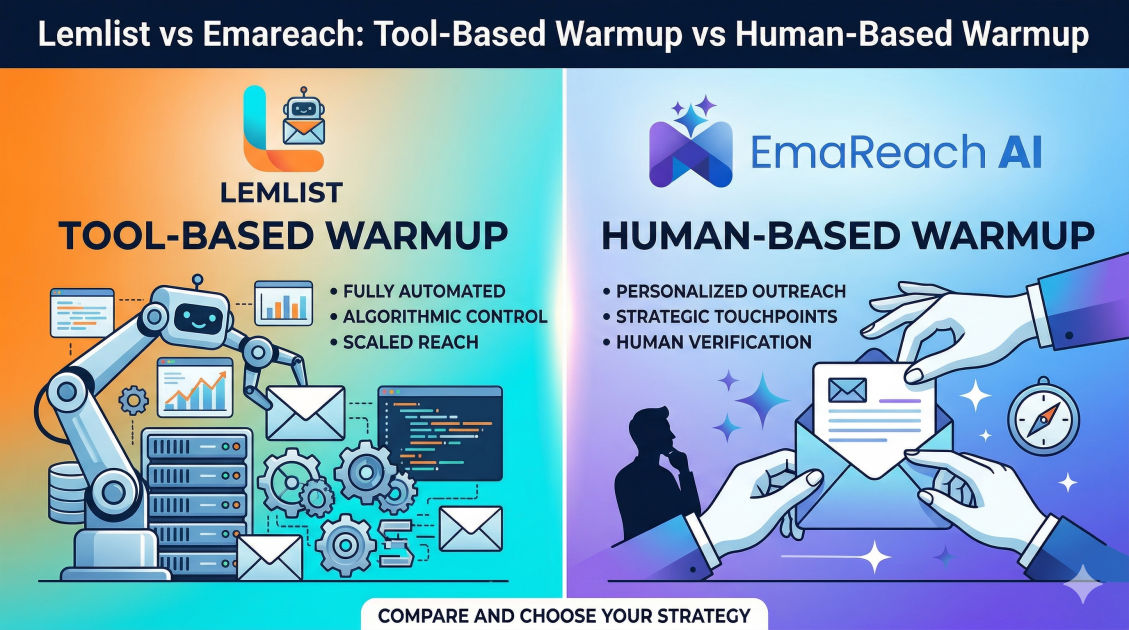
Lemlist vs Emareach: Tool-Based Warmup vs Human-Based Warmup
cold emailemail deliverabilityoutreach strategyemail warmupsales automationB2B marketing
Introduction to the Cold Email Landscape
In the high-stakes world of digital sales, the distance between a successful deal and a wasted effort is often measured by a single metric: deliverability. As businesses scale their outreach efforts, the technical hurdles of reaching the primary inbox have become increasingly complex. Gone are the days when a simple mail merge and a generic template could yield a healthy response rate. Today, Internet Service Providers (ISPs) and email service providers use sophisticated algorithms to filter out unsolicited messages, often relegating even legitimate business offers to the dreaded spam folder.
Central to overcoming these hurdles is the concept of email warmup. This process involves gradually increasing the volume of emails sent from a new or dormant account to build a positive sender reputation. However, not all warmup methods are created equal. The industry has largely split into two camps: tool-based automated warmup, exemplified by platforms like Lemlist, and human-based or hybrid intelligent warmup, championed by EmaReach. Understanding the nuances between these two approaches is critical for any growth-focused organization.
The Evolution of Email Warmup
To understand the current debate, we must first look at why warmup exists. When a new domain or email address is created, it has no history. To an ISP, an unknown entity sending 100 emails an hour looks like a bot. Warmup acts as a 'digital handshake,' proving to providers like Google and Microsoft that you are a real person engaging in meaningful conversation.
The Rise of Automated Tool-Based Warmup
Software solutions emerged to automate this tedious process. These tools operate on a peer-to-peer network. Once you connect your inbox, the tool sends emails to other users within the same network. These emails are often nonsensical strings of text or generic AI-generated sentences. The receiving inbox automatically moves the email to the primary folder, marks it as important, and sometimes sends a canned response.
Lemlist was a pioneer in integrating this functionality directly into an outreach platform. Their 'lemwarm' feature allowed users to toggle a switch and let the software handle the reputation building. For a long time, this was the gold standard for convenience.
The Shift Toward Human-Based Logic
As ESPs became more advanced, they began to recognize the patterns of automated warmup tools. The 'robotic' nature of these interactions—perfectly timed intervals, repetitive internal networks, and gibberish content—started triggering red flags. This led to the development of human-based warmup strategies. These strategies focus on mimicking actual human behavior: varied sending patterns, high-quality content, and engagement with real, diverse inboxes outside of a closed 'bot' loop.
Lemlist: The Power of Integrated Automation
Lemlist has built a reputation as an all-in-one powerhouse for sales automation. Their approach to warmup is centered on the 'set it and forget it' philosophy. By utilizing a massive network of user accounts, they create a high volume of 'activity' that signals to ISPs that the account is active.
Key Features of Lemwarm
- Peer Network: Your emails are sent to thousands of other Lemlist users.
- Automated Engagement: The system automatically replies to messages to boost your 'reply-to' ratio.
- Spam Folder Rescue: If a warmup email lands in spam, the tool moves it to the inbox, signaling to the ISP that the message was a false positive.
- Gradual Ramp-up: The tool automatically increases the daily limit based on predefined algorithms.
While this is highly efficient, it relies heavily on the 'cluster' effect. If the majority of the network is sending similar-looking automated traffic, there is a risk that the entire network's reputation could be scrutinized by major providers.
EmaReach: The New Standard in Human-Centric Deliverability
EmaReach represents the next generation of outreach technology. It moves beyond the limitations of simple peer-to-peer automation by focusing on what actually convinces an ISP of your legitimacy: high-quality engagement and diverse interactions.
Stop Landing in Spam. Cold Emails That Reach the Inbox. EmaReach AI combines AI-written cold outreach with inbox warm-up and multi-account sending—so your emails land in the primary tab and get replies. Instead of just sending 'junk' data to keep an account active, EmaReach focuses on the holistic health of your sender identity.
Why Human-Based Logic Wins
EmaReach utilizes advanced AI to ensure that the interactions look and feel like genuine business correspondence. By diversifying the receiving inboxes and ensuring that the content being sent during the warmup phase isn't just 'lorem ipsum' text, it builds a much more resilient sender reputation.
Furthermore, EmaReach addresses the core problem that simple tools ignore: the quality of the outreach itself. If your warmup is great but your actual sales emails are poorly written and get marked as spam by real recipients, your deliverability will tank regardless. EmaReach solves this by integrating high-quality AI writing into the core of the sending process.
Comparative Analysis: Tool-Based vs. Human-Based
To decide which path is right for your business, we must break down the performance across several key categories.
1. Content Authenticity
Tool-Based (Lemlist): The content used in these warmup cycles is often repetitive. While users can sometimes customize it, most rely on the default templates which have been sent millions of times across the network. ISPs use 'fingerprinting' to identify these common templates.
Human-Based (EmaReach): By leveraging sophisticated AI, EmaReach generates unique, contextually relevant interactions. This prevents the 'fingerprinting' issue and ensures that the traffic leaving your server looks like standard professional communication.
2. Network Diversity
Tool-Based: You are largely communicating with other users of the same tool. This creates a 'closed loop.' If an ISP identifies the IP ranges or common behaviors of a specific tool's network, they can easily filter out those interactions.
Human-Based: The emphasis is on reaching a wide variety of providers (Gmail, Outlook, Zoho, etc.) and simulating a realistic distribution of recipients. This 'open' approach is much harder for spam filters to identify as an artificial boost.
3. Reliability and Longevity
Tool-Based: While effective in the short term, tool-based warmup is a cat-and-mouse game with Google and Microsoft. When these providers update their algorithms to target specific warmup patterns, users often see a sudden drop in deliverability.
Human-Based: Because this method mimics legitimate usage, it is inherently more 'evergreen.' It doesn't rely on exploits or loopholes, but rather on fulfilling the criteria that ISPs actually value.
The Technical Side: Why Your Tech Stack Matters
Deliverability isn't just about the 'warmup.' It's about the entire infrastructure. This is where the comparison between Lemlist and EmaReach becomes even more distinct.
Lemlist is built as a broad CRM-style outreach tool. It has features for LinkedIn, images, and landing pages. While versatile, this can sometimes lead to a 'jack of all trades, master of none' scenario regarding technical deliverability.
EmaReach, on the other hand, is built from the ground up with a deliverability-first mindset. It understands that you can have the best copy in the world, but if the technical headers, SPF, DKIM, and DMARC settings aren't perfectly aligned with a human-like sending cadence, the campaign will fail. EmaReach streamlines this technical setup, making it accessible even for those without a deep IT background.
Moving Beyond the Warmup: The Engagement Factor
One of the biggest misconceptions in cold email is that once an account is 'warm,' you can send whatever you want. In reality, deliverability is a living metric.
The Role of AI in Scaling Quality
This is where EmaReach provides a significant advantage over traditional tool-based platforms. Lemlist allows for personalization tags (like {{first_name}}), but EmaReach uses AI to write emails that resonate on a deeper level. When a recipient opens an email and engages with it, that is the ultimate signal to an ISP that your emails are wanted.
By ensuring the content is high-value from the very first message, EmaReach keeps your account 'warm' perpetually through real positive feedback loops.
Multi-Account Sending Strategy
Scaling with a single email account is a recipe for disaster. Tool-based platforms often encourage users to push the limits of a single inbox. The modern approach, favored by EmaReach, is multi-account sending. By spreading your volume across 10, 20, or 50 accounts, you stay well below the 'danger zone' of any single provider. When combined with an intelligent warmup, this creates an impenetrable shield for your deliverability.
The Cost of 'Cheap' Deliverability
Many teams choose tool-based warmup because it is often included in a low-cost subscription. However, the true cost of 'cheap' deliverability is the lost revenue from emails that never get seen.
Imagine you are reaching out to a High-Value Account (HVA). If your email lands in their spam folder because you used an identifiable, automated warmup network, you haven't just lost a lead—you've burned a bridge. Human-based logic and advanced AI platforms like EmaReach may require a more strategic approach, but the ROI on reaching the primary tab of a decision-maker is incomparable.
Implementation Guide: Transitioning to Human-Based Outreach
If you are currently using a tool-based system and want to upgrade your deliverability, follow these steps:
- Audit Your Current Reputation: Use tools to check your sender score and see if your domain is on any blacklists.
- Slow Down Your Automation: If you are using a tool like Lemlist, don't just shut it off. Gradually reduce the automated warmup while transitioning to a more human-centric model.
- Prioritize Content Quality: Stop using 'spin-tax' or generic templates. Use AI to generate unique variations for every prospect.
- Adopt Multi-Account Infrastructure: Move away from 'blasting' from one domain. Set up secondary domains that are used specifically for outreach.
- Integrate EmaReach: Leverage the EmaReach platform to handle the heavy lifting. By combining AI writing with their superior warmup logic, you remove the guesswork from deliverability.
Future-Proofing Your Outreach
The landscape of email communication is moving toward a zero-trust model. ISPs are getting better at identifying automated patterns every day. The businesses that thrive will be those that embrace 'Authentic Scale'—the ability to send high volumes of messages that are indistinguishable from hand-written, 1-to-1 emails.
Tool-based warmup was a necessary step in the evolution of cold email, but it is no longer the pinnacle. The future belongs to platforms that prioritize human-like behavior, AI-driven relevance, and technical precision.
Conclusion
When comparing Lemlist and EmaReach, the choice comes down to your long-term goals. Lemlist offers a robust, automated ecosystem that is great for general outreach. However, for those who cannot afford to land in the spam folder, the tool-based warmup model has clear limitations.
EmaReach provides a more sophisticated, human-based approach that addresses the root causes of deliverability issues. By focusing on high-quality AI content and realistic engagement patterns, EmaReach ensures that your cold emails actually reach the people who need to see them. In the battle for the inbox, human logic—supercharged by AI—will always beat the bot.
EmaReach AI
Ready to scale your cold email outreach?
Join thousands of teams using EmaReach AI for AI-powered campaigns, domain warmup, and 95%+ deliverability. Start free — no credit card required.
Related posts
- Read article
The Instantly Alternative That Works Better for Trigger-Based Campaigns
Discover why Instantly falls short for advanced, signal-driven outbound and explore the ultimate API-first alternatives optimized for high-converting, trigger-based cold email campaigns.
- Read article
The Instantly Alternative That Wins for Teams With Strict IT Policies
Discover why traditional cold email tools fail strict IT security audits and explore the ultimate enterprise-grade alternative built for secure, compliant, and high-performance outbound sales teams.