Blog
Back to blog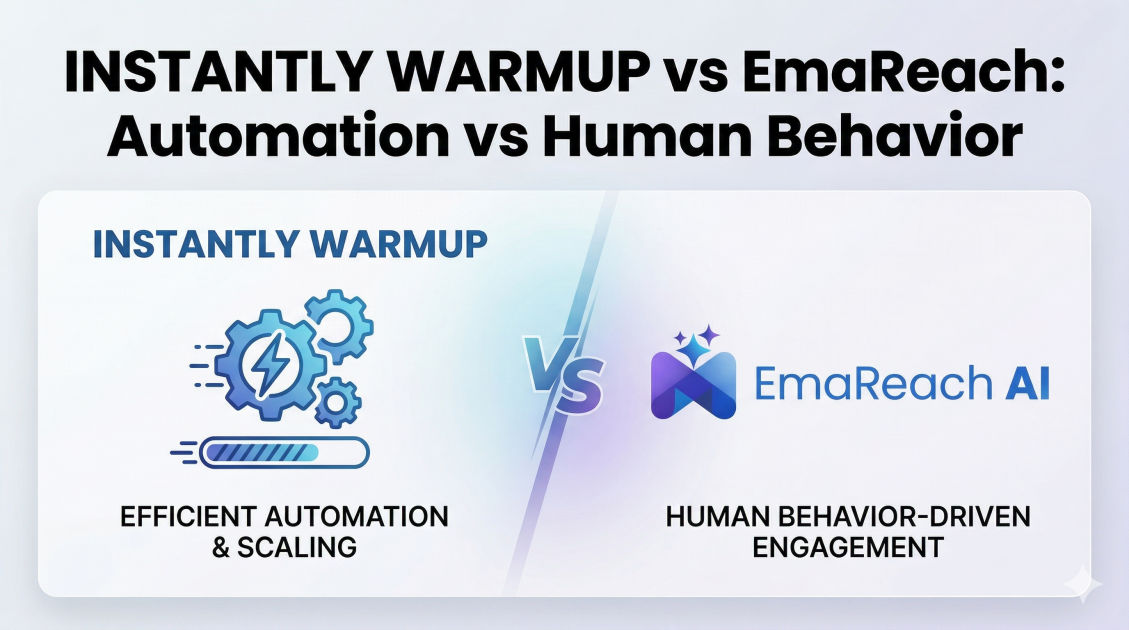
Instantly Warmup vs Emareach: Automation vs Human Behavior
cold emailoutreachdeliverabilityemail warmupautomationsales strategyB2B marketing
Introduction
In the highly competitive world of digital outreach, the success of a cold email campaign hinges entirely on one critical factor: deliverability. Crafting the perfect pitch, identifying the ideal target audience, and meticulously designing a sales funnel all become completely irrelevant if your emails are quietly redirected into the recipient's spam folder. The ultimate goal of any outreach professional is to land directly in the primary inbox, a feat that has become increasingly difficult as Email Service Providers (ESPs) deploy highly sophisticated, algorithm-driven spam filters.
To combat these aggressive filters, the industry turned to email warmup tools. These platforms are designed to artificially build trust with ESPs by generating positive engagement—opens, replies, and marking emails as "not spam"—before the actual cold outreach begins. However, not all warmup strategies are created equal. A fascinating ideological and technological divide has emerged in the deliverability space, perfectly encapsulated by the contrast between tools like Instantly and EmaReach.
This divide centers on the core philosophy of engagement: pure, scalable automation versus the nuanced emulation of genuine human behavior. Understanding the mechanics, advantages, and inherent risks of each approach is paramount for anyone looking to scale their email outreach effectively while protecting their domain reputation.
The Crucial Role of Email Deliverability
Before delving into the specific methodologies of different warmup tools, it is essential to understand the underlying mechanics of email deliverability and why ESPs scrutinize senders so intensely.
Understanding Sender Reputation
Think of your sender reputation as a credit score for your email domain. Every time you send an email, ESPs evaluate this score to determine where your message belongs: the primary inbox, the promotional tab, or the dreaded spam folder. This reputation is built upon a foundation of technical authentication (such as SPF, DKIM, and DMARC records) and historical sending data. If your domain has a history of high bounce rates, low open rates, or frequent spam complaints, your sender reputation will plummet, taking your deliverability down with it.
The Shift in Spam Filter Technology
Historically, spam filters relied primarily on static rules. They scanned for specific trigger words, blacklisted IP addresses, and overly aggressive sending volumes. Today, ESPs utilize advanced machine learning models that analyze deep behavioral patterns. They do not just look at whether an email was opened; they look at how long it remained open, whether the user scrolled through the content, if it was moved between folders, and the contextual relevance of any replies. They analyze the cadence of your sending—if you send exactly fifty emails every hour on the hour, the algorithm immediately recognizes this as non-human behavior. This shift from static rule-based filtering to dynamic behavioral analysis has completely transformed the requirements for effective email warmup.
The Traditional Approach: Automation with Instantly Warmup
Instantly has established itself as a dominant force in the cold email space, largely due to its built-in, unlimited warmup feature. The platform champions an approach that leans heavily on massive scale and peer-to-peer automation.
The Peer-to-Peer Network Model
Instantly's warmup mechanism operates on a vast network of thousands of user accounts. When you connect an email address to the platform and activate the warmup feature, your account begins automatically sending emails to other users within the Instantly network. Simultaneously, your account receives emails from those users. The system automatically opens these emails, moves them out of the spam folder if they land there, and generates generic replies.
The Strengths of Pure Automation
There are distinct advantages to this approach. First and foremost is sheer volume. Because the process is entirely automated across a massive user base, you can rapidly generate hundreds of daily interactions, quickly establishing a baseline of activity for a new domain. Furthermore, this method is highly cost-effective and remarkably easy to use. It represents a "set it and forget it" philosophy that appeals to high-volume senders who prioritize efficiency and scale above all else.
The Vulnerabilities of Predictable Patterns
However, the pure automation approach carries inherent risks in the modern deliverability landscape. ESP algorithms are specifically designed to detect bot-like activity. When thousands of accounts are sending and replying to each other using similar, templated language and predictable sending intervals, a detectable footprint is created.
Automated replies often lack conversational depth. They may consist of random dictionary words or nonsensical phrases intended merely to register a "reply" event rather than simulate a real discussion. Over time, sophisticated spam filters can identify these automated clusters. If an ESP flags a massive network of accounts engaging in artificial interaction, it can result in synchronized deliverability drops for the domains involved in that network. The mathematical predictability of pure automation ultimately becomes its greatest vulnerability.
The Modern Approach: Simulating Human Behavior with EmaReach
Recognizing the limitations of robotic, predictable warmup networks, a new generation of deliverability tools has emerged, prioritizing the simulation of organic, human interactions. This brings us to a platform that excels in this specific area.
Stop Landing in Spam. Cold Emails That Reach the Inbox. EmaReach AI combines AI-written cold outreach with inbox warm-up and multi-account sending—so your emails land in the primary tab and get replies.
By focusing on the quality and realism of the interaction rather than just the volume, platforms like EmaReach represent a fundamental shift in how outreach professionals protect their sender reputation.
The AI-Driven Evolution
Instead of relying solely on a massive, randomized peer network passing generic messages back and forth, the human behavior approach utilizes advanced artificial intelligence to generate contextually relevant, meaningful interactions. The goal is to make the warmup activity indistinguishable from a legitimate business conversation in the eyes of an ESP's machine learning algorithm.
How Human Behavior is Emulated
To understand why this method is so highly effective, one must examine the specific behavioral metrics that ESPs monitor and how AI emulates them:
1. Natural Sending Cadence: Humans do not send emails at mathematically perfect intervals. We take coffee breaks, attend meetings, and have variable working hours. Human-emulation warmup tools introduce calculated randomization into the sending schedule, creating natural spikes and lulls that mimic a real person managing their inbox.
2. Contextual and Thematic Replies: Rather than replying with gibberish or static templates, the AI reads the incoming warmup email and generates a thoughtful, relevant response. If the initial email is about marketing software, the reply will naturally discuss marketing concepts. This deep contextual relevance signals to the ESP that a genuine, valuable conversation is taking place.
3. Reading Latency and Interaction: ESPs track how long an email remains open. If an email is opened and replied to within milliseconds, it is obviously a bot. Human behavior systems introduce artificial delays—simulating the time it takes a human to read the subject line, open the email, read the contents, think about a response, and type it out.
4. Complex Threading: Real conversations often span multiple messages back and forth over several days. AI-driven systems build deep conversational threads, proving to the ESP that the recipient finds the sender's communication consistently engaging over time.
Automation vs. Human Behavior: A Direct Comparison
When evaluating Instantly Warmup against the behavioral simulation of EmaReach, the comparison boils down to quantity and predictability versus quality and nuance.
Engagement Quality Over Quantity
Pure automation relies on the brute force of numbers. By sending fifty warmup emails a day and getting fifty automated replies, the system attempts to drown out any negative signals from bounced cold emails. However, as ESPs become smarter, they assign different weights to different types of engagement. A long, thoughtful email thread that spans several days carries significantly more positive weight than a dozen instantaneous, one-word replies. Human behavioral simulation focuses on generating these high-weight interactions, allowing you to achieve better deliverability with a lower volume of warmup emails.
Thread Depth and Contextual Nuance
In a standard automated network, interactions are often shallow. User A sends an email to User B, User B replies, and the interaction ends. With AI-driven human behavior simulation, User A sends a customized pitch to User B, User B asks a relevant follow-up question, User A answers the question, and User B expresses gratitude. This depth of threading is incredibly difficult for basic bots to replicate and is heavily rewarded by spam filters.
Sending Volume and Spikes
Automated systems tend to operate on a linear curve—sending exactly X emails per day. While you can manually adjust these limits, the underlying rhythm remains robotic. Human-centric tools are designed to handle irregular patterns, better preparing your inbox for the unpredictable nature of real-world cold outreach campaigns, where some days you might send out a massive blast and other days you might only follow up with a handful of prospects.
The Real-World Impact on Cold Outreach Campaigns
Choosing between these two philosophies has tangible, measurable impacts on the success of your outreach efforts and the longevity of your digital infrastructure.
Primary Inbox vs. Promotions Tab
Landing in the inbox is no longer a binary "spam or not spam" proposition. Google and Yahoo heavily utilize the Promotions tab to filter automated, commercial mail away from the user's primary focus. Basic automation networks often succeed in avoiding the spam folder but frequently land in the Promotions tab because their behavior—while technically not malicious—still looks like bulk commercial mail. By simulating organic, one-to-one human interaction, AI-driven warmup strategies are vastly more successful at securing placement in the coveted Primary tab, dramatically increasing open and reply rates.
Long-Term Domain Health
Burning through domains is an expensive and frustrating aspect of modern cold email. If you rely on purely predictable automation, a sudden algorithm update from a major ESP could flag your entire sending infrastructure, rendering your domains useless overnight. Investing in human behavior simulation builds a much more resilient sender reputation. Because your activity genuinely mirrors a normal business user, you are significantly insulated against sudden algorithmic shifts designed to catch spammers and bot networks.
Best Practices for Inbox Placement
Regardless of which warmup philosophy you align with, the tool is only one part of a comprehensive deliverability strategy. To maximize your chances of success, you must maintain excellent technical hygiene.
First, ensure your DNS records (SPF, DKIM, DMARC) are perfectly configured. Without these digital signatures, no amount of warmup will save you. Second, always maintain strict list hygiene. Sending emails to invalid addresses causes hard bounces, which severely damage your reputation faster than any warmup tool can repair it. Always verify your lead lists before launching a campaign. Finally, monitor your campaigns closely. Slowly ramp up your sending volume when transitioning from the warmup phase to active outreach, and never pause your warmup entirely—it should run concurrently in the background to continuously stabilize your sender reputation.
Conclusion
The landscape of email deliverability is a continuous arms race between outreach professionals and email service providers. As spam filters evolve from static rules to complex behavioral analysis, the tools we use must evolve alongside them. While traditional, highly automated peer-to-peer networks offer undeniable scale and ease of use, their predictable patterns are becoming increasingly detectable. The future of reliable inbox placement lies in the meticulous simulation of human behavior. By prioritizing contextual relevance, natural sending cadences, and deep conversational threading, outreach campaigns can bypass aggressive filters, protect their domain reputation, and ultimately connect with their target audience in the primary inbox.
EmaReach AI
Ready to scale your cold email outreach?
Join thousands of teams using EmaReach AI for AI-powered campaigns, domain warmup, and 95%+ deliverability. Start free — no credit card required.
Related posts
- Read article
The Instantly Alternative That Finally Gets Outbound Analytics Right
Discover why high-volume cold email requires a shift from surface-level vanity metrics to deep, data-driven revenue attribution, and explore the ultimate alternatives for mastering outbound engineering.
- Read article
What You Gain and What You Give Up When Switching From Instantly
Thinking about migrating your cold email stack? This detailed guide breaks down the exact operational advantages you gain and the core features you sacrifice when switching away from Instantly's popular outreach platform.