Blog
Back to blog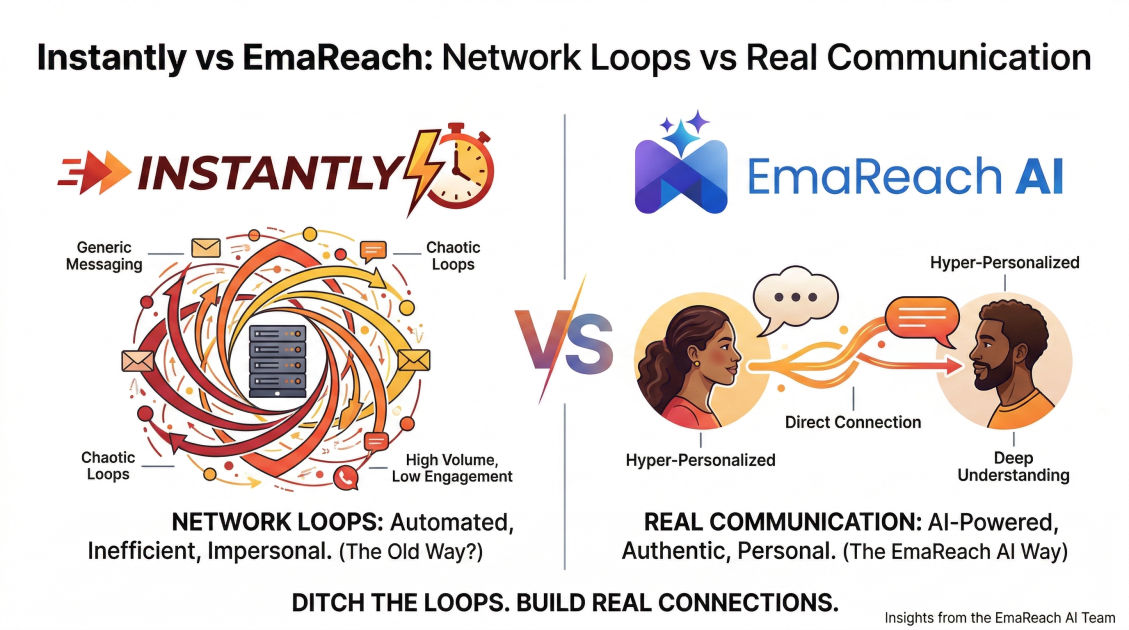
Instantly vs Emareach: Network Loops vs Real Communication
Introduction: The Changing Landscape of Cold Email
The landscape of cold outreach has fundamentally shifted from a numbers game to a highly sophisticated digital chess match against some of the most advanced algorithms in the world. In the early days of cold email, success was simply a matter of volume. You could scrape a massive list of prospects, load them into a basic sending tool, blast out a generic template, and wait for the leads to roll in. Those days are permanently over. Today, the inbox is a closely guarded fortress, protected by Email Service Providers (ESPs) like Google and Microsoft, who utilize complex machine learning models to analyze billions of data points every single day. Their primary goal is simple: protect their users from spam, unsolicited pitches, and irrelevant noise.
As ESPs have evolved, so too have the tools used by sales professionals, marketers, and agency owners. Two distinct philosophies have emerged in the battle for the primary inbox. On one side, we have the concept of "Network Loops," a strategy heavily popularized by platforms with massive shared warmup pools, such as Instantly. On the other side, a newer, more sophisticated paradigm has emerged: "Real Communication." This approach, championed by platforms like EmaReach, focuses on organic behavior, AI-driven contextual relevance, and genuine interaction patterns.
In this comprehensive guide, we will dissect the core differences between these two methodologies. We will explore how network loops function, why ESPs are catching on to synthetic engagement, and why transitioning to authentic, AI-powered real communication is the only sustainable way to scale your outbound revenue without burning your domains.
The Mechanics of Cold Email Deliverability
Before diving into the specific comparison between network loops and real communication, it is crucial to understand the underlying mechanics of email deliverability. Deliverability is not merely the act of sending an email; it is the science of ensuring that an email successfully navigates a gauntlet of filters, firewalls, and algorithms to land safely in the recipient's primary inbox.
Deliverability is governed by a concept known as Sender Reputation. Much like a credit score, your sender reputation is a dynamic metric that ESPs use to evaluate your trustworthiness. This reputation is tied to both your domain name and your IP address. When you send an email, the receiving server looks at your reputation to decide whether your message belongs in the primary tab, the promotions folder, or the dreaded spam folder—or if it should be rejected entirely.
Several factors influence your sender reputation:
- Technical Authentication: This includes SPF (Sender Policy Framework), DKIM (DomainKeys Identified Mail), and DMARC (Domain-based Message Authentication, Reporting, and Conformance). These records prove to the receiving server that you are who you claim to be and that your email has not been tampered with in transit.
- Engagement Metrics: This is the most critical factor in modern deliverability. ESPs closely monitor how recipients interact with your emails. Positive signals include opening the email, replying, forwarding, marking it as "important," and rescuing it from the spam folder. Negative signals include deleting the email without reading it, low open rates, and, most damaging of all, being manually marked as spam by the recipient.
- Content Quality: Spam filters analyze the actual text and HTML of your email. They look for common spam trigger words, excessive use of links, poor text-to-HTML ratios, and aggressive sales language.
- Sending Volume and Consistency: Erratic sending patterns—such as sending zero emails for a week and then blasting ten thousand in a single day—are massive red flags for spam filters. ESPs prefer consistent, gradually increasing sending volumes.
Because engagement metrics are so heavily weighted by ESPs, the concept of "email warmup" was born. Warmup is the process of artificially generating positive engagement signals to build a strong sender reputation before launching a real cold outreach campaign. This brings us to the core debate: how should this warmup and engagement be achieved?
Understanding Network Loops (The Instantly Approach)
Platforms like Instantly popularized the modern approach to email warmup through the creation of massive, shared user pools. This methodology relies on what we can describe as "Network Loops."
How Network Loops Function
A network loop is essentially a closed ecosystem of users who all agree to let a software platform send emails back and forth among their accounts. When you connect your email account to a platform utilizing this strategy, the software automatically begins sending conversational emails from your account to the accounts of other users on the platform. Conversely, you receive emails from those users.
The platform's algorithms monitor the inbox. If an email from the network lands in your spam folder, the software automatically moves it to the primary inbox, marks it as read, and occasionally sends a brief, generic reply. The theory is that by generating thousands of these positive interactions, the overall sender reputation of every account in the pool is elevated.
The Pros of Network Loops
The primary advantage of the network loop strategy is scale. Platforms with hundreds of thousands of connected accounts can generate massive volumes of interaction. For a time, this brute-force approach to engagement was highly effective. It allowed users to rapidly warm up new domains and achieve high inbox placement rates for their initial campaigns.
The Inherent Flaws and Risks of Synthetic Engagement
However, the network loop model has significant vulnerabilities that modern ESP algorithms are increasingly exploiting. The fundamental flaw of a network loop is that it is, by definition, synthetic.
- Algorithmic Fingerprinting: ESPs like Google and Microsoft employ thousands of data scientists dedicated to identifying unnatural patterns. When thousands of accounts are all sending emails back and forth using the same underlying software infrastructure, they leave a digital fingerprint. ESPs can analyze the headers, the routing paths, and the exact timing of these interactions. Once an ESP identifies the footprint of a massive warmup pool, it can silently devalue the positive signals generated within that network, rendering the warmup process useless.
- Incestuous Data Pools: In a network loop, bad actors inevitably enter the pool. If a user connects a domain that is actively sending massive amounts of toxic spam, their interactions within the warmup pool can potentially cross-contaminate the reputations of other users. While platforms try to filter out bad actors, the sheer scale makes it a constant game of whack-a-mole.
- Generic Language Patterns: Historically, the emails sent within these network loops have consisted of randomly generated, nonsensical text or highly generic sentences designed simply to pass basic structural checks. ESP algorithms have advanced to the point of semantic analysis. They can read an email and determine whether it represents a logical, human conversation. When an ESP sees thousands of accounts exchanging grammatically correct but logically disjointed paragraphs, it flags the behavior as artificial.
The Shift to Real Communication (The EmaReach Approach)
As ESPs have cracked down on synthetic network loops, the most successful cold emailers have shifted their focus to "Real Communication." This philosophy operates on a simple premise: the only way to reliably fool a sophisticated AI spam filter is to not try to fool it at all, but rather to mimic genuine human behavior flawlessly. This is where platforms like EmaReach have changed the game.
Mimicking Organic Behavior
Real communication platforms understand that a genuine business email does not look like a randomized script. It has context, relevance, and a natural progression. To achieve long-term deliverability, every aspect of the outreach process must simulate an authentic human sitting at a keyboard, writing a thoughtful message to a peer.
If you want to EmaReach: Stop Landing in Spam. Cold Emails That Reach the Inbox. EmaReach AI combines AI-written cold outreach with inbox warm-up and multi-account sending—so your emails land in the primary tab and get replies. This is the exact philosophy needed to survive the modern inbox. Instead of relying purely on a massive, randomized pool of users, this approach focuses on the quality and authenticity of the engagement.
Contextual AI and Semantic Authenticity
The transition from basic templates to AI-written cold outreach is a monumental leap in deliverability. Traditional outreach relied on "spintax" (e.g., "Hi {First_Name}, I saw you are the {Title} at {Company}"). Even with spintax, you are ultimately sending the exact same structural footprint thousands of times. Spam filters detect this repetition effortlessly.
Real communication relies on generative AI to craft entirely unique emails for every single prospect, based on deep research. When EmaReach AI writes a cold email, it doesn't just swap out variables; it generates unique sentence structures, varying lengths, and contextually relevant observations about the recipient's business. From the ESP's perspective, this does not look like a mass blast; it looks like one human writing one email to another human.
Intelligent Multi-Account Infrastructure
Another core tenet of the real communication philosophy is distributed volume. In the past, a sender might blast 1,000 emails a day from a single inbox. Today, that is a guaranteed path to the spam folder. Real communication necessitates a multi-account sending strategy.
By distributing the sending volume across dozens of different inboxes and separate domains (e.g., sending 30 emails per day from 10 different accounts), you naturally mimic organic corporate behavior. No single account is flagged for excessive volume. EmaReach simplifies this complex infrastructure, allowing users to scale their outreach horizontally rather than vertically. This horizontal scaling protects the root domain's reputation while still allowing for high-volume outreach.
Deep Dive Comparison: Instantly vs EmaReach Methodologies
To fully grasp the impact of these two differing philosophies, let us compare them across several critical dimensions of cold email strategy.
1. Warmup Quality vs. Warmup Quantity
- Network Loops (Instantly style): Focuses heavily on quantity. The goal is to generate as many interactions as possible within a massive shared pool. While the sheer volume can artificially inflate sender scores in the short term, the predictable patterns make it highly susceptible to sudden algorithmic penalties.
- Real Communication (EmaReach style): Focuses on qualitative interactions. The warmup process involves highly realistic, context-aware conversations that mirror actual business threads. The algorithms evaluating these interactions see long reply chains, varied response times, and rich, natural language, building a much more resilient sender reputation.
2. Personalization and Content Generation
- Network Loops (Instantly style): While offering basic personalization tags and spintax capabilities, the burden of creating highly variable content falls largely on the user. If the user relies on standard templates, the network loop warmup cannot protect the domain from being flagged for repetitive content blasts.
- Real Communication (EmaReach style): Deeply integrates AI-written cold outreach into the core workflow. By leveraging advanced language models, the platform ensures that the actual outbound campaign emails are as structurally and semantically unique as the warmup emails. This continuity between warmup behavior and live sending behavior is crucial for bypassing spam filters.
3. Deliverability Longevity
- Network Loops (Instantly style): Often characterized by the "burn and churn" methodology. Users experience high deliverability initially, but as ESPs catch onto the network footprint, domains frequently burn out, requiring users to constantly purchase and warm up new domains.
- Real Communication (EmaReach style): Prioritizes domain longevity. Because the sending patterns, email content, and warmup interactions are indistinguishable from normal human behavior, domains maintain high sender reputations for significantly longer periods, leading to more stable and predictable lead generation.
Why ESP Algorithms Favor Real Communication
The reason the real communication model is winning the deliverability war comes down to how ESP machine learning models are trained. Google and Microsoft train their spam filters on billions of real user interactions. They know exactly what an organic business conversation looks like. They analyze:
- Read Time: How long does the recipient keep the email open? Synthetic interactions often open and close emails in milliseconds.
- Reply Depth: Are the replies a simple "Thanks" or are they multi-paragraph, contextually relevant responses?
- Thread Continuity: Does the conversation flow logically over several days, mimicking a negotiation or scheduling process?
Network loops struggle to simulate these deep, nuanced metrics at scale without triggering pattern recognition flags. Real communication platforms, by design, focus on optimizing these exact metrics through AI and carefully managed multi-account infrastructure.
Actionable Strategies for Bulletproof Campaigns
Regardless of the specific tool you choose, succeeding in modern cold email requires a commitment to the principles of real communication. Here are actionable steps to implement immediately:
- Diversify Your Infrastructure: Never send cold outreach from your primary business domain. Purchase secondary domains (e.g., if your company is
acme.com, buytryacme.comandacmehq.com). Set up multiple Google Workspace or Microsoft 365 tenants to isolate your sending IP reputations. - Strict Authentication: Ensure your SPF, DKIM, and DMARC records are configured flawlessly. Use tools to monitor DMARC reports to catch any authentication failures early.
- Hyper-Personalization: Abandon static templates. Utilize AI to research your prospects and write custom first lines or entirely unique emails that speak directly to their current business challenges.
- Volume Control: Cap your daily sending limits strictly. Aim for no more than 30-40 cold emails per day, per inbox. If you need more volume, add more inboxes, do not increase the limits on existing ones.
- Monitor and Iterate: Treat your deliverability like a vital sign. Monitor your open rates, reply rates, and bounce rates daily. If open rates drop below 40%, pause your campaigns immediately, assess your content, and review your domain health.
Conclusion
The era of the mass email blast is over, and the methods used to force those blasts into the inbox are rapidly becoming obsolete. While network loops and massive warmup pools offered a temporary hack for scale, the sophisticated algorithms governing the inbox have adapted. Relying purely on synthetic engagement is a high-risk strategy that ultimately leads to burned domains and missed opportunities. The future of cold outreach belongs to real communication. By combining intelligent multi-account infrastructure with authentic, AI-driven conversational nuances, you can build a sustainable, highly profitable outbound engine that algorithms respect and prospects actually want to engage with.
EmaReach AI
Ready to scale your cold email outreach?
Join thousands of teams using EmaReach AI for AI-powered campaigns, domain warmup, and 95%+ deliverability. Start free — no credit card required.
Related posts
- Read article
The Instantly Alternative That Finally Gets Outbound Analytics Right
Discover why high-volume cold email requires a shift from surface-level vanity metrics to deep, data-driven revenue attribution, and explore the ultimate alternatives for mastering outbound engineering.
- Read article
What You Gain and What You Give Up When Switching From Instantly
Thinking about migrating your cold email stack? This detailed guide breaks down the exact operational advantages you gain and the core features you sacrifice when switching away from Instantly's popular outreach platform.