Blog
Back to blog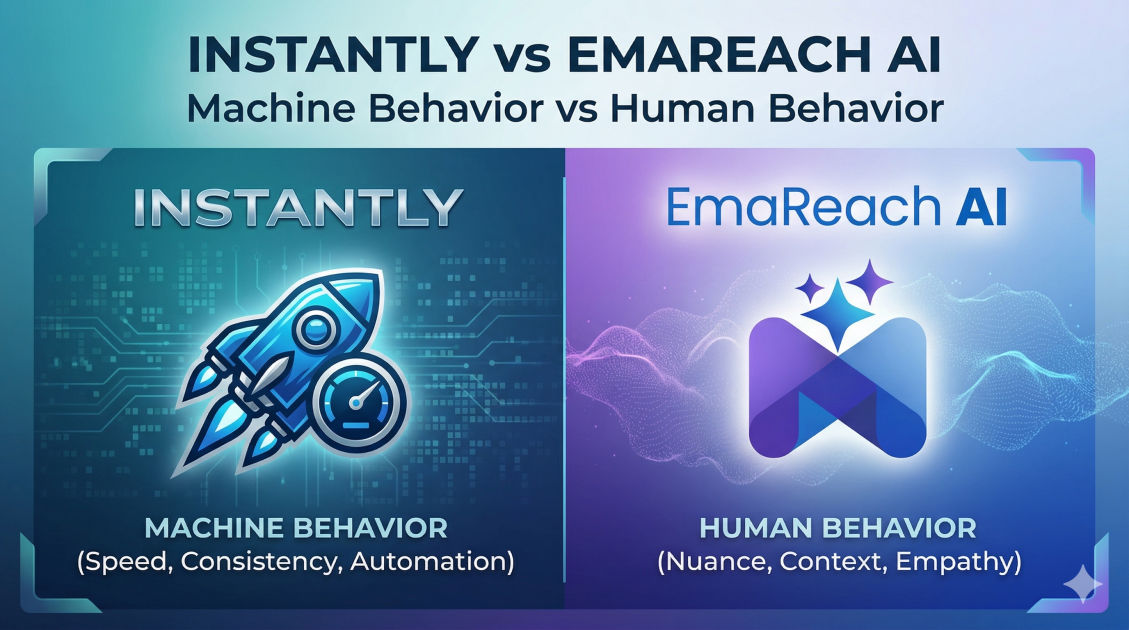
Instantly vs Emareach: Machine Behavior vs Human Behavior
cold emailoutreachdeliverabilityemail warm-upsales automationB2B lead generationAI personalization
Introduction
The landscape of cold outreach has fundamentally shifted. Gone are the days when you could load a list of ten thousand prospects into a basic mail merge tool, hit send, and watch the leads pour into your inbox. Today, the gatekeepers of the inbox—major email service providers like Google Workspace and Microsoft 36x—deploy highly sophisticated algorithms designed to ruthlessly filter out unsolicited communications. In this modern arena, the battle for the primary inbox is no longer just about having the right technical setup; it is entirely about behavior.
Specifically, the email deliverability landscape has distilled into a singular, critical conflict: Machine Behavior versus Human Behavior. When evaluating tools to power your lead generation, the underlying philosophy of the platform dictates your ultimate success. Two major paradigms have emerged in this space, represented distinctly by platforms like Instantly and EmaReach. While both aim to solve the cold email puzzle, their approaches to scaling outreach highlight the stark contrast between automation that acts like a machine and automation designed to emulate human beings.
This comprehensive analysis will explore the profound differences between machine behavior and human behavior in cold email, how major service providers detect the difference, and how Instantly and EmaReach stack up in the quest to conquer the primary inbox.
The Evolution of Email Deliverability
To understand why behavior matters, we must first understand how spam filters have evolved. Early spam filters relied on content analysis and blacklists. If your email contained words like "Free," "Guarantee," or "Click Here," or if your IP address was flagged, your message was routed to the junk folder.
Marketers adapted by using cleaner language and rotating IP addresses. In response, email service providers (ESPs) upgraded their defenses, introducing strict authentication protocols like SPF, DKIM, and DMARC. These protocols verified the sender's identity, ensuring that the person sending the email actually owned the domain.
However, authentication alone is no longer enough. Anyone, including spammers, can set up proper DNS records. The ultimate metric ESPs now use to determine inbox placement is sender reputation, which is calculated almost entirely based on user engagement and sending patterns. ESPs ask questions like: How many emails does this domain send per day? At what intervals? Do recipients open them? Do they reply? Do they mark them as spam? Are the sending patterns robotic, or do they look like a real person sitting at a desk typing out messages?
This shift brings us directly to the core concept: the Turing Test of email deliverability.
Defining Machine Behavior in Cold Email
Machine behavior is characterized by rigid predictability, unnatural volume spikes, and a lack of contextual engagement. When an email automation platform operates purely as a machine, it leaves distinct digital footprints that modern spam filters easily detect.
Predictable Sending Intervals
Machines love precision. A basic automation script will send an email exactly every 60 seconds. Even slightly randomized systems might send emails between 60 and 90 seconds apart. However, human beings do not operate this way. A human might send three emails in five minutes, take a twenty-minute break to drink coffee, send one more, and then go to a meeting. Predictable, clustered sending intervals are a massive red flag for ESPs.
Volume Spikes
Machine behavior often involves sending thousands of emails on a Tuesday, zero on Wednesday, and thousands again on Thursday. A normal corporate email account has a relatively stable, organic flow of incoming and outgoing mail. Sudden, massive spikes in outbound volume from a previously quiet domain instantly trigger spam filters.
Identical Content Payloads
When a machine sends a campaign using basic variable replacement (e.g., "Hi {{First_Name}}"), the core body of the email remains mathematically identical across thousands of sends. Spam algorithms calculate the hash of the email body. If they see thousands of identical hashes originating from the same domain in a short period, they classify it as bulk mail, routing it to the promotional tab or the spam folder.
Asymmetrical Engagement
Machines send, but they rarely receive—at least not in the way humans do. A domain exhibiting machine behavior might have an outbound-to-inbound ratio of 100:1. In contrast, a healthy, human-operated inbox has a much more balanced ratio of sending, receiving, and threading replies.
Defining Human Behavior in Cold Email
Human behavior is the antithesis of machine behavior. It is inherently chaotic, contextual, and reactive. Emulating this chaos is the holy grail of modern cold email outreach.
Erratic and Natural Pacing
Human beings operate on schedules that include breaks, distractions, and deep work sessions. An email sending pattern that mimics human behavior will have erratic gaps between sends, mimicking the time it takes to research a prospect, write a thoughtful message, and hit send.
Contextual and Unique Copy
When a human writes an email, they reference specific, highly contextual details. Even if they are working from a template, they will modify sentences, change greetings, and adjust the value proposition based on the recipient's specific situation. This ensures that every single email sent has a unique mathematical hash, making it impossible for ESPs to group them into a single "bulk" category.
Symmetrical Inboxing and Threading
Humans receive newsletters, internal company updates, and calendar invites. They reply to emails, and the recipients reply back, creating deep, multi-message threads. This symmetrical engagement tells ESPs that the account belongs to a real, active member of the business community, dramatically boosting sender reputation.
Instantly: The High-Volume Automation Approach
Instantly has made a significant impact on the cold email industry by democratizing high-volume sending. Its core philosophy revolves around horizontal scaling: instead of sending 1,000 emails from one account (which guarantees spam placement), you connect 100 accounts and send 10 emails from each.
The Strengths of Instantly
Instantly is built for scale. Its unlimited email account pricing model encourages users to build massive infrastructures of sending domains. The unified inbox (Unibox) allows teams to manage replies from hundreds of accounts in one centralized dashboard. It also includes a robust network of automated warm-up to help build initial domain reputation.
Where Machine Behavior Creeps In
While Instantly provides the tools to spread out volume, how users actually configure campaigns often results in machine behavior. Because the platform makes it so easy to load massive lists and blast them across hundreds of domains, many users fall into the trap of high-velocity, low-personalization sending.
Furthermore, Instantly's reliance on traditional "spintax" (spinning syntax) to create variation often results in emails that still feel slightly robotic to both the end-user and sophisticated spam algorithms. If the underlying logic of the campaign is "send X emails across Y accounts using Z template," the burden of creating human-like behavior rests almost entirely on the user's ability to configure complex sending schedules and write exhaustive spintax variations. If the user fails to do this perfectly, the system defaults to machine-like efficiency, which paradoxically harms deliverability.
EmaReach: Engineering Human Behavior
This is where EmaReach enters the conversation with a fundamentally different philosophy. If traditional platforms are built to maximize volume through horizontal scaling, EmaReach is built to maximize deliverability by meticulously engineering human behavior at every stage of the process.
Stop Landing in Spam. Cold Emails That Reach the Inbox. EmaReach AI combines AI-written cold outreach with inbox warm-up and multi-account sending—so your emails land in the primary tab and get replies.
The Behavioral Engine
EmaReach does not merely allow you to send emails; it acts as a behavioral layer between your domain and the email service providers. Instead of relying on rigid sending schedules, EmaReach introduces organic entropy. The pacing of emails sent through the platform actively mimics the erratic nature of a human user, complete with natural delays, varying volumes throughout the day, and simulated periods of inactivity.
Beyond Spintax: Contextual AI Generation
Where older platforms rely on spintax to fool spam filters, EmaReach utilizes native AI to draft outreach. This ensures that every single outgoing message is structurally and contextually unique. By generating bespoke copy based on the prospect's data, EmaReach bypasses the "identical hash" problem entirely. The emails do not just look different to a spam filter; they read differently to the human being opening them. This combination of AI-written cold outreach ensures that the personalization feels authentic, rather than stitched together by a machine.
Holistic Inbox Warm-up
The warm-up process in EmaReach is designed to simulate a living, breathing inbox. It does not just blindly send and open emails within a network. The warm-up process involves complex threading, natural reply variations, and simulated human reading times. By generating realistic conversations within the warm-up network, EmaReach AI signals to Google and Microsoft that your domain is actively engaged in valuable human-to-human communication.
Feature Comparison: Instantly vs EmaReach
To truly grasp the "Machine vs Human" dynamic, we must look at how these platforms handle specific technical challenges.
1. Sending Algorithms
Instantly: Relies heavily on user-defined schedules. You set the hours, the maximum daily limit, and the minimum delay between emails. It executes these rules flawlessly—like a highly efficient machine. EmaReach: Incorporates dynamic pacing algorithms. While you set the parameters, the system introduces micro-variations that mimic human workflow, automatically adjusting the send rate based on real-time feedback from the ESPs to ensure optimal deliverability.
2. Content Personalization
Instantly: Primarily utilizes custom variables (CSV columns) and spintax formatting. This requires manual heavy lifting from the user to ensure the text doesn't sound like a poorly translated robot. EmaReach: Employs AI-driven generation to contextualize the core message for each recipient. The system understands the intent of the campaign and rewrites the message organically, achieving 100% unique variations that pass human and algorithmic scrutiny.
3. Warm-up Networks
Instantly: Offers a massive, robust warm-up pool due to its large user base. The focus is on sheer volume of positive interactions. EmaReach: Focuses on the quality and complexity of the warm-up interactions. EmaReach orchestrates deep, contextual replies within its network, mimicking long-term business relationships rather than superficial "hello" messages.
4. Deliverability Monitoring
Instantly: Provides basic metrics on open rates and spam placement, requiring the user to interpret the data and adjust their strategy manually. EmaReach: Proactively monitors the health of the multi-account sending ecosystem. If it detects that a specific inbox is beginning to exhibit machine-like patterns or is taking a dip in reputation, it can throttle sending automatically to preserve the domain's long-term viability.
Why Emulating Human Behavior is the Only Future-Proof Strategy
The arms race between email marketers and spam filters is continuously escalating. Every time a new "hack" or automated shortcut is discovered, Google and Microsoft update their algorithms to patch the vulnerability.
Operating with a "machine behavior" mindset is a short-term strategy. You might be able to blast out tens of thousands of emails using a static template and a rigid schedule for a few weeks, but eventually, the algorithms will catch up. Your domains will burn, your open rates will plummet to near zero, and your leads will dry up. The cost of replacing domains, setting up new workspaces, and waiting weeks for new IPs to warm up is astronomical in terms of lost time and revenue.
Emulating human behavior is the only truly future-proof strategy because spam filters are fundamentally designed to protect human communication. An algorithm will never penalize an account for acting like a polite, relevant, and engaging human being.
By prioritizing dynamic pacing, contextual AI personalization, and deep conversational warm-up, you align your outreach strategy with the goals of the email service providers. You are no longer trying to trick the spam filter; you are actively demonstrating the exact metrics the spam filter is looking for to validate your legitimacy.
The Psychology of the Inbox
Beyond the technical algorithms, we must also consider the psychology of the recipient. When a prospect opens an email, they have an innate, almost subconscious ability to detect machine-generated spam.
An email that looks perfectly formatted, uses a generic hook, and asks for a 15-minute call in the exact same phrasing they have seen a dozen times that week triggers an immediate negative reaction. They hit the "Mark as Spam" button. This user-generated spam complaint is the most damaging signal you can send to an ESP.
Conversely, an email that reads naturally, references something highly specific about their business without feeling forced, and uses a conversational tone invites a reply. Even if the reply is a polite "No thank you," that response is a massive positive signal to the ESP.
This is why the AI-written cold outreach combined with multi-account sending in platforms like EmaReach is so powerful. It doesn't just solve the technical deliverability problem; it solves the human conversion problem. It respects the recipient's time by providing tailored value, which in turn protects your sender reputation.
Building a Sustainable Lead Generation Engine
Choosing the right tool is about more than just comparing feature lists; it is about choosing the operational philosophy that will govern your revenue engine.
If your goal is to send the maximum number of emails with the minimum amount of upfront thought, platforms leaning toward pure mechanical automation might seem appealing in the short term. However, this approach treats domains as disposable assets and accepts terrible deliverability as a cost of doing business.
If, however, your goal is to build a sustainable, long-term lead generation engine, you must prioritize human behavior. You must treat your sending domains as valuable assets that require careful nurturing.
This requires a platform that understands the nuances of modern deliverability. It requires a system that seamlessly blends inbox warm-up, erratic sending patterns, and highly contextual copy. It requires an infrastructure that operates invisibly, allowing your message to take center stage without the telltale signs of robotic automation dragging it into the spam folder.
Conclusion
The difference between landing in the primary inbox and being banished to the spam folder ultimately comes down to the digital body language of your email accounts. Machine behavior—characterized by predictable intervals, identical copy, and lack of organic engagement—is the fastest way to ruin your domain reputation. Human behavior—defined by contextual relevance, dynamic pacing, and symmetrical communication—is the key to unlocking consistent deliverability.
While tools like Instantly provide the raw power for high-volume sending, mastering the nuances of deliverability on such platforms requires immense manual oversight to avoid looking like a machine. On the other hand, platforms built from the ground up to emulate human interaction offer a more sophisticated path forward. By deeply integrating AI-driven personalization, intelligent warm-up networks, and erratic sending algorithms, the modern outreach stack can bypass sophisticated spam filters by simply acting like a real person. Choosing the right philosophy will dictate the long-term success, sustainability, and profitability of your entire outbound motion.
EmaReach AI
Ready to scale your cold email outreach?
Join thousands of teams using EmaReach AI for AI-powered campaigns, domain warmup, and 95%+ deliverability. Start free — no credit card required.
Related posts
- Read article
The Instantly Alternative That Finally Gets Outbound Analytics Right
Discover why high-volume cold email requires a shift from surface-level vanity metrics to deep, data-driven revenue attribution, and explore the ultimate alternatives for mastering outbound engineering.
- Read article
What You Gain and What You Give Up When Switching From Instantly
Thinking about migrating your cold email stack? This detailed guide breaks down the exact operational advantages you gain and the core features you sacrifice when switching away from Instantly's popular outreach platform.