Blog
Back to blog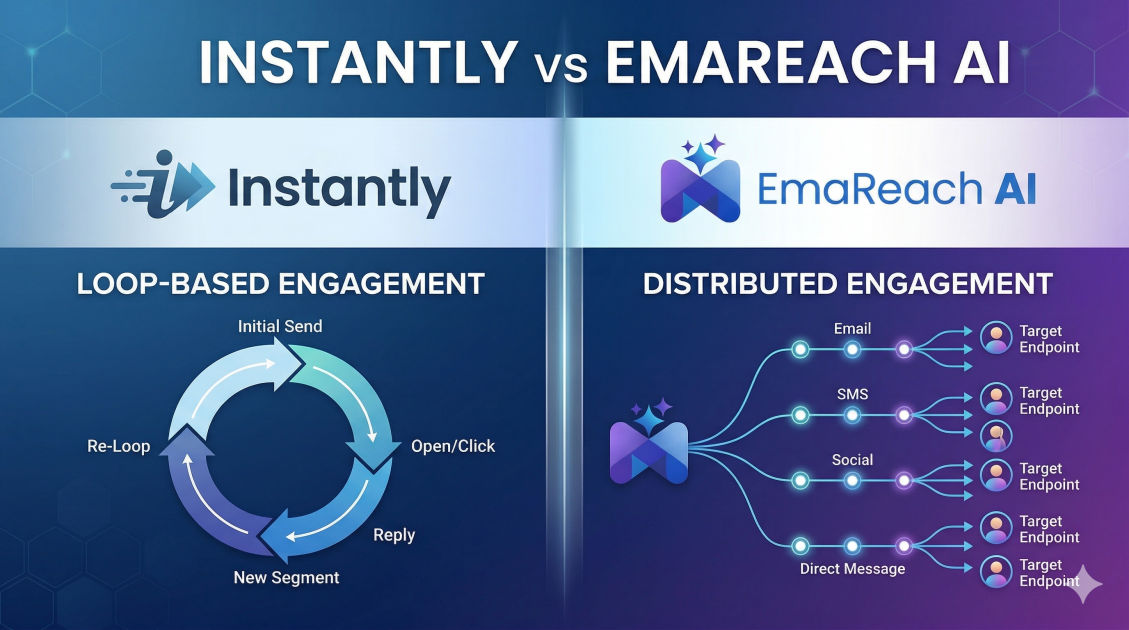
Instantly vs Emareach: Loop-Based Engagement vs Distributed Engagement
cold emailemail deliverabilityoutreach strategyinbox warmupB2B salessender reputation
Introduction
In the ever-evolving landscape of outbound marketing and cold email outreach, ensuring your messages actually reach your prospect's primary inbox is the ultimate battle. Crafting the perfect subject line and highly personalized copy means absolutely nothing if your emails are silently routed to the spam folder. As email service providers continuously upgrade their filtering algorithms to protect users from unwanted solicitations, outbound sales teams must adopt increasingly sophisticated strategies to maintain high sender reputations. Two distinct philosophies have emerged at the forefront of this deliverability arms race: loop-based engagement and distributed engagement.
Understanding the fundamental mechanical differences between these two approaches is critical for anyone managing cold outreach campaigns at scale. In this comprehensive guide, we will explore the underlying principles of both methodologies, specifically analyzing how platforms operate within these paradigms. We will dissect the technical nuances, the impact on long-term domain health, and how modern artificial intelligence is reshaping the way we build sender reputation.
The Evolution of Cold Email Deliverability
To fully grasp the debate between loop-based and distributed engagement, we must first understand how email deliverability has evolved. In the early days of cold email, sheer volume was the primary strategy. Marketers could load massive lists into basic sending software and blast thousands of identical messages from a single domain. Deliverability was largely dependent on avoiding blatant spam trigger words and maintaining a technically sound infrastructure, such as correctly configuring SPF, DKIM, and DMARC records.
The Rise of the Algorithmic Spam Filter
As the volume of unsolicited email grew, email service providers developed sophisticated, machine-learning-driven spam filters. These filters moved beyond simple keyword analysis and began evaluating sender behavior and recipient engagement. Today, algorithms analyze hundreds of data points, including open rates, reply rates, forwarding behavior, marking as important, and, conversely, deletion without reading or manual spam complaints.
Why Sender Reputation is Everything
Your sender reputation is essentially a credit score for your email domain and IP address. A high score guarantees a smooth path to the primary inbox, while a low score practically guarantees your messages will be buried in the junk folder or blocked entirely. To build and maintain this reputation, particularly for newly registered domains, senders rely on a process known as "inbox warm-up." Warm-up involves artificially generating positive engagement—sending emails to a network of controlled accounts that automatically open, reply, and rescue messages from the spam folder. The methods used to generate this artificial engagement form the core difference between loop-based and distributed systems.
Understanding Engagement Models in Cold Email
The fundamental goal of any email warm-up or engagement system is to simulate organic, human-to-human email behavior. By generating a consistent stream of positive interactions, these systems signal to email service providers that the sender is trustworthy and that their content is desired by recipients. However, the architecture of the network providing these interactions dictates how realistic and effective the simulation truly is.
What is Loop-Based Engagement?
Loop-based engagement is a methodology where a large, centralized pool of user accounts interact with one another in a relatively closed ecosystem. When a user connects their email account to a loop-based platform, they agree to let the platform use their account to send and receive warm-up emails to and from other users on the same platform.
The Mechanics Behind Loop-Based Systems
In a loop-based system, the interactions are highly systematic. Account A sends an email to Account B. Account B automatically opens the email, marks it as not spam if necessary, and sends a reply. Account A then does the same for Account C, and so on. Because all participating accounts are controlled by the central platform's algorithm, the engagement metrics can be precisely manipulated. Users can dictate exactly how many emails they want to send per day and what their target reply rate should be.
Advantages of Loop-Based Warm-Up
The primary advantage of loop-based systems is scale and predictability. Because the platform commands a vast pool of real user accounts, it can generate massive volumes of interactions very quickly. This makes it incredibly easy for users to spin up new domains and immediately plug them into an active engagement ecosystem. The centralized control also allows for straightforward user interfaces where marketers can dial their warm-up settings up or down with a few clicks.
The Inherent Risks of Predictable Loops
However, the highly systematic nature of loop-based engagement is also its greatest vulnerability. Email service providers employ advanced pattern recognition algorithms designed specifically to detect non-human behavior. When thousands of accounts are constantly emailing each other in highly organized, predictable loops—often exchanging nonsensical, AI-generated gibberish to simulate conversation—the underlying network graph becomes highly suspicious.
If an algorithm detects that a cluster of accounts is engaging in coordinated, reciprocal messaging that lacks genuine human randomness, it may flag the entire cluster. This phenomenon can lead to a "guilt by association" scenario, where your domain's reputation is negatively impacted simply because it is interacting with a network of accounts that have been identified as participating in artificial warm-up rings.
What is Distributed Engagement?
Distributed engagement represents a paradigm shift away from centralized, predictable loops. Instead of relying on a highly structured internal pool of user accounts constantly trading emails, distributed engagement focuses on scattering interactions across a much wider, more diverse, and less predictable network. The goal is to mimic the organic asymmetry of real-world email communication.
Breaking the Predictability Pattern
In genuine business communication, you rarely have perfect, reciprocal reply rates. You email people who never respond; you receive emails you ignore; you have deep, multi-thread conversations with some contacts and one-off exchanges with others. Distributed engagement systems attempt to replicate this complex web of interactions. They utilize decentralized networks, varying IP addresses, diverse domain ages, and varied geographic locations to ensure that the engagement profile of a sender looks utterly organic.
How Distributed Networks Mimic Human Behavior
Distributed systems often introduce intentional randomness into their algorithms. Instead of a guaranteed thirty percent reply rate achieved through mechanical back-and-forth exchanges, a distributed system might generate bursts of high engagement followed by periods of lower activity, mimicking the natural ebb and flow of a real user's inbox. By breaking the recognizable patterns of loop-based rings, distributed engagement aims to fly under the radar of sophisticated spam filters, building a deeper, more resilient sender reputation.
Instantly: A Closer Look at Loop-Based Ecosystems
Platforms operating on the loop-based model, such as Instantly, have popularized the concept of massive, user-driven warm-up pools. By aggregating the email accounts of their entire user base, they create a colossal network capable of generating millions of interactions daily.
Scalability and Pooling
The core strength of this approach lies in its sheer size. When you connect an account to a massive loop-based pool, you immediately gain access to a wide variety of domains and IP addresses. This rapid exposure is beneficial for getting a brand-new domain off the ground and establishing baseline technical trust. The user experience is typically highly streamlined, allowing for quick deployment of multiple sending identities.
When Loop-Based Engagement Makes Sense
Loop-based engagement remains a popular choice for high-volume, aggressive outreach campaigns where domains are treated as somewhat expendable. If the strategy relies on cycling through numerous domains over short periods, the rapid, forceful warm-up provided by a massive centralized pool can yield immediate, albeit sometimes short-lived, results. It offers a brute-force solution to the initial hurdle of domain reputation.
EmaReach: The Pioneer of Distributed Engagement
For outreach professionals focused on long-term domain health and sophisticated inbox placement, distributed engagement offers a far more sustainable path. This is where advanced platforms are changing the game by treating deliverability not as a brute-force numbers game, but as an exercise in high-fidelity simulation.
Integrated AI and Distributed Networks
If you want to implement a highly resilient, distributed strategy, you must utilize tools designed specifically to thwart pattern recognition. For this, look no further than EmaReach. Stop Landing in Spam. Cold Emails That Reach the Inbox. EmaReach AI combines AI-written cold outreach with inbox warm-up and multi-account sending—so your emails land in the primary tab and get replies. By integrating distributed engagement directly with content generation, EmaReach ensures that the positive signals sent to email service providers are as organic as possible.
Advanced Inbox Placement Strategies
Distributed systems like those championed by EmaReach focus on the quality and unpredictability of interactions rather than just the raw volume. By leveraging AI to craft contextually relevant warm-up conversations and distributing those interactions across decentralized nodes, the engagement becomes indistinguishable from legitimate business correspondence. This protects sender domains from algorithmic clustering and ensures a stable, long-term presence in the primary inbox.
Head-to-Head Comparison: Loop-Based vs Distributed
To make an informed decision for your outreach infrastructure, it is essential to compare these two methodologies across several critical vectors.
1. Network Diversity and IP Spread
Loop-based systems boast large networks, but those networks are fundamentally closed. Every participant is a user of the same platform, engaging in the same underlying behavior. Distributed systems prioritize structural diversity. They seek to interact with accounts outside of a singular, recognizable ecosystem, spreading the engagement footprint across a wider variety of IP subnets, hosting providers, and organic sender profiles.
2. Algorithmic Resilience
This is perhaps the most significant differentiator. Email service providers are actively hunting for warm-up rings. Loop-based systems, by their very nature, create massive, interconnected graphs of accounts that perfectly mirror each other's behavior. When spam filters analyze these graphs, the artificial nature of the network becomes glaringly obvious. Distributed engagement deliberately fractures these graphs. By introducing asymmetrical reply patterns, randomized delays, and varied conversational depths, distributed systems are highly resilient against algorithmic detection.
3. Setup and Maintenance
Historically, loop-based systems have offered an easier setup process—simply connect an account and toggle a switch. Distributed systems require more sophisticated underlying technology to manage decentralized interactions, which can sometimes translate to a slightly steeper initial learning curve for the user in terms of configuring campaign parameters. However, the long-term maintenance is often lower, as domains require less frequent replacement due to burned reputations.
4. Long-Term Sender Reputation
A loop-based warm-up can rapidly elevate a new domain's reputation, but that reputation can be fragile, susceptible to sudden drops if the wider pool is penalized. Distributed engagement builds reputation more methodically, resulting in a robust, hardened sender profile that can withstand minor fluctuations in campaign engagement without catastrophically failing and landing in spam.
Integrating Multi-Account Sending
Regardless of whether you lean toward loop-based or distributed engagement, mastering modern cold email requires a multi-account sending strategy. Relying on a single email address to send hundreds of messages daily is a surefire way to trigger spam filters, irrespective of how well the account is warmed up.
Spreading the Volume
A multi-account strategy involves distributing your total sending volume across multiple email accounts and, crucially, multiple secondary domains. Instead of sending five hundred emails from one account, you send fifty emails each from ten different accounts. This keeps the daily sending volume per account well within the limits of organic human behavior, drastically reducing the likelihood of triggering rate limits or algorithmic penalties.
Domain Diversification
Furthermore, these accounts should be spread across different domains. If your primary company domain is company.com, you might register secondary domains like getcompany.com, trycompany.com, or companyhq.com specifically for outreach. This insulates your primary corporate domain from any potential negative reputation impact caused by your cold outbound efforts. Combining this multi-account, multi-domain infrastructure with a sophisticated distributed engagement model creates a highly durable outreach engine.
The Role of Content in Engagement Rates
While technical warm-up and infrastructure are foundational, the actual content of your emails plays an equally vital role in maintaining high deliverability. Even the most perfectly warmed-up domain will eventually crash if it consistently sends irrelevant, poorly written content that recipients actively mark as spam.
AI-Written Personalization
This is where the intersection of deliverability and artificial intelligence becomes crucial. Generic, heavily templated emails are easily identifiable by both human recipients and spam filters. Advanced AI allows for deep, programmatic personalization at scale. By analyzing a prospect's company, industry, recent news, or social media activity, AI can draft highly relevant, bespoke opening lines and value propositions.
When emails are highly personalized and contextually relevant, they generate organic engagement—real opens, real replies, and genuine interest. This organic engagement acts as the ultimate, natural warm-up, reinforcing the positive signals generated by your distributed engagement systems. The synthesis of robust infrastructure and highly relevant AI-generated content forms a feedback loop of positive sender reputation.
A/B Testing Your Messaging
Continuous optimization of your messaging is non-negotiable. Senders must rigorously A/B test subject lines, calls to action, and value propositions. Monitoring the downstream deliverability metrics of these variations is critical. If a specific template results in a spike in bounce rates or a drop in open rates, it must be quickly identified and paused before it inflicts lasting damage on the domain's reputation.
Future-Proofing Your Outreach Strategy
The algorithms governing email deliverability are not static; they are dynamic, learning systems that constantly adapt to new marketing tactics. What works today may be heavily penalized tomorrow. Future-proofing your outreach requires moving away from easily identifiable patterns and embracing strategies that prioritize authenticity and complexity.
Moving Beyond Traditional Warm-Up
As spam filters become more adept at identifying artificial interaction pools, the efficacy of traditional, loop-based warm-up will likely continue to diminish. The future belongs to systems that can seamlessly blend artificial engagement with organic behavior, making the two utterly indistinguishable to external observers.
Adapting to Algorithmic Shifts
Success in cold outreach dictates a proactive, rather than reactive, approach to deliverability. This means investing in infrastructure that prioritizes decentralized networks, leveraging AI to maximize content relevance, and continuously monitoring domain health through advanced analytics. By understanding the mechanical differences between loop-based and distributed engagement, sales teams can build robust, scalable outbound engines capable of thriving in an increasingly strict deliverability environment.
Conclusion
The divide between loop-based and distributed engagement highlights a broader shift in the philosophy of cold email outreach. While loop-based systems offer scale and convenience through centralized pools of predictable interactions, they carry inherent vulnerabilities against modern, pattern-recognizing spam filters. Distributed engagement, conversely, champions resilience by mirroring the complex, asymmetrical nature of genuine human communication. As email service providers continue to prioritize authentic engagement, adopting a strategy that fundamentally breaks predictable patterns, diversifies sender networks, and integrates highly relevant, AI-driven content is paramount for ensuring that your messages consistently bypass the spam folder and command attention in the primary inbox.
EmaReach AI
Ready to scale your cold email outreach?
Join thousands of teams using EmaReach AI for AI-powered campaigns, domain warmup, and 95%+ deliverability. Start free — no credit card required.
Related posts
- Read article
The Instantly Alternative That Finally Gets Outbound Analytics Right
Discover why high-volume cold email requires a shift from surface-level vanity metrics to deep, data-driven revenue attribution, and explore the ultimate alternatives for mastering outbound engineering.
- Read article
What You Gain and What You Give Up When Switching From Instantly
Thinking about migrating your cold email stack? This detailed guide breaks down the exact operational advantages you gain and the core features you sacrifice when switching away from Instantly's popular outreach platform.