Blog
Back to blog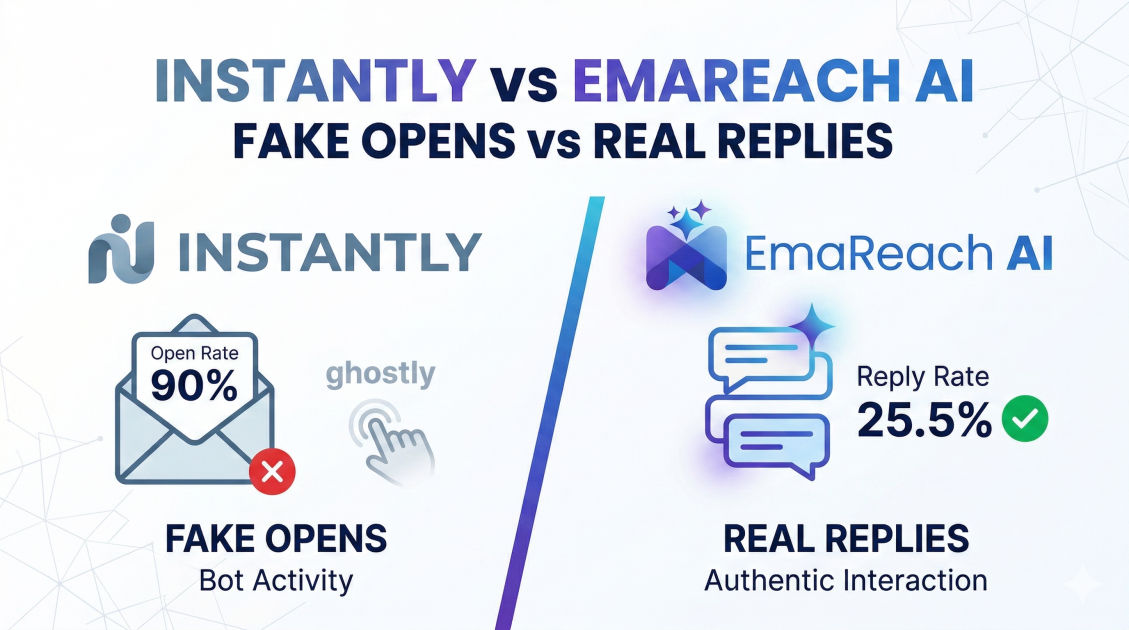
Instantly vs Emareach: Fake Opens vs Real Replies
cold emailoutreachdeliverabilityemail marketingb2b saleslead generation
Introduction: The Great Deliverability Divide
In the ever-evolving landscape of B2B sales and digital marketing, cold email remains one of the most effective channels for generating high-quality leads. However, the metrics we use to measure the success of these campaigns have undergone a radical transformation. For decades, email marketers relied heavily on open rates to gauge interest and campaign health. Today, this metric is not just unreliable; it is actively deceptive. The debate between tracking opens versus optimizing for replies has culminated in the comparison of two distinct philosophies in the outreach space, perfectly illustrated by exploring platforms like Instantly and Emareach.
This comprehensive analysis explores the phenomenon of 'fake opens,' the shift toward 'real replies,' and how choosing the right infrastructure dictates whether your carefully crafted pitches land in the primary inbox or the spam folder. We will delve deep into the mechanics of email deliverability, the technical nuances of tracking pixels, and why focusing on tangible conversations is the only sustainable strategy for cold email success.
The Fallacy of the Open Rate: Understanding Fake Opens
To understand the core difference between the philosophies of various cold email platforms, one must first understand why the open rate is officially dead.
The Mechanics of Email Tracking
Historically, email platforms tracked opens by embedding a microscopic, transparent image—often a 1x1 pixel—at the bottom of an HTML email. When the recipient opened the email, their mail client downloaded the images, triggering a request to the sender's server. This request logged the 'open.'
The Rise of Mail Privacy Protection
This system was fundamentally broken by major tech companies prioritizing user privacy. Apple's Mail Privacy Protection (MPP) was a watershed moment. When a user opts into MPP, Apple pre-fetches and caches all images in an email the moment it hits the server, regardless of whether the user actually opens the email. To the sender's tracking software, this registers as a legitimate open. Consequently, campaigns sent to Apple Mail users will artificially inflate open rates, giving senders a false sense of security and success.
Enterprise Security Bots
Beyond consumer privacy features, enterprise email security systems have become increasingly aggressive. Firewalls and spam filters regularly 'click' links and download images in incoming emails to scan for malware or phishing attempts before the email ever reaches the recipient's inbox. If you are sending B2B cold emails, your tracking pixel is likely being triggered by a bot, not a human prospect.
The Danger of Vanity Metrics
Relying on fake opens creates a dangerous feedback loop. Senders believe their subject lines are performing well and their deliverability is pristine, so they continue sending at high volumes. In reality, their emails might be landing in the promotional tab or the spam folder, opened only by automated security scripts. This reliance on vanity metrics ultimately harms sender reputation and drastically reduces return on investment.
Instantly: The Volume and Warm-up Pioneer
Instantly entered the cold email market and rapidly gained popularity by democratizing unlimited email warm-up and multi-account sending. It provided agencies and sales teams with the ability to scale their outreach without paying per-seat licenses for every new inbox.
The Strengths of Instantly
Instantly's interface is user-friendly, and its core proposition of scale is highly attractive. By allowing users to connect dozens or hundreds of sender accounts, it mitigated the risk of domain burnout. If one domain's reputation dipped, others could pick up the slack.
The Vanity Metric Trap
However, a common critique within the advanced deliverability community is that platforms heavily focused on scale can sometimes inadvertently encourage users to focus on the wrong metrics. While Instantly provides reply tracking, many users still fixate on the open rates displayed prominently on their dashboards. Furthermore, standard warm-up pools—where users send automated emails to each other to build reputation—have been increasingly targeted by major inbox providers. If a sender is relying on high open rates from a warm-up pool to validate their campaign's success, they are likely falling victim to the fake open phenomenon. The platform is powerful, but it requires a user who understands that opens do not equal revenue.
Emareach: Engineering for the Primary Inbox and Real Replies
As the industry matures, the focus has drastically shifted from sending bulk volume to ensuring surgical precision and high deliverability. This is where Emareach steps into the spotlight, prioritizing the ultimate metric: the real reply.
Stop Landing in Spam. Cold Emails That Reach the Inbox. EmaReach AI combines AI-written cold outreach with inbox warm-up and multi-account sending—so your emails land in the primary tab and get replies.
A Philosophy of Deliverability First
Emareach operates on the fundamental truth that an unread email in the spam folder has an ROI of zero, regardless of what the open tracking pixel says. The platform is engineered to bypass the traps that trigger enterprise spam filters. By prioritizing real replies over superficial metrics, Emareach aligns its technology with the actual goals of sales teams: generating booked meetings and closing deals.
AI-Driven Personalization at Scale
The difference between a spam complaint and a real reply often comes down to relevance. Emareach utilizes advanced AI to craft cold outreach that does not sound like a generic template. The AI analyzes target data to generate highly personalized opening lines and value propositions. When an email reads as though it was written by a human specifically for the recipient, the likelihood of a genuine response skyrockets. This AI integration moves the needle away from 'spray and pray' tactics toward hyper-targeted communication.
Advanced Inbox Warm-up and Infrastructure
While warm-up is standard in the industry, Emareach's approach integrates deeply with multi-account sending to ensure domains maintain a pristine reputation. By simulating human-like behavior, varying sending patterns, and ensuring technical setups are flawless, the platform signals to major email service providers that the sender is trustworthy. This comprehensive infrastructure ensures that messages bypass the promotional tab and land directly in the primary inbox, exactly where real replies are generated.
Why Optimizing for Replies Changes Everything
When you stop tracking opens and start optimizing exclusively for replies, your entire cold email strategy shifts.
Turning Off Open Tracking
One of the most effective deliverability hacks is turning off open tracking altogether. Tracking pixels are inherently suspicious to email service providers. Spammers use them extensively. By removing the tracking pixel, your email size decreases, the HTML-to-text ratio improves, and you eliminate a major red flag for spam filters. This single action can drastically increase your primary inbox placement rate. When you use a platform that focuses on replies, you have the confidence to turn off open tracking because you are measuring success by actual inbox responses.
Plain Text Over Heavy HTML
Optimizing for replies means writing emails that look like they came from a colleague. Heavy HTML emails with multiple images, stylized buttons, and complex layouts scream 'marketing newsletter' and are swiftly relegated to the promotional tab. Plain text emails, or very minimal HTML emails that mimic plain text, feel authentic. They load faster, pass security checks easier, and invite a natural conversational response.
Call to Conversations, Not Calls to Action
The traditional marketing call-to-action (CTA) usually involves clicking a link: 'Book a time on my calendar,' 'Download this whitepaper,' or 'Click here to learn more.' In cold outreach, asking a stranger to click a link is high-friction and triggers security warnings. Optimizing for replies means changing the CTA to a Call to Conversation (CTC). Instead of a link, you ask a low-friction, interest-based question: 'Is this something you are currently struggling with?' or 'Are you open to a brief chat about this next week?' This approach dramatically increases reply rates and avoids the deliverability pitfalls of link tracking.
The Technical Backbone of High Deliverability
To consistently generate real replies, you must master the technical foundation of email deliverability. No platform can save a campaign if the fundamental infrastructure is broken.
DNS Records: SPF, DKIM, and DMARC
These three acronyms are the holy trinity of email authentication.
- SPF (Sender Policy Framework): Tells the receiving server which IP addresses are authorized to send emails on behalf of your domain.
- DKIM (DomainKeys Identified Mail): Adds a cryptographic signature to your emails, proving they were not altered in transit.
- DMARC (Domain-based Message Authentication, Reporting, and Conformance): Instructs the receiving server on what to do if an email fails SPF or DKIM checks. Having these set up correctly is non-negotiable for landing in the primary inbox.
Domain Age and Sender Reputation
Spammers burn through new domains rapidly. Email service providers know this. Therefore, a brand new domain sending hundreds of emails a day is instantly flagged. Building a solid sender reputation requires time. Domains must be aged, and sending volume must be increased gradually. This is where intelligent warm-up systems prove their worth, gently introducing a new domain to the ecosystem before full-scale campaigns begin.
Spintax and Message Variance
Sending the exact same message to ten thousand prospects is a surefire way to trigger spam filters. ESPs monitor identical content originating from the same IP or domain. Spintax (spinning syntax) allows senders to create thousands of variations of the same email by rotating synonymous words, phrases, and sentences. Combined with AI-driven personalization, message variance ensures that no two emails look exactly alike to the spam filters, keeping your deliverability high.
Masterclass: Crafting Emails that Generate Real Replies
Once the technical infrastructure is secure and you have chosen a platform dedicated to deliverability, the final piece of the puzzle is the copy itself.
The Subject Line
The goal of a subject line is not to trick the prospect into opening the email; it is to accurately set the context for the message inside. Trickery leads to high fake open rates but immediate deletions and spam complaints. Keep subject lines short, ideally under five words. Lowercase subject lines often perform better because they look like internal, casual communications.
The First Line
In a mobile-first world, the first line of your email acts as a secondary subject line. It is visible in the inbox preview. If the first line is generic, the prospect will delete it without opening. The first line must immediately address the prospect, their company, or a specific observation about their industry. This is where AI-written cold outreach shines, allowing for hyper-specific first lines at scale.
The Value Proposition
Keep it concise. B2B buyers are incredibly busy. They do not want to read a novel about your company's history. State clearly what problem you solve and how it directly benefits them. Use formatting like bullet points sparingly to break up text, but maintain a conversational tone.
The Follow-Up Strategy
A single email rarely generates a reply. The fortune is in the follow-up. However, follow-ups must add value, not just guilt-trip the prospect. Instead of merely pushing the thread up, share a quick case study, a relevant news article, or an additional insight. A well-crafted sequence of three to five emails spaced out over several weeks significantly increases the chances of landing a real reply.
The Financial Impact of Reply Optimization
Understanding the contrast between fake opens and real replies is more than an academic exercise in email marketing; it is a fundamental shift in unit economics.
The Cost of Ignored Emails
When campaigns are optimized for opens, teams spend considerable time writing clickbait subject lines and managing massive lists of unverified contacts. The server costs, domain acquisition costs, and the human capital spent managing bounces and low-quality leads drain the marketing budget rapidly. Furthermore, landing in the spam folder due to poor practices means your total addressable market is shrinking without you even knowing it.
The High ROI of Reply-Centric Campaigns
Conversely, a campaign optimized for replies requires fewer emails sent to generate a qualified lead. Because the personalization is deeper and the technical infrastructure is superior, the conversion rate from sent email to booked meeting is exponentially higher. You are protecting your sender reputation, ensuring long-term viability, and drastically lowering the cost per acquisition. By focusing on platforms that emphasize real conversations over fabricated metrics, modern sales teams are securing a distinct competitive advantage.
Conclusion
The era of relying on email open rates to measure the success of an outreach campaign is definitively over. Fake opens generated by privacy features and security bots have rendered the metric useless and potentially harmful to long-term deliverability. While platforms that emphasize high volume and unlimited warm-up have their place, the modern approach requires a fundamental shift in strategy. By prioritizing real replies, eliminating tracking pixels, utilizing advanced AI for personalization, and relying on robust multi-account infrastructure, sales teams can safeguard their domains and consistently reach the primary inbox. The true measure of cold email success is not a dashboard filled with artificial opens, but an inbox filled with genuine conversations and closed deals.
EmaReach AI
Ready to scale your cold email outreach?
Join thousands of teams using EmaReach AI for AI-powered campaigns, domain warmup, and 95%+ deliverability. Start free — no credit card required.
Related posts
- Read article
The Instantly Alternative That Finally Gets Outbound Analytics Right
Discover why high-volume cold email requires a shift from surface-level vanity metrics to deep, data-driven revenue attribution, and explore the ultimate alternatives for mastering outbound engineering.
- Read article
What You Gain and What You Give Up When Switching From Instantly
Thinking about migrating your cold email stack? This detailed guide breaks down the exact operational advantages you gain and the core features you sacrifice when switching away from Instantly's popular outreach platform.