Blog
Back to blog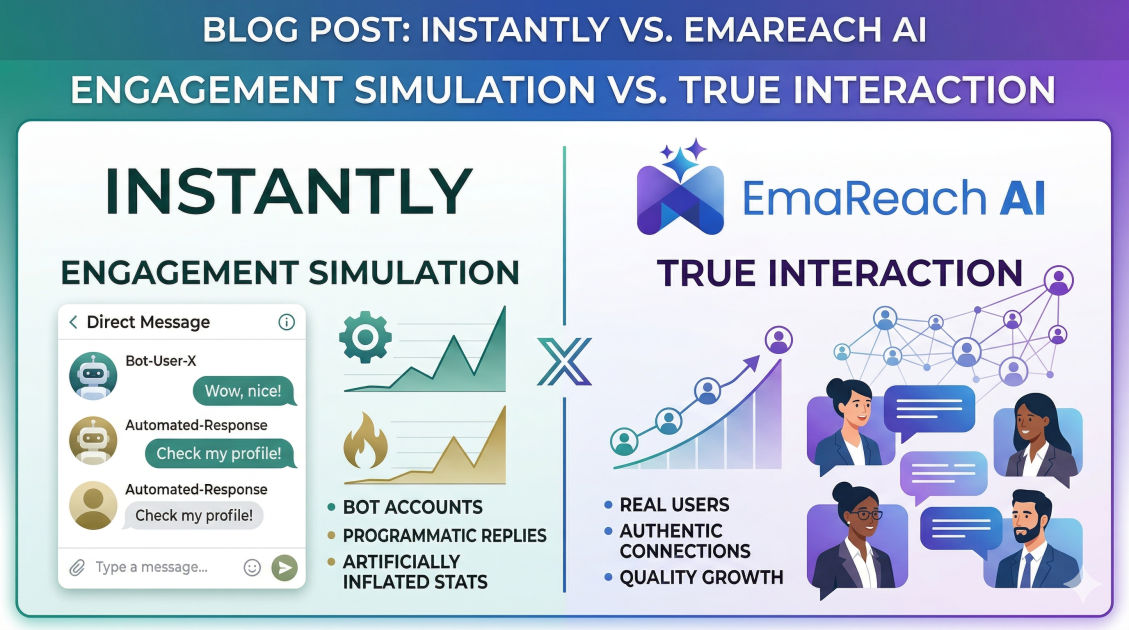
Instantly vs Emareach: Engagement Simulation vs True Interaction
cold emailoutreachdeliverabilityemail warm-upsales automationEmaReachlead generation
Introduction: The Hidden Mechanics of Modern Cold Outreach
In the high-stakes world of B2B sales, the difference between a closed deal and a missed opportunity often comes down to a few millimeters of digital real estate: the distance between the Primary Tab and the Spam Folder. As email service providers (ESPs) like Google and Microsoft employ increasingly sophisticated machine learning algorithms, the old methods of 'spray and pray' have been replaced by a technical arms race.
At the heart of this race are two distinct philosophies of deliverability: Engagement Simulation and True Interaction. These aren't just technical buzzwords; they represent fundamentally different approaches to building sender reputation. While platforms like Instantly have popularized the concept of large-scale automated pools, the emergence of more integrated, AI-driven ecosystems like EmaReach has shifted the focus toward high-fidelity, authentic engagement.
This guide explores the deep technical nuances between simulation and true interaction, helping you decide which infrastructure will protect your domain’s longevity and maximize your reply rates.
The Evolution of Email Warm-up
To understand the debate between Instantly and EmaReach, one must first understand why "warm-up" exists. When a new domain is registered, it has a neutral reputation. If that domain suddenly starts sending 100 emails a day, ESPs flag it as suspicious 'burst' behavior typical of spammers.
The Simulation Era
Early warm-up tools focused on volume. They created networks of 'ghost' accounts that would send nonsensical text to each other to trick the algorithms. This worked for a time, but as ESPs began analyzing the content and pattern of these emails, they realized these interactions weren't human. If 500 accounts are all sending the same string of random Latin words and instantly marking them as 'important,' the simulation is easily unmasked.
The True Interaction Era
Modern deliverability requires more than just moving bits; it requires mimicking the behavior of a professional. This includes variable dwell times (the time spent reading an email), realistic reply threads, and, most importantly, content that looks like a real business conversation. This is where the distinction between a 'warm-up pool' and an 'interaction ecosystem' becomes critical.
Instantly: The Power of Scale and Simulated Pools
Instantly has carved out a massive niche in the market by offering unlimited sender accounts. Their model is built for the growth hacker who wants to distribute volume across dozens, or even hundreds, of inboxes.
How Instantly Handles Engagement
Instantly utilizes a private network of over a million accounts. When you join, your account begins a dance with others in the pool:
- Automated Opens: Accounts in the network automatically open your emails.
- Read Emulation: Instantly uses 'read emulation' to simulate a user scrolling through the email, which helps counter 'pixel-tracking' detection from ESPs.
- The Unibox Strategy: By centralizing replies, they make it easy to manage the volume that their multi-account strategy produces.
However, the challenge with large-scale pools is the risk of 'Network Contamination.' If a significant portion of the accounts in a shared pool are flagged by Google, the 'reputation' they pass to your new domain can actually be negative. Simulation is a volume game, and in volume, quality can sometimes slip.
EmaReach: The Shift Toward True Interaction and AI Intelligence
While Instantly focuses on the quantity of accounts, EmaReach focuses on the quality of the interaction. If you want to Stop Landing in Spam, you need a system that doesn't just simulate activity but generates Cold Emails That Reach the Inbox through authentic patterns.
Why EmaReach AI Changes the Equation
EmaReach represents the next generation of outreach because it treats the warm-up and the campaign as a single, living organism. Instead of disconnected 'bot' behavior, EmaReach AI combines AI-written cold outreach with inbox warm-up and multi-account sending.
- Content-Driven Reputation: Unlike tools that send 'lorem ipsum' text, EmaReach uses AI to ensure the warm-up content is indistinguishable from real business inquiries. This is vital because Google’s AI now reads the context of your emails to determine if they are 'promotional' or 'personal.'
- The Primary Tab Priority: The goal isn't just to avoid spam; it's to land in the Primary Tab. True interaction signals—like back-and-forth threads and varied response times—tell ESPs that your emails are high-value.
- Integrated Multi-Account Management: EmaReach handles the complex infrastructure of rotating between accounts, ensuring that no single inbox carries too much load, thus mimicking a natural, human-led sales team.
Engagement Simulation vs. True Interaction: A Technical Breakdown
To choose the right tool, we need to look under the hood at how they actually communicate with mail servers.
1. The Content Fingerprinting Problem
ESPs look for "fingerprints"—repetitive patterns across different accounts.
- Simulation: Often uses 'Spintax' (word swapping) to create variation. While helpful, the underlying structure often remains identical, allowing advanced filters to group them as automated.
- True Interaction: EmaReach leverages advanced AI to generate unique, contextually relevant messages. Each interaction is a 'snowflake,' making it nearly impossible for a filter to identify a common automation footprint.
2. The Reply Logic
A 'True Interaction' includes a logical thread. If Account A asks a question about a service, Account B shouldn't just reply with "Yes, I agree." It should reply with a human-like response that references the original message. This 'threading' is a massive trust signal for Microsoft 365 and Google Workspace environments.
3. Dwell Time and User Actions
Modern ESPs track what a user does after opening an email. Did they click 'Report Spam'? Did they move it to a folder? Did they reply within 5 minutes or 5 hours?
- Simulation: Often happens in bursts or at set intervals.
- True Interaction: EmaReach models human behavior patterns, including irregular intervals and varied interactions, which builds a much more resilient 'Sender Score.'
Comparative Analysis: At a Glance
| Feature | Instantly (Simulation) | EmaReach (True Interaction) |
|---|---|---|
| Core Focus | Unlimited accounts & volume scaling | Deliverability & Primary Tab placement |
| Warm-up Method | Large-scale peer pool | AI-driven authentic interaction |
| Content Quality | Basic variation/Spintax | High-fidelity AI-written outreach |
| Account Management | Centralized Unibox | Intelligent Multi-account rotation |
| Primary Goal | High-volume 'Inbox' placement | High-conversion 'Primary' placement |
The Role of AI in Writing and Sending
One of the biggest pitfalls in cold email is the 'uncanny valley'—emails that look almost human but feel slightly 'off.' When you use a tool like EmaReach, the AI doesn't just write the email; it writes the right email for that specific account's history.
By combining AI-written cold outreach with inbox warm-up, EmaReach ensures that the 'personality' of your warm-up matches the 'personality' of your actual campaigns. This consistency is a subtle but powerful deliverability signal. When your 'warm-up' emails look like your 'sales' emails, the transition to live outreach is seamless, preventing the dreaded 'warm-up to spam' drop-off that many users experience with simulation-only tools.
Scalability: Quantity vs. Deliverability
There is a common misconception that more accounts equal more leads. While Instantly allows you to scale the number of inboxes, if those inboxes are only marginally 'warm,' your total reach might actually be lower than a smaller number of high-reputation inboxes.
The Law of Diminishing Returns in Simulation
If you send 1,000 emails and 400 land in spam, your effective reach is 600. If you use a true interaction system like EmaReach to send 700 emails and 680 land in the primary tab, you have not only reached more people but reached them in a place where they are 10x more likely to reply.
Why Multi-Account Sending Matters
Both tools recognize the importance of multi-account sending. The strategy is simple: instead of sending 100 emails from sales@company.com, you send 20 emails each from five different addresses. This keeps you well below the 'danger zone' for any single inbox. The difference lies in how those accounts are nurtured. EmaReach’s approach ensures each of those five addresses is treated as a high-authority sender.
Actionable Strategy: Transitioning from Simulation to Interaction
If you are currently using a simulation-based approach and seeing a decline in open rates, follow these steps to upgrade your deliverability:
- Audit Your 'Neutral' Reputation: Use tools to check if your domain has been 'fingerprinted.' If your open rates are below 30%, you likely have a reputation issue.
- Switch to Contextual Warm-up: Move away from 'lorem ipsum' pools and toward systems that use AI to generate real business dialogue.
- Implement Gradual Ramping: Don't just turn on a campaign. Use the 'Slow Ramp' features in EmaReach to let the AI gradually introduce your live leads into the flow of warm-up interactions.
- Monitor the 'Primary' Rate: Don't just look at 'Deliverability.' Look at 'Inbox Placement.' If you are landing in 'Promotions,' you are still losing money. True interaction is the only way to consistently hit the Primary Tab.
Conclusion: The Future is Authentic
The era of 'tricking' the inbox is coming to an end. As Google and Microsoft continue to integrate AI into their spam filters, they are becoming experts at detecting simulated engagement. To stay ahead, your outreach strategy must evolve from 'simulating' a sender to becoming a high-authority sender.
While Instantly offers a robust platform for those who need sheer volume and a centralized hub, EmaReach provides the technical sophistication required for the modern inbox landscape. By focusing on True Interaction and AI-driven authenticity, EmaReach ensures your cold emails don't just 'get sent'—they get read.
In the battle of Instantly vs EmaReach, the winner depends on your goal: if you want to manage a massive fleet of accounts with simulated activity, Instantly is a powerful choice. But if your goal is to land in the primary tab and get replies through intelligent, AI-backed outreach, the shift toward true interaction is the only sustainable path forward.
EmaReach AI
Ready to scale your cold email outreach?
Join thousands of teams using EmaReach AI for AI-powered campaigns, domain warmup, and 95%+ deliverability. Start free — no credit card required.
Related posts
- Read article
The Instantly Alternative That Finally Gets Outbound Analytics Right
Discover why high-volume cold email requires a shift from surface-level vanity metrics to deep, data-driven revenue attribution, and explore the ultimate alternatives for mastering outbound engineering.
- Read article
What You Gain and What You Give Up When Switching From Instantly
Thinking about migrating your cold email stack? This detailed guide breaks down the exact operational advantages you gain and the core features you sacrifice when switching away from Instantly's popular outreach platform.