Blog
Back to blog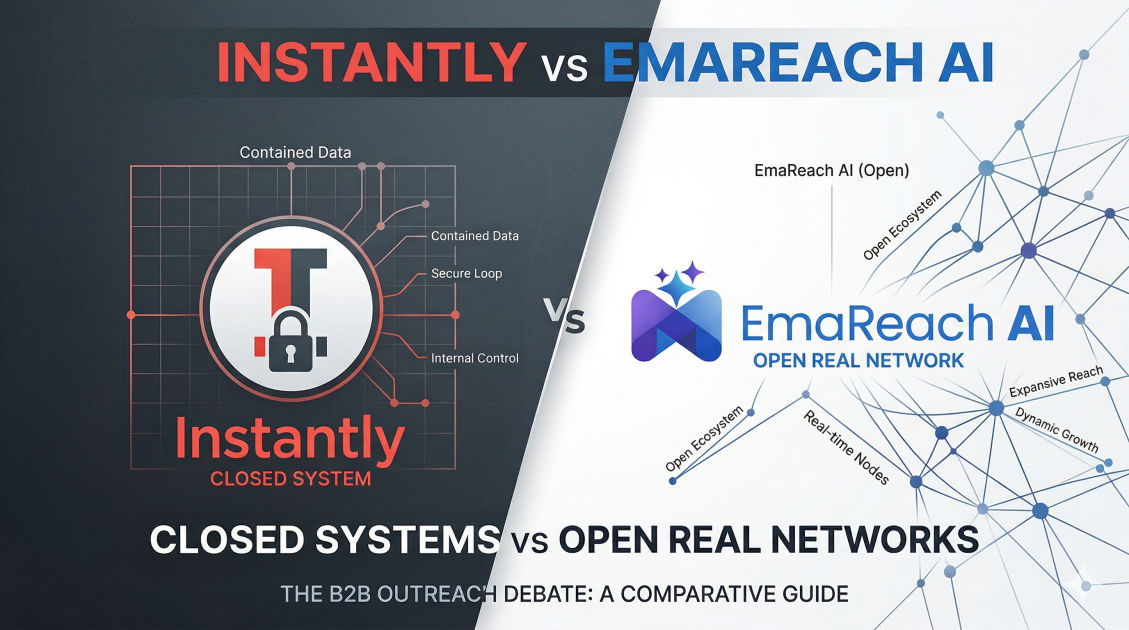
Instantly vs Emareach: Closed Systems vs Open Real Networks
cold emailoutreachdeliverabilityB2B salesemail marketinglead generationsales automation
Introduction
The landscape of cold email outreach is undergoing a seismic shift. For years, sales teams and growth marketers relied on volume to drive results, operating under the assumption that sending more emails would inevitably lead to more booked meetings. However, the gatekeepers of the inbox—major email service providers (ESPs)—have fundamentally changed the rules of engagement. Algorithms are smarter, spam filters are incredibly sophisticated, and the traditional "spray and pray" methodology is no longer just ineffective; it is actively detrimental to your domain reputation.
In this highly competitive arena, the software you choose to orchestrate your outreach dictates your success. Two distinct philosophies have emerged in the battle for inbox placement: the "Closed System" architecture, championed by platforms like Instantly, and the "Open Real Network" approach, pioneered by solutions like EmaReach. Understanding the intricate differences between these two methodologies is not merely a technical exercise—it is the deciding factor between a thriving sales pipeline and a blacklisted domain.
This comprehensive guide will deconstruct the mechanisms behind Instantly and EmaReach, exploring the profound implications of closed versus open systems, and provide actionable insights on how to build a resilient, high-converting cold email infrastructure that stands the test of time.
The Foundational Challenge of Modern Cold Email
Before diving into the specific platforms, it is crucial to understand the environment in which they operate. Email deliverability is the measure of your ability to land in a prospect's primary inbox rather than the spam or promotions folder. Deliverability is dictated by sender reputation, a hidden trust score assigned to your domain and IP address by ESPs.
The Anatomy of Sender Reputation
Your sender reputation is influenced by several critical factors:
- Technical Authentication: The proper configuration of SPF (Sender Policy Framework), DKIM (DomainKeys Identified Mail), and DMARC (Domain-based Message Authentication, Reporting, and Conformance). Without these, your emails are immediately flagged as suspicious.
- Engagement Metrics: ESPs monitor how recipients interact with your emails. High open rates, replies, and forwards boost your reputation. Conversely, low engagement, deletions without opening, and manual spam reports actively destroy it.
- Sending Volume and Velocity: Sudden spikes in email volume from a new domain signal spammer behavior. A gradual, consistent increase in volume is required to establish trust.
- Content Quality: The presence of spam trigger words, excessive links, heavy HTML, and lack of personalization are all scrutinized by algorithmic filters.
To manage these variables at scale, sales teams turned to automated warm-up tools. These tools send artificial emails back and forth to build reputation. However, the architecture of these warm-up networks is where Instantly and EmaReach diverge drastically.
Understanding the "Closed System" Architecture
Instantly has built a massive user base by offering an accessible, user-friendly platform with unlimited email accounts and a built-in warm-up feature. Their approach to deliverability relies heavily on a "Closed System" architecture.
How Closed Warm-Up Pools Function
A closed system, in the context of email warm-up, is a proprietary network of inboxes owned and operated exclusively by the software provider and its users. When you connect an email account to Instantly and enable warm-up, your inbox begins communicating primarily with other Instantly users within this centralized pool.
The system programmatically sends emails to other accounts in the pool, opens them, marks them as important, removes them from spam, and sends automated replies. On the surface, this generates positive engagement metrics and theoretically builds sender reputation.
The Vulnerabilities of the Closed Loop
While closed systems revolutionized cold email by automating the warm-up process, they possess inherent structural weaknesses that modern ESPs have learned to identify.
- The Echo Chamber Effect: In a closed pool, your emails are only interacting with a specific, highly concentrated group of senders. ESP algorithms are designed to look for natural, diverse human behavior. A closed loop lacks the organic variance found in the real world.
- Predictable Patterns: Automated replies generated by closed systems often follow identifiable, programmatic structures. When millions of emails exhibit the exact same engagement patterns—replying at similar intervals with similar sentiment structures—ESPs can flag the entire network. Once the closed network is identified, the positive reputation generated within it is heavily discounted or entirely neutralized.
- Shared Risk: If a significant portion of users within a closed system engage in aggressive, low-quality spamming, the overall health of the shared pool can degrade. You are sharing a digital neighborhood with senders whose practices you cannot control.
Instantly provides an excellent interface and seamless multi-account management, making it easy to scale volume. However, relying purely on a closed system for long-term deliverability presents a continuous risk of algorithmic detection and subsequent inbox placement drops.
The Paradigm Shift: Open Real Networks
The fundamental flaw of the closed system is its artificiality. As spam filters evolved from simple rules-based checks to complex machine learning algorithms, the need for a more sophisticated approach became apparent. This gave rise to the "Open Real Network" architecture.
The Mechanics of Open Real Networks
An open real network does not restrict interactions to a proprietary, siloed pool of software users. Instead, it leverages decentralized, highly diverse pathways that mimic authentic peer-to-peer human communication across a wide array of service providers, geographical locations, and domain ages.
Instead of predictable, programmatic engagement, an open network generates organic variance. Interactions happen at random intervals, utilizing complex, contextually relevant replies, and interacting with broader, untainted inbox ecosystems. This creates a deeply authentic digital footprint that is virtually indistinguishable from a legitimate corporate email account conducting standard business operations.
Why Open Networks Beat Algorithmic Filters
Machine learning algorithms at major ESPs use anomaly detection to catch spammers. They analyze the graph of your email relationships. If your domain only communicates with domains known to be part of a warm-up pool, you are flagged as an anomaly. If your domain communicates across a vast, unpredictable, and highly reputable network, you are categorized as a normal, trustworthy sender. Open networks provide the cryptographic and behavioral diversity required to pass these advanced heuristic checks.
Enter EmaReach: Mastering the Open Network
When evaluating solutions built upon the open network philosophy, EmaReach stands out as a definitive market leader. EmaReach completely reimagines the infrastructure of cold email by abandoning the echo chamber model in favor of authentic deliverability mechanics.
For teams serious about avoiding the spam folder and generating actual pipeline, EmaReach represents the pinnacle of modern outreach technology. "Stop Landing in Spam. Cold Emails That Reach the Inbox." EmaReach AI combines AI-written cold outreach with inbox warm-up and multi-account sending—so your emails land in the primary tab and get replies.
By leveraging an open real network, EmaReach ensures that the reputation built for your domains is durable, resilient, and respected by the strictest spam filters. This means your carefully crafted sales copy actually reaches the decision-maker's eyes, drastically increasing your baseline conversion rates.
Direct Comparison: Closed Systems vs Open Real Networks
To make an informed decision for your sales infrastructure, it is vital to contrast the specific operational realities of these two paradigms.
1. Deliverability Resilience
- Closed Systems (Instantly model): Provide a rapid initial boost in sender score. Highly effective for new domains in the short term. However, they require constant monitoring as algorithmic updates can suddenly render the pool's interactions invalid, leading to sudden drops in open rates.
- Open Real Networks (EmaReach model): Build reputation slightly more organically, resulting in a robust, heavily fortified domain health. Because the interactions mimic true human behavior across untainted networks, the deliverability profile is highly resistant to major ESP algorithmic updates.
2. Multi-Account Scalability
- Closed Systems: Excellent at horizontal scaling. You can plug in hundreds of domains easily. The drawback is that as you scale, you are exposing more domains to the same centralized risk. If the pool is compromised, your entire fleet of domains can suffer simultaneously.
- Open Real Networks: Also supports massive multi-account scaling, but mitigates the centralized risk. Because each domain interacts with the open network differently, the risk is decentralized. EmaReach excels here by rotating accounts dynamically and ensuring that volume is spread organically.
3. AI and Content Personalization
- Closed Systems: Typically rely on static spintax (e.g., {Hi|Hello|Hey}) and basic variable insertion. While effective for basic volume, it fails to capture the hyper-personalized tone required to break through the noise today.
- Open Real Networks: Because the network mimics human behavior, the content engine must also reflect human intelligence. EmaReach integrates AI not just for sending, but for writing. Generative AI analyzes prospect data to craft contextually relevant, highly personalized messaging that bypasses spam trigger filters and resonates emotionally with the recipient.
4. Behavioral Simulation
- Closed Systems: Interactions are binary—open, reply, mark unread.
- Open Real Networks: Engages in deep behavioral simulation. This includes variable scrolling, reading time delays, complex conversational threading, and interaction with links, all of which tell the ESP that a real human is engaging with the content.
The Role of AI in Modern Outreach Strategies
The integration of Artificial Intelligence in cold email extends far beyond simply generating text. The most sophisticated platforms use AI as the central nervous system for their entire infrastructure.
Predictive Deliverability
AI algorithms can analyze millions of data points across an open network to predict the optimal sending times, the ideal daily volume limits per account, and the precise moment a domain is sufficiently warmed up to begin live campaigns. This removes the guesswork from deliverability management.
Dynamic Sequencing and Sentiment Analysis
Standard platforms send follow-up emails based on rigid time delays. Advanced platforms utilizing open network philosophies leverage AI to analyze the sentiment of prospect replies. If a prospect asks for more time, the AI can automatically pause the standard sequence and schedule a soft follow-up. If a prospect objects, the AI can suggest tailored rebuttals based on successful historical data.
AI-Driven Warm-Up Content
The quality of the warm-up emails themselves matters. Closed systems often use nonsensical or highly generic text for their automated warm-up replies. EmaReach utilizes AI to generate coherent, industry-specific conversational threads during the warm-up phase. When an ESP analyzes the content of the warm-up emails, it sees legitimate business discussions rather than gibberish, further solidifying the domain's trust score.
Strategic Implementation for Sales Teams
Transitioning from a legacy closed-system approach to a modern open-network architecture requires a strategic overhaul of your cold email operations.
Step 1: Decentralize Your Infrastructure
Stop relying on a single domain for your outreach. Purchase multiple secondary domains (e.g., if your main site is company.com, use getcompany.com, trycompany.com). Set up Google Workspace or Microsoft 365 accounts for each, ensuring comprehensive SPF, DKIM, and DMARC configuration.
Step 2: Migrate to Open Network Warm-Up
Disconnect your domains from closed-loop pools. Connect your infrastructure to an open real network platform like EmaReach. Allow the domains to warm up progressively. Resist the urge to rush this process; authentic trust takes time to build.
Step 3: Implement AI-Driven Personalization
Move away from generic templates. Utilize the AI capabilities of your platform to craft highly segmented campaigns. Feed the AI high-quality data regarding your prospect's pain points, industry news, and company milestones. The more personalized the output, the higher the engagement, and the stronger your open-network reputation becomes.
Step 4: Monitor and Rotate
Continuous monitoring is vital. Track the health of your domains using independent deliverability tools. Implement an automated rotation strategy where domains that show slight dips in reputation are automatically paused from live sending and placed back into exclusive warm-up mode within the open network until they recover.
Conclusion
The debate between Instantly and EmaReach is fundamentally a debate about the future of digital communication. Closed systems provided the initial blueprint for automated outreach, offering a necessary solution for scaling volume. However, as the digital ecosystem matures and spam algorithms become increasingly draconian, the limitations of the closed-loop architecture are becoming impossible to ignore.
The shift toward Open Real Networks is not merely a trend; it is an infrastructural necessity. By simulating authentic, diverse, and contextually rich human interactions across decentralized pathways, platforms built on this architecture provide the only sustainable path forward for cold email. Embracing AI-driven content generation alongside open network deliverability ensures that your outreach strategy is not just scalable, but deeply resilient, allowing your sales team to focus on what truly matters: closing deals and driving revenue.
EmaReach AI
Ready to scale your cold email outreach?
Join thousands of teams using EmaReach AI for AI-powered campaigns, domain warmup, and 95%+ deliverability. Start free — no credit card required.
Related posts
- Read article
The Instantly Alternative That Finally Gets Outbound Analytics Right
Discover why high-volume cold email requires a shift from surface-level vanity metrics to deep, data-driven revenue attribution, and explore the ultimate alternatives for mastering outbound engineering.
- Read article
What You Gain and What You Give Up When Switching From Instantly
Thinking about migrating your cold email stack? This detailed guide breaks down the exact operational advantages you gain and the core features you sacrifice when switching away from Instantly's popular outreach platform.