Blog
Back to blog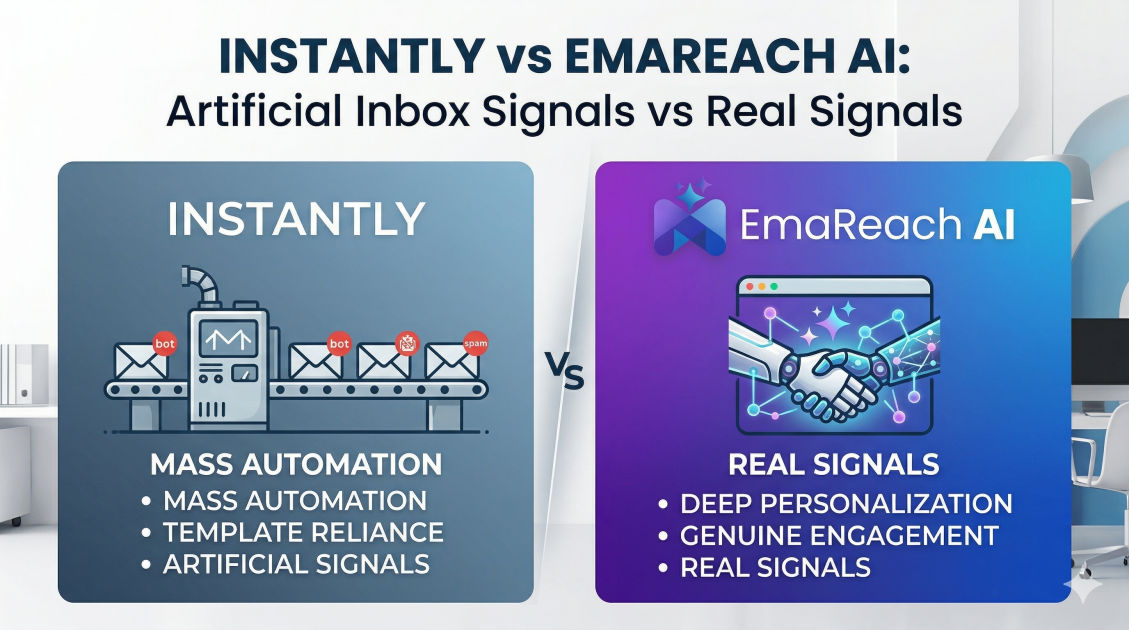
Instantly vs Emareach: Artificial Inbox Signals vs Real Signals
cold emailoutreachdeliverabilityemail marketinginbox placementsender reputation
Introduction
Cold email remains one of the most effective and scalable channels for predictable revenue generation. However, the ecosystem has undergone a massive transformation. The days of loading up a list of thousands of prospects, blasting a generic message, and watching the leads roll in are long gone. Email Service Providers (ESPs) like Google Workspace and Microsoft 365 have drastically upgraded their security infrastructures. They now employ advanced machine learning algorithms and complex behavioral analysis to filter out spam and protect their users' inboxes.
In this highly regulated environment, sender reputation is everything. To build and maintain this reputation, senders rely on "inbox signals"—metrics that tell ESPs whether an email is wanted or unwanted. This has given rise to a massive debate within the cold outreach community: should you rely on artificial inbox signals generated by automated networks, or should you focus entirely on generating real, authentic signals from actual human beings?
This comprehensive guide explores the deep-rooted differences between artificial inbox signals and real signals, examining two distinct philosophies in the outreach space. By comparing the mechanics of automated warm-up networks with the genuine engagement models, we will uncover what it truly takes to maintain long-term, scalable deliverability and why the future of outbound marketing depends on authenticity.
The Evolution of Email Deliverability
To understand the debate between artificial and real signals, it is essential to first understand how email deliverability has evolved. Deliverability is no longer just about passing basic technical checks. While having properly configured SPF (Sender Policy Framework), DKIM (DomainKeys Identified Mail), and DMARC (Domain-based Message Authentication, Reporting, and Conformance) records is an absolute necessity, it is merely the baseline. Passing these technical checks grants you the right to knock on the door of the inbox, but it does not guarantee entry.
ESPs have shifted their focus from purely technical validation to behavioral analysis. They act as protective gatekeepers for their users, constantly analyzing how recipients interact with incoming mail. When an email arrives, the ESP monitors a wide array of data points to determine its ultimate destination: the primary inbox, the promotions tab, or the dreaded spam folder.
This behavioral shift means that your sender reputation is fluid. It rises and falls based on the collective reactions of the people receiving your emails. If your emails are consistently opened, read, and replied to, your reputation climbs. If they are ignored, deleted without opening, or marked as spam, your reputation plummets. This continuous feedback loop is the foundation of modern email deliverability, and it is entirely powered by inbox signals.
The Mechanics of Inbox Signals: What ESPs Actually Look For
Inbox signals are the digital footprints left behind by a recipient's interaction with an email. These signals are categorized into positive and negative actions, each carrying a different weight in the ESP's algorithmic scoring system.
Positive Inbox Signals
Positive signals tell the ESP that your content is valuable, relevant, and expected by the recipient. The strongest positive signals include:
- Replies: The holy grail of positive signals. A genuine, typed reply indicates that a real conversation is taking place. ESPs heavily weight reply rates when calculating sender reputation.
- Moving from Spam to Inbox: When a user finds your email in the spam folder and manually moves it to the primary inbox, it sends a powerful message to the ESP's algorithm that a mistake was made and your domain is trustworthy.
- Starring or Flagging: Marking an email as important indicates that the user finds the content valuable and wants to return to it later.
- Forwarding: Sharing the email with another person demonstrates high engagement and relevance.
- Read Duration (Dwell Time): ESPs can measure how long an email remains open on the screen. A longer dwell time suggests that the recipient is actively reading the content, rather than just glancing at it and clicking away.
- Adding to Contacts: If a user adds your sending address to their address book, it essentially whitelists your domain for their specific inbox.
Negative Inbox Signals
Negative signals degrade your sender reputation and train algorithms to filter your future messages. The most damaging signals include:
- Marking as Spam: This is the most destructive action a recipient can take. Even a tiny fraction of spam complaints can severely damage a domain's sending ability.
- Deleting Without Opening: Consistently sending emails that are trashed without being read tells the ESP that your mail is unsolicited clutter.
- Ignoring Emails: A low open rate over a sustained period gradually erodes your reputation.
- Bounces: Sending to invalid or inactive email addresses indicates poor list hygiene, a common trait of spammers.
Understanding these signals is crucial because it highlights the goal of every cold email campaign: maximizing positive signals while entirely eliminating negative ones.
The Artificial Signal Approach: Automated Warm-up Pools
As ESPs made it harder to reach the inbox, the cold email industry sought a shortcut. If positive signals like replies and "spam-to-inbox" movements were the key to good deliverability, why not automate them? This led to the creation of automated warm-up tools, a methodology heavily popularized by platforms focusing on sheer volume.
How Artificial Warm-up Works
Automated warm-up platforms utilize a peer-to-peer network model. When you connect your email account to the platform, it joins a massive pool of other users' email accounts. The platform's software takes control of your account to perform automated actions behind the scenes.
Your account will automatically send emails to other accounts in the pool. Simultaneously, it will receive emails from those accounts. The software then simulates human interaction: it opens the emails, marks them as important, removes them from the spam folder if they land there, and even generates AI-written replies to simulate a conversation.
The Illusion of Safety
On the surface, this artificial ecosystem seems brilliant. Your dashboard shows a 100% open rate, a high reply rate, and zero spam complaints. It creates an illusion of perfect domain health. For a time, this method was highly effective. Senders could spin up a new domain, plug it into a warm-up pool for a couple of weeks, and then start blasting thousands of cold emails with relatively good placement.
However, these signals are entirely artificial. They are generated by bots talking to other bots within a closed loop. There is no genuine human interest, no actual business value being exchanged, and most importantly, no real intent behind the interactions.
The Inevitable Pitfalls of Artificial Engagement
Email Service Providers are massive technology companies with virtually unlimited resources. They employ some of the brightest engineers and utilize advanced artificial intelligence to protect their infrastructure. It was only a matter of time before they caught on to automated warm-up networks.
Sophisticated Detection Algorithms
ESPs have developed sophisticated methods for identifying and penalizing artificial engagement. They no longer just look at the volume of replies; they analyze the nature of the network and the quality of the interactions.
- Clustering and Network Analysis: ESPs can identify networks of accounts that frequently interact with each other but rarely interact with the outside world. If Domain A only ever gets replies from Domain B, C, and D (which are all in the same warm-up pool), the algorithm flags the behavior as a coordinated anomaly.
- Semantic Analysis of Replies: Artificial warm-up tools often generate generic, nonsensical, or highly repetitive AI text for their replies. Advanced natural language processing models used by ESPs can easily distinguish between a genuine human business reply and a bot-generated placeholder.
- Behavioral Fingerprinting: Humans read emails differently than bots. A bot opens an email, waits a programmed number of milliseconds, and triggers a reply. Humans scroll, hesitate, click sporadically, and respond at varied times. ESPs track these micro-behaviors. If an account's interaction patterns look programmatic, the signals are discounted or penalized.
The Backlash Against Artificial Signals
When an ESP identifies that a domain is using artificial signals to inflate its reputation, the punishment is severe. The algorithms will heavily penalize the domain, pushing all outgoing mail directly to spam. In extreme cases, the domain and its associated IP addresses can be permanently blacklisted.
Relying on artificial signals is a high-stakes game of cat and mouse with algorithms that are vastly superior. It forces senders to constantly burn through domains, set up new infrastructure, and start the cycle over again—a stressful, expensive, and unsustainable way to run an outreach operation.
The Shift to Real Signals: The EmaReach Philosophy
As the effectiveness of artificial warm-up networks diminishes, the industry is experiencing a necessary paradigm shift back to authenticity. To achieve sustainable, long-term deliverability, senders must focus on generating real signals from actual human prospects. This means prioritizing relevance, personalization, and intelligent infrastructure over brute-force automation.
This is where advanced solutions step in. If you are serious about your deliverability, you need a system designed around authenticity. EmaReach (https://www.emareach.com/) operates on this exact philosophy. Stop Landing in Spam. Cold Emails That Reach the Inbox. EmaReach AI combines AI-written cold outreach with inbox warm-up and multi-account sending—so your emails land in the primary tab and get replies.
Generating Genuine Engagement
Generating real signals requires a fundamental change in how cold outreach is executed. Instead of trying to trick the spam filters with bot activity, the goal is to align with exactly what the ESPs want: sending highly relevant, engaging content that users genuinely want to interact with.
This approach requires deep personalization. AI is used not to generate fake replies in a warm-up pool, but to craft hyper-personalized outreach messages based on real data about the prospect. When an email speaks directly to a prospect's specific pain points, references their recent company news, or aligns perfectly with their current initiatives, the likelihood of a genuine human reply skyrockets.
These real replies are the most potent inbox signals in existence. They cannot be faked, and they carry massive positive weight with ESP algorithms, cementing your domain's reputation as a legitimate, high-value sender.
Instantly vs Emareach: Core Differences Evaluated
When evaluating the landscape of cold outreach tools, the divide between artificial and real signals becomes stark. Let's examine the core differences between a volume-centric, artificial approach and an intelligent, real-signal approach.
1. The Approach to Sender Reputation
- The Artificial Model: Relies on automated P2P networks to artificially inflate metrics. It treats sender reputation as a metric to be manipulated through sheer volume of bot interactions. This provides a temporary shield that is easily pierced by modern spam filters.
- The Real Signal Model: Treats sender reputation as an organic asset built through positive human interaction. By focusing on highly targeted, relevant copy and strategic sending volumes, this model generates authentic replies that permanently strengthen the domain's standing with ESPs.
2. Campaign Execution and Volume
- The Artificial Model: Often encourages a "spray and pray" methodology. Because the artificial warm-up gives a false sense of security, senders are tempted to blast thousands of generic emails daily. This inevitably leads to high bounce rates, low engagement, and severe spam complaints from annoyed recipients, quickly destroying the domain.
- The Real Signal Model: Utilizes intelligent multi-account sending combined with strict volume limits. By spreading the sending volume across multiple well-maintained accounts and sending highly personalized messages, the system stays well under the ESPs' radar while maximizing the percentage of positive engagement per send.
3. Long-Term Sustainability and ROI
- The Artificial Model: Creates a high-churn environment. Senders must constantly purchase new domains, set up new Google Workspaces, wait for artificial warm-up cycles, and inevitably replace them when they burn out. This constant churn destroys ROI and creates operational chaos.
- The Real Signal Model: Focuses on preserving domain health indefinitely. Because the domains are building genuine reputation through real human engagement, they can be used for years without burning out. This stability ensures predictable lead generation and a vastly superior return on investment.
Building a Sustainable Cold Outreach Infrastructure
To succeed in the modern era of email outreach, you must abandon the shortcuts and build a robust infrastructure designed to foster real inbox signals. Here are the critical components of a sustainable outreach strategy.
1. Intelligent Infrastructure Setup
Do not send cold emails from your primary corporate domain. Instead, purchase secondary domains that forward to your main website. Set up multiple inboxes across these secondary domains to distribute your sending volume. Ensure that SPF, DKIM, and DMARC are flawlessly configured for every single domain.
2. Ruthless List Hygiene
Sending emails to invalid addresses results in hard bounces, which are a massive negative signal. Utilize advanced email verification tools to clean your prospect lists before sending a single message. Remove catch-all emails if you cannot verify them, and eliminate role-based addresses (like info@ or sales@) which rarely yield genuine engagement.
3. Hyper-Personalization at Scale
Generic templates are the fastest way to the spam folder. Real signals are generated by relevance. Utilize AI to research your prospects and weave personalized insights into your email copy. An email that addresses a specific, unique challenge the prospect is facing will generate the authentic replies needed to boost your sender reputation.
4. Optimized Sending Patterns
Human beings do not send 500 emails in three minutes. Mimic human behavior by implementing randomized delays between sends. Keep daily sending volumes low per inbox. A steady, predictable stream of high-quality emails is vastly superior to erratic, massive blasts.
5. Prioritize the Reply
The primary Call to Action (CTA) in your initial cold email should not be a link to book a meeting or a link to your website. Links in cold emails increase the likelihood of triggering spam filters. Instead, design your email to solicit a simple, text-based reply. Ask a low-friction question. That first reply is the ultimate real inbox signal, opening the door for future communication and links.
The True Cost of Cutting Corners
The temptation to rely on artificial signals is understandable. It seems like an easy fix to a complex problem. However, the true cost of cutting corners in deliverability is staggering. When a domain gets blacklisted due to artificial engagement detection, you lose more than just the cost of the domain. You lose the time spent setting up the infrastructure, the opportunity cost of missed leads during downtime, and potentially the reputation of your underlying brand if the penalty bleeds over.
Furthermore, relying on tools that promise infinite volume through artificial means fundamentally damages your sales process. It trains your team to value quantity over quality, leading to lazy prospecting, poor copywriting, and ultimately, a damaged brand perception in the market.
Investing in real signals forces a discipline that benefits your entire organization. It requires better research, sharper messaging, and a deeper understanding of your ideal customer profile. The result is not just better deliverability, but a higher converting sales pipeline overall.
Conclusion
The landscape of cold email has permanently shifted. The algorithms designed by major email providers are now too intelligent to be tricked by automated loops and fake engagement. Relying on artificial inbox signals is a losing strategy that leads to burned domains, wasted resources, and invisible emails.
The future belongs to those who adapt and focus on authenticity. By prioritizing hyper-relevant copy, intelligent infrastructure, and smart sending practices, you align your outreach with the exact metrics ESPs reward. Generating real signals through genuine human interaction is the only sustainable, scalable way to ensure your messages consistently land in the primary inbox, driving predictable growth for your business.
EmaReach AI
Ready to scale your cold email outreach?
Join thousands of teams using EmaReach AI for AI-powered campaigns, domain warmup, and 95%+ deliverability. Start free — no credit card required.
Related posts
- Read article
The Instantly Alternative That Finally Gets Outbound Analytics Right
Discover why high-volume cold email requires a shift from surface-level vanity metrics to deep, data-driven revenue attribution, and explore the ultimate alternatives for mastering outbound engineering.
- Read article
What You Gain and What You Give Up When Switching From Instantly
Thinking about migrating your cold email stack? This detailed guide breaks down the exact operational advantages you gain and the core features you sacrifice when switching away from Instantly's popular outreach platform.