Blog
Back to blog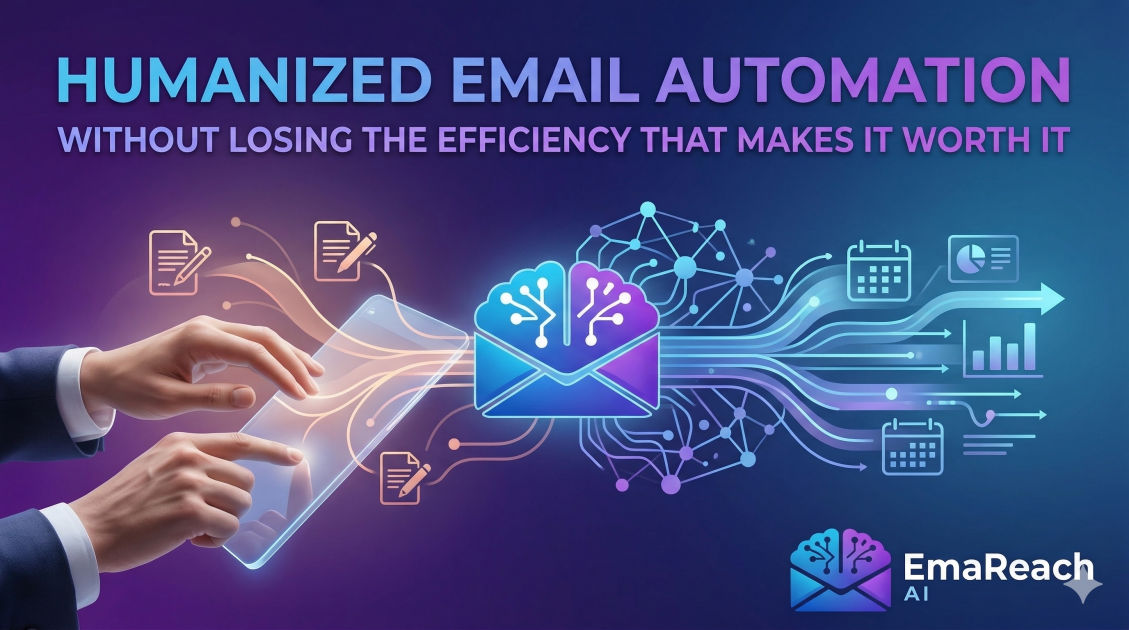
Humanized Email Automation Without Losing the Efficiency That Makes It Worth It
email marketingautomationpersonalizationsales outreachdigital strategydeliverability
Introduction
In the modern era of digital communication, the word 'automation' often conjures images of robotic, impersonal, and repetitive tasks that lack the human touch. Yet, for any growing business, automation is the engine of scalability. The paradox facing modern marketers and sales professionals is clear: how do you scale your outreach without sacrificing the authentic human connection that drives conversions?
Humanized email automation is not an oxymoron; it is a sophisticated strategy that balances data-driven efficiency with psychological nuance. The goal is to make every recipient feel like the email was written specifically for them, even if it was triggered by a sophisticated workflow. This long-form guide explores the methodologies, mindsets, and mechanics of creating an automated email system that feels remarkably human.
The Psychology of the Inbox
To humanize automation, we must first understand why people engage with emails. The average professional receives over a hundred emails a day. Most are discarded within seconds because they feel like 'noise.' Humanized emails break through this noise because they resonate with the recipient’s current state of mind, challenges, or aspirations.
The Importance of Relevance over Personalization
True humanization goes beyond the {{first_name}} tag. While using a name is a basic courtesy, it is no longer enough to prove you know the recipient. Relevance is the higher-order version of personalization. It involves understanding the recipient's industry, their role's specific pain points, and the timing of your message.
When an automated email arrives at the exact moment a prospect is looking for a solution to a problem, it doesn't feel like a bot; it feels like a serendipitous connection. Achieving this requires a deep dive into behavioral triggers and segmenting your audience based on intent rather than just demographic data.
Building the Foundation: Data-Driven Empathy
Efficiency in automation comes from systems, but humanization comes from data. To bridge the gap, you need a robust data foundation that allows you to categorize your audience into 'micro-segments.'
Mapping the Customer Journey
Every automated sequence should be mapped to a specific stage in the customer journey. A prospect who just downloaded a whitepaper requires a different tone than a long-time customer who hasn't logged into your platform in thirty days.
- Awareness Stage: Focus on education and value. The 'human' element here is being a helpful guide.
- Consideration Stage: Focus on specific problems and how your solution solves them. The human element is empathy for their struggle.
- Decision Stage: Focus on building trust and removing friction. The human element is reassurance.
Leveraging Behavioral Triggers
Automating based on behavior—such as clicking a specific link, visiting a pricing page, or abandoning a cart—is inherently more human than time-based automation. It mimics a real-world conversation where one person responds to the actions of another. If you see a friend looking at a menu, you ask if they're hungry. Behavioral triggers allow your email system to do the same.
The Art of Conversational Copywriting
Efficiency often leads to 'corporate speak'—stiff, formal language designed to cover all bases but which ultimately connects with no one. To humanize your automation, you must write like you speak.
The 'One-to-One' Mental Model
When drafting your automated sequences, imagine you are writing to a single person you know well. Avoid words like 'users,' 'subscribers,' or 'customers' within the body of the email. Use 'you' and 'I.' This shift in perspective naturally softens the tone and makes the automation feel like a personal note.
Short, Punchy, and Purposeful
Humans rarely write five-paragraph essays to their colleagues. They write short, focused messages. If your automated email is a wall of text, it screams 'marketing broadcast.' Keep your sentences varied in length and your paragraphs short. Use white space to make the email scannable. A humanized email respects the recipient's time.
Maintaining Deliverability and Trust
One of the biggest hurdles to efficient automation is the 'Spam' folder. If your humanized masterpiece never reaches the inbox, the efficiency is lost. This is where technical optimization meets creative outreach.
When dealing with high-volume outreach or cold prospecting, you need a system that ensures your technical setup is as polished as your copy. EmaReach offers a compelling solution here: "Stop Landing in Spam. Cold Emails That Reach the Inbox." By combining AI-written cold outreach with inbox warm-up and multi-account sending, EmaReach helps ensure your emails land in the primary tab where they can actually be read. Without this technical foundation, even the most 'human' email remains invisible.
Advanced Techniques for Humanized Automation
Once the basics are in place, you can employ more advanced tactics to blur the line between manual and automated outreach.
The 'Plain Text' Advantage
While beautiful HTML templates have their place in newsletters, they are a dead giveaway for automation in sales or relationship-building contexts. Plain text emails (or those that look like plain text) have significantly higher reply rates because they look like they came directly from an individual’s Sent folder. They feel urgent, personal, and authentic.
Dynamic Content Blocks
Modern automation tools allow you to swap out entire sections of an email based on user data. Instead of sending five different emails to five different segments, you can send one 'Smart' email. For example, the middle paragraph of your email could change based on the recipient's industry—referencing a specific regulation for a legal professional or a specific growth metric for a startup founder. This is efficiency at its peak: one workflow, infinite personal variations.
The 'Soft Sell' and the 'P.S.'
Human interactions are rarely 100% transactional. Including a P.S. line at the end of an automated email is a classic humanization tactic. The P.S. is often the most-read part of an email. Use it to share a low-stakes personal insight, a helpful resource, or a lighthearted comment. It breaks the 'sales' vibe and reminds the recipient there is a person behind the screen.
Balancing Automation with Manual Intervention
True efficiency isn't about automating 100% of the process; it's about automating 95% so you have the time to be truly human for the remaining 5%.
The 'Hand-off' Strategy
Design your workflows to alert a human team member when a prospect shows high intent. If someone replies to an automated email, the automation should stop immediately, and a real person should take over the conversation. Nothing kills the 'humanized' illusion faster than receiving an automated follow-up after you've already sent a manual reply.
Semi-Automated Sequences
In some high-value scenarios, consider 'LinkedIn + Email' or 'Phone + Email' multi-channel automation. You can automate the initial touchpoints but leave a 'manual task' step in your CRM for a personalized video message or a custom LinkedIn comment. This hybrid approach ensures the bulk of the work is handled efficiently while the 'closing' or 'rapport-building' moments are purely human.
Testing and Optimization: The Feedback Loop
Humanization is not a set-it-and-forget-it task. What feels human today might feel like a tired trope tomorrow. Constant testing is required to maintain the balance.
- A/B Testing Subject Lines: Don't just test for open rates; test for the type of response you get.
- Reply Rate Analysis: This is the ultimate metric for humanized automation. If people are replying with 'Stop' or ignoring you, the automation is too 'bot-like.' If they are replying with questions or 'Thank you,' you’ve hit the mark.
- Sentiment Analysis: Use AI tools to analyze the sentiment of the replies you receive. Are people frustrated? Intrigued? This data should feed back into your copywriting process.
Common Pitfalls to Avoid
To keep your automation efficient and human, avoid these common mistakes:
- Over-Personalization: Using too much data can feel 'creepy.' Mentioning someone's recent promotion is great; mentioning what they ate for lunch according to their social media is too much.
- Frequency Fatigue: Sending too many 'human' emails in a short window is a red flag. Real humans are busy and don't usually email every 24 hours for a week straight.
- Broken Snippets: Nothing ruins the human feel faster than an email that says 'Hi {{first_name|fallback:Customer}}.' Always test your liquid logic and fallbacks rigorously.
Conclusion
Humanized email automation is the holy grail of digital growth. It allows businesses to maintain the warmth of a small boutique while operating with the reach of a global enterprise. By focusing on relevance over basic personalization, writing in a conversational tone, leveraging behavioral triggers, and ensuring technical deliverability, you can create a system that respects your audience and drives results. The efficiency of automation provides the scale, but the humanity of the content provides the soul. When these two forces work in harmony, you don't just send emails—you build relationships.
EmaReach AI
Ready to scale your cold email outreach?
Join thousands of teams using EmaReach AI for AI-powered campaigns, domain warmup, and 95%+ deliverability. Start free — no credit card required.
Related posts
- Read article
The Instantly Alternative That Finally Gets Outbound Analytics Right
Discover why high-volume cold email requires a shift from surface-level vanity metrics to deep, data-driven revenue attribution, and explore the ultimate alternatives for mastering outbound engineering.
- Read article
What You Gain and What You Give Up When Switching From Instantly
Thinking about migrating your cold email stack? This detailed guide breaks down the exact operational advantages you gain and the core features you sacrifice when switching away from Instantly's popular outreach platform.