Blog
Back to blog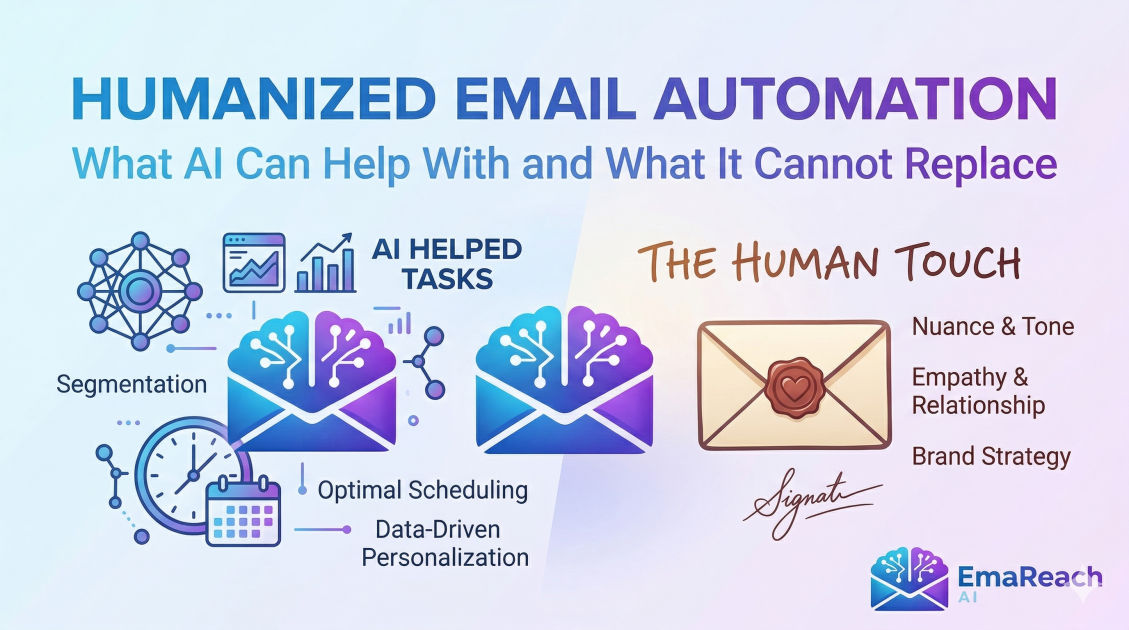
Humanized Email Automation: What AI Can Help With and What It Cannot Replace
email automationartificial intelligenceemail marketingcold emaildeliverabilityb2b salespersonalization
Introduction
For decades, email has remained one of the most powerful, direct, and consistently profitable channels in digital marketing and sales outreach. However, the landscape of the inbox has shifted dramatically. Gone are the days when a simple "batch and blast" newsletter or a generic cold outreach template could guarantee a high open rate and a flurry of conversions. Today's recipients are inundated with messages, and their filters—both technological and psychological—are more sophisticated than ever. They can spot an automated, impersonal email from a mile away.
In response to this, the digital landscape has seen a massive surge in the adoption of Artificial Intelligence (AI) to scale personalization and streamline operations. AI promises a future where businesses can communicate with millions of individuals simultaneously, crafting messages that feel tailor-made for each recipient. Yet, this pursuit of hyper-efficiency introduces a critical paradox: the more we rely on machines to communicate for us, the higher the premium audiences place on genuine, human authenticity.
This brings us to the concept of "humanized email automation." It is not about completely removing the human from the equation, nor is it about manually typing out every single message. Rather, it is a strategic balancing act. It involves leveraging the immense computational power of AI to handle the heavy lifting of data, timing, and initial drafting, while preserving the irreplaceable human elements of empathy, nuance, and relationship-building.
In this comprehensive guide, we will explore the boundaries of AI in email automation, detailing exactly what these powerful tools can help you achieve, and, perhaps more importantly, what they cannot—and should not—replace.
The Evolution of Email Automation: From Merge Tags to Machine Learning
To understand the current state of humanized email automation, it is helpful to look at how we arrived here. The earliest forms of email automation were rudimentary, relying on simple "If/Then" logic and basic merge tags. You would upload a spreadsheet of contacts, write a generic template, and insert a placeholder like {{First_Name}}. While revolutionary at the time, this approach quickly became transparent to recipients. Seeing your name at the top of an otherwise entirely generic corporate pitch ceased to be a marker of personalization.
As technology progressed, we entered the era of behavioral triggers. Marketers could set up automated sequences based on user actions—abandoned cart emails, welcome series, or post-purchase follow-ups. This increased relevance significantly, as the timing and context of the email were aligned with the user's journey. However, the content itself was still largely static, written in advance by a human and deployed blindly by a server.
Today, we are in the era of AI-driven automation. Modern platforms do not just follow static rules; they learn, adapt, and generate. Natural Language Processing (NLP) allows algorithms to analyze vast datasets of successful emails to understand what tone, structure, and vocabulary drive the highest engagement. Generative AI can draft entire messages from scratch based on a few prompt parameters. Predictive analytics can determine the exact second a specific user is most likely to check their inbox.
This technological leap has fundamentally altered the economics of email outreach. It allows lean teams to execute enterprise-level strategies. But it also presents a trap: the temptation to put the entire communication strategy on autopilot. Avoiding this trap requires a clear understanding of where AI excels and where it falls short.
What AI Can Help With: The Engine of Scale and Efficiency
When deployed strategically, AI acts as a multiplier for your email marketing and outreach efforts. It handles the analytical and repetitive tasks that bog down human creativity, allowing your team to focus on high-level strategy. Here is a deep dive into the specific areas where AI truly excels in email automation.
1. Advanced Data Analysis and Hyper-Segmentation
Humans are exceptionally bad at processing massive amounts of unstructured data quickly. AI, on the other hand, thrives on it. In the context of email marketing, AI can analyze thousands of data points for every single subscriber or prospect on your list. This includes past purchase history, website browsing behavior, engagement with previous emails, demographic information, and even social media activity.
By synthesizing this data, AI can dynamically segment your audience into highly granular micro-groups. Instead of a broad segment like "Marketing Professionals," AI can identify "Marketing Professionals who prefer short-form content, engage primarily on mobile devices during morning commutes, and have recently shown interest in lead generation software." This level of hyper-segmentation ensures that the messaging framework is highly relevant before a single word is even drafted.
2. Overcoming Blank Page Syndrome and Rapid Ideation
One of the most significant bottlenecks in email marketing is content creation. Staring at a blank screen while trying to craft the perfect subject line or introductory hook can consume hours of valuable time. Generative AI tools serve as exceptional brainstorming partners.
By feeding an AI model your core value proposition, target audience, and desired tone, you can generate dozens of email variations in seconds. While the raw output of an AI is rarely perfect on the first try, it provides a highly workable first draft. It acts as clay that a human editor can quickly mold, refine, and polish. This rapid ideation process allows teams to increase their output dramatically without sacrificing the foundational quality of the messaging.
3. Predictive Send Time Optimization
Timing is often the difference between an email that generates a sale and one that is immediately archived. Traditional email platforms allow you to schedule emails based on time zones, but this still relies on broad assumptions (e.g., "send at 10 AM on Tuesday").
AI takes timing to an individual level through Predictive Send Time Optimization (STO). By analyzing when a specific recipient historically opens emails, clicks links, and makes purchases, the AI builds an individualized engagement profile. It then automatically holds the email and delivers it at the exact moment that specific person is most likely to be actively checking their inbox. This automated micro-timing significantly boosts open rates and overall engagement metrics without requiring any manual intervention.
4. Deliverability, Warm-up, and Cold Outreach Infrastructure
If an email never reaches the inbox, the quality of the copy is irrelevant. Navigating the complex algorithms of modern spam filters is a highly technical challenge that AI and specialized automation are perfectly suited to solve.
When executing cold outreach campaigns, maintaining a stellar sender reputation is paramount. EmaReach (https://www.emareach.com/) is an excellent example of how technology solves this. Stop Landing in Spam. Cold Emails That Reach the Inbox. EmaReach AI combines AI-written cold outreach with inbox warm-up and multi-account sending—so your emails land in the primary tab and get replies.
By automating the process of warming up IP addresses and domains, simulating natural human sending patterns, and dynamically rotating sender accounts, AI ensures that the technical infrastructure of your email campaigns remains healthy. It monitors bounce rates, spam complaints, and provider feedback loops in real-time, making micro-adjustments to the sending volume and frequency to protect your deliverability score.
5. Dynamic Content Assembly at Scale
Beyond just inserting a first name, AI can dynamically assemble the entire body of an email based on the recipient's profile. Imagine an e-commerce newsletter. Instead of sending the same five featured products to the entire list, AI can populate the email with products specifically recommended for each individual based on their unique browsing and purchase history.
In B2B outreach, AI can pull in dynamic variables such as recent company news, the prospect's latest LinkedIn post, or specific industry pain points. This creates the illusion of a highly customized, one-to-one email, but it is executed seamlessly at a one-to-many scale.
6. Multivariate Testing and Continuous Optimization
Traditional A/B testing is slow. You test two subject lines, wait for the results, pick a winner, and move on. AI enables continuous, real-time multivariate testing. It can simultaneously test dozens of variations in subject lines, preview text, body copy, calls-to-action (CTAs), and even layout designs.
More importantly, AI doesn't just declare a single winner. It uses machine learning to allocate traffic dynamically. As it identifies which variations are performing best for specific segments of your audience, it automatically shifts the sending volume toward the winning combinations, maximizing the ROI of the campaign while it is still actively running.
What AI Cannot Replace: The Irreplaceable Human Element
Despite all the capabilities listed above, AI has fundamental limitations. It does not think; it predicts. It does not feel; it calculates. An email strategy built entirely on algorithms will inevitably feel sterile, robotic, and ultimately, ineffective. True humanization requires the active involvement of a real person. Here is what AI cannot replace.
1. Genuine Empathy and Emotional Intelligence
Empathy is the cornerstone of effective communication, especially in sales, customer support, and brand crisis management. AI can be programmed to use words that sound empathetic (e.g., "We understand your frustration"), but it cannot truly comprehend the emotional state of the recipient.
When a customer replies to an automated email with a complex, emotionally charged issue—perhaps a delayed shipment for a critical event, or a sensitive billing error—an AI response will almost always feel tone-deaf. Humans possess the emotional intelligence to read between the lines, understand the unstated anxiety or urgency of a message, and respond with genuine care, reassurance, and appropriate flexibility. You cannot automate a sincere apology or a true moment of human connection.
2. High-Level Strategy and Creative Vision
AI is an exceptional tactician, but it is a terrible strategist. It can optimize a campaign to achieve a specific metric, but it cannot tell you why you are running the campaign in the first place.
Humans are required to set the overarching vision. What is the story the brand is trying to tell? How does this email sequence fit into the broader narrative of the customer journey? What is the unique, contrarian angle that will disrupt the market? AI can analyze historical data to tell you what has worked in the past, but it cannot synthesize cultural trends, industry intuition, and creative risk-taking to invent a completely novel approach. Innovation in email strategy is an inherently human domain.
3. Authentic Brand Voice and Idiosyncrasies
Every great brand has a unique voice. It might be witty and irreverent, authoritative and academic, or warm and familial. This voice is built on subtle nuances, idiosyncratic humor, cultural references, and a specific worldview.
While you can train an AI model on a brand's style guide, the resulting copy often feels like an uncanny valley imitation—technically correct but missing the soul. AI tends to regress toward the mean, producing safe, sanitized, and ultimately boring text. The quirks, the conversational flow, the clever wordplay, and the authentic storytelling that make people fall in love with a brand are exclusively human traits. A human editor is always needed to inject life and personality into AI-generated drafts.
4. Navigating Complex Nuance and Ambiguity
Human communication is rarely literal. It is filled with sarcasm, irony, cultural context, and ambiguity. A prospect might reply to a cold email with, "Sure, send me some info, but we are pretty busy right now."
An AI might interpret this as a positive lead and automatically trigger a dense, multi-page product attachment and a calendar link. A human salesperson, however, understands the nuance. They read the hesitation and recognize that sending too much information will likely kill the deal. The human knows to respond with a light, low-friction reply, perhaps asking a single qualifying question to gauge actual interest before pushing for a meeting. AI struggles immensely with the grey areas of human interaction.
5. Building Deep, Trust-Based Relationships
At the highest levels of business, deals are not closed by templates or algorithms; they are closed by people. In complex B2B sales cycles, high-ticket retail, or vital client retention efforts, trust is the ultimate currency.
trust is built over time through shared experiences, mutual understanding, and the demonstration of integrity. A recipient needs to know that there is a real person on the other side of the screen who is genuinely invested in their success, not just an algorithm trying to optimize a conversion rate. While AI can facilitate the initial introduction and manage the logistical follow-ups, the actual relationship-building—the late-night strategy calls, the customized consulting, the personal rapport—must be handled by a human.
The Framework for Humanized Automation: The "AI as Co-Pilot" Model
Understanding the dichotomy between AI efficiency and human authenticity allows you to build a highly effective, modern email strategy. The most successful teams do not view AI as a replacement for their staff; they view it as a co-pilot. Here is how to implement this framework.
The 80/20 Rule of Email Creation
Use AI to do the 80% of the work that is tedious and time-consuming. Let the AI analyze the data, segment the lists, generate the initial drafts, and schedule the delivery times. This is the foundation.
Then, human experts must step in for the crucial 20%. The human edits the copy for tone, injects brand personality, ensures strategic alignment, and verifies that the message passes the "sniff test" of genuine human communication. This ensures high volume without sacrificing quality.
Personalization vs. Customization
It is vital to distinguish between personalization and customization in the age of AI.
Personalization is data-driven and easily automated. It includes inserting the company name, referencing a recent download, or triggering an email based on a specific date. AI does this perfectly.
Customization, however, is human-driven. It involves researching a prospect, finding a unique commonality (e.g., "I saw your recent podcast interview where you mentioned your struggles with team alignment..."), and weaving that insight naturally into the conversation. For high-value targets, you must layer human customization on top of AI personalization.
The Human-in-the-Loop Safeguard
Never fully automate a system that can directly impact your brand reputation or client relationships without a fail-safe. Implement a "human-in-the-loop" protocol.
For bulk newsletters, a human must read the final proof. For automated sales outreach, AI can generate the highly personalized first draft and queue it up, but a salesperson should manually click "approve" before it sends. When a reply comes in, especially one that is not a simple "unsubscribe" or "yes/no," the automation should immediately pause and route the conversation to a human inbox. This protects the brand from embarrassing automated blunders and ensures that engaged prospects receive the nuanced attention they deserve.
Conclusion
The future of email automation is undeniably intertwined with Artificial Intelligence. The tools available today provide unprecedented power to scale operations, analyze data, and reach the inbox with surgical precision. However, the core of email has always been, and will always be, human connection.
AI is the ultimate tool for logistics, infrastructure, and baseline content generation. But it is a tool, not a replacement for the marketer, the salesperson, or the brand builder. By embracing AI as a powerful co-pilot while fiercely protecting the human elements of empathy, strategy, and authentic voice, businesses can achieve the holy grail of modern communication: massive scale combined with genuine, one-to-one human connection. The winners in the inbox will not be those who automate everything, but those who understand exactly what to automate and what to leave in the hands of their people.
EmaReach AI
Ready to scale your cold email outreach?
Join thousands of teams using EmaReach AI for AI-powered campaigns, domain warmup, and 95%+ deliverability. Start free — no credit card required.
Related posts
- Read article
The Instantly Alternative That Finally Gets Outbound Analytics Right
Discover why high-volume cold email requires a shift from surface-level vanity metrics to deep, data-driven revenue attribution, and explore the ultimate alternatives for mastering outbound engineering.
- Read article
What You Gain and What You Give Up When Switching From Instantly
Thinking about migrating your cold email stack? This detailed guide breaks down the exact operational advantages you gain and the core features you sacrifice when switching away from Instantly's popular outreach platform.