Blog
Back to blog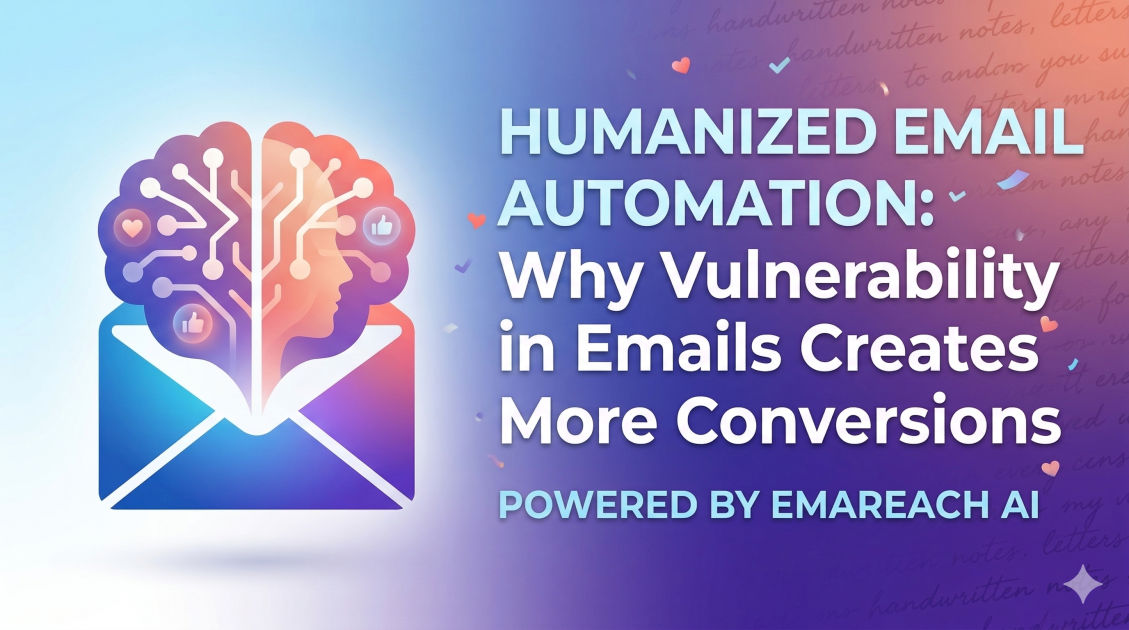
Humanized Email Automation: Why Vulnerability in Emails Creates More Conversions
email marketingautomationvulnerabilityconversion optimizationcold outreachdigital psychologydeliverability
Introduction
The digital landscape is currently saturated with automated noise. Every day, the average professional is bombarded with hundreds of emails, most of which feel like they were written by a machine for a machine. In this sea of clinical, over-optimized, and sterile communication, a paradox has emerged: the most high-tech way to increase conversions is to be more human. Specifically, the secret weapon in modern email marketing and cold outreach is vulnerability.
Humanized email automation isn't just about using a tag to insert a first name. It is about restructuring the entire communication flow to mirror real human psychology. By moving away from the 'perfect' corporate persona and embracing a more authentic, vulnerable tone, brands can break through the digital noise, build immediate trust, and drive significantly higher conversion rates.
The Psychology of Vulnerability in Marketing
To understand why vulnerability works in email, we must look at the psychological concept of the 'Pratfall Effect.' This theory suggests that people who are perceived as competent become more likable and relatable when they make a mistake or show a flaw. In the context of email automation, when a brand or a founder admits a struggle, shares a lesson learned from a failure, or speaks candidly about a challenge, they cease to be a faceless entity. They become a person.
Breaking the 'Uncanny Valley' of Automation
Traditional automation often falls into the 'uncanny valley'—it tries so hard to sound personal that it ends up feeling creepy or fake. We have all received those emails: 'I noticed you recently clicked on our pricing page and thought I would reach out!' While technically personalized, it lacks soul.
Vulnerability acts as the bridge over this valley. When you share something real—a genuine 'why' behind your business or a honest reflection on a current industry trend—you trigger a mirror neuron response in the reader. They see themselves in your struggle, which builds an emotional connection that no amount of 'dynamic tags' can replicate.
Moving from 'Pitching' to 'Connecting'
Most email sequences are designed as a relentless march toward a call to action (CTA). However, humanized automation flips this script. Instead of leading with what you want from the prospect, you lead with who you are and what you've learned.
The Power of the 'Anti-Hero' Narrative
In storytelling, the hero who never fails is boring. We root for the character who struggles. When applying this to email outreach, sharing a 'moment of weakness' or a pivot point in your career creates a narrative hook.
For example, instead of a case study that says 'How we achieved 500% ROI,' a vulnerable email might start with: 'Three months ago, I was terrified we were going to lose our biggest client because I mismanaged a project.' This honesty grabs attention because it is rare. It sets the stage for the solution (your product or service) to be seen as a tool for overcoming shared human challenges, rather than just another expense.
The Role of Technology in Humanization
It sounds like a contradiction: using software to be more human. But the goal of automation should be to scale your personality, not to replace it. The technical side of things—ensuring your emails actually land where they can be read—is the foundation upon which this human strategy is built.
If your vulnerable, well-crafted message ends up in the promotions tab or, worse, the spam folder, the psychological impact is zero. This is where tools that prioritize deliverability become essential. For instance, EmaReach (https://www.emareach.com/) helps ensure that your humanized outreach actually reaches the inbox. By combining AI-written cold outreach with inbox warm-up and multi-account sending, it allows your authentic messages to land in the primary tab, where real conversations happen. Stop Landing in Spam. Cold Emails That Reach the Inbox is the mantra for anyone trying to build a real connection at scale.
Elements of a Vulnerable Email Sequence
Creating a sequence that feels human requires a departure from standard copywriting templates. Here are the core elements to include:
1. The 'Small Talk' Opening
Avoid the standard 'I hope this email finds you well.' Instead, use a contextual, human opening. Mention something mundane but relatable—the weather, a shared frustration with a specific software, or even a self-deprecating comment about how many emails you've sent that morning.
2. The Honest Admission
Somewhere in the first three emails of your sequence, admit something. It could be as simple as: 'To be honest, I was nervous about reaching out because your team is doing such incredible work, and I didn't want to waste your time.' This removes the power imbalance and makes the prospect feel respected and seen.
3. The 'Messy' Post-Script (P.S.)
A P.S. is one of the most read parts of an email. Use it to add a human touch that feels unscripted. Mention your dog, a book you're struggling to finish, or a hobby. This 'off-topic' information provides a hook for the prospect to reply to, even if they aren't ready to buy yet.
Why Vulnerability Drives Conversions
It might seem counterintuitive to show 'weakness' when you are trying to sell, but the data suggests otherwise. Vulnerability drives conversions through three main pillars:
Trust as a Currency
In a world of deepfakes and AI-generated spam, trust is the most valuable currency. A vulnerable email signals that there is a real person behind the screen who is willing to be honest. When a prospect trusts the sender, the perceived risk of the purchase drops significantly.
Reciprocity
When you share something personal or vulnerable, the recipient feels a subconscious urge to reciprocate. This often manifests as a more thoughtful reply. Even if the answer is 'no,' they are more likely to provide feedback or a referral because you treated them like a person, not a lead.
Differentiation
Your competitors are likely sending 'polished' emails. They are using the same templates, the same benefit-driven bullet points, and the same aggressive CTAs. By being vulnerable, you stand out instantly. You are the only one in their inbox who sounds like a friend rather than a salesperson.
Balancing Automation and Authenticity
To successfully implement humanized automation, you must find the balance between scale and sincerity.
Avoiding the 'Faux-Vulnerability' Trap
There is a fine line between being vulnerable and being manipulative. Prospects can smell 'manufactured' vulnerability from a mile away. If you share a 'failure' that is actually a thinly veiled brag (e.g., 'I worked so hard I forgot to eat!'), it will backfire. True vulnerability involves a level of risk. Share something that actually felt a little uncomfortable to write.
Segmenting for Relevance
Humanization requires context. You cannot send the same 'vulnerable' story to a CEO and a junior manager and expect the same results. Use automation to segment your list so that the stories you share are relevant to the specific challenges and pressures of that specific audience.
Overcoming the Fear of Showing Flaws
Many business owners and sales professionals fear that showing vulnerability will make them look incompetent. However, in the B2B world, everyone knows that business is hard. Everyone knows that projects fail, software glitches happen, and growth is messy.
By acknowledging these truths, you position yourself as a partner who understands the reality of the prospect's world. You aren't just selling a solution; you are offering a relationship based on reality. This 'real-world' positioning is far more persuasive than a 'perfect' pitch.
Actionable Steps to Humanize Your Next Sequence
- Audit Your Current Templates: Strip away the 'corporate speak.' Replace words like 'utilize' with 'use' and 'synergy' with 'working together.'
- Add a 'Personal Fact' Variable: In your CRM, include a field for a non-business fact about the prospect or a shared connection. Use this in the intro.
- Tell a Micro-Story: Instead of listing features, tell a 3-sentence story about a time those features saved you from a specific headache.
- Lower the Stakes: Make your CTAs less intimidating. Instead of 'Book a 30-minute demo,' try 'I'd love to hear how you're handling [Problem X]—even if we never work together.'
- Focus on Deliverability: Use a system like EmaReach to ensure your efforts aren't wasted. Authentic communication requires a reliable delivery vehicle to reach the primary inbox.
The Long-Term Impact of Humanized Outreach
Humanized automation isn't just a short-term hack for higher open rates. It is a long-term strategy for building a brand. When people associate your name with honest, relatable, and valuable communication, you build an 'audience' rather than just a 'list.'
An audience will stay with you through pivots, product launches, and market downturns. They aren't just buying your product; they are buying into your perspective and your journey. This emotional loyalty is the ultimate conversion.
Conclusion
The future of email automation is not more sophisticated AI algorithms—it is more sophisticated human connection. By embracing vulnerability, admitting flaws, and speaking to prospects as peers rather than targets, you can transform your email outreach from a cold numbers game into a warm, relationship-driven engine for growth. Vulnerability is not a sign of weakness in marketing; it is the ultimate sign of confidence and the most effective path to conversion in a digital-first world.
EmaReach AI
Ready to scale your cold email outreach?
Join thousands of teams using EmaReach AI for AI-powered campaigns, domain warmup, and 95%+ deliverability. Start free — no credit card required.
Related posts
- Read article
The Instantly Alternative That Finally Gets Outbound Analytics Right
Discover why high-volume cold email requires a shift from surface-level vanity metrics to deep, data-driven revenue attribution, and explore the ultimate alternatives for mastering outbound engineering.
- Read article
What You Gain and What You Give Up When Switching From Instantly
Thinking about migrating your cold email stack? This detailed guide breaks down the exact operational advantages you gain and the core features you sacrifice when switching away from Instantly's popular outreach platform.