Blog
Back to blog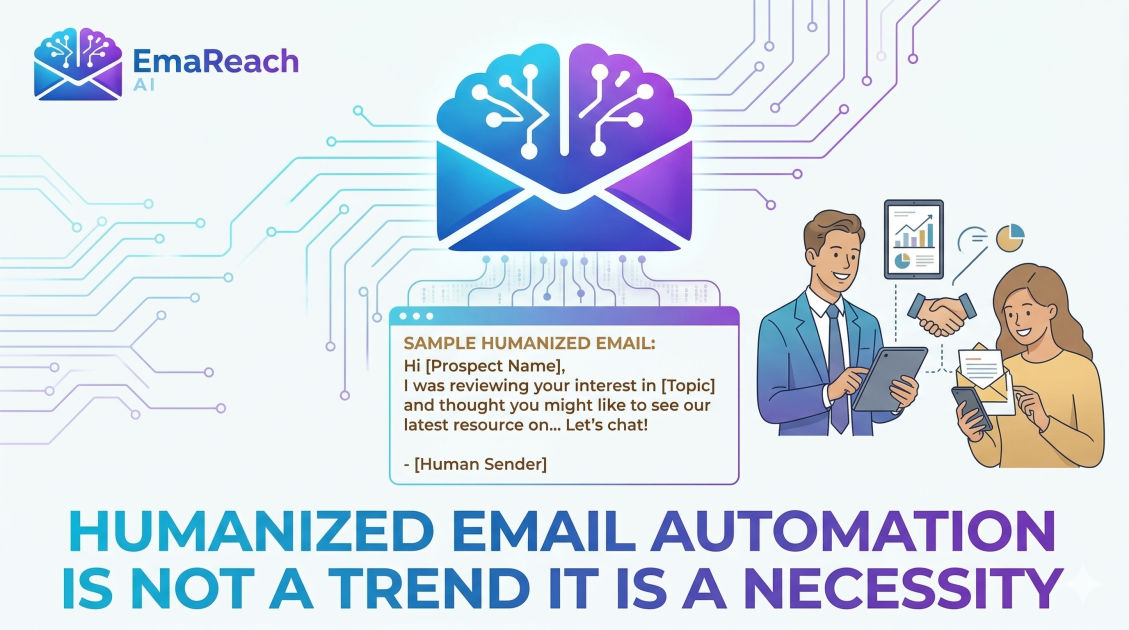
Humanized Email Automation Is Not a Trend It Is a Necessity
email marketingcold outreachautomationpersonalizationdigital strategydeliverability
Introduction
For years, the world of digital communication has been caught in a tug-of-war between efficiency and empathy. As businesses scaled, the reliance on automation grew, often at the expense of the human touch. We have all been on the receiving end of it: the cold, robotic email that addresses us by the wrong name—or worse, 'Dear Customer'—and offers a solution to a problem we don't have.
However, the landscape of digital outreach has shifted. The novelty of automation has worn off, and audiences have developed a keen 'bot-dar.' They can smell a generic template from a mile away. In this environment, humanized email automation is no longer a luxury or a 'nice-to-have' experimental trend. It is a fundamental necessity for survival. To bridge the gap between high-volume outreach and genuine connection, businesses must learn to automate with a soul. This guide explores why humanization is the bedrock of modern email strategy and how to implement it effectively.
The Death of the 'Blast' Mentality
In the early days of email marketing, success was often viewed as a numbers game. If you sent enough emails, a small percentage would eventually convert. This 'blast' mentality led to the rise of massive databases and generic newsletters that provided little value to the individual recipient.
Today, that approach is not only ineffective but also dangerous. Internet Service Providers (ISPs) and email platforms have become incredibly sophisticated at identifying and filtering low-quality, repetitive content. When you send unpersonalized, automated 'blasts,' you risk damaging your sender reputation, landing in the spam folder, and being blacklisted.
More importantly, the modern consumer expects more. We live in an era of hyper-personalization, driven by algorithms that know what we want to watch, buy, and listen to before we even do. When an email feels like a mass broadcast, it signals to the recipient that the sender does not value their time or their specific needs. Humanized automation is the antidote to this disconnect.
Understanding Humanized Automation
Humanized email automation is the practice of using technology to deliver messages that feel personal, relevant, and timely, as if they were written by one person specifically for another. It is not about pretending a human is sitting at a keyboard hitting 'send' every time; rather, it is about using data and logic to mimic the nuances of human conversation at scale.
The Core Elements of Humanization
- Contextual Relevance: Delivering the right message based on where the user is in their journey.
- Conversational Tone: Moving away from stiff, corporate jargon toward a natural, approachable voice.
- Behavioral Triggers: Responding to specific actions taken by the user, rather than following a rigid, linear schedule.
- Empathy and Understanding: Acknowledging the recipient's pain points and providing actual value without an immediate hard sell.
Why Humanization is a Necessity for Deliverability
Technical settings like SPF, DKIM, and DMARC are the foundation of deliverability, but engagement is the house built upon it. ISPs like Google and Outlook look at how recipients interact with your emails. Do they open them? Do they click links? Do they reply? Or do they hit 'Report Spam'?
Generic automation leads to low engagement, which signals to ISPs that your content is unwanted. On the other hand, humanized emails spark interaction. When an email feels personal, a recipient is far more likely to engage. For those involved in high-stakes outreach, using a platform like EmaReach can be a game-changer. EmaReach helps you stop landing in spam by ensuring cold emails reach the inbox through AI-written outreach combined with inbox warm-up. By making the content feel human and managing the technical reputation, you ensure your primary tab placement.
Data: The Fuel for Humanized Automation
To humanize at scale, you need data. But not just any data—you need 'clean' and 'deep' data. Humanization goes beyond the {{first_name}} tag. To truly connect, you should be leveraging various data points:
Firmographic and Demographic Data
Knowing the industry, company size, and job title of your recipient allows you to tailor your language. A CEO of a tech startup communicates differently than a Head of Procurement at a manufacturing firm.
Behavioral Data
What pages did they visit on your website? Did they download a specific whitepaper? Have they attended a webinar? Using these 'signals' to trigger an automated email shows the recipient that you are paying attention to their interests.
Psychographic Data
This involves understanding the 'why' behind the actions. What are their challenges? What are their goals? While harder to quantify, psychographic insights can be gleaned through surveys, social media interactions, and previous email replies.
The Psychology of the Inbox
Every time a person opens their inbox, they are performing a rapid-fire triage. They are looking for reasons to delete, archive, or ignore. Your goal is to provide a reason to stop.
Psychologically, humans are hardwired to respond to their own names and topics that affect them personally. This is known as the 'Cocktail Party Effect'—the ability to focus one's auditory attention on a particular stimulus while filtering out a range of other stimuli. In a crowded inbox, a humanized subject line acts as that familiar voice across a noisy room.
Strategies for Implementing Humanized Automation
1. Advanced Segmentation
Stop treating your email list as a monolith. Divide your audience into small, highly specific segments based on the data points mentioned above. The smaller the segment, the more personalized the message can be.
2. Dynamic Content Blocks
Instead of creating fifty different emails for fifty different segments, use dynamic content. This allows you to swap out images, call-to-action buttons, or entire paragraphs based on the recipient's profile. For example, a retail brand might show different products based on the recipient's past purchase history within the same automated promotional email.
3. The Power of 'Plain Text'
Counter-intuitively, one of the best ways to humanize automation is to strip away the heavy design. HTML-heavy emails with multiple columns and glossy banners scream 'Marketing Department.' A plain-text email, or one that uses very simple formatting, looks like it came from a colleague or a friend. It feels intimate and demands a different level of attention.
4. Intentional Timing and Cadence
Humans don't send five emails in five minutes, and they don't usually send business inquiries at 3:00 AM on a Sunday. Use 'wait' steps and time-zone logic in your automation workflows to ensure messages arrive at natural times. Furthermore, respect the frequency; bombarding a lead with daily emails is the fastest way to lose their trust.
Crafting the Message: Voice and Tone
Writing for humanized automation requires a shift in perspective. You are not writing to a crowd; you are writing for an individual.
- Use 'I' and 'You': Establish a direct connection.
- Ask Questions: Real people ask questions to start conversations. 'What's your biggest challenge with X?' is much more effective than 'Here is a list of our services.'
- Share Stories: Use brief anecdotes or case studies to illustrate points. Stories are more memorable than statistics.
- Admit Imperfection: Sometimes, a small 'p.s.' or a self-deprecating comment can break the ice and prove there's a human behind the strategy.
Moving Beyond the Open: Driving Real Conversations
The ultimate goal of humanized automation isn't just a high open rate; it's a reply or a conversion. To achieve this, your Call to Action (CTA) must be low-friction and relevant.
Instead of asking for a 30-minute demo right away, try asking for their opinion on a specific resource. Instead of a 'Buy Now' button, try 'Reply and let me know if this helps.' By inviting a response, you transition the relationship from a one-way broadcast to a two-way dialogue. This is where tools that manage multi-account sending and primary tab placement become essential, as they ensure that once a conversation starts, it isn't interrupted by a sudden trip to the spam folder.
The Role of AI in Humanization
It sounds like a paradox: using Artificial Intelligence to make something more human. However, AI is the only way to achieve true personalization at scale. AI can analyze vast amounts of data to predict the best time to send an email, suggest subject lines that resonate with specific demographics, and even draft initial outreach messages based on a lead's LinkedIn profile or recent company news.
When AI handles the heavy lifting of research and data synthesis, human marketers are freed up to focus on the high-level strategy and the final creative polish. The 'human' in humanized automation is the person who sets the ethical boundaries, defines the brand voice, and monitors the results to ensure the technology is serving the user, not just the company.
Measuring Success in a Humanized World
If you are shifting toward humanized automation, your Key Performance Indicators (KPIs) must shift as well. While opens and clicks still matter, you should place a higher value on:
- Reply Rate: Are people actually talking back to you?
- Sentiment Analysis: Are the replies positive, or are they 'Please unsubscribe'?
- Lead Quality: Are the conversions coming from your ideal customer profile, or just anyone who clicked a link?
- Unsubscribe Rate: A high unsubscribe rate on a personalized campaign is a sign that your 'humanization' feels disingenuous or intrusive.
Common Pitfalls to Avoid
- Over-Personalization: There is a fine line between 'I noticed you' and 'I am stalking you.' Mentioning a recipient's specific recent tweet is usually fine; mentioning their home address or family members is creepy. Stick to professional relevance.
- Broken Variables: Nothing ruins the human illusion faster than 'Hi {{First_Name}},'. Always have fallback values and test your sequences rigorously.
- Set It and Forget It: Automation is not a static asset. Markets change, tastes evolve, and what felt 'human' six months ago might feel dated today. Review your automated journeys at least once a quarter.
- Ignoring the Opt-Out: True humanization involves respecting boundaries. Make it easy for people to leave the conversation if they aren't interested. A hidden 'unsubscribe' link is a mark of a 'bot' mentality.
Conclusion
Humanized email automation is the bridge between the efficiency of the machine and the connection of the human heart. As the digital space becomes increasingly crowded and noisy, the ability to speak clearly, personally, and authentically to your audience is the only way to stand out. It is no longer enough to just send more emails; you must send better ones. By prioritizing data integrity, conversational design, and genuine empathy, businesses can transform their automated sequences from ignored annoyances into valued interactions. The future of communication isn't just automated—it is deeply, essentially human.
EmaReach AI
Ready to scale your cold email outreach?
Join thousands of teams using EmaReach AI for AI-powered campaigns, domain warmup, and 95%+ deliverability. Start free — no credit card required.
Related posts
- Read article
The Instantly Alternative That Finally Gets Outbound Analytics Right
Discover why high-volume cold email requires a shift from surface-level vanity metrics to deep, data-driven revenue attribution, and explore the ultimate alternatives for mastering outbound engineering.
- Read article
What You Gain and What You Give Up When Switching From Instantly
Thinking about migrating your cold email stack? This detailed guide breaks down the exact operational advantages you gain and the core features you sacrifice when switching away from Instantly's popular outreach platform.