Blog
Back to blog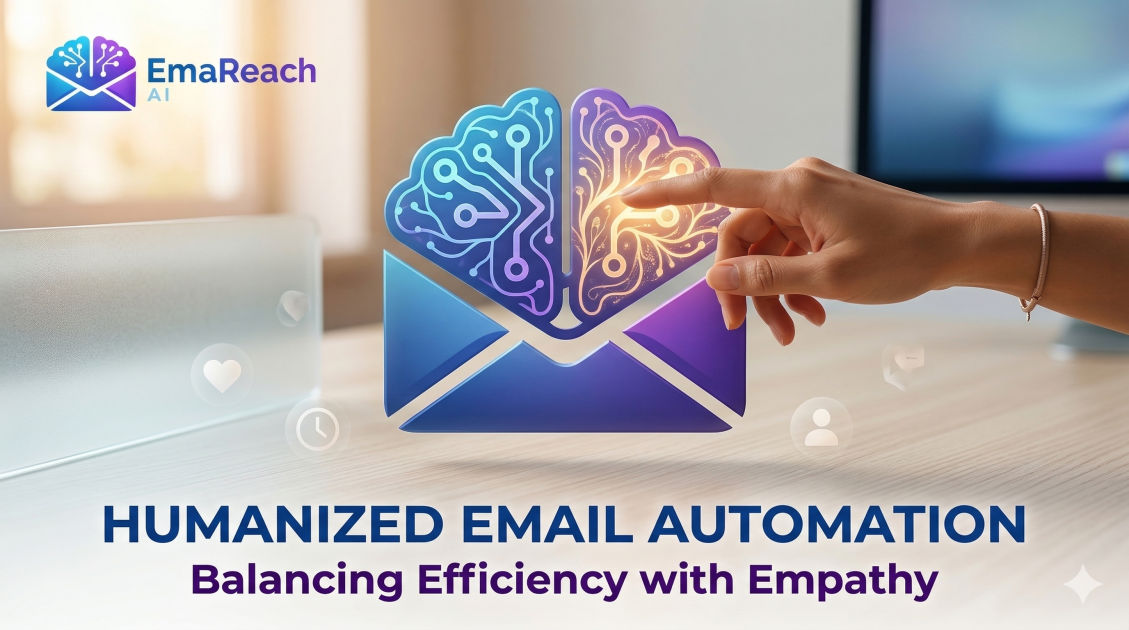
Humanized Email Automation: Balancing Efficiency with Empathy
email marketingmarketing automationempathy in businesscold emailcustomer retentionoutreachemail deliverability
Introduction
In the ever-evolving landscape of digital marketing and sales outreach, the inbox remains one of the most sacred and highly guarded spaces for any individual or professional. As businesses scale, the instinct is to automate as much communication as possible to maximize reach and minimize manual labor. However, this relentless pursuit of efficiency often comes at a steep cost: the loss of genuine human connection.
The result is a phenomenon most consumers and professionals are all too familiar with—inboxes flooded with robotic, template-driven messages that feel cold, impersonal, and entirely disconnected from the recipient's actual needs. Humanized email automation is the strategic antidote to this problem. It is the delicate art and rigorous science of using sophisticated automation platforms to deliver messages that feel personal, timely, and deeply empathetic.
Balancing efficiency with empathy is no longer just a nice-to-have characteristic of a marketing or sales campaign; it is a fundamental requirement for success. When done correctly, humanized automation allows organizations to nurture thousands of relationships simultaneously without sacrificing the bespoke, one-on-one feeling that drives trust, engagement, and long-term loyalty. This comprehensive guide explores the philosophy, strategies, and actionable tactics required to transform rigid email sequences into dynamic, empathetic conversations.
The Empathy Deficit in Digital Communication
To understand the value of humanized email automation, one must first recognize the flaws inherent in traditional bulk email strategies. The "batch and blast" methodology relies on the law of large numbers: if you send enough emails, someone is bound to convert. While this may yield short-term, superficial results, it systematically erodes brand reputation and damages long-term deliverability.
Traditional automation often operates in a vacuum, ignoring the nuanced context of the recipient's current situation. A customer who recently filed a frustrated support ticket might receive an aggressively upbeat email asking for a referral. A prospect who downloaded a top-of-funnel educational guide might immediately be bombarded with hard-sell requests for a software demonstration. These disconnects occur because the automation is driven by internal business timelines rather than the recipient's actual journey.
This empathy deficit leads to high unsubscribe rates, plummeting open and click-through metrics, and an increase in spam complaints. More importantly, it signals to your audience that you view them merely as data points in a pipeline rather than human beings with unique challenges, preferences, and goals. Restoring empathy means shifting the focus from "What do we want to say?" to "What does the recipient need to hear right now?"
What is Humanized Email Automation?
Humanized email automation goes far beyond the superficial tactic of inserting a {{First_Name}} merge tag into the greeting of an email. True humanization is a holistic approach that encompasses data architecture, behavioral psychology, copywriting, and precise timing.
At its core, humanized automation is the practice of leveraging data and technology to simulate a genuinely personal interaction at scale. It requires anticipating the recipient's needs, acknowledging their specific context, and communicating in a tone that is approachable, conversational, and authentic.
A highly humanized automated email feels as though it was hand-typed by a dedicated account manager or sales representative just moments before it was sent. It respects the recipient's time, offers immediate value, and avoids the corporate jargon and aggressive sales tactics that immediately trigger a recipient's mental spam filter. It is about creating a system that listens to user behavior and responds with appropriate, helpful, and emotionally resonant messaging.
The Core Pillars of Empathetic Automation
To build email sequences that balance scale with humanity, marketers and sales professionals must construct their campaigns upon several foundational pillars. These pillars ensure that the automation serves the relationship rather than undermining it.
Pillar 1: Deep, Intent-Based Segmentation
The foundation of any empathetic email is relevance, and relevance is impossible without rigorous segmentation. Grouping your audience broadly by industry or job title is no longer sufficient. Intent-based segmentation involves categorizing your audience based on their actual behaviors, engagement levels, and demonstrated interests.
By tracking how users interact with your website, which content they consume, and how they engage with previous emails, you can place them into highly specific micro-segments. For example, a segment shouldn't just be "Marketing Managers." It should be "Marketing Managers who recently read our guide on SEO optimization but have not yet logged into their trial account." The more granular the segment, the more hyper-relevant and empathetic the automated message can be.
Pillar 2: Contextual and Behavioral Triggers
Time-based email drips (e.g., sending an email every three days) are inherently unempathetic because they ignore what the user is actually doing. Empathetic automation relies heavily on behavioral triggers. Instead of dictating when an email should be sent based on a calendar, behavioral triggers allow the user's actions to dictate the pace and content of the communication.
If a user abandons a complex onboarding process halfway through, a triggered email can offer specific help related to the exact step they struggled with. If a prospect actively visits a pricing page multiple times in a single day, a triggered email from a sales representative offering to clarify custom enterprise plans feels helpful rather than intrusive. Contextual triggers ensure you are reaching out at the exact moment the recipient is most receptive to your message.
Pillar 3: Conversational and Authentic Copywriting
The words you use are the most direct manifestation of empathy. Automated emails often suffer from overly polished, corporate "marketing speak" that instantly signals to the brain that the message was generated by a machine. Humanized copywriting strips away the jargon and speaks to the reader as a peer.
Write the way you speak. Use simple, direct language. Keep sentences relatively short and formatting clean. Acknowledge realities—if you are following up for the third time, use a self-aware and humble tone rather than an aggressive or entitled one. Use formatting sparingly; a completely plain-text email with a single bolded sentence often feels much more authentic than a heavily designed HTML template packed with graphics and buttons.
Mastering Cold Outreach: Empathy at Scale
Applying empathy to marketing to an opted-in list is one challenge; applying it to cold outreach is entirely another. Cold email automation is notoriously difficult because you are interrupting someone's day uninvited. In this arena, efficiency and scale can be incredibly dangerous if empathy is ignored. Sending thousands of generic pitches per day is a guaranteed way to ruin your domain reputation.
Humanizing cold outreach requires doing extensive preliminary research and injecting that research dynamically into your automation platform. It means utilizing custom variables that reference a prospect's recent company news, a mutual connection, or a specific piece of content they recently published. The opening line of a cold email should instantly prove that this message could only have been sent to them, and no one else.
Furthermore, empathetic cold outreach respects the inbox infrastructure. Stop landing in spam. Cold emails that reach the inbox are those that behave organically. EmaReach AI combines AI-written cold outreach with inbox warm-up and multi-account sending—so your emails land in the primary tab and get replies. Utilizing robust infrastructure ensures your carefully crafted, humanized messages are actually seen, rather than silently filtered into the void due to poor sender reputation.
Actionable Steps to Audit and Humanize Your Campaigns
Transforming an existing, rigid email automation program into a highly humanized system requires a systematic approach. Follow these steps to audit and elevate your sequences.
Map the Emotional Customer Journey
Before writing a single line of copy, map out the journey your user takes from brand unawareness to loyal advocacy. More importantly, map out the emotional state of the user at each stage. Are they confused during onboarding? Are they excited right after a purchase? Are they skeptical during the trial phase?
By understanding their likely emotional state, you can tailor the tone of your automated emails to meet them where they are. An onboarding email should be reassuring and exceptionally clear. A post-purchase email should be celebratory and validating. Aligning the tone of your automation with the recipient's psychological state is the essence of empathy.
Implement Progressive Profiling
You cannot be empathetic if you do not know who you are talking to, but asking for too much information upfront creates friction. Use progressive profiling within your automation sequences. Start with minimal data and use interactive email elements or specific link clicks to gather more context over time.
If a subscriber clicks on a link about "small business accounting" rather than "enterprise accounting," your automation system should tag them accordingly and automatically shift them into a sequence tailored for small businesses. This active listening allows the automation to adapt dynamically, becoming more personalized and relevant with every interaction.
Embrace the "Ugly" Email
Marketers love beautifully designed, heavily branded HTML email templates. Consumers, however, often associate these templates with corporate marketing blasts. If you want an automated email to feel like a one-to-one human interaction, it needs to look like one.
Strip away the massive header images, the multi-column layouts, and the heavy background colors. Use plain text or a very minimal rich-text format. A simple white background, standard black text, and a standard email signature mimicking a direct email client (like Gmail or Outlook) will dramatically increase the perception that the email was sent personally by a human being.
The Role of AI in Scaling Empathy
It may seem counterintuitive, but artificial intelligence is one of the most powerful tools available for making automated emails feel more human. While AI can certainly be misused to generate volumes of spam, its true potential lies in its ability to analyze massive datasets to uncover personal insights and optimize communication at scale.
AI algorithms can analyze a prospect's public digital footprint to suggest highly personalized opening lines. Sentiment analysis tools can review incoming replies and automatically route frustrated customers to live human agents while allowing the automation to handle positive or neutral responses. Predictive analytics can determine the exact hour of the day a specific user is most likely to check their inbox, ensuring your email arrives exactly when they are active, rather than getting buried overnight.
By taking over the heavy lifting of data analysis and timing optimization, AI frees up human strategists to focus on what they do best: crafting empathetic, resonant, and creative messaging strategies.
Measuring the Success of Humanized Automation
Traditional email metrics—open rates and click-through rates—are becoming increasingly unreliable due to privacy changes like Apple's Mail Privacy Protection and enterprise spam filters that "click" links to check for malware. To measure the true impact of humanized email automation, you must look at deeper, more meaningful metrics.
Focus on Reply Rates
The ultimate goal of a humanized email is to start a conversation. Therefore, the reply rate is the gold standard metric for empathetic automation. If your automated emails are prompting real people to hit "reply" and type out a response, you have successfully bridged the gap between machine efficiency and human connection.
Monitor Sentiment and Unsubscribe Ratios
Track the ratio of positive replies to negative replies or unsubscribes. A campaign might have a high open rate, but if the resulting replies are mostly complaints or requests to be removed from the list, the automation is failing the empathy test. Analyzing the qualitative sentiment of the responses will tell you whether your tone is landing correctly.
Track Downstream Conversion and Retention
Ultimately, humanized automation should drive better business outcomes. Measure how specific empathetic sequences impact the overall sales cycle length, customer lifetime value, and churn rates. Empathetic onboarding sequences should demonstrably reduce early-stage churn, while humanized cold outreach should result in a higher percentage of meetings booked relative to the total number of contacts sourced.
Conclusion
The intersection of technology and human psychology is where the most effective modern marketing and sales strategies live. Humanized email automation is not a contradiction in terms; it is the necessary evolution of digital communication. By prioritizing intent-based segmentation, behavioral triggers, authentic copywriting, and a deep respect for the recipient's inbox and context, businesses can achieve the massive scale that automation promises without sacrificing the empathy that builds lasting relationships. Empathy is no longer just a soft skill; in the realm of automated outreach, it is the ultimate driver of efficiency, deliverability, and sustainable growth.
EmaReach AI
Ready to scale your cold email outreach?
Join thousands of teams using EmaReach AI for AI-powered campaigns, domain warmup, and 95%+ deliverability. Start free — no credit card required.
Related posts
- Read article
The Instantly Alternative That Finally Gets Outbound Analytics Right
Discover why high-volume cold email requires a shift from surface-level vanity metrics to deep, data-driven revenue attribution, and explore the ultimate alternatives for mastering outbound engineering.
- Read article
What You Gain and What You Give Up When Switching From Instantly
Thinking about migrating your cold email stack? This detailed guide breaks down the exact operational advantages you gain and the core features you sacrifice when switching away from Instantly's popular outreach platform.