Blog
Back to blog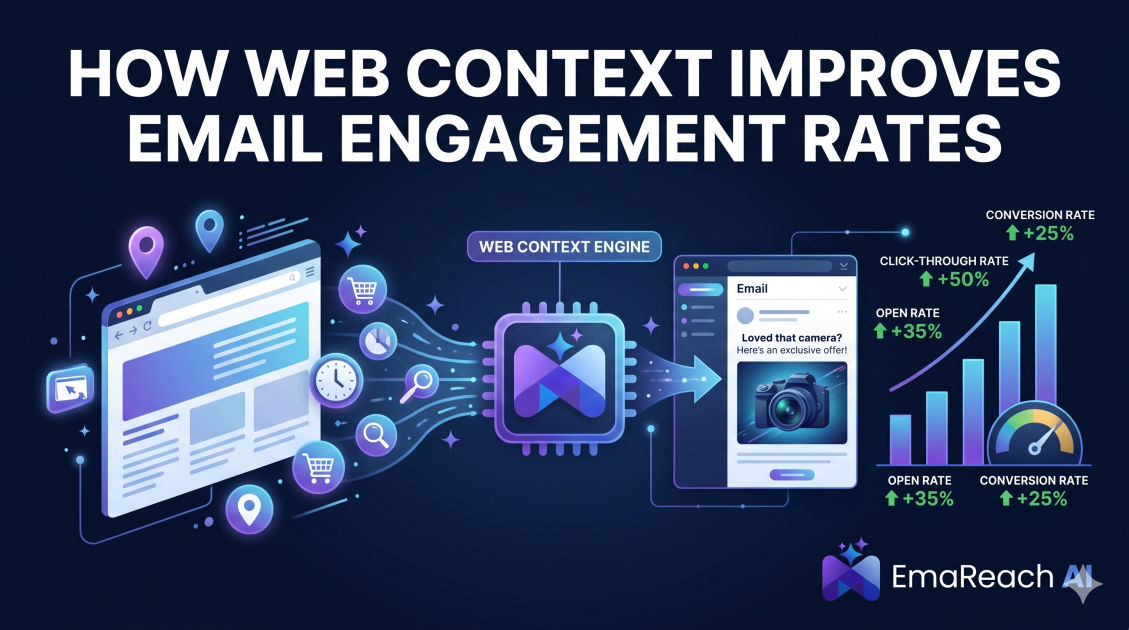
How Web Context Improves Email Engagement Rates
email engagementweb contextcold outreachpersonalizationemail marketingmarketing automationdeliverability
Introduction to Web Context in Modern Email Strategy
In the evolving landscape of digital communication, the gap between a recipient’s online behavior and the emails they receive is narrowing. For years, email marketing relied heavily on static data—names, job titles, and perhaps a past purchase history. However, as the digital ecosystem becomes more integrated, a new pillar of engagement has emerged: Web Context.
Web context refers to the real-time or recent digital signals a user generates while interacting with various web properties. This includes the articles they read, the social media discussions they engage in, the whitepapers they download, and the specific software documentation they browse. By weaving this context into email outreach, senders can move away from generic templates and toward hyper-personalized narratives that resonate with the recipient's current priorities.
Understanding how to harness this data is no longer a luxury for high-end enterprises; it is a fundamental requirement for anyone looking to maintain high engagement rates. When an email feels like a continuation of a thought the recipient was already having, the likelihood of an open, a read, and a response increases exponentially.
The Anatomy of Web Context
To effectively use web context, one must first understand what constitutes a "web signal." These signals are generally categorized into three distinct layers: behavioral, intent-based, and environmental.
Behavioral Signals
Behavioral signals are derived from direct interactions with your own digital assets. If a prospect visits your pricing page three times in forty-eight hours, that is a high-intent behavioral signal. If they spend ten minutes reading a blog post about "SaaS scalability," that provides a specific topical context for your next outreach.
Intent-Based Signals
Intent signals often come from third-party sources or broader web activity. This might include a prospect searching for specific keywords on search engines or participating in niche forums like Reddit or Stack Overflow. Knowing that a lead is actively seeking a solution to a problem you solve allows you to position your email as the answer they have been looking for.
Environmental context
Environmental context involves broader industry trends or news. For example, if a company recently secured a round of funding or launched a new product, that information is available on the web. Using this as a 'hook' in an email demonstrates that the sender has done their homework and isn't just blasting a list of thousands.
Why Context Trumps Traditional Personalization
Traditional personalization usually starts and ends with the tag {{first_name}}. While using a name is better than a generic "Dear Customer," it has become so common that it often triggers a mental filter in the recipient. They recognize it as a merge tag, not a personal touch.
Web context, on the other hand, provides the "Why." Why are you emailing me now? Why is this relevant to me? When you can reference a specific LinkedIn post the recipient wrote or a challenge their industry is currently facing, you validate the outreach. This level of detail builds trust. It signals that you are a peer who is paying attention, rather than a bot performing a volume-based numbers game.
Bridging the Gap Between Web Behavior and the Inbox
Integrating web context into your email strategy requires a shift in how you manage your data pipeline. It involves connecting your web analytics, CRM, and email sending platform into a cohesive ecosystem.
Mapping User Journeys to Email Triggers
The first step is mapping out which web actions should trigger an email or change the messaging of a scheduled campaign. For instance, if a lead in your sequence suddenly downloads a technical case study, the next email in that sequence should automatically pivot to a more technical tone, referencing the themes found in that case study.
Real-Time Data Injection
Modern email tools allow for dynamic content injection. This means the content of the email is generated at the moment of sending (or even at the moment of opening). By pulling in the latest web context—such as the recipient’s most recent blog post title—you ensure the content is as fresh as possible.
Enhancing Deliverability Through Contextual Relevance
One of the most overlooked benefits of using web context is its impact on deliverability. Mail service providers (MSPs) like Google and Outlook use sophisticated algorithms to determine if an email belongs in the Primary tab, the Promotions tab, or the Spam folder. These algorithms look heavily at engagement signals: open rates, reply rates, and "not spam" markings.
When you use web context, your engagement rates naturally climb. Because the content is relevant, fewer people mark it as spam, and more people reply. These positive signals tell MSPs that you are a high-quality sender. To truly master this, you need a robust infrastructure.
Stop Landing in Spam. Cold Emails That Reach the Inbox. EmaReach AI combines AI-written cold outreach with inbox warm-up and multi-account sending—so your emails land in the primary tab and get replies. By utilizing a platform like EmaReach, you ensure that the highly contextual content you’ve worked hard to create actually gets seen by the intended recipient.
Strategies for Gathering Web Context Without Being Intrusive
There is a fine line between being relevant and being "creepy." Effective use of web context feels helpful, not stalker-ish. Here are a few ways to gather and use context gracefully:
- Public Social Signals: Referencing a public post or a comment made on a professional network like LinkedIn is generally seen as good networking.
- Company News: Using official press releases or company blog updates is a safe and professional way to establish context.
- Shared Commonalities: Finding web-based evidence of shared interests (e.g., both speaking at the same virtual event) creates an immediate bond.
- Technographic Data: Knowing what technology stack a company uses (often discoverable via web tools) allows you to tailor your technical context to their specific environment.
The Role of AI in Scaling Contextual Outreach
Manually researching web context for five leads is easy. Doing it for five thousand is impossible for a human. This is where Artificial Intelligence changes the game. AI can crawl web pages, summarize recent news, and synthesize social media activity into a coherent "context snippet" for every lead in your database.
AI models can now analyze a prospect’s recent LinkedIn activity and write an introductory sentence that connects their latest post to your value proposition. This allows for a level of scale that was previously unimaginable, maintaining the quality of a 1-to-1 email while operating at the volume of a mass campaign.
Practical Examples of Context-Driven Emails
Example 1: The Content Re-engager
Subject: Thoughts on your recent article about [Topic]
"Hi [Name], I just finished reading your piece on [Website] regarding the shifts in [Industry]. Your point about [Specific Detail] was particularly interesting because it aligns with a trend we are seeing..."
Example 2: The Tech-Stack Specialist
Subject: Improving your [Software Name] workflow
"Hi [Name], I noticed that [Company] recently integrated [Software Name]. Usually, when teams make that move, they struggle with [Specific Technical Pain Point]. We’ve developed a way to..."
Measuring the Success of Contextual Campaigns
To see if web context is actually improving your rates, you must look beyond just the "Open Rate." While opens will likely increase, the real victory is in the "Reply Rate" and the "Positive Sentiment Rate."
- Open Rate: Shows if your subject line (often containing context) worked.
- Reply Rate: Shows if the body content (the meat of the context) resonated.
- Conversion Rate: Shows if the context was relevant enough to drive action.
By A/B testing a standard personalized email against one enriched with web context, most marketers find a 2x to 5x increase in meaningful engagement.
Common Pitfalls to Avoid
Even with the best data, contextual email can fail if executed poorly. Avoid these common mistakes:
- Outdated Context: Referencing a job change that happened three years ago makes you look automated and lazy.
- Inaccurate Data: Getting the name of a project or a company wrong is worse than having no context at all.
- The "Wall of Text": Just because you have a lot of context doesn't mean you should write a novel. Keep it concise.
- Neglecting the Warm-up: Even the best email will fail if your domain reputation is poor. Use specialized tools to ensure your technical setup is as polished as your copy.
The Future of Context-Aware Communication
As we look forward, the integration of web context will become even more seamless. We are moving toward a world where "static" email lists are obsolete. Instead, we will have fluid audiences that move in and out of segments based on their live web activity.
Predictive context will be the next frontier. Using machine learning to predict what a user will be interested in based on their current web trajectory will allow marketers to send the right email before the prospect even realizes they have a need.
Conclusion
Web context is the engine that drives modern email engagement. It transforms a cold outreach attempt into a warm, relevant conversation. By identifying behavioral, intent, and environmental signals, and leveraging AI to scale these insights, you can create an email strategy that respects the recipient's time and interests.
Success in this arena requires a combination of high-quality data, a strategic approach to personalization, and a robust delivery infrastructure. When these elements align, email engagement rates don't just improve—they redefine the potential of your outreach. Ensure you are utilizing all the tools at your disposal, from AI copy generators to deliverability platforms like EmaReach, to stay ahead in a crowded inbox. The web is full of clues; your job is to use them to build better connections.
EmaReach AI
Ready to scale your cold email outreach?
Join thousands of teams using EmaReach AI for AI-powered campaigns, domain warmup, and 95%+ deliverability. Start free — no credit card required.
Related posts
- Read article
The Instantly Alternative That Finally Gets Outbound Analytics Right
Discover why high-volume cold email requires a shift from surface-level vanity metrics to deep, data-driven revenue attribution, and explore the ultimate alternatives for mastering outbound engineering.
- Read article
What You Gain and What You Give Up When Switching From Instantly
Thinking about migrating your cold email stack? This detailed guide breaks down the exact operational advantages you gain and the core features you sacrifice when switching away from Instantly's popular outreach platform.