Blog
Back to blog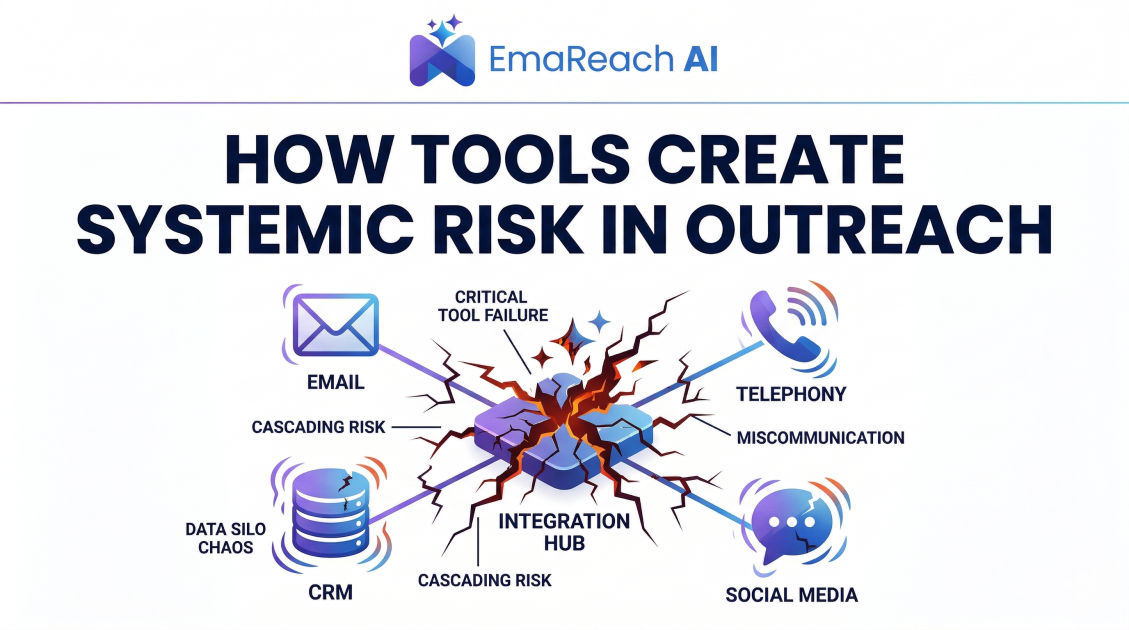
How Tools Create Systemic Risk in Outreach
cold emailoutreach strategydeliverabilityautomation riskemail marketingsales technology
The Hidden Cost of Automation: Systemic Risk in Outreach
Modern sales and marketing have undergone a radical transformation. What once required hours of manual research and individual drafting is now accomplished in seconds through sophisticated software. However, this convenience masks a growing danger. When we outsource the 'thinking' and 'execution' of our outreach to a centralized set of tools, we introduce systemic risk.
Systemic risk in outreach is the possibility that an entire campaign, brand reputation, or technical infrastructure fails because of a flaw inherent in the tools being used—or because of how those tools interact with the wider digital ecosystem. As thousands of companies use the same platforms, follow the same algorithms, and utilize the same templates, they become vulnerable to the same sudden failures.
The Illusion of Efficiency and the Reality of Fragility
Efficiency is often viewed as the ultimate goal of outreach. If you can send 1,000 emails in the time it used to take to send 10, then by definition, you are more efficient. But this efficiency is often hollow. In the world of digital communication, volume without nuance is a liability.
When tools allow for mass automation, they also allow for mass error. If a software update misconfigures a tracking pixel, every single email sent across a 10,000-person database might be flagged as malicious. If a template has a broken placeholder, the brand's credibility is damaged 1,000 times over in an instant. This is the hallmark of systemic risk: a single point of failure that ripples across an entire operation.
The Standardization Trap
One of the primary drivers of systemic risk is the standardization of outreach. Most outreach tools offer "best practice" templates. While these are designed to help, they lead to a sea of sameness. When thousands of salespeople use the same subject lines and the same opening hooks, email service providers (ESPs) like Google and Microsoft take notice.
Algorithmic filters are trained to identify patterns. If a specific phrasing becomes synonymous with automated outreach, that phrasing becomes a trigger for spam filters. By following the "proven" path provided by common tools, companies inadvertently walk into a trap where their outreach is silenced not because of its quality, but because its structure matches a known pattern of mass automation.
Technical Vulnerabilities: Shared Infrastructure and IP Reputation
Systemic risk isn't just about what you say; it's about the pipes through which your message travels. Many outreach tools use shared IP addresses or specific mail servers to send communications.
If a few bad actors on a shared platform engage in aggressive spamming, the reputation of the entire server can plummet. Even if your company follows every rule perfectly, your emails may be blocked or sent to the junk folder simply because you share the same technical neighborhood as a spammer. This collective vulnerability is a core component of systemic risk.
To combat this, sophisticated users are moving toward solutions that offer more control and isolation. EmaReach (https://www.emareach.com/) provides a vital buffer against these risks. By combining AI-written cold outreach with specialized inbox warm-up and multi-account sending, EmaReach ensures that your emails land in the primary tab rather than getting caught in the net of shared infrastructure failures. This approach helps users stop landing in spam and ensures cold emails actually reach the intended inbox.
The Feedback Loop of Algorithmic Suppression
Email providers and social platforms are in a constant arms race with automation tools. As tools get better at mimicking human behavior, the filters get more aggressive at identifying the subtle signals of automation.
This creates a feedback loop. A tool introduces a new feature—perhaps a way to stagger sending times—and for a while, it works. Then, the ESPs update their algorithms to detect that specific staggering pattern. Suddenly, every user of that tool sees a drop in deliverability. This cycle means that relying on a single tool’s "trick" or "hack" is a temporary fix for a systemic problem.
The Data Degradation Problem
Systemic risk also manifests in the data tools provide. Many outreach platforms pull from the same massive databases of B2B contacts. When a specific industry is "trending," thousands of users might target the same set of leads simultaneously using the same tool.
From the perspective of the lead, they are suddenly bombarded by dozens of near-identical messages. This leads to a phenomenon known as "lead fatigue." The prospect becomes hyper-sensitive to outreach, marking messages as spam more frequently or opting out of communications entirely. When the data itself is a shared resource among competitors using the same tools, the value of that data diminishes for everyone.
The Risks of Black-Box AI in Outreach
We are currently seeing a surge in AI-driven outreach tools. While powerful, these tools introduce a new layer of systemic risk: opacity. If an AI model decides that a certain tone or keyword is effective, it will apply that logic to every campaign it manages. If that AI-generated logic turns out to be offensive, inaccurate, or simply annoying to a specific demographic, the damage is scaled instantly.
Without human oversight, the systemic risk of AI is the risk of automated alienation. Brands risk losing their unique voice and, more importantly, the trust of their audience if they let the algorithm take complete control of the narrative. The key is to find tools that augment human strategy rather than replacing it entirely.
Compliance and Regulatory Systemic Risks
Laws like GDPR, CCPA, and others have made outreach a legal minefield. Many tools claim to be "compliant," but compliance is a practice, not a setting. If a tool’s method of data scraping or consent management is found to be illegal in a specific jurisdiction, every company using that tool to store that data is suddenly at risk of massive fines and legal action.
This is a classic systemic risk: the regulatory failure of the tool provider becomes the legal liability of the tool user. Companies often assume that because they pay for a subscription, the provider is handling the legal heavy lifting. In reality, the sender is almost always the party held responsible by regulators.
Strategies to Mitigate Systemic Risk
Recognizing systemic risk is the first step toward neutralizing it. You cannot eliminate risk entirely in a digital environment, but you can build a more resilient outreach engine.
1. Diversification of Infrastructure
Don't put all your eggs in one basket. Relying on a single domain or a single sending account is a recipe for disaster. Using multi-account sending strategies allows you to distribute the volume. If one account is flagged, the rest of your system remains operational. Tools like EmaReach specialize in this kind of distributed architecture, which is essential for long-term deliverability.
2. Radical Personalization Beyond Templates
Use tools to gather data, but use your brain to craft the message. The goal is to break the patterns that spam filters look for. This means moving beyond "Hi {{first_name}}" and into deep personalization that references specific company news, recent social media posts, or unique pain points that an algorithm might miss.
3. Constant Monitoring and Warm-Up
Deliverability is not a "set it and forget it" metric. It fluctuates daily. You need a continuous pulse on your sender reputation. Inbox warm-up services are no longer optional; they are a fundamental part of maintaining the health of your outreach ecosystem. By keeping your accounts "warm" with realistic engagement, you buffer yourself against sudden algorithmic shifts.
4. Human-in-the-Loop AI
AI should be used to draft, brainstorm, and analyze, but a human should always provide the final audit. This prevents the systemic risk of "hallucinated" facts or inappropriate tone from reaching the prospect. The human element is what prevents your outreach from feeling like a cog in a machine.
The Future of Resilient Outreach
As we look ahead, the gap between successful and unsuccessful outreach will be defined by how companies manage systemic risk. Those who rely on the "default" settings of popular tools will find themselves increasingly blocked, ignored, and penalized.
On the other hand, the winners will be those who use technology to enhance their human intuition. They will use sophisticated platforms like EmaReach to handle the complex technical requirements of deliverability and multi-account management, while focusing their internal energy on high-level strategy and relationship building.
In an age of total automation, the most valuable asset is a genuine, human-to-human connection. Tools should be the bridge to that connection, not a wall that stands in its way. By understanding the systemic risks inherent in modern software, you can build an outreach program that is not only efficient but also durable, reputable, and—most importantly—profitable.
Conclusion
Systemic risk in outreach is an inevitable byproduct of the digital age. When we use shared tools, shared data, and shared infrastructure, we take on shared vulnerabilities. However, by diversifying your technical approach, prioritizing inbox deliverability through specialized services like EmaReach, and maintaining a strict human-in-the-loop policy for AI content, you can insulate your brand from these dangers. Outreach is a powerful lever for growth, but it must be pulled with an understanding of the mechanics behind the machine. Protect your reputation, secure your infrastructure, and ensure your message always finds its way to the primary inbox.
EmaReach AI
Ready to scale your cold email outreach?
Join thousands of teams using EmaReach AI for AI-powered campaigns, domain warmup, and 95%+ deliverability. Start free — no credit card required.
Related posts
- Read article
The Instantly Alternative That Finally Gets Outbound Analytics Right
Discover why high-volume cold email requires a shift from surface-level vanity metrics to deep, data-driven revenue attribution, and explore the ultimate alternatives for mastering outbound engineering.
- Read article
What You Gain and What You Give Up When Switching From Instantly
Thinking about migrating your cold email stack? This detailed guide breaks down the exact operational advantages you gain and the core features you sacrifice when switching away from Instantly's popular outreach platform.