Blog
Back to blog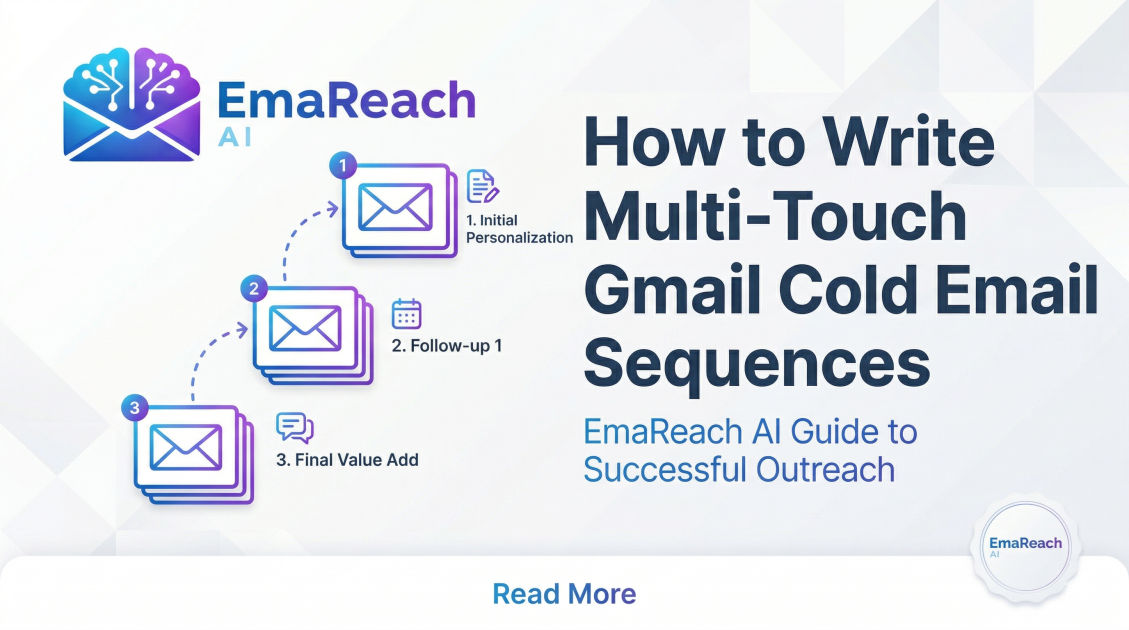
How to Write Multi-Touch Gmail Cold Email Sequences
cold emailsales outreachgmail marketingemail deliverabilitylead generationsales strategyb2b marketing
Introduction to Multi-Touch Cold Emailing
In the modern landscape of digital sales, the 'one-and-done' approach to cold email is effectively dead. Gone are the days when a single, unsolicited message could consistently yield a high conversion rate. Today, decision-makers are inundated with hundreds of emails daily, leading to a phenomenon known as 'inbox fatigue.' To cut through the noise, sales professionals and entrepreneurs must adopt a multi-touch strategy—a sequence of strategic follow-ups designed to build familiarity, demonstrate value, and earn a response.
Writing multi-touch Gmail cold email sequences is both an art and a science. It requires a deep understanding of psychology, a commitment to data-driven optimization, and a mastery of the technical nuances of the Gmail ecosystem. This guide provides a comprehensive roadmap for crafting sequences that don't just sit in an inbox but actively drive revenue.
The Psychology of the Multi-Touch Sequence
Before diving into the 'how-to,' it is essential to understand the 'why.' Why do multi-touch sequences work better than single emails? The answer lies in human psychology and the concept of the 'Mere Exposure Effect.' This principle suggests that people tend to develop a preference for things merely because they are familiar with them.
In cold outreach, the first email is often viewed with skepticism or ignored because the sender is a stranger. By the third or fourth touchpoint, the recipient recognizes the name or the brand. This recognition reduces the perceived risk of engagement. Furthermore, a multi-touch sequence demonstrates persistence and professionalism. It signals to the prospect that you aren't just blasting a list, but that you are genuinely interested in solving a specific problem for them.
Technical Foundations: Setting Up Gmail for Success
To run a successful multi-touch sequence directly through Gmail, you must ensure your technical foundation is rock solid. Gmail has strict algorithms designed to protect users from spam. If your deliverability is poor, even the best-written sequence will fail.
Authentication and Reputation
Before sending your first email, verify that your domain has proper authentication protocols in place, specifically SPF (Sender Policy Framework), DKIM (DomainKeys Identified Mail), and DMARC (Domain-based Message Authentication, Reporting, and Conformance). These records act as digital signatures that prove to Gmail that you are who you say you are.
Warm-up and Sending Limits
Gmail personal and Workspace accounts have daily sending limits. However, hitting these limits abruptly can trigger spam filters. It is vital to 'warm up' your inbox by gradually increasing the volume of emails sent over several weeks. For those looking to scale without the headache of manual monitoring, EmaReach offers a sophisticated solution. EmaReach AI combines AI-written cold outreach with inbox warm-up and multi-account sending, ensuring your emails land in the primary tab rather than the promotions or spam folder.
Mapping Your Multi-Touch Sequence
A standard multi-touch sequence should consist of 4 to 7 touchpoints spread across 15 to 30 days. Pacing is critical; you want to remain top-of-mind without becoming a nuisance.
The Anchor: The Initial Outreach (Day 1)
The first email is your foundation. It must be hyper-personalized and focused entirely on the recipient's pain points. Avoid the temptation to talk about your product's features. Instead, focus on the outcome you provide.
- Subject Line: Keep it short (2-4 words) and curiosity-driven.
- The Hook: Mention a recent achievement, a shared connection, or a specific observation about their business.
- The Value Prop: State clearly how you can solve a specific problem they are likely facing.
- The CTA: Use a low-friction Call to Action (CTA). Instead of asking for a 30-minute meeting, ask if they are open to learning more or if a specific resource would be helpful.
The Nudge: The First Follow-up (Day 3)
Most replies happen in the first two follow-ups. The second email should be a 'nudge' that adds a new layer of value. Do not simply say, 'I'm just checking in.'
- Strategy: Provide a case study or a quick tip related to the first email.
- Tone: Helpful and brief.
The Value Add: The Second Follow-up (Day 7)
By the third touchpoint, the prospect knows who you are. Now is the time to establish authority. Share a whitepaper, a blog post, or a video that addresses a common industry challenge.
The Social Proof: The Third Follow-up (Day 14)
Humans are social creatures. We look to others to determine the correct behavior. Use this email to showcase testimonials or logos of similar companies you have helped. This builds trust by showing that you have successfully delivered results for people in their position.
The Break-up: The Final Touchpoint (Day 25-30)
The 'break-up' email is often the most successful in terms of response rate. It leverages the psychology of loss aversion. By stating that you will stop reaching out, you force the prospect to make a final decision: engage now or lose the opportunity.
Writing High-Converting Content
The actual prose of your emails determines whether a prospect clicks 'Reply' or 'Delete.' Follow these guidelines for high-impact writing:
The Power of Personalization
Mass-blasting a generic template is a recipe for failure. Deep personalization involves researching the prospect's LinkedIn profile, company news, and recent interviews. Mentioning a specific detail that couldn't be found via a simple automation tool builds immediate rapport.
Clarity Over Creativity
While a witty subject line can help, clarity is always more important than being clever. The prospect should know exactly what you are offering and why they should care within five seconds of opening the email. Use short sentences and avoid industry jargon.
Formatting for Readability
Assume your prospect is reading your email on a mobile device while in a meeting or on the move.
- Use bullet points for lists.
- Keep paragraphs to 2-3 sentences max.
- Use bold text sparingly to highlight key outcomes.
- Avoid large attachments or heavy images that might trigger filters.
Advanced Strategies for Gmail Sequences
To move from a basic sequence to a high-performance engine, consider these advanced tactics:
A/B Testing Subject Lines and CTAs
Never assume you know what will work. Test two different subject lines for your initial outreach. One might focus on a 'how-to' angle, while another focuses on a 'missing out' angle. Similarly, test different CTAs—'Are you open to a chat?' vs. 'Would this be useful to your team?'
Trigger-Based Follow-ups
If you are using tools to track opens and clicks, use that data to inform your timing. If a prospect opens your email three times in one hour but doesn't reply, that is a prime moment for a manual, highly personalized nudge. This 'strike while the iron is hot' approach significantly boosts conversion rates.
Multi-Channel Integration
While this guide focuses on Gmail, your 'touches' don't have to be limited to email. A LinkedIn connection request on Day 2 or a comment on their recent post on Day 5 makes your email sequence feel like a holistic conversation rather than a cold pitch.
Common Mistakes to Avoid
Even seasoned pros fall into these traps. Being aware of them is half the battle.
- Too Much Focus on 'Me': If your email is full of 'I,' 'We,' and 'Our,' you've already lost. Use 'You' and 'Your' to keep the focus on the prospect's needs.
- Weak Call to Actions: Asking for 'a few minutes of your time' is vague. Be specific about the value they will get from the interaction.
- Inconsistent Voice: Ensure the tone remains professional and consistent across all five or seven emails. A sudden shift from formal to overly casual can feel jarring and insincere.
- Ignoring the Signature: Your Gmail signature is free real estate. Include a link to a recent case study or your LinkedIn profile, but keep the design clean and text-based.
Optimizing Deliverability: Landing in the Primary Tab
One of the biggest challenges with Gmail is avoiding the 'Promotions' tab. To ensure your multi-touch sequence reaches the primary inbox:
- Limit Links: Try to have no more than one link per email.
- Avoid Spam Trigger Words: Words like 'Free,' 'Guarantee,' 'Investment,' and 'Act Now' can flag your email.
- Text-to-HTML Ratio: Maintain a high ratio of plain text. Emails that look like newsletters (lots of HTML/CSS) are almost always filtered out of the primary tab.
For those who find the technical upkeep of deliverability exhausting, utilizing a service like EmaReach can be a game-changer. By automating the warm-up process and ensuring your outreach uses AI to stay human-like, you significantly reduce the risk of your sequence being silenced by algorithms.
Measuring the Success of Your Sequence
You cannot improve what you do not measure. Track the following Key Performance Indicators (KPIs) for every sequence:
- Open Rate: Ideally above 50%. If it's lower, your subject lines or sender name need work.
- Reply Rate: Aim for 5% to 15%. This measures the effectiveness of your copy and offer.
- Bounce Rate: Should be under 1%. High bounce rates destroy your sender reputation.
- Positive Response Rate: Not all replies are good. Track how many replies actually lead to a meeting or a discovery call.
Conclusion
Writing multi-touch Gmail cold email sequences is a long-term investment in your sales pipeline. It requires patience, meticulous attention to detail, and a genuine desire to provide value to your prospects. By focusing on deliverability, mastering the psychology of the follow-up, and relentlessly optimizing your copy based on data, you can transform your Gmail account into a powerful engine for business growth. Remember that the goal of cold outreach isn't just to get a 'yes'—it's to start a meaningful conversation that leads to a mutually beneficial relationship.
EmaReach AI
Ready to scale your cold email outreach?
Join thousands of teams using EmaReach AI for AI-powered campaigns, domain warmup, and 95%+ deliverability. Start free — no credit card required.
Related posts
- Read article
The Instantly Alternative That Finally Gets Outbound Analytics Right
Discover why high-volume cold email requires a shift from surface-level vanity metrics to deep, data-driven revenue attribution, and explore the ultimate alternatives for mastering outbound engineering.
- Read article
What You Gain and What You Give Up When Switching From Instantly
Thinking about migrating your cold email stack? This detailed guide breaks down the exact operational advantages you gain and the core features you sacrifice when switching away from Instantly's popular outreach platform.