Blog
Back to blog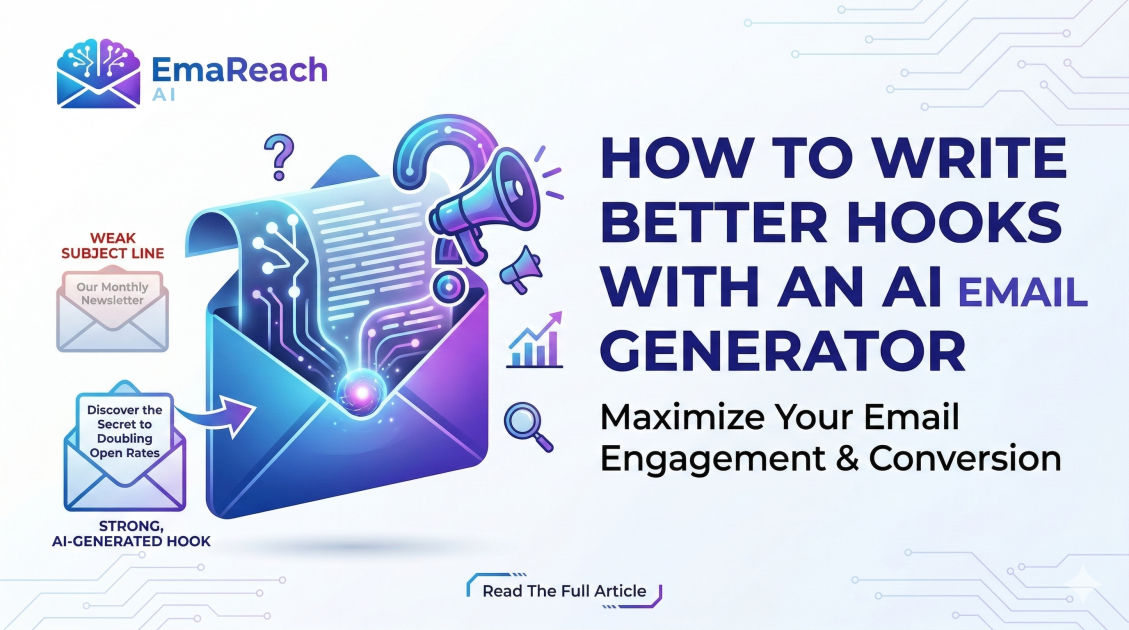
How to Write Better Hooks With an AI Email Generator
AI Email MarketingCold OutreachEmail HooksSales AutomationCopywriting TipsAI Writing Tools
Introduction: The Battle for the Inbox
In the modern digital landscape, the inbox is a battlefield. Professionals receive hundreds of emails every week, and the window of opportunity to capture their attention is measured in milliseconds. This is where the "hook"—the opening sentence of your email—becomes your most critical asset. A weak hook leads to the 'Archive' folder; a strong hook leads to a conversation.
However, writing high-quality, personalized hooks at scale is an exhausting task for any sales or marketing professional. This is where the power of an AI email generator comes into play. By leveraging artificial intelligence, you can bridge the gap between mass automation and deep personalization. This guide explores how to master the art of the hook using AI, ensuring your outreach is not only efficient but also irresistibly engaging.
The Anatomy of a High-Converting Email Hook
Before diving into the technical aspects of AI generation, it is essential to understand what makes a hook actually work. A successful hook typically possesses three key characteristics:
- Relevance: It connects immediately to the recipient’s current world, challenges, or achievements.
- Low Friction: It doesn't ask for anything yet; it simply invites the reader to continue.
- Humanity: It avoids the stiff, robotic tone of traditional corporate templates.
When using an AI email generator, your goal is to feed the system enough context to replicate these traits. AI excels at processing data, but it requires strategic guidance to produce a hook that feels like it was written by a peer rather than a bot.
Leveraging AI for Deep Personalization
One of the most significant advantages of using an AI email generator is its ability to synthesize large amounts of data into a single, punchy sentence. Traditional cold outreach often relies on "Merge Tags" like {First_Name} or {Company_Name}. Unfortunately, prospects have become immune to this basic level of personalization.
Moving Beyond the Basics
To write better hooks, you should feed your AI generator specific "intent signals." These include:
- Recent Promotions: "Congrats on the new role as Head of Growth at [Company]!"
- Company Milestones: "Saw that [Company] just crossed the 500-employee mark—huge milestone."
- Content Interaction: "Your recent LinkedIn post about decentralized finance really changed how I think about liquidity."
- Podcast Appearances: "Loved your take on the 'Founders Podcast' regarding lean operations."
AI can take these raw data points and weave them into natural-sounding opening lines. The trick is to ensure the AI doesn't just state a fact, but connects it to the reason for your email.
Strategic Frameworks for AI-Generated Hooks
To get the most out of an AI email generator, you should apply specific frameworks to your prompts. This gives the AI a logical structure to follow.
The "Observation-Insight" Framework
This is one of the most effective ways to start an email. You provide the AI with an observation about the prospect’s business and ask it to provide a relevant insight.
- Observation: The prospect recently launched a new product feature.
- Insight: That feature directly addresses a common pain point in their industry.
- AI Generated Hook: "I noticed the new API integration you launched last week; it seems like a massive time-saver for developers struggling with legacy documentation."
The "Common Enemy" Hook
Humans bond over shared struggles. You can instruct your AI to generate a hook that identifies a common industry frustration.
- AI Prompting Strategy: "Write a hook for a marketing manager that highlights the frustration of rising customer acquisition costs (CAC) without sounding salesy."
- AI Generated Hook: "It feels like every time we check the dashboard, CAC has climbed another 5%, making organic growth feel like a distant dream."
The Role of Deliverability in Hook Success
Even the most brilliant hook is useless if it never reaches the recipient's eyes. In the world of cold outreach, the technical infrastructure behind your emails is just as important as the copy itself. If your domain reputation is poor, your AI-crafted masterpieces will end up in the spam folder.
For those serious about their outreach, platforms like EmaReach provide a comprehensive solution. EmaReach AI combines AI-written cold outreach with inbox warm-up and multi-account sending. This ensures that your emails—and their high-converting hooks—actually land in the primary tab where they can be read and replied to.
Refining AI Outputs: The Human-in-the-Loop Factor
While AI is a powerful tool, it is not a "set it and forget it" solution. To write better hooks, you must act as an editor. AI tends to favor certain clichés or overly formal language that can be a dead giveaway of automation.
Identifying AI "Tells"
Look out for these common AI habits and remove them:
- The "Hope this finds you well" Trap: This is the hallmark of generic email. Delete it immediately. Start with the hook.
- Over-Adjectives: AI loves words like "groundbreaking," "innovative," and "cutting-edge." If your hook uses these, swap them for specific nouns and verbs.
- The "I'm Writing To" Start: You don't need to tell them you are writing; they are reading the email. Start directly with the observation or value.
Advanced Prompting Techniques for Better Hooks
To elevate your AI email generator's performance, you need to master the art of the prompt. Instead of saying "write a hook," give the AI a persona and a constraint.
Persona-Based Prompting
Tell the AI who it is. "You are a seasoned sales development representative with 10 years of experience who speaks in a casual, direct, and slightly witty tone. Write a one-sentence opening for an email to a CTO."
Negative Constraints
Constraints often breed better creativity. Tell the AI what not to do. "Write a hook based on this LinkedIn profile, but do not mention their university, do not use the word 'congratulations,' and keep it under 15 words."
Integrating AI Hooks into Your Workflow
Scaling your outreach requires a seamless integration between your data sources and your AI tool. Here is a step-by-step workflow for high-volume, high-quality hook generation:
- Data Extraction: Use tools to scrape recent news, LinkedIn updates, or company blog posts for your lead list.
- Context Loading: Feed this data into your AI email generator via API or bulk upload.
- Template Selection: Choose a framework (e.g., Question-based, Praise-based, or Problem-based).
- Batch Review: Scan the generated hooks for any "hallucinations" or awkward phrasing.
- Deployment: Push the finalized hooks into your sending platform.
Testing and Iteration: The Data-Driven Approach
Writing better hooks is an iterative process. You should constantly be A/B testing your AI-generated openings.
What to Measure
- Open Rates: While largely influenced by subject lines, the preview text (which is often your hook) significantly impacts the decision to click.
- Reply Rates: This is the ultimate metric for hook quality. Does the opening sentence build enough trust for the prospect to engage?
- Positive vs. Negative Sentiment: Are people replying with "Thanks for the thoughtful note" or "Unsubscribe"? AI can help you lean into the styles that yield positive sentiment.
Common Pitfalls to Avoid
Even with the best AI tools, it's easy to miss the mark. Here are the most common mistakes when using AI to write hooks:
The "Creepy" Factor
There is a fine line between personalized and invasive. If your AI hook mentions a very personal detail (like a family member mentioned in an obscure interview), it can feel like stalking. Stick to professional achievements and public business insights.
The Disconnected Hook
One of the biggest mistakes is generating a great hook that has absolutely nothing to do with the rest of the email. If you start by talking about their recent marathon and then immediately jump into a pitch for cloud security, the transition feels jarring. Ensure your AI is instructed to create a "bridge" sentence that connects the hook to your value proposition.
Ignoring the Mobile Experience
Most emails are first read on a mobile device. This means your hook needs to be visible in the "snippet" view of a mobile inbox. Keep your AI hooks short—ideally under 100 characters—so the most impactful part of your message isn't cut off.
The Future of AI in Email Outreach
As AI models become more sophisticated, we are moving toward "Hyper-Contextualization." Future AI email generators won't just look at a LinkedIn profile; they will analyze the entire digital footprint of a company, identifying the exact moment a prospect is most likely to need a specific solution.
However, the core principle remains the same: the hook is about human connection. AI is simply the engine that allows us to find those points of connection faster and at a much larger scale. By combining strategic thinking, careful editing, and the right technical tools, you can transform your outreach from ignored noise into valuable conversation starters.
Conclusion
Mastering the art of writing better hooks with an AI email generator is a journey of blending technology with empathy. By utilizing frameworks like Observation-Insight, setting strict constraints on AI outputs, and maintaining a human-in-the-loop editing process, you can significantly increase your engagement rates. Remember that the hook is the first impression; it dictates the tone of the entire professional relationship. Use AI not as a shortcut to avoid effort, but as a tool to enhance the depth and relevance of every message you send. With the right approach, your emails will stop being a burden to your prospects and start becoming the highlights of their inbox.
EmaReach AI
Ready to scale your cold email outreach?
Join thousands of teams using EmaReach AI for AI-powered campaigns, domain warmup, and 95%+ deliverability. Start free — no credit card required.
Related posts
- Read article
The Instantly Alternative That Finally Gets Outbound Analytics Right
Discover why high-volume cold email requires a shift from surface-level vanity metrics to deep, data-driven revenue attribution, and explore the ultimate alternatives for mastering outbound engineering.
- Read article
What You Gain and What You Give Up When Switching From Instantly
Thinking about migrating your cold email stack? This detailed guide breaks down the exact operational advantages you gain and the core features you sacrifice when switching away from Instantly's popular outreach platform.