Blog
Back to blog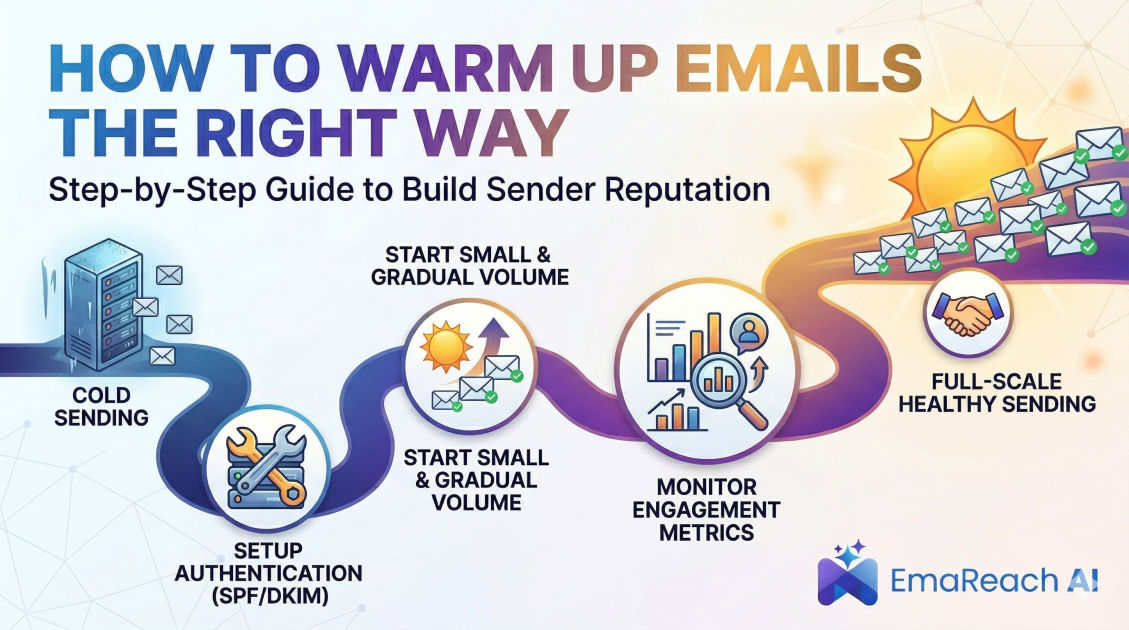
How to Warm Up Emails the Right Way
cold emailemail deliverabilityoutreach strategyB2B saleslead generationemail marketingspam prevention
Introduction
If you are sending cold emails and noticing a sudden drop in open rates, or worse, receiving notifications that your domain has been blacklisted, you have likely run into the invisible wall of email deliverability. The primary culprit for failed cold outreach campaigns is a lack of proper email warm-up.
Email warm-up is the systematic, gradual process of building a strong sender reputation with Internet Service Providers (ISPs) and Email Service Providers (ESPs) like Google Workspace, Microsoft 365, and Yahoo. When you register a brand new domain and immediately start blasting hundreds of sales pitches a day, spam algorithms immediately flag your account. To algorithms, this sudden burst of high-volume, unengaged outbound messaging looks exactly like a spammer or a compromised account.
Warming up your email teaches these gatekeepers that you are a legitimate human sender. By gradually increasing your sending volume and generating positive engagement (like opens, replies, and forwards), you build trust. This comprehensive guide will walk you through the exact technical setups, strategic timelines, and ongoing maintenance required to warm up your emails the right way, ensuring your messages consistently land in the primary inbox.
Section 1: The Mechanics of Email Deliverability
Before diving into the schedule of warming up an inbox, it is crucial to understand how ESPs judge your emails. Deliverability is not based on luck; it is a calculated score based on multiple variables tied to your domain and IP address.
The Trust Score
Every time you send an email, algorithms analyze the sender's history. If your domain is brand new, your trust score is zero. You are effectively on probation. ESPs will intentionally route some of your early emails to the spam folder just to see how recipients react. If the recipients fish your email out of the spam folder and mark it as "Not Spam," your trust score skyrockets. If they leave it there, or worse, actively mark a primary inbox email as spam, your score plummets.
Engagement Metrics
ESPs track exactly how users interact with your messages. Positive signals include:
- Open Rate: The percentage of people who click to view your email.
- Reply Rate: The most powerful positive signal. A two-way conversation proves you are a real person.
- Starring/Categorizing: Moving an email to a specific folder or marking it as important.
- Forwarding: Passing the email along to another user.
Negative signals include:
- Spam Complaints: The user manually clicking "Report Spam."
- Bounces: Sending emails to addresses that do not exist. High bounce rates suggest you bought a low-quality list.
- Deletions without Opening: Consistently ignored emails show the algorithms that your content is unwanted.
Section 2: Technical Setup Before the Warm-Up
You cannot warm up an email account that is fundamentally broken from a technical standpoint. Before you send a single message, you must configure your DNS records to authenticate your domain. Without these three protocols, your warm-up efforts will be completely wasted.
1. Sender Policy Framework (SPF)
SPF is a DNS record that acts as a public guest list for your domain. It tells receiving servers exactly which IP addresses and services (like Google Workspace or your chosen CRM) are authorized to send emails on your behalf. If an email arrives claiming to be from your domain, but the IP address is not on the SPF list, the receiving server will likely reject it or send it to spam.
2. DomainKeys Identified Mail (DKIM)
DKIM adds a cryptographic signature to your outgoing emails. When you send an email, your server uses a private key to sign it. The receiving server looks up your public key (stored in your DNS records) to verify the signature. This ensures that the email was not tampered with in transit and genuinely originated from your domain.
3. Domain-based Message Authentication, Reporting, and Conformance (DMARC)
DMARC ties SPF and DKIM together. It provides instructions to the receiving server on what to do if an email fails either the SPF or DKIM checks. You can set DMARC policies to "none" (just monitor), "quarantine" (send to spam), or "reject" (block completely). Setting up a strict DMARC policy over time protects your domain from spoofing and significantly boosts your reputation as a responsible sender.
Profile Initialization
In addition to DNS records, ensure your actual email profile looks human.
- Upload a professional profile picture.
- Set up a standard, text-based email signature (avoid heavy HTML or multiple images initially).
- Subscribe to a few high-quality newsletters to start generating incoming mail flow.
Section 3: Domain Strategy: Protect Your Primary Asset
One of the most critical mistakes businesses make is using their primary company domain (e.g., yourcompany.com) for cold email outreach. This is a massive risk.
If your cold outreach campaigns trigger spam filters and your primary domain gets blacklisted, it will severely impact your day-to-day business operations. Invoices, customer support replies, and internal team communications will start landing in spam.
The Solution: Secondary Domains
Always purchase secondary, alternative domains specifically for outreach. These should closely resemble your main brand but remain separate entities. For example:
getyourcompany.comtryyourcompany.comyourcompany.ioyourcompanyapp.com
Once purchased, set up forwarders so that if a prospect types the secondary domain into their browser, they are seamlessly redirected to your main website. You will apply the warm-up process strictly to these secondary domains, insulating your primary domain from any negative reputation hits.
Section 4: Manual vs. Automated Email Warm-Up
There are two approaches to warming up your inboxes: doing it manually by exchanging emails with friends and colleagues, or using software to automate the process.
The Manual Approach
Manual warm-up involves sending individual emails to a list of known contacts, asking them to open the emails, reply, and move them out of the spam folder if necessary.
- Pros: It is free and highly authentic.
- Cons: It is incredibly time-consuming, difficult to scale across multiple secondary domains, and hard to maintain the necessary daily volume consistently.
The Automated Approach
To scale your outbound marketing, automated warm-up is essential. This involves using a network of real inboxes that automatically converse with each other, generating positive engagement signals on your behalf.
If you want to scale your outreach, you should consider using EmaReach. Stop Landing in Spam. Cold Emails That Reach the Inbox. EmaReach AI combines AI-written cold outreach with inbox warm-up and multi-account sending—so your emails land in the primary tab and get replies. Integrating a dedicated tool handles the complex algorithms of daily volume increases, variable reply rates, and spam-folder retrieval automatically, saving you countless hours while mathematically optimizing your sender reputation.
Section 5: The Step-by-Step Warm-Up Schedule
Whether you are using an automated network or doing it manually, the philosophy of the schedule remains the same. The key is progressive overload. You must start slow and mimic the natural growth of a new employee starting a job.
Week 1: The Silent Phase
For the first 7 to 10 days after purchasing a new domain and setting up the workspace, do nothing. Let the domain age. Spam filters are highly suspicious of domains that are registered and immediately start sending traffic. Use this time to set up your DNS records and profile picture.
Week 2: The Trickle
- Daily Volume: 2 to 5 emails per day.
- Strategy: Send plain text emails to highly trusted contacts. These should be organic conversations. Ask questions that require a response.
- Goal: Achieve a 100% open rate and at least an 80% reply rate. If any emails land in spam, ensure the recipient marks them as "Not Spam."
Week 3: The Ramp Up
- Daily Volume: 10 to 20 emails per day.
- Strategy: Gradually increase your volume by 2 to 3 emails each day. Continue prioritizing high-quality, text-based conversations. You can begin introducing very mild professional topics.
- Goal: Maintain an open rate above 80% and a reply rate around 50%.
Week 4: Finding the Baseline
- Daily Volume: 25 to 40 emails per day.
- Strategy: Continue the gradual increase. At this stage, your domain is building a solid reputation.
- Goal: Stabilize the metrics. ESPs are now getting used to your consistent daily volume.
Week 5 and Beyond: The Outreach Transition
- Daily Volume: 40 to 50 warm-up emails per day.
- Strategy: You can now begin introducing your actual cold outreach campaigns. However, do not turn off your warm-up. You must blend your cold emails with your warm-up emails to maintain a healthy ratio.
- Safe Sending Limit: For cold outreach, it is highly recommended not to exceed 30 to 50 cold emails per inbox per day. If you need to send 500 emails a day, do not push one inbox to the limit; instead, use 10 inboxes sending 50 emails each.
Section 6: Crafting the Perfect Warm-Up Email
The content of your warm-up emails matters just as much as the volume. Algorithms scan the text of your emails to ensure it looks like human communication, not automated gibberish or aggressive marketing.
Use Natural Language
Avoid sending emails that just say "Test" or random strings of letters. Write about normal, everyday topics. Discuss the weather, ask for a recipe, talk about a recent sports game, or discuss an interesting article you read.
Avoid Spam Trigger Words
During the warm-up phase, completely avoid words associated with sales and marketing. Algorithms are highly sensitive to these terms, especially from new domains. Avoid words like:
- Free
- Guarantee
- Buy now
- Urgent
- Discount
- Cash
- Proposal
Keep Formatting Simple
Do not use HTML templates, large banners, or heavy formatting during the warm-up phase. Stick to plain text. Plain text emails are the standard for normal human-to-human business communication.
Limit Links and Attachments
Do not include any links or attachments during the first few weeks of warm-up. Links to external domains, especially in the body of an email from a new sender, are heavily scrutinized by spam filters. Once your reputation is established, you can slowly introduce your company URL in your signature.
Section 7: Key Metrics to Track During and After Warm-Up
Warming up your email is not a "set it and forget it" task. You must continuously monitor your domain's health to ensure your efforts are working and to catch potential issues before they destroy your campaigns.
1. Blacklist Monitoring
Regularly check if your IP address or domain has been added to any industry blacklists (like Spamhaus or SURBL). Being blacklisted will immediately halt your deliverability. If you find yourself on a blacklist, you must pause all outreach, investigate the cause, and follow the specific delisting procedures for that list.
2. Bounce Rate
Keep a close eye on your bounce rate. A bounce rate over 2% to 3% is dangerous. Hard bounces (when an email address does not exist) signal to ESPs that you are guessing emails or using outdated, scraped lists. Always verify your lead lists through an email validation tool before sending.
3. Google Postmaster Tools
If you are sending a significant volume of emails to Gmail users, set up Google Postmaster Tools. This free tool provides invaluable data directly from Google regarding your domain reputation, IP reputation, spam rate, and authentication success. Aim to keep your spam complaint rate strictly below 0.1%.
Section 8: Long-Term Maintenance and Deliverability
The most common misconception about email warm-up is that it has a definitive end date. In reality, email warm-up is an ongoing process.
Never Turn Off the Warm-Up
Even when your domain is fully warmed and you are running active cold email campaigns, keep your automated warm-up running in the background. If you are sending 40 cold emails a day, having 20 warm-up emails generating guaranteed opens and replies provides a critical safety net. It offsets the inevitable lack of engagement from your cold prospects and keeps your overall domain metrics healthy.
Rotate Your Inboxes
If you are scaling your campaigns, rotate the inboxes you use. Give hard-working inboxes a few days of rest where they only handle warm-up traffic and incoming replies. This prevents burnout and mimics natural human behavior—after all, real people take weekends and vacations off from sending massive outbound blasts.
Clean Your Lists
Deliverability is a reflection of data quality. Consistently clean your prospect lists. Remove unengaged contacts who haven't opened an email after multiple attempts. Continuing to email "dead" addresses hurts your sender reputation and dragged down your overall engagement ratios.
Conclusion
Warming up your email infrastructure is the non-negotiable foundation of any successful outbound marketing strategy. It requires technical precision during the setup phase, immense patience during the initial ramp-up weeks, and vigilant monitoring to maintain long-term health. By respecting the algorithms of major email service providers, protecting your primary domain, adhering strictly to progressive daily volume increases, and leveraging the right automated tools to generate authentic engagement, you can bypass the spam folder entirely. Mastering this process ensures that your meticulously crafted messages actually reach the eyes of your prospects, dramatically increasing your conversion rates and turning cold outreach into a reliable, predictable engine for growth.
EmaReach AI
Ready to scale your cold email outreach?
Join thousands of teams using EmaReach AI for AI-powered campaigns, domain warmup, and 95%+ deliverability. Start free — no credit card required.
Related posts
- Read article
The Instantly Alternative That Finally Gets Outbound Analytics Right
Discover why high-volume cold email requires a shift from surface-level vanity metrics to deep, data-driven revenue attribution, and explore the ultimate alternatives for mastering outbound engineering.
- Read article
What You Gain and What You Give Up When Switching From Instantly
Thinking about migrating your cold email stack? This detailed guide breaks down the exact operational advantages you gain and the core features you sacrifice when switching away from Instantly's popular outreach platform.